Physician credentialing checklist
A physician credentialing checklist lists every license, certificate, verificati...

Last Updated: Oct 23, 2026
How much is a medical practice worth? Medical practices have sold for 0.5x to 2.5x annual revenue, and general practices usually sit at the low end, at 0.5x to 0.9x. Those ranges come from DoctorsManagement. Profitable specialty practices are priced on adjusted EBITDA instead, and JMCO‘s worked examples run from 5x to 8x.
Where you land in those ranges can decide whether a sale funds your next chapter or falls short. Buyers only pay for earnings they can verify, so a practice that can’t prove its numbers gets the low end.
Below, you’ll find the three valuation methods, a quick estimate you can run today, and the seven exports that defend your price.

Medical practices have sold for 0.5x to 2.5x annual revenue, while profitable specialty practices are usually priced at roughly 5x to 8x adjusted EBITDA.
Appraisers use the income, asset, or market approach, or a weighted blend, and the income approach dominates for profitable practices.
Buyers normalize earnings first, resetting owner pay to market rate and keeping only add-backs that are specific, supportable, and unlikely to recur.
Cash-pay practices such as med spas gain value from recurring membership revenue, while unredeemed prepaid treatments come off the price at closing.
The Value Evidence Pack is seven exports from your practice management system, each mapped to the valuation driver a buyer needs to verify.
Appraisers value a medical practice with the income, asset, or market approach, or a weighted blend of the three, depending on profitability and purpose.
The income approach dominates any medical practice business valuation where the practice makes a profit, because the buyer is paying for future cash flow. It either multiplies adjusted EBITDA or discounts projected cash flow to today.
JMCO notes that smaller practices may see discount rates of 20% to 25%, while larger groups often qualify for lower rates.
Buyer type moves the number as much as method does. Take an illustrative practice with $600,000 of adjusted EBITDA. At 4x from an individual physician it is worth $2.4 million, and at 6x from a private equity group it is worth $3.6 million.
Medical practice valuation multiples come in two forms, a revenue multiple applied to gross collections and an EBITDA multiple applied to adjusted profit.
Many multiples quoted online are revenue multiples, and those ignore overhead entirely. DoctorsManagement puts general practices at 0.5x to 0.9x gross annual revenue and the wider market at 0.5x to 2.5x. Here is what that band means for a practice with $500,000 in annual sales.
Where a practice lands in that band depends on its margin. Two practices with $500,000 in sales can earn very different profits, so serious buyers check EBITDA before agreeing to any revenue-based price.
A profitable medical practice usually sells for a mid-to-high single-digit multiple of adjusted EBITDA, and larger practices earn higher multiples than small ones.
JMCO’s worked examples show the spread. A practice with $400,000 of EBITDA valued at $2 million carries a 5x multiple. A practice with $1 million of EBITDA might apply 6x to 8x. The EBITDA multiple medical practice buyers quote is only as good as the EBITDA beneath it, so they normalize it first.
In an illustrative case, $250,000 of reported EBITDA plus a $150,000 owner add-back and a $20,000 legal fee gives $420,000 adjusted. At 5x, that is $2.1 million. Every $10,000 add-back a buyer rejects costs you $50,000 of price at that multiple.
A medical practice valuation calculator takes six steps. You total collections, strip out costs and owner pay, add back one-offs, apply a multiple band, and discount for key-person risk.
Asking “how much is my medical practice worth?” before you call an appraiser? This arithmetic gets you a defensible range. The figures below are an illustrative practice, not market data.
Cross-check against revenue as well. At 0.5x to 2.5x, $1.8 million of collections implies $900,000 to $4.5 million, so the EBITDA estimate sits comfortably inside it. Any estimate this way stays an estimate. The answer to “how much is my practice worth?” that a lender, court, or the IRS will accept still needs a formal appraisal.
Procedure-heavy specialties with commercial or cash-pay revenue, such as dermatology and aesthetics, command the highest multiples, while primary care and mental health sit lowest.
Once you have a rough number, specialty tells you which end of the range is realistic. It sets margin, payer exposure, and how many buyers are competing. The ranges below are illustrative bands, not transaction data, and the buyer column shows who usually competes for each.
Only the primary care revenue range is sourced directly. The others sit inside DoctorsManagement’s 0.5x to 2.5x overall range and track JMCO’s EBITDA examples. A dermatology group with clean billing lands at the top of its band, while a solo practice with aging receivables lands at the bottom.
Cash-pay practices are valued on how repeatable their self-pay revenue is, while insurance-based practices are valued on payer mix and whether payer contracts transfer.
Start with the insurance side. An insurance-based practice carries reimbursement risk, because payers set the price and can cut it. In an asset sale, payer contracts often do not transfer automatically. The buyer may need to re-credential providers and wait for cash flow to restart.
A cash-pay practice has no payer mix to discount, but its revenue follows the injector and the marketing budget. Smaller cash-pay practices are often priced on seller’s discretionary earnings (SDE), which counts the owner’s pay as profit. Purpose-built med spa software keeps the membership and package data this kind of buyer asks for.
Here is an illustrative med spa with $900,000 in revenue, showing why SDE and EBITDA give very different numbers:
The same practice looks 70% more profitable as SDE than as EBITDA. So always ask which figure a quoted multiple applies to, because 3x SDE and 3x EBITDA are very different prices.
Recurring revenue is the cash-pay lever. Active memberships billed monthly show a buyer contracted income, which supports a higher multiple. Prepaid packages work the other way, because unredeemed sessions are treatments the buyer must still deliver. Their value usually comes off the price at closing.
In practices we onboard, prepaid package balances often live in a spreadsheet or a paper card file. Nobody can say exactly what is owed, and a buyer will assume the worst.
Specialty and payment model set the band. Within it, five operational factors decide whether a practice lands at the top or the bottom, and appraisers check all five.
A heavy Medicare or Medicaid mix signals revenue vulnerability, because government rates reset periodically and carry policy risk. A practice earning 70% of revenue from commercial insurers usually commands a stronger multiple than an identical practice earning 70% from government programs.
Goodwill is often the largest intangible asset in a medical practice valuation. Personal goodwill lives with the physician, because patients come for Dr. Smith, and leave when Dr. Smith does. Enterprise goodwill lives with the practice, its brand, location, staff, and systems, and it transfers with the sale.
Physician-dependent goodwill is one of the biggest discount factors a seller faces. When a practice cannot show that patients are loyal to the practice, buyers cut their offer or demand long transition agreements.
Buyers review accounts receivable (A/R) aging early in due diligence. A large share of receivables over 90 days old is a common warning sign of collection problems. Clean claims, low denial rates, and documented billing workflows make revenue predictable, which is exactly what an EBITDA multiple rewards.
Active patient count and year-over-year retention show whether the practice is growing, stable, or declining. For example, 2,800 active patients with 78% annual retention tells a better story than 3,200 patients on a falling trend. Cutting your no-show rate before a sale lifts the revenue trend line buyers project forward.
A practice that runs on the owner’s memory does not scale. Buyers, private equity especially, pay more for documented workflows, digital intake forms, e-consents, automated reminders, and an EHR that holds every note. Those systems reduce transition risk, which lowers the discount rate a cash-flow buyer applies.
Run your AR aging report before engaging any appraiser. If a large share of receivables is over 90 days old, spend 60 to 90 days collecting or writing them off before your valuation date. Aged AR is one of the first things buyers discount.
The Value Evidence Pack is seven exports from your practice management system that prove each valuation driver a buyer would otherwise discount as unverified.
Every factor above is only worth what you can prove. A buyer discounts any claim it cannot verify from system exports. A seller who says “our patients are loyal” gets no credit for it, while a 12-month return rate export does. The diagram below shows which part of the price each export defends.
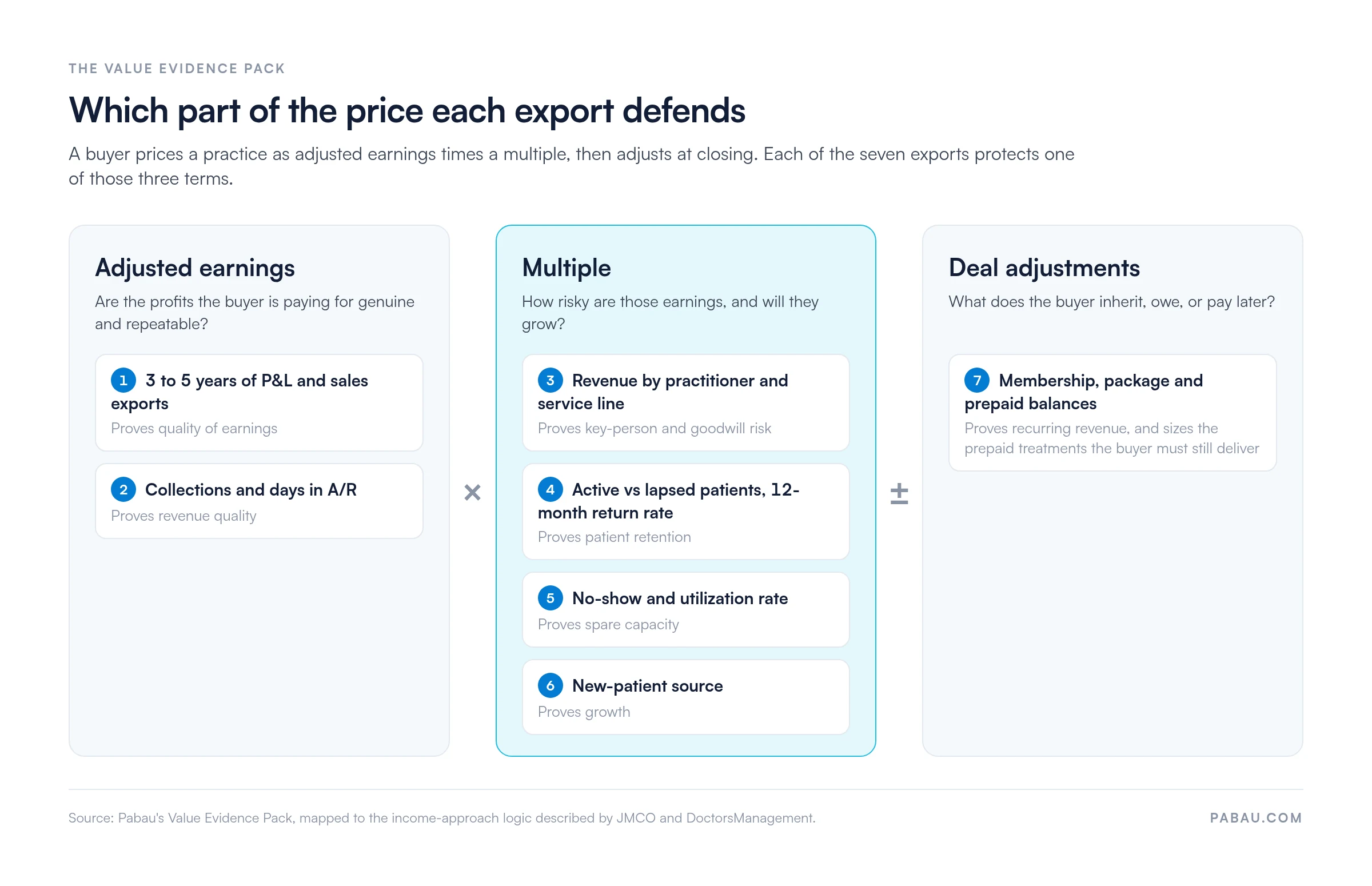
Driver 1 rests on the revenue your books record, so the sales export must reconcile to bank deposits month by month. Before any buyer meeting, assemble a data room with these files:
If those files take weeks to assemble, your data is scattered across tools. A single practice management app produces them from one patient record. Comparing medical practice management software on export depth is worth doing two to three years before a sale.
With the evidence ready, the next question is who sits across the table. Private equity groups usually pay the highest multiples, and individual physicians usually pay the least. Hospital systems pay for strategic value, within fair-market-value limits.
Private equity pays more because it is buying a platform that runs without the selling physician. It often pays part of the price as rollover equity in the new group. If you are on the other side of the table, our guide to buying a medical practice covers diligence from the buyer’s view.
Any buyer that receives referrals from the seller, a hospital especially, must pay fair market value. Stark Law, administered by CMS, and the Anti-Kickback Statute, enforced by the HHS Office of Inspector General, both forbid paying for referrals.
Whoever the buyer is, the appraisal anchors the talks. A medical practice appraisal estimates fair market value, the price a willing, informed buyer and seller would agree on without pressure to deal.
That standard is narrower than the number a particular buyer might pay. These four terms often get mixed up in negotiations:
So a healthcare practice valuation and market value differ whenever one buyer can capture benefits the fair-market-value standard ignores. That difference is where strategic premiums come from.
Appraisers issue two report types. JMCO describes a conclusion of value as a comprehensive report considering every approach, suitable for legal, tax, or ownership transitions. A calculation of value is simpler and cheaper, built on agreed assumptions for internal decisions.
For a physician practice valuation tied to a partner buy-in, estate planning, financing, or a hospital deal, ask for a conclusion of value. Expect to supply 3 to 5 years of financial statements, the same files as the data room above.
Selling a medical practice pays you the headline price minus debt, escrow, deferred earnout payments, and taxes, so cash at closing is usually lower.
When people ask how much medical practices sell for, the answers quote enterprise value, not this net figure. Five deal terms decide how far apart the two numbers sit:
There is no standard percentage for the purchase price allocation in a medical practice sale. The split is negotiated, and both returns must report it the same way. Agree it with your tax advisor before signing the letter of intent.
The good news is that most of these numbers are yours to move. Start two to three years before a planned sale, because buyers read trends across 3 to 5 years of statements. Each step below improves one line of the Value Evidence Pack.
Run through this list before the data room opens. Each item closes off a question buyers use to push the price down.
These are the issues that trip sellers up once a buyer starts digging:
Many owners only find out their records aren’t sale-ready when the appraiser’s first document request arrives. By then, the Pack has to be rebuilt from a booking tool, a billing system, spreadsheets, and paper package cards.
Pabau keeps appointments, patient records, invoices, and memberships in one database. Pabau’s reporting software includes more than 50 pre-built reports, covering Client, Sales, Appointment, Lead, Financial, and Team views. Those six report groups map onto drivers 1 to 6 of the Pack.
Pabau’s memberships feature bills recurring plans and tracks packages against each patient, so driver 7 is a ledger rather than a guess. Every subscription includes the full platform, and structured onboarding migrates your patient records and appointment history so your trend line starts before the switch.


Pabau keeps appointments, patient records, invoices, and memberships in one system, so the exports buyers ask for are ready before diligence starts.

A medical practice is worth its verified earnings times the multiple a specific buyer will pay, minus what the deal holds back. Specialty sets the band, but evidence decides where you land in it.
So start two to three years out. Normalize your earnings honestly, move patients onto memberships, and make each Value Evidence Pack export something your system produces on demand. A buyer who can verify your numbers has no reason to discount them.
Book a demo to see how Pabau keeps your reports, billing, and membership records ready for the day an appraiser asks.

Planning a practice transition from the ground up? Medical practice business plan covers the financial and operational foundations that shape long-term practice value.
Looking at the deal from the other side? Buying a medical practice walks through valuation, deal structure, and handover from the buyer’s view.
Want to reduce physician dependency and build enterprise goodwill? Growing a medical practice outlines the growth strategies that shift value from the individual to the practice.
Running the practice day to day? Private practice management covers the systems and routines that keep a practice profitable and transferable.
Wondering which EMR features matter? EMR features to evaluate flags the scheduling, billing, and consent tools missing from a notes-only EMR.
Medical practices have sold for 0.5x to 2.5x annual revenue, according to DoctorsManagement. For a sharper figure, multiply adjusted EBITDA by a buyer-specific multiple. Then subtract debt, escrow, and taxes to see what you take home.
The fee depends on the report you need. A calculation of value uses agreed assumptions and costs less than a full conclusion of value. Ask appraisers for a fixed-fee quote, and pay for the conclusion of value when a lender, court, or tax filing will rely on it.
They do different jobs. An appraiser gives an independent opinion of value under a stated standard. A broker markets the practice, finds buyers, and negotiates, usually for a success fee. Many sellers get the appraisal first so the asking price rests on evidence.
Not by default. Real estate is often valued separately from the practice, and some sellers keep the building and lease it to the buyer. Either way, put the lease terms in the data room, because rent and lease length affect what a buyer will pay.
For a smaller practice, 5x adjusted EBITDA or higher is a strong result. JMCO’s worked examples use 5x at $400,000 of EBITDA and 6x to 8x at $1 million.