CRM for chiropractors: how to manage patients, bookings and marketing
A CRM for chiropractors is a patient relationship management system built around...

Last Updated: Oct 13, 2026

A personal mission statement is one to three sentences naming what you value and the impact you want to have.
For clinicians it works as a decision filter, so competing priorities stop being a fresh argument every time.
The worksheet moves through five steps: core values, key life roles, strengths, practice alignment, and a guided draft.
Give your statement a job. Run a hiring call, a pricing change, or a new treatment through it before you commit.
Practice management software like Pabau holds the forms, records, and team tasks that turn a written standard into daily habit.
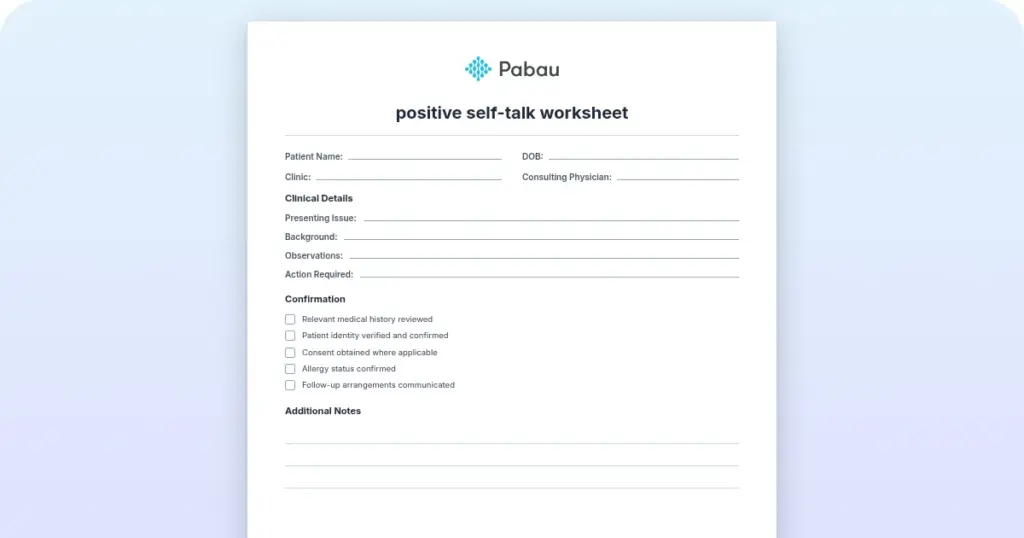
The worksheet walks you through core values, key life roles, personal strengths, and practice alignment. It ends with a guided drafting page and space to review your statement each year.
Download templateA personal mission statement is one to three sentences naming what you value and the impact you want to have. For clinicians it works as a decision filter. When two priorities collide, it tells you which one wins.
This guide covers what belongs in a statement, why it matters in clinical settings, and how to write one in five steps. The free worksheet above gives you the pages to do it. Generic personal development tools stop at self-reflection. This one carries through to how you run your practice and lead your team.
It is a short written declaration of who you are, what you value most, and what you want your work to change. For healthcare professionals it answers one question: why do I practice the way I do?
A vision statement describes where you want to be in five or ten years. A mission statement defines your purpose right now. It usually runs one to three sentences and pulls together your values, your roles, and your sense of contribution.
Stephen Covey’s 7 Habits framework made personal mission statements a mainstream tool for lining up daily actions with deeper purpose. Other frameworks ask the same question differently. The Japanese concept of ikigai maps purpose across what you love, what you are good at, and what people need.
Whichever route you take, a finished statement covers four things:
Your sense of purpose is one of the few parts you can work on directly. Writing it down changes three things.
Your decisions get more consistent. A stated purpose holds the same standard on a quiet Tuesday and a fully booked Friday. It gives you a question you can ask in the room. Does this choice serve the person in front of me?
Your team knows the standard. For practice owners, a stated mission gives staff something to aim at. When people know what you stand for, they can make the small calls without checking in first.
Hard calls take less time. Without a stated purpose, every decision starts from nothing. Should you add a treatment, hire another practitioner, or raise your prices? A clear mission rules some options out before you open the spreadsheet. Practice management reports turn those decisions into numbers instead of guesswork.
The best statements come out of reflection rather than a flash of inspiration. The worksheet breaks the job into five steps. Work through all five before you write a final draft.
Values are the principles you will not trade away. Common ones in healthcare include compassion, integrity, evidence-based practice, patient autonomy, continuous learning, and social responsibility. Pick the values that already drive your choices, not the ones you feel you ought to hold.
The worksheet gives you a list of values drawn from clinical settings. Choose three to five that land hardest, then write one sentence on why each matters to you. Those sentences become the raw material for your statement.
You are not only a clinician. You may also be a practice owner, team leader, mentor, educator, partner, or parent. A statement that covers only work tends to collapse the first time those roles pull against each other.
The worksheet asks for your four to six most important roles right now. For each one, write a single sentence on how you want to show up. Keep it to what you can actually deliver this year.
What skills, experience, or perspective do you bring that a colleague does not? The worksheet runs a short strengths inventory, then asks a sharper question. What would your ideal patient say about the experience you created for them?
If you draw a blank, a structured personality test can surface traits you stopped noticing years ago. Answers from colleagues work just as well. Ask two people you trust what they come to you for.
This is the step most worksheets skip. Compare your draft values against how the practice actually runs today. List three things you already do that support your mission.
Then list three that work against it. Late-running clinics, a consent process patients do not understand, a treatment you offer because it sells. That second list is your to-do list, and it is usually short enough to act on.
Write a first version without editing yourself, then cut it to three sentences or fewer. Read it aloud. If you stumble on it, it is still too long.
Then put it to work. Take the hardest decision you made last month and run it through the statement. If it gives you a clear answer, you have something usable. If it does not, the wording is too broad.
With digital medical records, forms like this stay attached to the patient’s full history.
Here are four statements written with this same process. Each reflects different roles and values, so treat them as reference points rather than wording to copy.
Your role shapes the wording. An owner of a wellness practice tends to write about the whole client journey, while a hospital nurse writes about the bedside.
A statement only earns its place if it changes how you run the practice. For owners and practice leaders, that means putting the wording into your culture, your hiring, and your day-to-day calls.
Share it with your team. Your mission is not only for you. When staff understand what you value and where the practice is heading, they can make decisions on their own that still fit. That cuts the need for micromanagement and raises how much people own their work.
Use it to filter decisions. When something new comes up, a treatment to add or a pricing change, ask whether it fits the mission. Reconfigure them where they do not.
The same filter applies to the bigger moves you make to grow a medical practice. Consistency is also what patients notice and repeat. One US med spa owner built a five-star reputation on holding the same standard in every appointment.
Revisit it annually. Nothing here is carved in stone. Book an hour each year, reread the statement, and change the parts that no longer describe you. The worksheet is built to be reused, so you are not starting from a blank page.
Values written on a wall poster and workflows built in software rarely say the same thing. The intake form asks one set of questions, and the follow-up email strikes a different tone. New hires learn the standard by watching whoever trained them. Comparing a practice management system against an EMR shows where each can help close that gap.
Practice management software like Pabau puts those pieces in one system. You build the intake questions, consent forms, and follow-up messages once, and every practitioner works from the same version. A patient portal then carries that wording straight to the people you treat.
The result is a patient experience that matches what you wrote down. Records, photos, and messages sit against the client file, so any team member can pick up where the last one stopped. Your annual review then has something to read besides memory.

Pabau keeps forms, records, and patient messages in one system, so your team delivers the same standard every time. Reporting shows you where practice and intention drift apart.

A mission statement written in an afternoon and filed away changes nothing. The value shows up the second time you use it: the hiring call, the pricing question, the treatment you decide not to offer. Keep the statement where you make those calls.
So download the worksheet, block out an hour, and write the first version badly. You can sharpen it next year, once you have seen which parts held up under pressure.
The practices that hold their standard are usually the ones whose systems enforce it. Book a demo to see how Pabau turns your values into the forms, reminders, and records your team uses every day.

Ready to put your values on paper? Cover letter template covers contact details, an opening statement, clinical qualifications, and a professional closing.
Measuring empathy in your practice? Jefferson Scale of Empathy explains the three versions, the 10 reverse-scored items, and what a license costs.
Wondering how your leadership style shows up? Leadership style quiz scores your style across 10 questions on decisions, feedback, crises, goals, and meetings.
Need a place to capture your next meeting? Meeting notes template covers what to record, a filled-in huddle example, and follow-up that sticks.
A mission statement describes your purpose and values in the present, so it covers why you do what you do now. A vision statement describes a future goal, usually where you want to be in five or ten years. Both matter, but the mission is what guides your daily decisions.
Aim for one to three sentences. That is short enough to recite from memory and long enough to carry your values, roles, and contribution. Anything longer than a paragraph stops working as a decision filter.
Yes. As you grow as a clinician, your sense of what matters shifts. Review the statement once a year and update it where it no longer fits. The worksheet is built to be reused, so you can work through it again each time.
The worksheet includes a guided values exercise. Start by recalling a moment when the work felt right. What were you doing, and which values were being honored? Repeat that reflection three times, then look for the patterns. Values that keep appearing are your core values.
Usually not. The strongest statements focus on how you practice rather than what you treat. A mission grounded in evidence-based care and genuine human connection works for a dermatologist, a therapist, or a physical therapist. That breadth is what keeps it usable as your practice changes.
Each team member fills in the worksheet alone, then shares the result in a group discussion. That surfaces the values you already hold in common and shows where you differ. Some practices run it once a year as a team exercise to reset culture.