Treatment summary
A treatment summary is a written record of what care was delivered during an epi...

2
Last Updated: Oct 16, 2026

A mental state examination (MSE) is a structured clinical assessment of a patient’s current psychological functioning, covering 10 standard domains.
Mood is subjective (self-reported by the patient); affect is objective (observed by the clinician) – a distinction that matters for accurate documentation.
The MSE is not the same as the Mini-Mental State Examination (MMSE); the MMSE is a scored cognitive screening tool, not a full psychiatric assessment.
Practice management software like Pabau helps psychiatry and mental health clinics document MSE findings consistently, with structured digital forms and clinical notes built into every consultation.
Incomplete MSE documentation is one of the most common sources of clinical risk in psychiatric practice. When key domains are missed or recorded inconsistently, treatment decisions get made on partial information – and audit trails leave clinicians exposed.
The mental state examination is a core component of every psychiatric and mental health assessment. You might be a consultant psychiatrist, a primary care physician conducting a mental health review, or a clinical psychologist seeing a new patient. Either way, the MSE gives you a structured framework to observe, describe, and document a patient’s psychological functioning at a specific point in time.
This guide covers all 10 MSE domains, the mood vs affect distinction, how the MSE compares to the MMSE, documentation best practice, and a worked example you can use as a reference.
A mental state examination is a structured assessment of a patient’s psychological functioning conducted at a specific point in time. According to StatPearls (NCBI), it is an important part of the clinical assessment process in psychiatric practice, providing a standardized way of observing and describing a patient’s current state of mind.
Critically, the MSE is not a separate standalone test. Unlike a structured physical assessment such as a hip examination, it is gathered continuously throughout the clinical encounter, through direct observation, conversation, and structured questioning. Several moments feed directly into it:
Clinicians working in mental health practice rely on the MSE for several purposes: initial psychiatric assessment, monitoring change over time, risk stratification, and medicolegal documentation. It supports diagnostic formulation under frameworks like the DSM-5-TR but does not, on its own, establish a diagnosis.
The mental state examination covers 10 standard domains, consistent across AAFP clinical guidance, StatPearls, and Royal College of Psychiatrists standards. The table below gives you a quick reference for each domain with the key descriptors used in clinical documentation.
Mood is what the patient reports. Affect is what the clinician observes. This distinction matters in practice. A patient may describe their mood as “fine” while displaying a flat, restricted affect – suggesting emotional blunting that contradicts the self-report. Document both separately, using a structured emotional scales worksheet where it helps standardize ratings across a team.
Affect is further described by its quality (flat, blunted, labile, restricted), its range (full versus constricted), and whether it is congruent or incongruent with the patient’s reported mood and thought content. Incongruence is a clinically significant finding.
Thought splits into two separate domains for MSE purposes. Thought process (also called thought form) refers to how thoughts are organized and connected: logical and goal-directed, or fragmented with flight of ideas, loose associations, or thought blocking. Thought content describes what the patient is thinking about: delusions, obsessions, phobias, suicidal ideation, or homicidal ideation.
Suicidal ideation and risk must be directly inquired about and documented explicitly. Clinicians assessing patients at risk should also consider broader crisis intervention frameworks that sit alongside MSE findings in risk formulation.
Insight in the MSE refers to the patient’s awareness and understanding of their own mental illness, including whether they recognize they are unwell and accept the need for treatment. It can be graded: full insight, partial insight, or absent insight. Intellectual insight (knowing one is ill) is distinct from emotional insight (truly internalizing that understanding).
Judgment assesses whether the patient can make reasonable decisions, particularly regarding their care and safety. Impaired judgment is clinically relevant when considering capacity assessments, safeguarding decisions, and – in some jurisdictions – the threshold for compulsory treatment under relevant mental health legislation.
The mini-mental state examination (MMSE) is frequently confused with the full MSE. They serve different purposes and should not be used interchangeably.
Psychologists and psychiatrists often use both tools at different points in a patient’s care. The MSE applies at every assessment, while the MMSE template comes in when cognitive impairment is specifically suspected.
Good MSE documentation reflects what was observed and reported at a specific moment. It uses descriptive, behavioral language – not diagnostic labels – and records both normal and abnormal findings. Here are five principles that support safer clinical note-writing in psychiatric settings, echoing the same structured logic behind formats like the BIRP note.
Clinicians writing structured psychiatric notes can also benefit from reviewing established structured note formats across mental health settings. The psychiatric evaluation template on the Pabau guides library provides a practical reference for structuring initial psychiatric assessments.
The following is a worked mental state examination example for a fictional patient presenting with low mood and reduced function, the kind of presentation that might also prompt a formal depression self-assessment. Use it as a reference for the documentation style and level of clinical detail expected in practice.

Pabau helps psychiatry and mental health clinics build structured MSE templates, capture clinical notes efficiently, and maintain audit-ready records across every consultation.

Documentation burden is a persistent problem in psychiatric practice. Clinicians working across high patient volumes often find that freeform notes lead to inconsistent MSE recording:
The cumulative impact on clinical quality and auditability is significant.
Practice management platforms with structured digital forms can address this directly. When each MSE domain has its own field in a clinical template, the clinician is prompted to address all 10 areas – reducing omission errors. Dropdown descriptors for speech, affect, and insight mean consistent terminology across the team rather than idiosyncratic free text that complicates clinical handovers.

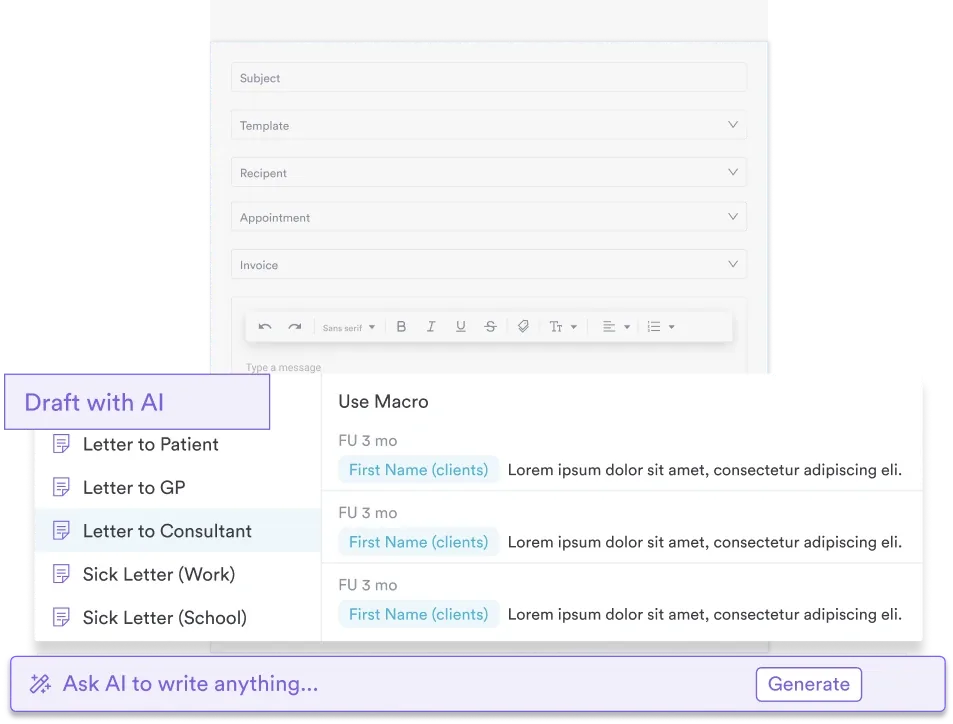
AI-assisted documentation tools are increasingly relevant here. Pabau’s AI medical scribe can transcribe and structure clinical encounters, with the output reviewed and confirmed by the clinician before it becomes part of the patient record. Pabau’s analysis of AI scribe benefits covers this in more detail, including how the approach can reduce post-consultation administrative time while maintaining clinical accuracy.
For psychiatry practices, Pabau’s client record system supports longitudinal tracking. Comparing this consultation’s MSE findings against previous assessments gives clinicians a structured view of change over time. That matters in conditions like bipolar disorder, schizophrenia, and treatment-resistant depression.
When building MSE templates in clinical software, add a mandatory ‘suicide and self-harm risk’ field to the thought content section. Making it a required field rather than optional text ensures it is explicitly addressed and documented at every assessment – not assumed from the absence of a note.
A well-conducted mental state examination is one of the most clinically powerful tools in psychiatric practice. It captures a patient’s functioning in the moment, builds the evidentiary base for clinical decisions, and creates the documentation trail that protects both patient and clinician.
The challenge is consistency: ensuring all 10 domains are documented with appropriate detail at every consultation, not just the ones that seem most relevant in the moment. Pabau’s structured clinical templates help mental health teams build that consistency into their workflow from day one.
If you’d like to see how it works in practice, book a demo with the Pabau team.

Helping a client build a daily routine? Daily routine worksheet for adults helps adults build personalized routines that support mental wellness and daily habit tracking.
Looking for crisis documentation guidance? Crisis Intervention Strategies covers risk formulation and documentation alongside MSE findings.
Exploring practice software for mental health settings? Mental Health EMR outlines how Pabau supports psychiatric and therapy practice workflows.
A mental state examination is a structured clinical assessment of a patient’s current psychological functioning, covering 10 standard domains: appearance, behavior, speech, mood, affect, thought, perception, cognition, insight, and judgment. It is used in every psychiatric assessment, during ongoing monitoring of mental health conditions, at emergency presentations, and as part of medicolegal documentation. Unlike a physical examination, it is conducted continuously throughout the clinical encounter rather than as a discrete test.
Mood is subjective: it is what the patient reports about their own emotional state. Affect is objective: it is what the clinician observes in the patient’s emotional expressiveness during the consultation. A patient might report a neutral mood while displaying a flat, restricted affect – a clinically significant incongruence. Both should always be documented separately.
The MSE is a comprehensive, unscored psychiatric assessment covering all aspects of mental functioning. The mini-mental state examination (MMSE) is a scored cognitive screening tool (0-30) primarily assessing orientation, memory, and language – used to screen for dementia and cognitive impairment. The MMSE is also a copyright-protected instrument. They serve different clinical purposes and are not interchangeable.
Any trained clinician can conduct a mental state examination as part of a clinical assessment. This includes psychiatrists, clinical psychologists, psychiatric nurses, primary care physicians, and other healthcare professionals who have received relevant training. The depth and context of the MSE will vary depending on the clinician’s role and the clinical setting – a primary care physician’s MSE may be briefer than a consultant psychiatrist’s in a specialty care setting.
MSE findings can support the assessment of a wide range of conditions, including depression, bipolar disorder, schizophrenia, anxiety disorders, personality disorders, dementia, delirium, and substance use disorders. Importantly, the MSE does not establish a diagnosis on its own – it contributes to clinical formulation alongside the psychiatric history, physical examination, and relevant investigations, within diagnostic frameworks such as the DSM-5-TR from the American Psychiatric Association.
Document all 10 MSE domains in every assessment, including normal findings. Use descriptive, behavioral language rather than diagnostic labels. Record mood in the patient’s own words where relevant. Document thought content findings – including suicidal ideation or its absence – explicitly. Note the clinical context: a change in presentation from the previous review carries more weight than an isolated snapshot. Reviewing established guidance on safer clinical notes and using structured templates supports consistent documentation across a clinical team.