Antipsychotic medication list
An antipsychotic medication list is a structured reference that organizes psychi...

3
Last Updated: Oct 13, 2026
An ADHD cleaning checklist is a cleaning list built for adults with ADHD. In other words, every line is one small action you can finish in a few minutes. Instead of “clean the bedroom,” it reads “make the bed,” “pick up floor items,” and “open curtains.” As a result, that format cuts the planning and remembering that make cleaning feel overwhelming.
Cleaning is often hard with ADHD because the condition can affect starting, planning, and sticking with dull tasks. As a result, a checklist moves those decisions onto paper, so you only ever face the next small step.
The version that works for most people is simple. First, do two 10-minute resets a day, give each weekday one focus area, and always start with the smallest task. Next, the sections below give you a checklist for each piece.

An ADHD cleaning checklist breaks chores into single micro-actions, like making the bed or wiping the sink. You don’t have to plan or hold steps in your head.
The design principles are micro-tasks, a clear visual layout, short lists, an easy first task, and grouped tasks that keep you in one room.
Two 10-minute resets a day, plus a weekly schedule with one focus area per day, spread cleaning out so no single session feels overwhelming.
Pabau, the practice management platform we build, cuts admin load for any clinician through automated workflows, digital forms, and Pabau Scribe, our AI scribe.
An ADHD cleaning checklist is a visual list of cleaning tasks, each broken into a single action you can do without stopping to think. A standard list says “clean the kitchen.” An ADHD-friendly one says “load dishwasher,” “wipe stovetop,” “wipe counters,” and “take out the trash.” As a result, each line asks for one tiny decision.
The checklist does two jobs. First, it moves the mental load onto the page, so your working memory doesn’t have to juggle a dozen tasks. Second, checking off each item can give a small sense of reward, which makes the next task easier to start.
As a result, for many neurodivergent adults, that structure turns a chore they keep putting off into one they can finish.
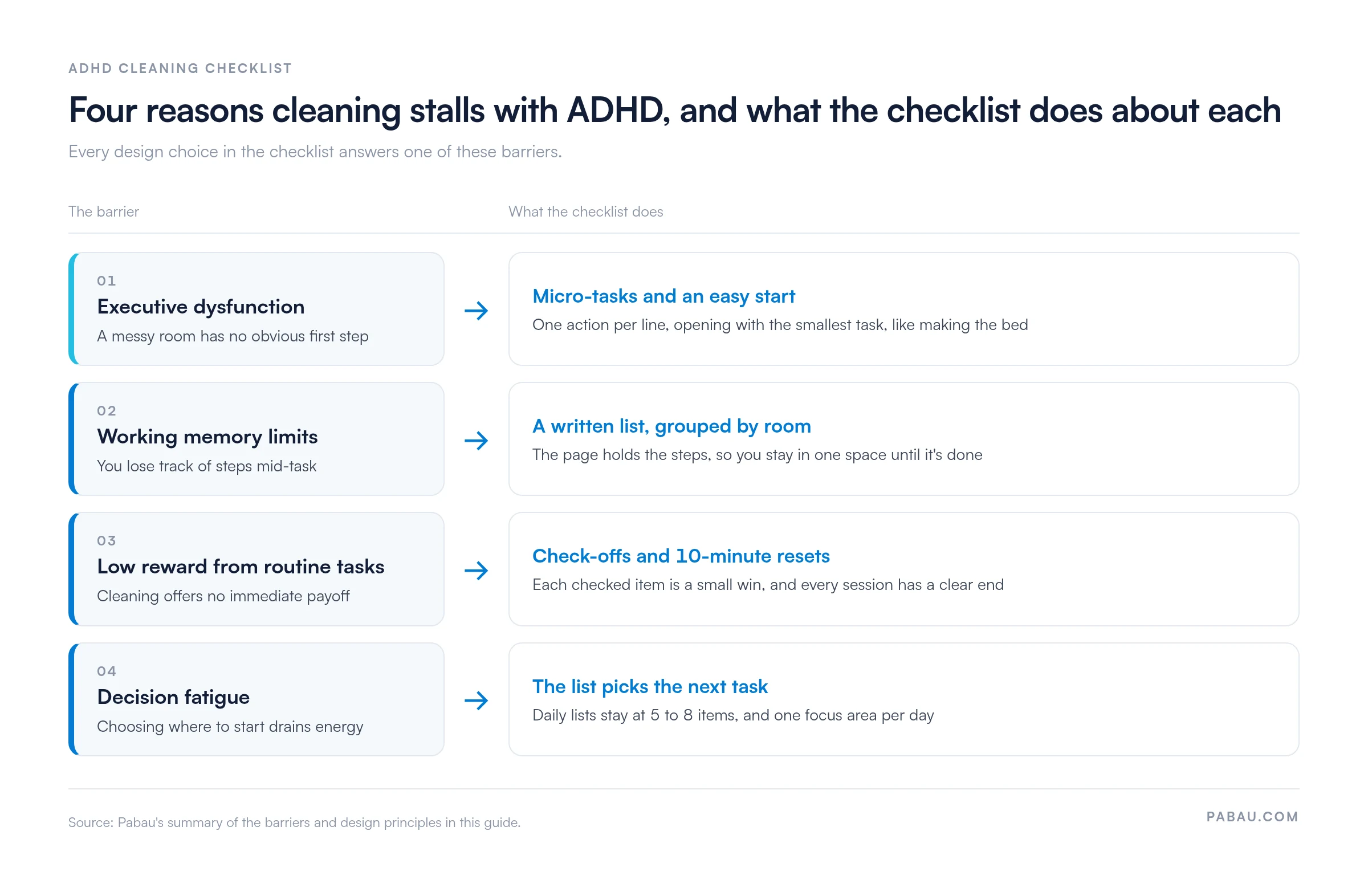
Cleaning tends to stall for people with ADHD because of four common barriers.
In short, a well-designed ADHD cleaning checklist targets all four barriers at once. The diagram below matches each barrier to the part of the checklist that handles it.
ADHD-friendly checklists share five design principles.
A daily ADHD cleaning checklist splits into two short sessions: a 10-minute morning reset and a 10-minute evening wind-down. As a result, clutter doesn’t pile up during the day, and neither session runs long enough to feel like a chore.
Overall, two short sessions are easier to start than one long one. Also, consistency matters more than perfection. For example, if you miss the evening reset, the next morning’s reset gets you back on track.
For a deeper weekly clean, give each day one focus area so you never face the whole home at once. Then work room by room, so you stay in one physical space and keep your momentum.
Spread cleaning tasks across the week so no single day feels overwhelming. To do that, give each weekday one focus area, whether that’s a room or a job like laundry.
The weekend stays flexible. For example, if you missed a day, use it to catch up. Otherwise, take the break. As a result, that flexibility keeps one missed day from turning into guilt and keeps the system sustainable.
Cleaning paralysis is the feeling of being unable to start, even when you want to. These four strategies help you break through it.
Don’t begin with the biggest mess. Instead, pick the easiest, fastest task, like making the bed, wiping the sink, or putting clothes in the hamper. Then, finishing something quick gives you a small sense of progress, which can make the next task feel more doable.
Set a timer for 10-15 minutes and work until it buzzes. Also, a defined time limit makes the task feel finite and less overwhelming. In practice, timed work intervals like this, adapted from the Pomodoro technique, can help you start because you know exactly when you can stop.
If you can, clean alongside a friend or family member, or keep someone on a video call. In fact, many people with ADHD find that another person’s presence helps them start and stay accountable. This approach is called body doubling.
Don’t decide what to do next. Instead, let the checklist decide. Then pick the next unchecked item and do it, which removes decision fatigue and keeps your momentum going.
Likewise, the same habits carry over to work, time, and emotions. Our guide to ADHD strategies for adults covers time management, focus, and emotional regulation in more depth.
Similarly, the idea behind the checklist works at work too: write tasks down or hand them off, so your memory isn’t the system. In a therapy practice, the tasks that fill a clinician’s head are intake paperwork, session notes, and follow-up reminders.
Therapy practice management software such as Pabau takes those jobs off any clinician’s to-do list. Pabau’s digital intake forms reach patients before the first session, so nobody re-keys paper forms.
In addition, Pabau Scribe, our AI scribe, drafts clinical notes from the session, so you aren’t writing them up from memory at the end of the day. Automated workflows send appointment confirmations, recalls, and follow-ups, so no one on the team has to remember them.

Automated workflows, digital forms, and Pabau Scribe take reminders and notes off your list, so your attention stays with patients.

Start with tonight’s 10-minute evening reset, not a full weekly plan. One short session you finish does more for the habit than a perfect schedule you never begin.
Copy the lists onto paper or into your phone, cut any task that doesn’t fit your home, and keep each list short. However, the trade-off is that your home won’t be spotless every day. Still, it will stay manageable, and a missed day costs you one reset instead of a whole weekend.
Running a practice as well? Book a demo to see how Pabau handles reminders, intake forms, and session notes so you don’t have to keep them in your head.

Need strategies beyond cleaning? ADHD strategies for adults covers time management, focus, and emotional regulation.
Looking for focus exercises? ADHD therapy activities lists 20 short, structured exercises for kids, teens, and adults.
Tracking symptoms with a clinician? The ADHD symptom tracker covers inattention, hyperactivity-impulsivity, medication, and mood.
Working on executive function in therapy? The ADHD worksheet walks through symptom checklists and executive function questions.
Need structured templates for clinical documentation? Pabau’s mental health software includes digital intake forms and note templates for therapy practices.
An ADHD cleaning checklist breaks cleaning into single micro-actions, like making the bed, wiping the sink, or sweeping, instead of large tasks. It removes decision-making and builds momentum as you check items off, which helps neurodivergent adults get past task paralysis.
ADHD can affect executive function, working memory, and how the brain responds to reward, and decision fatigue adds a fourth barrier. Together, they make it hard to start, plan, and stay motivated. Cleaning offers no immediate payoff, so it slides down the priority list.
Break each large task into single micro-actions. Instead of “clean the kitchen,” list “load dishwasher,” “wipe stovetop,” “wipe counters,” and “take out the trash.” Each line is one small step your brain can act on without overwhelm.
Yes. A structured checklist moves the mental load onto paper and removes decisions. It also gives a small reward with each checked item and offers a clear starting point. Together, those lower the effort it takes to begin.
It can be. Many people with ADHD find timed work intervals make a task feel finite. A 10-15 minute timer gives you a clear stopping point, which makes starting less daunting.
Start with the room or area that gives you the quickest visual win. That’s usually the bedroom, where making the bed takes a minute, or a single kitchen counter. A quick win builds momentum for the next task.