Sample treatment plan
A sample treatment plan is a structured clinical document that sets out a patien...

3
Last Updated: Oct 12, 2026

A Massachusetts cosmetology license takes 1,000 training hours, one written PSI exam, and a $68 application fee.
No statute sets a minimum age, and Massachusetts dropped the hands-on practical exam in October 2023.
Renewal costs $68 every two years, and the due date follows the licensee’s own birthday.
The Board’s 2025 scope policy bars cosmetology staff from injections and from peels that reach past the epidermis.
Registered nurses may inject under a physician-directed plan, and a pending bill, H.5087, would license med spas directly.
Massachusetts cosmetology license requirements come down to 1,000 training hours, one written exam, and a $68 fee. No statute sets a minimum age, and the practical exam disappeared in October 2023. If you’re opening a med spa in Massachusetts, our best medical spa software roundup compares scheduling and staff reporting tools.
The complication starts when a med spa hires across two rulebooks. The Board of Registration of Cosmetology and Barbering licenses your estheticians and cosmetologists. Physicians and nurses answer to two other boards entirely.
That split decides who may microneedle past the epidermis, who may inject Botox, and who may legally own the practice. The sections below work through each license, what renewal costs, and the scope line the Board drew in 2025.
Massachusetts asks for 1,000 training hours, a 75% score on one written exam, and a $68 application fee. The statute sets no minimum age. The state also dropped the practical exam, and it asks for no continuing education outside electrology.
All of it comes from M.G.L. c.112, §§87T–87KK, with the Board’s operating rules in 240 CMR 2.00 through 11.00. The dollar figures are administrative rather than statutory. They sit in the Board’s own licensing guidance on Mass.gov, which is where the $68 and $155 come from.
The Board of Registration of Cosmetology and Barbering licenses cosmetologists, estheticians, manicurists, barbers, and electrologists.
All five credentials come out of M.G.L. c.112, §§87T–87KK. Your physicians answer to the Board of Registration in Medicine, and your nurses to the Board of Registration in Nursing.
The Board’s long name reflects a quirk. It is legally two boards sharing one office. Chapter 13 creates a Board of Registration of Barbers at §39 and a Board of Registration of Cosmetology at §42.
The Division of Occupational Licensure runs them jointly, so a search for the Massachusetts board of cosmetology lands on the combined board.
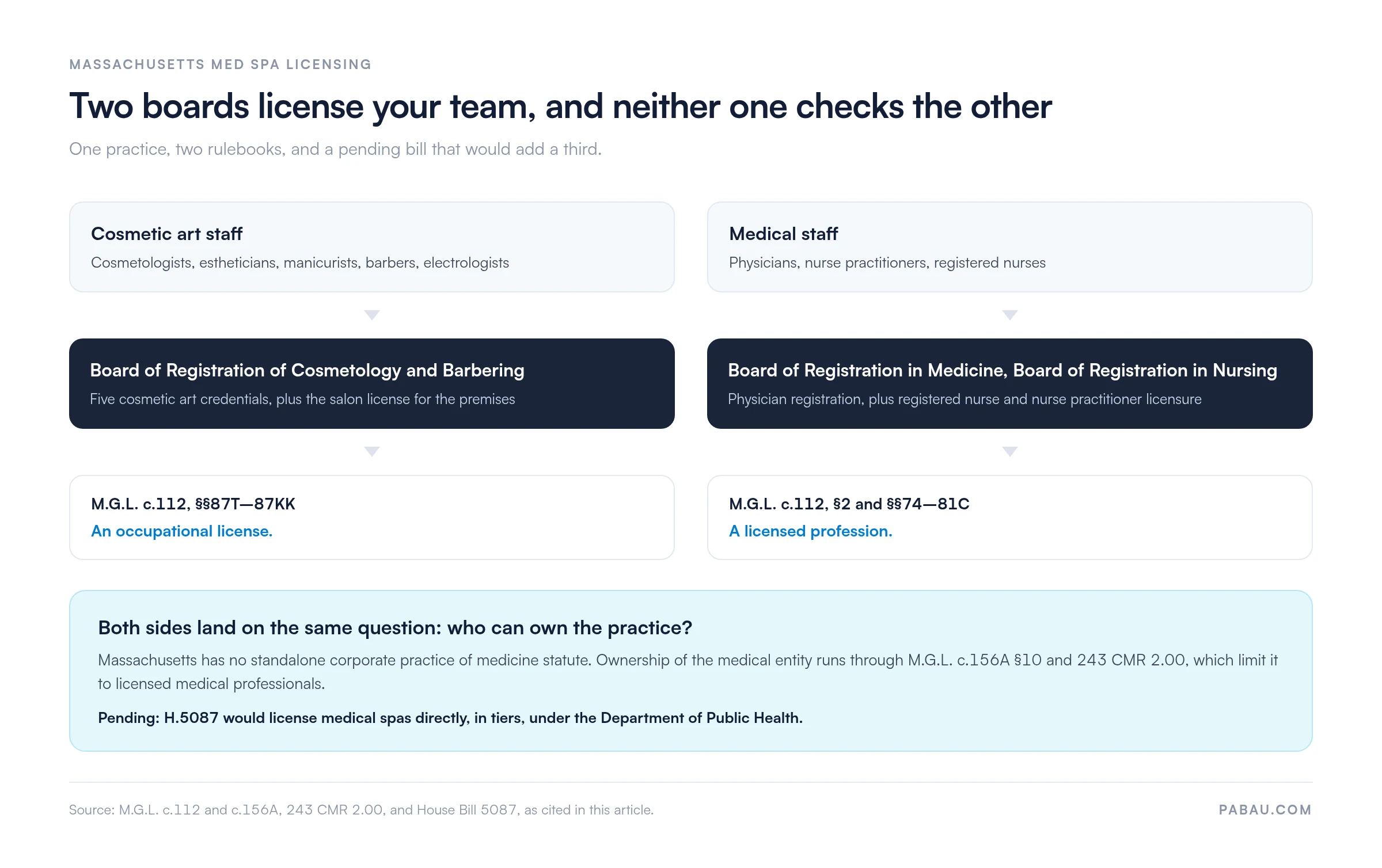
The difference runs deeper than which office prints the certificate. A cosmetology license in Massachusetts is an occupational license. Chapter 112’s cosmetology sections govern training, exams, and salons, and the Division inspects premises rather than clinical judgment.
Medicine and nursing sit in different sections of that same chapter. §2 creates physician registration and the Board of Registration in Medicine. Sections 74 to 81C create the Board of Registration in Nursing and govern registered-nurse and nurse-practitioner licensure.
Drawn out, the two tracks look like this. They only meet at the ownership question.
Nurse practitioners already hold full practice authority here. Chapter 260 of the Acts of 2020 amended §80E so NPs can prescribe and treat without a supervising physician.
That takes two years of supervised practice under a qualified healthcare professional, then an attestation filed with the Board. It is a flat two-year clock, not an hours count.
Physician assistants did not get the same independence. §9E still requires a PA’s services to be rendered under a physician’s continuous supervision. The statute does not require the physician’s personal presence at every appointment.
For an owner, the split means separate personnel files and separate scope questions. You verify a cosmetologist through one board and a nurse practitioner through another.
Neither office checks the other’s expiration date, and neither one audits your treatment menu against who is licensed to deliver it.
Massachusetts issues five cosmetic art credentials to individuals. Fees and the renewal cycle are close to identical across all five. Training hours and scope are what separate them at the hiring stage.
The table below carries the first-time, in-state application fee. An out-of-state transfer is priced differently, and that section comes further down.
The esthetician license is the one that matters most on an aesthetics menu. It also carries a harder edge than it did before 2025.
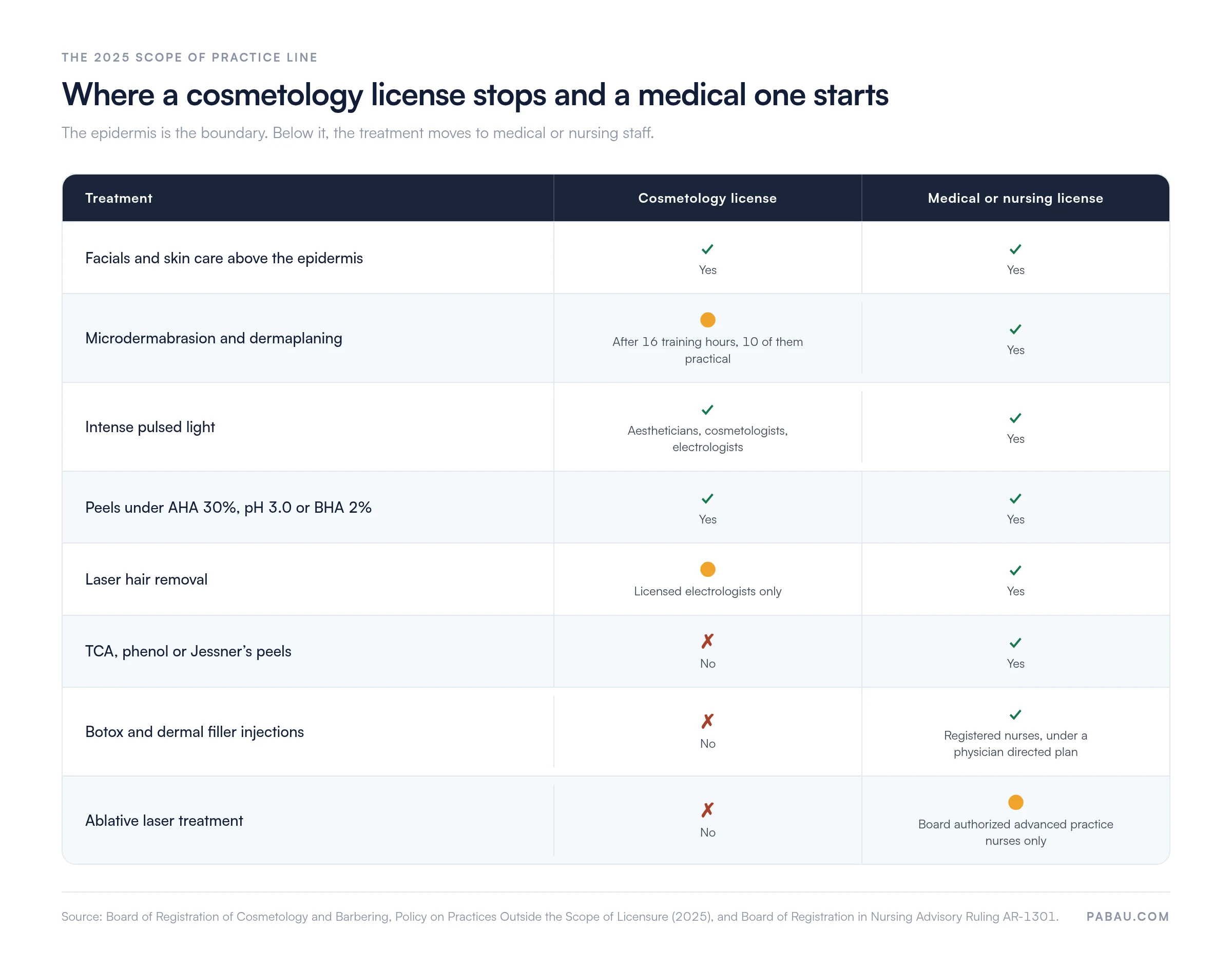
Estheticians, cosmetologists, manicurists, barbers, and electrologists may not perform a medical or invasive procedure.
That line comes from the Board’s Policy on Practices Outside the Scope of Licensure, updated in 2025. The policy names the excluded procedures one by one.
Set against the medical side of the practice, the boundary looks like this.
The title rule catches practices that are otherwise compliant. If a team page lists a medical esthetician, Massachusetts does not recognize the title. The Board treats the claim as a scope violation rather than a marketing flourish.
Running a cosmetic art service inside or next to a medical practice adds one more rule. The staff member still needs a Board-issued salon license for a separate, dedicated room. That license cannot carry a medical name.
The medical side of the ledger runs on a less obvious rule. Advisory Ruling AR-1301, from the Board of Registration in Nursing, lists Botox and dermal filler injections as procedures a registered nurse may perform.
That authority applies under a physician-directed plan of care. So Massachusetts treats injectables as a delegable nursing act rather than a physician-exclusive one. Ablative laser is the exception, limited to Board-authorized advanced practice nurses.
Laser hair removal by cosmetology-licensed staff runs on a third rule again. The Board of Registration of Cosmetology and Barbering wants two years of practice under a physician’s supervision first.
Only then does it issue an independent laser-operator credential, and that track is separate from AR-1301’s nursing scope.
Finish the hours at an approved school, sit the written exam through PSI, then apply and pay through the Division’s ePLACE portal. Each step gates the next one.
Before an applicant hits submit, four details are worth a second look. Each one is quick to fix now and slow to fix later.
State board exams for cosmetology in Massachusetts used to mean two separate tests. Several results online still describe a hands-on component, and that portion is gone. A graduate now faces the written theory exam only. Training for a Minnesota cosmetology license still ends in a hands-on test, held in person at a licensed school.
Ignore one claim you will see repeated. Several sites state that Massachusetts requires applicants to be at least 16. No section in M.G.L. c.112 §§87T–87KK sets a minimum age, so where that number appears, it is a school’s own enrollment policy.
A cosmetology license renews every two years for $68, and the deadline falls on the licensee’s own birthday. Massachusetts cosmetology license renewal runs through the Division’s ePLACE portal. An esthetician renews the same way, for the same fee.
Online is the only route Massachusetts offers for these credentials. There is no paper renewal form for an individual license. So build the ePLACE login into your own reminder system rather than waiting on a mailed notice.
Say you hire an esthetician born on March 14. Her license expires on her birthday in the renewal year, not at the end of a quarter or a calendar year. Hire three people born in three different months and you are already tracking three separate deadlines.
Continuing education is where cosmetology and electrology split. A cosmetologist, esthetician, manicurist, or barber owes no CE at all.
An electrologist owes 10 CEU credits every two-year cycle under 240 CMR 11.00. At least three of those hours cover infection control and bloodborne pathogens, and the requirement is waived for a first renewal cycle.
Run a Massachusetts cosmetology license lookup through the Division of Occupational Licensure’s verification tool, linked from the Board’s own page. Search by name or by license number.
The tool filters by license type, which settles the esthetician-versus-cosmetologist question in seconds. A lookup that returns an esthetician record clears that person for skin work only. It does not clear them for the chemical hair services a cosmetologist license covers, and the reverse holds too.
A lookup will not show continuing-education status for most of these credentials, because Massachusetts does not require CE outside electrology. Use the cosmetology board license lookup for status and expiration date. Then ask the practitioner directly about specialty training beyond the base license.
Premises carry their own record. A cosmetic art service performed near a medical treatment needs its own salon license for a separate room. Check that license too before you sign off on a floor plan.
Record the license number and expiration date on the staff profile rather than in a filing cabinet. Good software for med spas keeps that date next to the schedule, so a lapsed license surfaces before a client’s appointment does.
You can move a cosmetic art license into Massachusetts without sitting the exam again, if the license you hold already matches the state’s standards. Reciprocity turns on five conditions, and an applicant has to clear all of them. Whether a school program counts as substantially equivalent is for the Division to judge.
Fall short on any one of them and the exam becomes mandatory again. That includes anyone trained through an apprenticeship rather than a school. Massachusetts treats apprenticeship training as a trigger for the exam, not as a pathway of its own.
The transfer fee also splits in a way a flat number hides. An out-of-state cosmetologist, esthetician, or manicurist pays $204 if no exam is required, and $136 if it is. A barber pays $225 either way. An electrologist pays $97, the same fee a first-time in-state applicant pays.
Do not assume the credential travels cleanly in the other direction either. New York cosmetology license rules run through a different board with different hours. Under the Louisiana cosmetology license requirements, a licensed transfer applicant still has to pass the state exam.
Massachusetts has no statute that names a corporate practice of medicine doctrine, unlike a state such as California. The rule comes from old case law and the Board of Registration in Medicine’s own regulations instead.
The doctrine traces back to McMurdo v. Getter, a 1937 Massachusetts Supreme Judicial Court case. It held that a licensed practitioner cannot practice as the employee of an unlicensed person or corporation. The Board of Registration in Medicine carries that holding forward today through 243 CMR 2.00.
The regulation lists five entity types a physician may practice through. They are a professional corporation, a professional LLC, a partnership, a nonprofit, or a licensed healthcare facility as employer. A general business corporation is not on that list.
The professional-entity statutes back that up directly. M.G.L. c.156A, §10 lets a professional corporation issue or transfer shares only to a “qualified person,” meaning someone licensed in the profession the corporation practices.
Chapter 156C, §6(c) applies the same rule to a professional LLC. It requires a certificate from the licensing board confirming its members meet that board’s standards.
So a cosmetologist, an esthetician, or an outside investor cannot hold equity in the entity that practices medicine. If you are still working out who can open a medical spa in your own case, settle ownership before you settle the treatment menu.
Most combined practices land on a two-entity structure, the same pattern used across states with a clearer doctrine.
A professional corporation or PLLC, owned entirely by licensed medical professionals, holds the clinical side. A separately owned management services organization holds the lease, equipment, marketing, and non-clinical staff. It connects to the clinical entity through a flat or fair-market-value fee rather than a share of revenue.
This is general information, not legal advice. Have a Massachusetts healthcare attorney structure the entities before you sign a lease or take an investment.
House Bill 5087 would end the practice of stitching a med spa’s compliance together from three separate rulebooks.
Those rules were never written with med spas in mind. Filed in January 2026, H.5087 went to the Joint Committee on Public Health.
The bill would create a dedicated Department of Public Health license for medical spas. The license would run in tiers, from cosmetology-only services up to escalating levels of medical aesthetic procedures. Each tier carries its own on-site clinical or medical-director requirement.
It also proposes an ownership exemption for a medical spa wholly owned by the practitioners who work there. That group covers physicians, physician assistants, nurses, electrologists, and advanced estheticians, provided an owner practices on-site most of the time.
That would be a narrower ownership rule than the PC-and-MSO structure practices use today, not a wider one.
Confirm the bill’s status before you plan around it. A hearing was held in March 2026, and it had not passed as of this writing. Track H.5087’s progress rather than assuming the current rules are the final word.
A cosmetology or esthetics license covers hair, nails, and non-medical skin work, inside the line the 2025 policy draws. Any treatment past that line belongs to staff licensed under the medical and nursing chapters.
Who performs each treatment is a second question stacked on the first. Nurse practitioners hold full, independent practice authority in Massachusetts. Physician assistants and registered nurses still work inside a physician-directed plan of care.
That is why the clinical lead is the most consequential hire in a combined practice. Our guide to how to hire a medical director covers the supervision questions worth settling before the first injectable appointment goes on the calendar.
Consent paperwork follows the licensing line too. A device-based facial that stays above the epidermis still gets a health screening and a signed consent. Our galvanic facial consent form shows what that record covers, from the contraindication list to the consent declaration.
A combined practice runs two rulebooks through one schedule, and H.5087 may add a third. The front desk has to know that a facial can go to an esthetician and a filler appointment cannot. That answer has to hold on a busy Saturday, not just in the staff handbook.
Practice management software like Pabau handles that with role-based permissions on the calendar. You tie each service to the staff roles allowed to deliver it, so a booking that would break scope never reaches the schedule. Nobody has to catch it at the door.
Consent follows the same logic. An injectable appointment can carry its own medical history and consent form, while a wax booking carries a shorter one. Both land on the same client record, so a patient who books across both sides keeps one file.
Staff profiles close the last loop. Keep each practitioner’s license number and expiration date on their profile. The birthday-based renewal date then sits next to the schedule, instead of in a separate spreadsheet.
Owners weighing their options usually compare the best aesthetic clinic software against a general salon booking tool. Only one of the two understands scope.

Pabau ties each service to the staff roles allowed to deliver it, and keeps license expiry dates on the staff profile. Your front desk books within scope by default.

The license mechanics are the easy half. Hours, an exam, a fee, and a renewal date are all published, and none of them is discretionary.
The harder half sits on top of them, and it is getting more complicated rather than less. If one front desk sells a facial and a filler appointment, the ownership structure has to be right before either service is delivered. A new license tier could sit on top of that structure if H.5087 becomes law.
So verify every license before a service is performed, and watch the bill if a Massachusetts location is in your plans. Then get a healthcare attorney to sign off on the entity structure. Book a demo to see how Pabau keeps cosmetology and medical bookings inside their own scope.

Opening a med spa in Massachusetts? See who can own one, and why the medical entity plays by different rules.
Need the wider compliance list? Work through the med spa compliance checklist before your next inspection.
Hiring your clinical lead? Hire a medical director who can cover the treatments you plan to sell.
Licensed in another state? Compare North Carolina cosmetology license requirements to see how far the rules move between states.
Expanding to the West Coast? Read California’s med spa licensing laws, which run on their own ownership rules.
Not on its own. Every state licenses separately, so you apply to the new state’s board and it decides whether your Massachusetts hours count. Some accept them outright, and others add an exam or extra hours first.
The holder stops working until it is renewed. Massachusetts does not publish a late-renewal fee for these credentials the way it publishes the application fee. Contact the Division of Occupational Licensure the moment a date has passed.
Yes, and plenty of med spa staff do. Massachusetts licenses the person rather than the job title, so both boards’ rules apply at once. Which scope governs depends on the treatment being delivered.
Yes, if you charge for it. Cutting hair for pay takes a cosmetologist or barber license under M.G.L. c.112, §§87T–87KK, which means 1,000 training hours and the written exam.
Yes, and an esthetician license is the usual route. Waxing sits inside the esthetics scope, which takes 600 hours. A cosmetologist license covers it too, since that curriculum already includes 80 aesthetics hours.