HD Brows consultation form: Free template and guide
HD Brows is a seven-step brow treatment that combines consultation, tinting, wax...

2
Last Updated: Oct 13, 2026

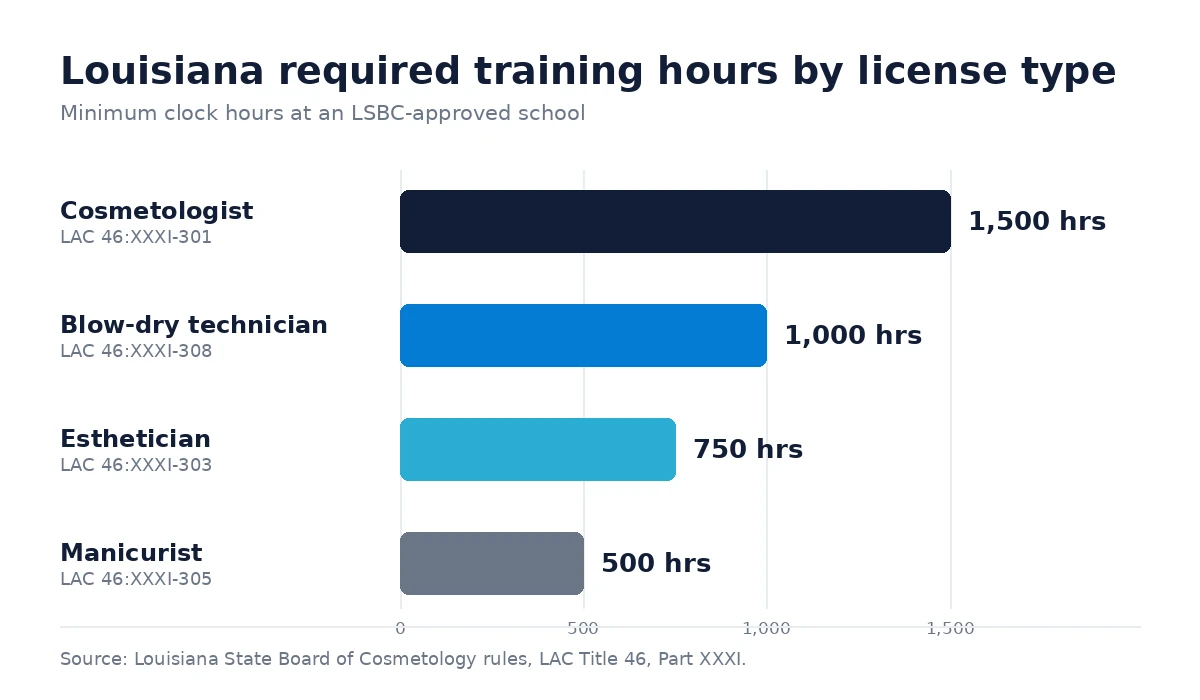
A cosmetologist needs 1,500 training hours, an esthetician 750 and a manicurist 500. All of them come from a school approved by the Louisiana State Board of Cosmetology.
You must be at least 16 and hold tenth-grade equivalence. A high school diploma is not required.
Three exams are mandatory for every license type: the national theory exam, the Louisiana state law exam and a practical exam.
The initial certificate of registration costs $35, and so does every annual renewal, after the 2025 amendment to La. R.S. 37:599.
Individuals renew on or before their own birthday. Salons, booth renters, managers and schools renew by January 31 instead.
Louisiana is not a member of the Cosmetology Licensure Compact, so an out-of-state license still means sitting the state exam.
The license covers work on the epidermis and stops there. Lasers, injectables and other treatments reaching the dermis belong to the medical board.
Louisiana cosmetology license requirements come down to 1,500 training hours for a cosmetologist, a minimum age of 16, three exams and a $35 fee. The Louisiana State Board of Cosmetology issues the certificate of registration, and estheticians and manicurists follow the same path on fewer hours.
Most guides to this topic list those numbers without a single citation. Every figure here carries the statute or board rule behind it. That matters, because one widely repeated fee is now out of date.
The initial certificate is $35, not the $25 that competitor pages still publish. Acts 2025, No. 355 amended La. R.S. 37:599 in June of that year.
Two other details decide whether a license survives the year. Individuals renew on their birthday, while salons renew by January 31. The license itself also stops at the epidermis, where the medical and nursing boards take over.
Every Louisiana cosmetology license needs school hours, a minimum age of 16, tenth-grade equivalence, three passed exams and a $35 fee. Only the hour count changes by license type.
The Louisiana State Board of Cosmetology sets the hours in its rules at LAC Title 46, Part XXXI. The statute at La. R.S. 37:582 sets the age, the education floor, the exams and the fee.
Anyone who practices cosmetology for compensation in Louisiana needs a certificate of registration from the board. La. R.S. 37:581 makes working without the right certificate unlawful.
La. R.S. 37:563(6)(a) defines cosmetology as esthetics, hairdressing or manicuring done for pay. It covers work with the hands, with mechanical or electrical devices, and with cosmetic preparations such as lotions, creams, soaps and antiseptics.
Two exemptions matter to readers. Persons authorized to practice medicine or surgery are exempt while discharging their professional duties in a facility the board does not license, under R.S. 37:581(B)(1). A physician therefore needs no Louisiana cosmetology license.
Read that exemption in the other direction and it tells you something useful. A cosmetology license confers no medical authority at all.
Barbers sit outside this system entirely. They are licensed by the Louisiana Board of Barber Examiners, so a barbering credential never comes from the cosmetology board.
The board sets the hour count in its rules, and it runs from 500 to 1,500 depending on which license you want. All of it has to come from a board-approved cosmetology school.
LAC 46:XXXI-301 sets the cosmetology syllabus. It covers infection control, OSHA requirements, human physiology and chemical principles, alongside shampooing, coloring, relaxing, cutting and braiding. The Louisiana Cosmetology Act and the board’s rules are taught too.
Your school has to register you with the board within 45 days of your start date, under LAC 46:XXXI-311. Late registration carries a fine that starts at $250 and climbs to $2,500 past 165 days.
Out-of-state hours transfer in if they were earned within the preceding three years and are properly certified (LAC 46:XXXI-313). Transferring more than once inside Louisiana costs a $10 re-registration fee.
You can also sit the exams before you graduate. LAC 46:XXXI-309 makes cosmetology students eligible for the practical at 1,400 hours and for the written exam at 1,000.
Esthetics students qualify at 750 hours, manicuring and instructor students at 500, and blow-dry technicians at 1,000.
There is no shortcut around the school requirement. R.S. 37:582(B) requires completion of the relevant course at a board-approved school, and esthetics has no apprenticeship route at all.
Louisiana cosmetology exam requirements come to three tests, and you have to pass all three. The board lists a national exam, a state exam and a practical exam for each license type.
How often you can sit them depends on the license. R.S. 37:586(A)(2) puts the cosmetologist practical, the Louisiana state theory and the national theory exams on the calendar at least twice a month.
Esthetician, manicurist and teacher exams run at least four times a calendar year under R.S. 37:586(A)(3). Special-permit exams run at least twice a year.
Your application has to arrive complete. LAC 46:XXXI-309(B) asks for a student registration certificate, a cumulative hours report, a color photograph, the initial license fee and the exam fees.
Two administrative points bite. R.S. 37:586(E) requires all fees owed to your school to be paid first. Failing to appear without proper notice adds a $25 fee when you reapply.
A testing service under contract to the board delivers the national theory exam, under R.S. 37:586(A)(1). Because a vendor runs it, the fee is set commercially rather than in statute.
Competitor pages report a figure of around $83 through IQT Testing. Treat that as a reported vendor charge and confirm the current amount with the board before you budget. R.S. 37:586(A)(6) also puts the cost of an off-site testing center on the applicant.
The state law exam covers the Louisiana Cosmetology Act and the board’s own rules. The board publishes the two together in a single volume it calls the GoldBook, which is the document to study from.
The statutory fee for a theory examination is $25, and a retake costs the same. Exam papers and results are confidential under R.S. 37:586(C).
Cosmetology candidates bring a mannequin to the practical, as LAC 46:XXXI-309(E) requires. Esthetics practicals work differently, and the board publishes a separate notice on models for esthetics testing.
The board also publishes distinct exam material for estheticians, manicurists, blow-dry technicians and alternative hair design. R.S. 37:586(B) confirms that exams combine practical demonstrations with written and oral testing.
The practical examination fee is $25, and a retake is another $25.
A first-time cosmetologist pays $85 in statutory fees: $25 for the theory exam, $25 for the practical and $35 for the certificate. A $10 student registration fee comes earlier, when you enter the course.
The full Louisiana cosmetology license cost also includes the vendor fee for the national theory exam, which sits outside the statute. School tuition sits outside it as well.
Every figure above comes from La. R.S. 37:599, as amended by Acts 2025, No. 355, effective June 20, 2025. The board’s own homepage carries a notice about the fee increase the governor signed.
Here is where a stale number still circulates. LAC 46:XXXI-309(B) refers to a $25 initial license fee, and several competitor pages repeat it.
The statute controls, so the figure to plan around is $35. The rule text simply has not caught up with the amendment.
A registered cosmetologist, esthetician, manicurist or teacher renews on or before their own date of birth, under La. R.S. 37:590(A)(2). Miss it and the certificate expires 30 days after that birthday.
Salons run on a completely separate clock. R.S. 37:590(A)(1) puts beauty shop owners, mobile salon owners, booth renters, salon managers and schools on a January 31 deadline. Those certificates expire the following March 1.
A salon owner who also holds a practitioner license therefore carries two unrelated renewal dates. Nobody sends a single reminder that covers both, which is how an otherwise careful owner ends up practicing on an expired certificate.
Cosmetologists, estheticians and manicurists need no continuing education in Louisiana. Renewal is a fee and a date, not a course.
Instructors are the exception, and the rule is more precise than the SERP suggests. LAC 46:XXXI-505(D) requires each licensed instructor to attend a board-approved seminar at least once every two years.
That seminar has to run at least 16 hours in cosmetology and related fields. An instructor who has not attended within the preceding 24 months holds an inactive license under LAC 46:XXXI-505(C)(1).
The master instructor title runs on an annual cycle instead. LAC 46:XXXI-505(B) grants it, abbreviated MCI, after five consecutive years of teaching plus 16 hours of approved continuing education in each of those years.
Keeping the MCI means 16 hours every single year, under LAC 46:XXXI-505(C)(2). Miss a year and the title is reinstated after two consecutive years of completing the 16 hours.
An active cosmetologist, esthetician, manicurist or instructor license from another state, US territory or foreign country makes you eligible for Louisiana licensure by reciprocity. You still have to sit the Louisiana state examination.
Louisiana cosmetology license reciprocity runs through LAC 46:XXXI-509 and R.S. 37:582(C). Submit the completed reciprocity application, supporting documents, fees and evidence that you passed the exams your original jurisdiction required.
The license issues once you pass the state exam. LAC 46:XXXI-509(C) adds the national or practical exam if you never passed one of those. The board publishes separate applications for cosmetology, manicuring, esthetics, instructors, military applicants and foreign applicants.
Now the part a reader may have seen wrong elsewhere. Louisiana is not a member of the Cosmetology Licensure Compact, so there is no multistate privilege to rely on here.
As of 2026 the compact members are Alabama, Arizona, Colorado, Kansas, Kentucky, Maryland, Ohio, Tennessee, Virginia and Washington. Louisiana appears on neither the enacted nor the pending list, and the compact covers cosmetologists only.
Louisiana esthetician license requirements start at 750 hours of esthetics training at a board-approved school, under LAC 46:XXXI-303. The rest matches the cosmetology route.
That means the same minimum age of 16, the same tenth-grade education floor, the same three exams and the same $35 certificate fee. Esthetics students become exam-eligible at the full 750 hours.
The curriculum is heavily clinical for a non-medical license. LAC 46:XXXI-303 covers sanitation and sterilization, human physiology and anatomy, skin histology, skin diseases and disorders, nutrition and general chemistry.
The practical side covers skin analysis, draping, product selection, cleansing, massage, mask therapy, electricity and electrical apparatus, hair removal, aromatherapy, spa treatments and makeup.
Esthetics practical exams use live models rather than a mannequin, which the board addresses in its own notice. School is the only route in, because Louisiana has no apprenticeship path into esthetics.
Louisiana manicurist license requirements are 500 hours of manicuring training at a board-approved school, under LAC 46:XXXI-305. The age, education, exam and fee rules are identical to the other license types.
A separate manicurist license only matters to someone who does nails alone. A cosmetology certificate already authorizes manicuring services, because R.S. 37:563(6)(a) folds manicuring into the definition of cosmetology.
R.S. 37:563(11) defines manicuring as trimming, filing, decorating, shaping, sculpting or caring for the nails and skin of the hands or feet. Massage of the hands, arms, legs and feet is included, and so is pedicuring.
One exclusion in that same paragraph is a compliance trap. Manicuring does not include the use of blades or graters for callus or skin removal, so a credo blade sits outside the license.
The board issues several credentials beyond the three main practitioner licenses. Some are full licenses, and some are narrow permits for a single service.
That last one looks like a route in and is not. Microdermabrasion moved into the esthetics scope itself, so a licensed esthetician needs no separate permit for it.
Special-permit examinations run at least twice a year under R.S. 37:586(A)(4). Confirm the current application and hour requirements with the board before you commit to any of the narrower permits.
A salon license in Louisiana is a separate credential from the practitioner certificate, and the premises needs its own registration with the board. Holding a cosmetology license does not license the shop you work in.
The certificate for a beauty shop, salon, mobile salon or home care operation costs $55. An initial inspection of a salon, mobile salon or booth rental adds $50, and a booth rental permit is another $50.
R.S. 37:563(1) defines the beauty shop or salon, R.S. 37:563(10) defines the manager role, and R.S. 37:563(13) makes the mobile salon license its own category.
The salon calendar runs on January 31, not on anyone’s birthday. A certificate not renewed by then expires the following March 1, after which restoration is the only way back.
The board assigns inspectors by parish and publishes a complaint form for the public. It also warns that scammers pose as board inspectors, and confirms it will never request payment over the phone.
Penalties are modest per incident and add up fast. R.S. 37:604 lets the board order up to $200 per violation, capped at $5,000 in total, and each day a violation continues counts separately.
A Louisiana cosmetology license covers work on the epidermis, and it stops there. Work that reaches the dermis, uses a laser or involves an injection belongs to a different board.
Three agencies share this territory. The Louisiana State Board of Cosmetology licenses the salon work. Medical procedures fall to the Louisiana State Board of Medical Examiners, and the Louisiana State Board of Nursing sets what a nurse may do.
The esthetician scope of practice in Louisiana is capped at the epidermis, and the board wrote that cap into its own definitions. LAC 46:XXXI-101, amended effective December 1, 2023, is the rule to read.
It defines esthetic services to include makeup application, facials, superficial chemical peels, dermaplaning, microdermabrasion and nano-needling performed on the epidermis. Dermaplaning is exfoliating the epidermis and removing vellus hair with a bladed tool.
Nano-needling gets a numeric limit. The rule defines it as a non-invasive technique for transdermal serum delivery. It must not penetrate beyond the epidermis or more than 0.25 mm of the outermost layer of skin.
The same rule defines the dermis separately, as the layer below the epidermis. Read the two definitions together and a service that reaches the dermis falls outside the license.
The statute draws two further lines. R.S. 37:563(8) says esthetics does not include the diagnosis, treatment or therapy of any dermatological condition, and it excludes electrolysis outright.
One correction while we are here. Louisiana issues no medical esthetician license, whatever a job advert may say. The state licenses estheticians, and that is the whole list.
Louisiana reserves laser surgery to four professions. La. R.S. 37:1274.1 states that only persons licensed in this state to practice medicine, veterinary medicine, dentistry or podiatry shall perform it.
The Louisiana State Board of Medical Examiners goes further. Its statement of position on medical lasers and chemical skin treatments was revised on November 13, 2001. It holds that using lasers or chemical treatments is the practice of medicine.
That applies for cosmetic purposes just as much as surgical or therapeutic ones. A non-physician may perform such treatments only under the direct supervision of a Louisiana-licensed physician, subject to five conditions.
The second condition is the one with commercial consequences. Treatment must happen under the physician’s immediate personal supervision, meaning the physician is physically present on the premises whenever the non-physician is on duty.
The rest follow from that. The non-physician may never exercise independent medical judgment, must be trained in the specific device and technique, and treatment must follow a physician’s physical examination.
The statement names the settings that prompted it, including spas, salons and health clubs. It criticizes the arrangement where a physician serves as medical director in title but not in physical presence.
Chemical peels have a concentration line behind them. The board’s 1997 statement placed alphahydroxy acid above 14% inside the practice of medicine. The 2001 revision extends that to glycolic, lactic, salicylic and trichloroacetic acids and resorcinol.
It also reaches any light source, microwave energy, and the injection of foreign or natural substances for soft tissue augmentation.
The penalties bite on both sides. A non-physician commits the unauthorized practice of medicine, which R.S. 37:1290 punishes by up to five months of incarceration and a $500 fine per offense.
A participating physician faces discipline up to revocation, plus a fine of up to $5,000 and costs, under R.S. 37:1285(C).
Nursing sits in between. The Louisiana State Board of Nursing has its own declaratory statement on cosmetic aesthetic procedures. It accepts that a trained RN may perform certain procedures on a licensed prescriber’s order.
That list includes non-ablative laser skin resurfacing, laser hair removal, sclerotherapy of superficial veins and Botox or similar FDA-approved products for cosmetic use. Dermal fillers are expressly excluded from the RN scope.
Both boards revise their statements without notice. Check the current PDF on the medical board and nursing board sites before you rely on either. The version summarized here may have moved on.
Medical spa laws in Louisiana do not flatly ban outside ownership, which makes this state easier to misread than most. The medical board addressed it directly in a December 2024 statement on the corporate practice of medicine.
Its position is that a physician’s employment by a corporation other than a professional medical corporation is not unlawful in itself. What matters is how that corporation behaves afterwards.
The management must not infringe on the physician’s medical judgment or clinical decisions, and it has to safeguard professional autonomy. A corporate employer that controls how a physician provides care crosses into the unauthorized practice of medicine.
The exception is the professional medical corporation. Formed under La. R.S. 12:901 to 915, it must be owned and governed exclusively by physicians, and it is in effect authorized to practice medicine.
Outside that vehicle, a corporation cannot practice medicine. The Medical Practice Act at R.S. 37:1261 to 1292 restricts practice to licensed persons, and a corporate entity cannot hold a license. Enforcement runs through civil injunction under R.S. 37:1286 and criminal prosecution under R.S. 37:1290.
For a licensed esthetician weighing this up, the practical answer is clear enough. Your license lets you own and run a salon, and it does not let you own a business that delivers medical aesthetics.
Take advice from Louisiana healthcare counsel before you structure a med spa, because the ownership arrangement is where the medical board looks first.
Two renewal dates, three boards and a scope line at 0.25 mm add up to a record-keeping problem. If the board inspects, you need to show who performed a treatment, that they were licensed for it, and that consent was captured first.
Plenty of practices hold that together across a paper diary, a phone camera roll and a folder of scanned consent forms. Practice management software like Pabau puts the same information in one client record instead.
Appointments, treatment notes, consent forms and before-and-after photos sit on a single timeline per client. Staff-level permissions mean a treatment only gets booked to a practitioner qualified to deliver it, so a peel never lands on an unlicensed diary.
Notes are the part that slips when a day runs long. Pabau Scribe, our AI scribe, drafts the treatment note from the consultation, so the record is written while the detail is fresh.
The result is records you can hand to an inspector without a scramble. Every Pabau subscription includes every feature, and structured onboarding sets up your forms, permissions and templates around how your practice runs.

Pabau ties every treatment note, consent form and before-and-after photo to one client record, and staff permissions keep bookings inside each practitioner’s license. Louisiana salons and med spas can show an inspector who did what, and when.

By US standards, a Louisiana cosmetology license is cheap and quick. Eighty-five dollars in statutory fees and 1,500 school hours is a lower bar than most states set, and there is no continuing education to maintain.
The two details that catch people out cost far more than the license did. One is a renewal date nobody expects, because individuals renew on their birthday and salons renew on January 31.
The other is the epidermis. The license covers superficial peels, dermaplaning and nano-needling to 0.25 mm. It covers none of the laser or injectable work a growing med spa wants to add.
Get the hours and the two dates into a calendar, then treat the medical board’s position statements as the ceiling on what you can offer. Book a demo to see how Pabau keeps Louisiana licensing, consent and treatment records in one system.

Wondering who is allowed to own the medical side of a practice? Who Can Open a Medical Spa? State Ownership Rules walks through the ownership models states allow.
Working out how to pay an injector without breaking the rules? Compensation laws for medical spas: What you need to know covers commission, bonuses and fee splitting.
Holding an RN license and thinking about your own practice? How to open a med spa as a nurse: Step-by-step guide sets out the licensing and supervision steps.
Comparing Louisiana with a stricter ownership state? Who can own a med spa in Florida? Rules by license type breaks Florida down by license type.
Need the same breakdown for another state? Washington cosmetology license requirements: Hours, fees and scope covers hours, fees and the scope line there.
Your timeline is set by 1,500 clock hours at a board-approved school, so it depends on whether you study full time. You can sit the written exam at 1,000 hours and the practical at 1,400, before you graduate.
Budget $85 in statutory fees: $25 for the theory exam, $25 for the practical and $35 for the initial certificate. A $10 student registration fee comes earlier, and the national exam vendor charges its own fee on top.
The minimum age is 16, set by La. R.S. 37:582(A)(1). No maximum age applies, and the same floor covers the esthetician and manicurist certificates.
No. Cosmetologists, estheticians and manicurists renew with a fee alone. Instructors are the exception: LAC 46:XXXI-505(D) requires a board-approved seminar of at least 16 hours, at least once every two years.
No. La. R.S. 37:582(A)(2) asks for the equivalent of satisfactory completion of the tenth grade, or the equivalent of a diploma from a nonpublic school. Individual schools may still set stricter admissions standards.
Superficial chemical peels sit inside the license, because LAC 46:XXXI-101 lists them as an esthetic service performed on the epidermis. Deeper peels do not, and the medical board treats chemical skin treatments as the practice of medicine.
No. La. R.S. 37:1274.1 limits laser surgery to persons licensed in Louisiana to practice medicine, veterinary medicine, dentistry or podiatry. A trained RN may perform it on a prescriber’s order under the nursing board’s declaratory statement.
No. Louisiana appears on neither the enacted nor the pending member list as of 2026. An out-of-state holder applies through reciprocity and sits the Louisiana state exam. The compact also covers cosmetologists only.