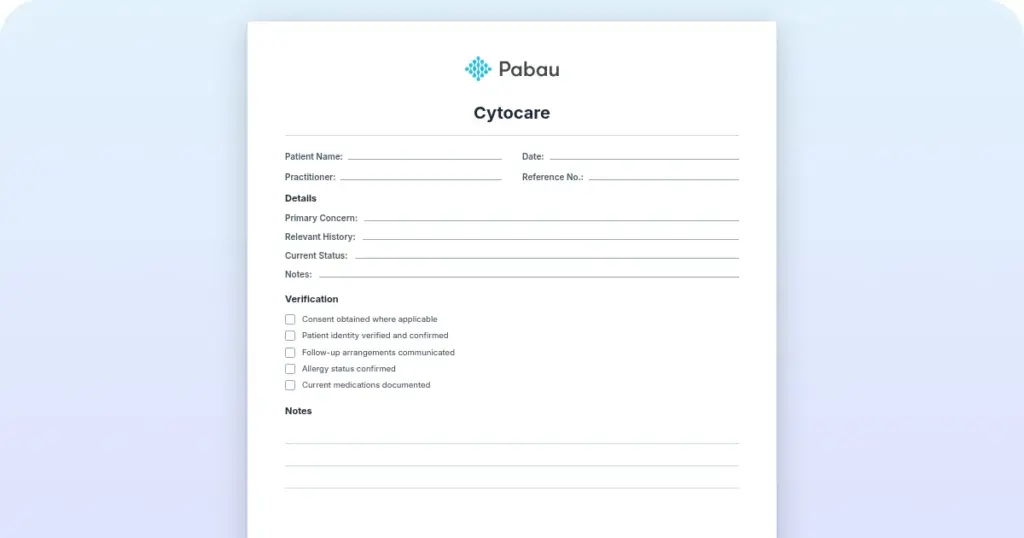
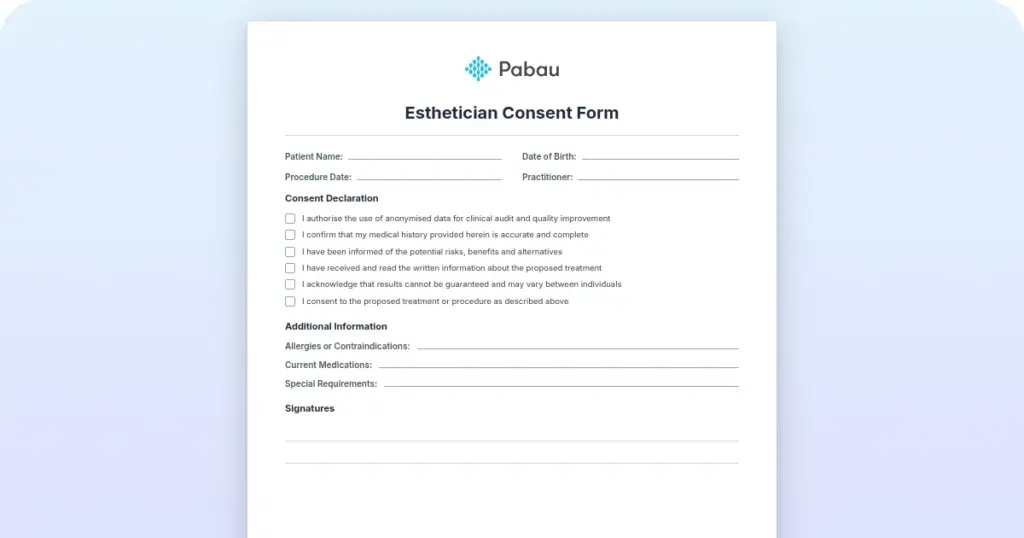
Cytocare consent form
Cytocare is a hyaluronic acid-based mesotherapy skin booster from Revitacare, in...

1
Last Updated: Oct 27, 2026

North Carolina sets no minimum age in statute, only 1,500 training hours and a written and practical exam.
A cosmetologist license costs $49 to start and $39 to renew every three years, plus eight hours of continuing education a year.
The Board of Cosmetic Art Examiners licenses your cosmetologists and estheticians, while the Medical Board and the Board of Nursing license your clinical staff.
A 2022 declaratory ruling lets estheticians microneedle to 1mm, but bars FDA Class 3 devices, diagnosis, and the word medical in a job title.
North Carolina’s corporate-practice-of-medicine rules keep a cosmetologist out of the entity that delivers your injectables.
North Carolina cosmetology license requirements ask for more classroom hours than New York, New Jersey or Texas. The state also charges less than any of them. Budget 1,500 hours at an approved cosmetic art school, a written exam, a practical exam, and $49 for the license itself. Renewal is $39 every three years. For owners also planning medical aesthetic services, our comparison of the top med spa software lists each platform’s pricing.
The fee schedule never answers the question that follows. Where does that license stop? A practice selling facials and filler from one front desk runs two rulebooks at once. The Board of Cosmetic Art Examiners writes only one of them.
So below are the hours, fees, renewal dates and lookup steps. Then come the ownership rules that decide who may sell those treatments at all.
A North Carolina cosmetology license takes 1,500 training hours, two exams, and $49. G.S. §88B-7 names hours, an exam and a fee, then stops. It sets no age, no residency test and no diploma requirement. Next door, a South Carolina cosmetology license takes the same 1,500 hours but sets a minimum age of 16 and a 10th-grade education.
All eight come from G.S. Chapter 88B, with the Board’s operating rules in 21 NCAC 14. The Board publishes its own fee schedule, which is where the $49 comes from rather than the statute.
Those eight lines cover one half of a combined practice. The people injecting on the other side of the hallway answer to nobody on that list.
The North Carolina Board of Cosmetic Art Examiners licenses cosmetologists, apprentices, estheticians, manicurists, natural hair care specialists and teachers. All six credentials come out of G.S. Chapter 88B. Your physicians answer to the North Carolina Medical Board, and your registered nurses and nurse practitioners answer to the Board of Nursing.
There is no North Carolina Board of Cosmetology, whatever the search box suggests. A hunt for the North Carolina cosmetology board lands on the Board of Cosmetic Art Examiners instead. Use that name on paperwork, because it issues every cosmetic art credential the state recognizes.
The difference runs deeper than which office prints the certificate. A North Carolina cosmetic arts license is an occupational business license. Chapter 88B governs shops, sanitation and scope, and the Board inspects premises rather than reviewing clinical judgment.
Medicine and nursing sit in Chapter 90 instead. Article 1 creates the Medical Board at §90-2 with 13 members, and defines the practice of medicine at §90-1.1(5). That definition covers prescribing and administering drugs, performing surgery, using the title Doctor, M.D. or D.O., and diagnosing or treating disease.
For an owner, that split means two separate personnel files. You verify a cosmetologist through the Board of Cosmetic Art Examiners, and a nurse practitioner through the Medical Board or the Board of Nursing. Neither office will flag the other’s expiry date, and neither one audits your treatment menu against your staff list.
Article 9A of Chapter 90 is the Nursing Practice Act, and it creates the Board of Nursing. Nurse practitioners are approved to use that title under §90-18(c)(14). As of this writing they still work inside the physician-oversight framework at §90-18.2.
Under that framework a supervising physician gives written prescribing guidance and reviews medications periodically. Controlled substances in pain management beyond 30 days work differently. The nurse practitioner has to consult the supervising physician directly, then at least every 90 days.
Do not plan around full practice authority yet. The SAVE Act, Senate Bill 966 of the 2025 to 2026 session, would repeal §90-18.2 and make North Carolina the 28th state to grant it.
Legislators filed the bill on April 30, 2026, and it sits in the Senate Rules and Operations Committee. It is not law, so hire and supervise on the current framework.
That is the medical half settled. The cosmetic art half carries six credentials of its own, and picking the wrong one is an expensive hiring mistake.
North Carolina issues six cosmetic art credentials to individuals, and an aesthetics menu leans hardest on the esthetician license. Renewal cycles and fees are close to identical across five of them. Training hours and scope are what separate them at the hiring stage.
The table below carries the in-state and out-of-state initial fees side by side, because the out-of-state figure is a sum rather than a separate price. Both columns come from the Board’s own fee schedule.
§88B-2(11a) defines esthetics as facials, makeup, skin care, and removing superfluous hair with creams, tweezers or waxing. It also covers applying eyelashes, including extensions and brow or lash color, plus surface manipulation in relation to skin care.
Cosmetology is a narrower definition than most owners expect. §88B-2(8a) describes it as arranging, dressing, curling, waving, cleansing, cutting, bleaching or coloring the hair of a person by any means. Skin work reaches a cosmetologist through the wider cosmetic art definition at §88B-2(5), not through the cosmetology definition.
So a cosmetologist and an esthetician are not interchangeable, and the hour count is a poor guide to which is which. The 1,500-hour credential is built around hair. Esthetics, at 600 hours, centers on skin. Longer training does not make a cosmetologist the better hire for a facial room.
Estheticians and cosmetologists may dermaplane and microneedle, but only to 1mm and only on the Board’s terms. The Board issued that ruling on July 25, 2022, reversing its own August 24, 2020 position that dermaplaning was out of scope entirely.
The reasoning matters, because the Board applies the same test to every new service. It brought both treatments inside scope because the intention of the service is stimulation of the skin. Intent decides the question, not the device on the counter.
Four hard lines follow. Cross any one and the treatment moves onto a medical staff member’s list.
That last line catches practices that have done nothing else wrong. If your team page lists a medical esthetician or a master esthetician, the state recognizes neither title. The Board reads it as a rules violation, so rewrite the bios before an inspector does.
Some permitted items are worth writing into your service list. The ruling names lash lifts, brow lamination, microcurrent, microdermabrasion, low-level radiofrequency, and light chemical exfoliation up to trichloroacetic acid below 20%.
Read the Board’s declaratory ruling before you add a device to the treatment menu. It runs four pages, and settles most arguments a supplier’s rep will start.
Two service categories fall outside Chapter 88B altogether. Massage and bodywork therapy has its own licensing board. Permanent makeup, tattooing and microblading are regulated as tattooing by each county’s Environmental Health Department, so the Board has no say over them.
That matters for a menu that mixes brow lamination with microblading. One sits inside your esthetician’s license, and the other answers to the county. With scope settled, the next question is how somebody gets licensed in the first place.
Licensing runs in a fixed order. Finish the hours at an approved school, apply and pay, then sit the written and practical exams through Prov. A temporary permit covers the wait, and the exam score decides which title the graduate ends up with.
The 1,200-hour route is not a shortcut to a cosmetologist license, and this is where hiring goes wrong. A 1,200-hour graduate who passes at 70 is licensed as an apprentice, not as a cosmetologist.
That apprentice then works six months under a licensed cosmetologist, then files an apprentice affidavit for the full license.
Here is how it plays out at the hiring stage. Two graduates apply in the same week, both from a 1,500-hour program. One scores 78 and is licensed as a cosmetologist. The other scores 72, is licensed as an apprentice, and works under supervision until the affidavit clears.
So an apprentice on your team may have trained the full 1,500 hours. The license type tells you the exam result, not the schooling behind it.
Three failed attempts closes the door temporarily. §88B-18 stops an applicant reapplying after a third failure until they finish whatever additional requirements the Board prescribes. Budget for the delay if a new graduate is already on your schedule.
Total cost figures differ across sources for one reason. §88B-20 lets the Board pass the cost of preparing, administering and grading the exam on to the applicant. Those vendor fees sit outside the $49, so no single number covers everyone.
The temporary permit has a trap in it. §88B-12 expires the permit six months from the date of graduation, not from the date it was issued. A graduate who takes two months to apply has four months of permit left, and it cannot be renewed.
Permits are also for North Carolina graduates only. The Board will not issue one to somebody waiting on a reciprocity application, so an out-of-state hire cannot bridge the wait this way.
One more claim is worth ignoring. Several sites state that North Carolina requires applicants to be 16, and no section of Chapter 88B sets a licensing age. That number is a school enrollment rule, and it binds the school rather than the Board.
A cosmetologist license renews every three years for $39, on or before October 1 of the renewal year. The window opens on July 1, and renewal runs through the Board’s online portal. Everyone else in the shop renews on a shorter cycle.
Continuing education is eight hours per year of the licensing cycle, under §88B-21(e). A cosmetologist may take all 24 hours at once inside the three-year cycle rather than spreading them. At least half of the education has to be in the licensee’s own cosmetic art field.
Nobody has to pay for it, and that is worth telling your team. The Board offers free CE classes, and it warns licensees against providers that advertise their courses as mandatory.
Self-directed learning counts too. A tutorial, an online course, or a new skill learned from a colleague can all go in the record.
Two CE exemptions exist, and both need a form. A cosmetologist with at least 20 consecutive years in the profession is exempt. So is a licensee aged 60 or over with at least 10 consecutive years of active practice.
Inactive status is the other option for a licensee in good standing. No continuing education is due, and the licensee may still buy supplies. Performing cosmetic art for payment is out. On reactivation the Board may ask for eight to 24 hours of CE first.
Miss the deadline and §88B-20 adds a $10 late fee. Renewing an expired individual license inside five years means paying that late fee plus the unpaid license fees. Shops work differently. A $10 late fee applies after February 2, and a further $25 reinstatement charge applies after March 1.
Five years is the point of no return. §88B-21(f) covers apprentices, cosmetologists, estheticians, manicurists, natural hair care specialists and teachers alike. Anyone who has not renewed within five years of expiry must pass a Board-prescribed examination before reinstatement.
Run that through a stylist who let a license lapse during a four-year career break. She pays the unpaid license fees plus the $10 late fee, and the Board can reinstate her. One more year and the same paperwork buys her an exam date instead.
One more quirk catches owners out. The Board receives no CE reports from course providers, so each licensee keeps their own records and produces them only if audited. Ask for the documentation yourself, because no lookup will show it to you.
Run the lookup on the Board’s own online license verification tool, searching by name or license number. You can print the record, and it is the only authoritative source for a North Carolina cosmetic art credential.
The tool filters by license type, which is what resolves the apprentice question. Apprentice, cosmetologist, esthetician, manicurist and natural hair care specialist each appear separately, alongside the matching teacher categories. A record that comes back as apprentice is telling you something important about supervision.
Work through the same five checks before every start date.
The obligation sits with the business rather than the practitioner. §88B-14 makes the shop application list every licensee working there, marked as either an employee or a booth renter. That list is what an inspector holds you to.
Shop licenses are also unforgiving about change. §88B-14 makes them non-transferable between owners and between locations, so buying a salon or moving one means a fresh application. The Board inspects without notice, and the visit can land 30 to 45 days after you open.
Do all of this before the first shift, not after a complaint. Recording the license number and the expiration date on the staff profile is the part that gets forgotten. Good medical spa software keeps that date sitting next to the schedule.
You can move a license into North Carolina without sitting the exam again, and the Board says the review is quick. North Carolina cosmetology license reciprocity runs on three pathways in §88B-13, and an applicant needs to satisfy only one of them.
Sites quote a flat $35 or $64 reciprocity fee, as though it were a single price. It is two prices added together. The $15 reciprocity application fee in §88B-20 sits on top of the initial license fee for the credential you are seeking.
The arithmetic is short. A cosmetologist pays $49 plus $15, which is $64. An esthetician, manicurist, natural hair care specialist, apprentice or teacher pays $20 plus $15, which is $35. Those are exactly the two out-of-state totals the Board publishes, which is why the flat-fee version reads plausibly.
Knowing the split matters when the Board’s in-state and out-of-state tables sit on the same page. Read $35 as a fee in its own right and you will budget the wrong amount for a cosmetologist. That is the one credential breaking the pattern.
Military applicants have a separate route. G.S. §93B-15.1 covers service members and their spouses relocating to North Carolina, alongside the protections in the Servicemembers Civil Relief Act.
Do not assume the credential itself travels cleanly. Texas cosmetology license requirements run through a different regulator, with different hours. The Georgia cosmetology license requirements sit closer to North Carolina’s, with 1,500 school hours plus written and practical exams for a Master Cosmetologist. Substantial equivalence is a judgment the Board makes rather than a box you tick.
One more moving part to watch. Senate Bill 808 is before the General Assembly and would change licensure requirements across the cosmetic art disciplines. The Board’s own notice says no changes have been finalized, so check its homepage before you plan a hiring cycle around current hours.
Hiring is the smaller half of a combined practice. Ownership is the half that needs a lawyer.
North Carolina is unusually direct about who may own a business that practices medicine, and a cosmetologist is not on the list. Most states leave the doctrine scattered across licensing statutes and case law. Here the Medical Board publishes a position statement with corporate practice of medicine in its title.
A business practicing medicine in North Carolina must be owned in its entirety by people holding active North Carolina licenses. That is the core holding of Medical Board position statement 10.1.2, adopted in March 2016 and amended in September 2025.
Owners must be Board licensees, or one of the combinations §55B-14 allows. The Board names its exceptions, and none of them describes a med spa. Hospitals and health maintenance organizations qualify, as do public health clinics and charitable nonprofits. Its reasoning is that these are government-regulated creations serving the public welfare.
Enforcement reaches both sides of the arrangement. A physician who provides medical services on behalf of a corporate-practice arrangement can face Board discipline. Against a lay owner, the Board says it may seek injunctive relief.
One sentence in the statement deserves a second read. The Board says the employee-versus-contractor distinction is not determinative. It does not decide whether a licensee is aiding and abetting the corporate practice of medicine. Papering the physician as a contractor does not fix an ownership problem.
The statutes underneath reach the same conclusion. §55B-6 lets a professional corporation issue shares only to a licensee as defined in §55B-2, and a shareholder may transfer shares only to another licensee. Its narrow carve-outs cover architecture, engineering, geology and similar professions, none of which reach medicine.
§55B-14 is worth reading closely, because the Medical Board points at it directly. It allows a multidisciplinary healthcare professional corporation, but only among named clinical roles. Physicians, physician assistants, nurse practitioners, nurse midwives, psychologists, audiologists, optometrists and podiatrists appear on the list.
Cosmetologists and estheticians do not. So the multidisciplinary carve-out is no route to cosmetology ownership of the clinical entity either. §57D-2-02 then applies the same licensee-only rule to a professional limited liability company.
Put plainly, a cosmetologist, an esthetician or an outside investor cannot hold equity in the entity that practices medicine in North Carolina. If you are still working out who can open a medical spa in your own case, settle that first.
Splitting the business in two is the pattern that survives this rule. A professional corporation or PLLC owned entirely by licensed medical professionals holds the clinical side and every clinical decision. The management company, separately owned, holds the lease, the equipment, the marketing and the non-clinical staff.
A management services agreement ties the two together. No single North Carolina statute names that arrangement, so treat it as a structuring pattern rather than a rule you can point to. The Board’s contractor sentence is a reminder that labels do not decide the question.
This is general information, not legal advice. Have a North Carolina healthcare attorney structure the entities before you sign a lease or take an investment.
A cosmetology or esthetics license covers hair, nails and non-medical skin work, inside the §88B-2 definitions and the 1mm line the 2022 ruling drew. Any treatment past that line sits with staff licensed under Chapter 90.
The dividing test is the one §90-1.1(5) sets out. A prescription, an injection, a diagnosis or a device the Board has excluded puts the treatment inside the practice of medicine. An esthetician’s training does not move that boundary.
Who may then perform it is a second question. Nurse practitioners still work under the §90-18.2 oversight framework described earlier. Delegation to a registered nurse is a scope and medical-director judgment rather than a published list.
That is why the clinical lead is the most consequential hire in a combined practice. Our guide to how to hire a medical director covers the supervision questions to settle before the first injectable appointment goes on the calendar.
Practice management software like Pabau keeps the two rulebooks apart at the point of booking. A combined practice runs both through one schedule. The front desk has to know that a facial can go to an esthetician and a filler appointment cannot.
Pabau does that with role-based permissions on the calendar. Each service is tied to the staff roles allowed to deliver it, so a booking that would break scope never reaches the schedule. Nobody has to catch it at the door on a busy Saturday.
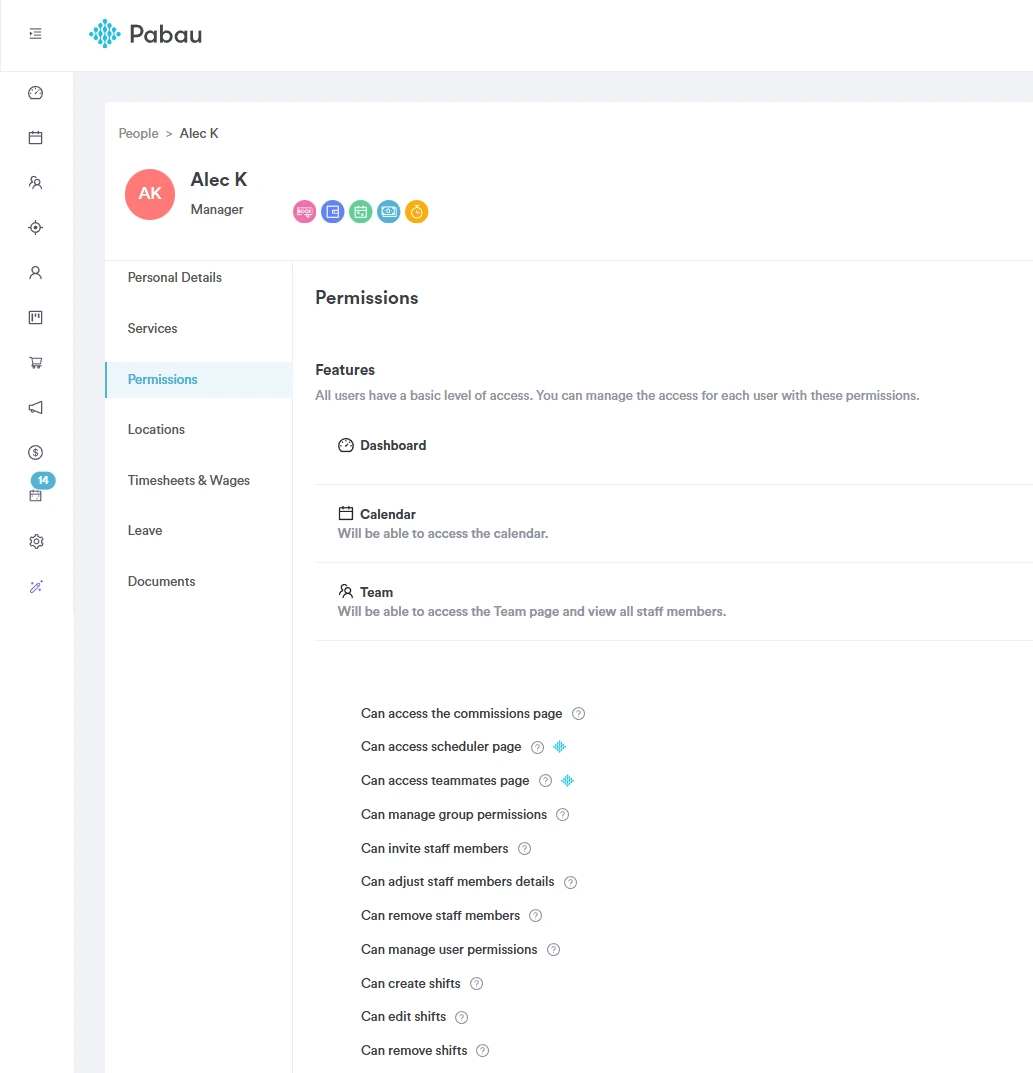
Consent follows the same logic. An injectable appointment can carry its own medical history and consent form, while a wax booking carries a shorter one. Both land on the same client record, so a patient who books across both sides has one file.
Staff profiles close the last loop. Keep each practitioner’s license number and expiration date on their profile, and the October 1 renewal date sits next to the schedule. Nobody finds out about a lapsed license on the morning of a shift.
Owners weighing their options usually compare the best aesthetic clinic software against a general salon booking tool. Only one of the two understands scope.

Pabau ties each service to the staff roles allowed to deliver it, and keeps license expiry dates on the staff profile. Your front desk books within scope by default.

The license mechanics are the easy half. Hours, exams, fees and renewal dates are all published, none of them is discretionary, and the Board answers the phone.
One decision underneath them is expensive to get wrong. If a single front desk sells a facial and a filler appointment, the ownership structure has to be right before either service is delivered. Unwinding it after an inspection or an audit costs far more than setting it up correctly.
So verify every license before a service is performed, and keep the expiration dates where your schedulers can see them. Then get a North Carolina healthcare attorney to sign off on the entity structure. Book a demo to see how Pabau keeps cosmetology and medical bookings inside their own scope.

Opening a med spa in North Carolina? See who can own one, and why the medical entity plays by different rules.
Need the wider compliance list? Work through the med spa compliance checklist before your next inspection.
Hiring your clinical lead? Hire a medical director who can cover the treatments you plan to sell.
Licensed in another state? Compare New York cosmetology license requirements, where 1,000 hours and a four-year cycle apply instead.
Expanding to the West Coast? Read California’s med spa licensing laws, which run on their own ownership rules.
Under a year on a full-time schedule. The 1,500-hour requirement in §88B-7 sets the pace, so evening and weekend programs run considerably longer. Exam scheduling through Prov adds a few weeks after the classroom hours end.
No. The Board’s 2022 declaratory ruling keeps FDA Class 3 and radiation-emitting devices out of esthetics scope. Most laser platforms carry one of those designations, so laser work sits with staff licensed under Chapter 90.
Not as a licensed practitioner. The temporary employment permit in §88B-12 only exists after graduation, and the school files that paperwork. Chapter 88B creates no student credential, so there is nothing to put a trainee on a salon floor for pay.
Yes, if cosmetic art is performed on the premises for pay. §88B-14 licenses the premises rather than the practitioner, and it reaches facials and waxing as readily as haircuts. That license does not transfer with a sale or a move.
That depends on the receiving state rather than on North Carolina. §88B-13 governs licenses coming in, and each state runs its own equivalence test on the way out. Check the destination board before you promise a relocating stylist a start date.