HD Brows consultation form: Free template and guide
HD Brows is a seven-step brow treatment that combines consultation, tinting, wax...

2
Last Updated: Oct 13, 2026

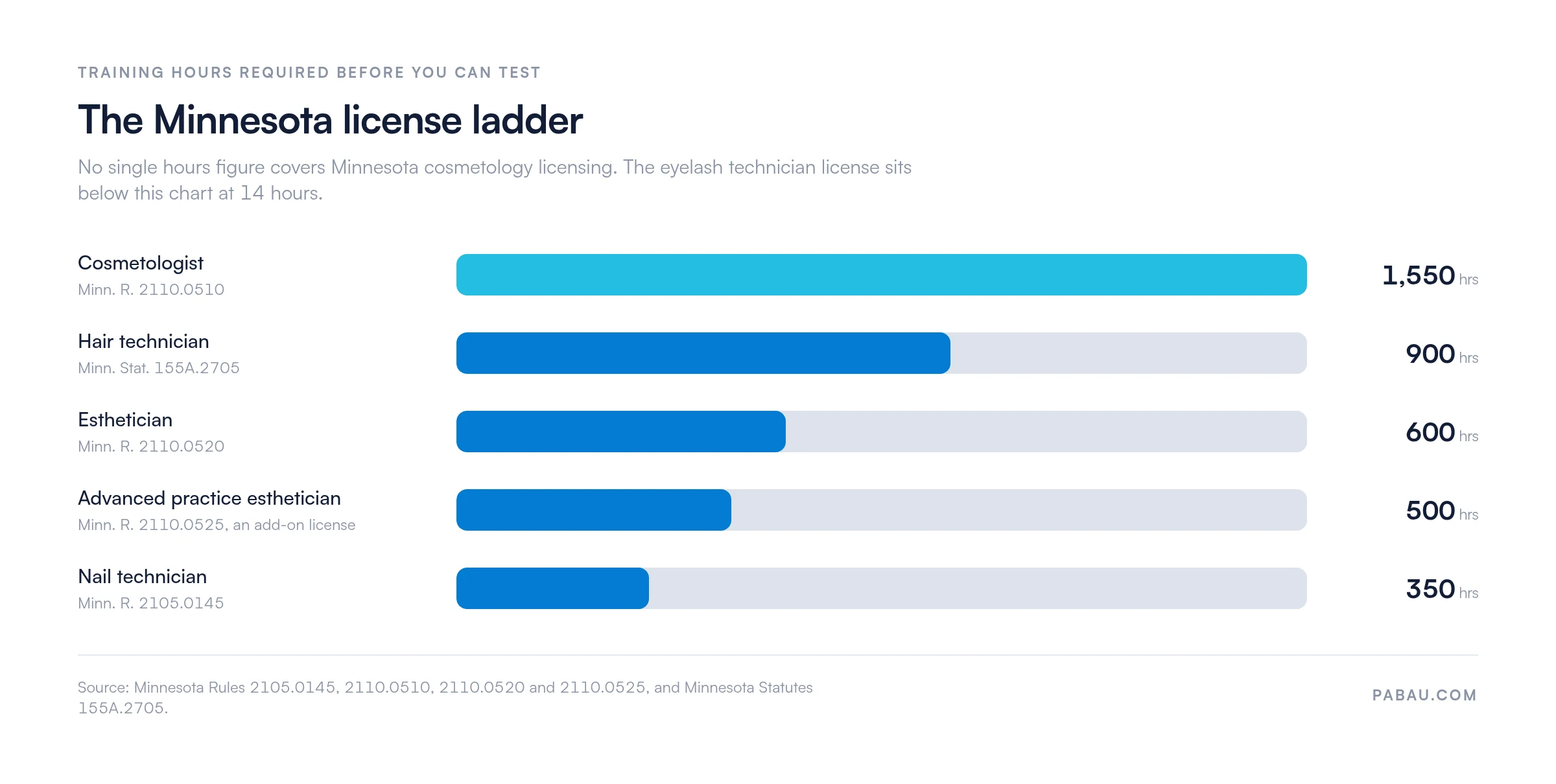
Minnesota’s Board of Cosmetologist Examiners issues eight individual licenses, and required training runs from 350 hours for nail technicians to 1,550 for cosmetologists.
Minnesota does require a hands-on exam. A licensed Minnesota school runs the Practical Skills Test, on top of the three written tests through PSI.
An initial practitioner license costs $195 under Minnesota Statutes 155A.25, which is $155 for the license plus a $40 application fee.
Every license runs a three-year cycle and expires the last day of your birth month, with eight hours of continuing education due each cycle.
Transferring in from another state starts with the Domestic License Transfer Application. Each state that licensed you must send a Certification of Licensure straight to the Board.
Minnesota cosmetology license requirements change with the license you pick, and the hours swing hard. If your cosmetology license leads to work in a med spa, our list of software for med spas ranks the platforms you might use there.
Minnesota does require a hands-on exam, whatever you’ve read elsewhere. Licensed schools run the Practical Skills Test in person, and the three written tests through PSI sit on top of it.
So start with the license ladder below. Your hours, exams, fee and renewal date all follow from that one choice.
Minnesota Statutes 155A.27 lists eight individual cosmetology licenses, and the services you want to sell decide which one you need.
Hair, skin and nails each have their own license, and the cosmetologist license covers all three. The hair technician license, live since 2024, covers hair only. Advanced practice esthetician sits on top of an esthetics license rather than replacing it.
One line matters more than the hours. Statute 155A.23 limits the advanced practice esthetician to mechanical and electrical skin devices. Those may only work on the epidermal layer. Injections and any work below the epidermis stay with medical professionals.
If that’s where you’re heading, read up on who can open a medical spa before you sign a lease. A cosmetology license and a medical license answer to different regulators.
Each row below names the rule or statute that sets the figure, so you can check it yourself.
Charted against each other, the five program licenses spread over more than 1,000 hours.
Two edge cases catch people out. Barbers answer to the Minnesota Board of Barber Examiners, a separate agency, so barbering is not on this ladder.
The Minnesota cosmetology managers license test is also not a course. A salon manager already holds an operator license and sits a 25-question exam, per PSI’s Minnesota candidate information bulletin.
With your row picked, the route to the license itself is the same for everyone.
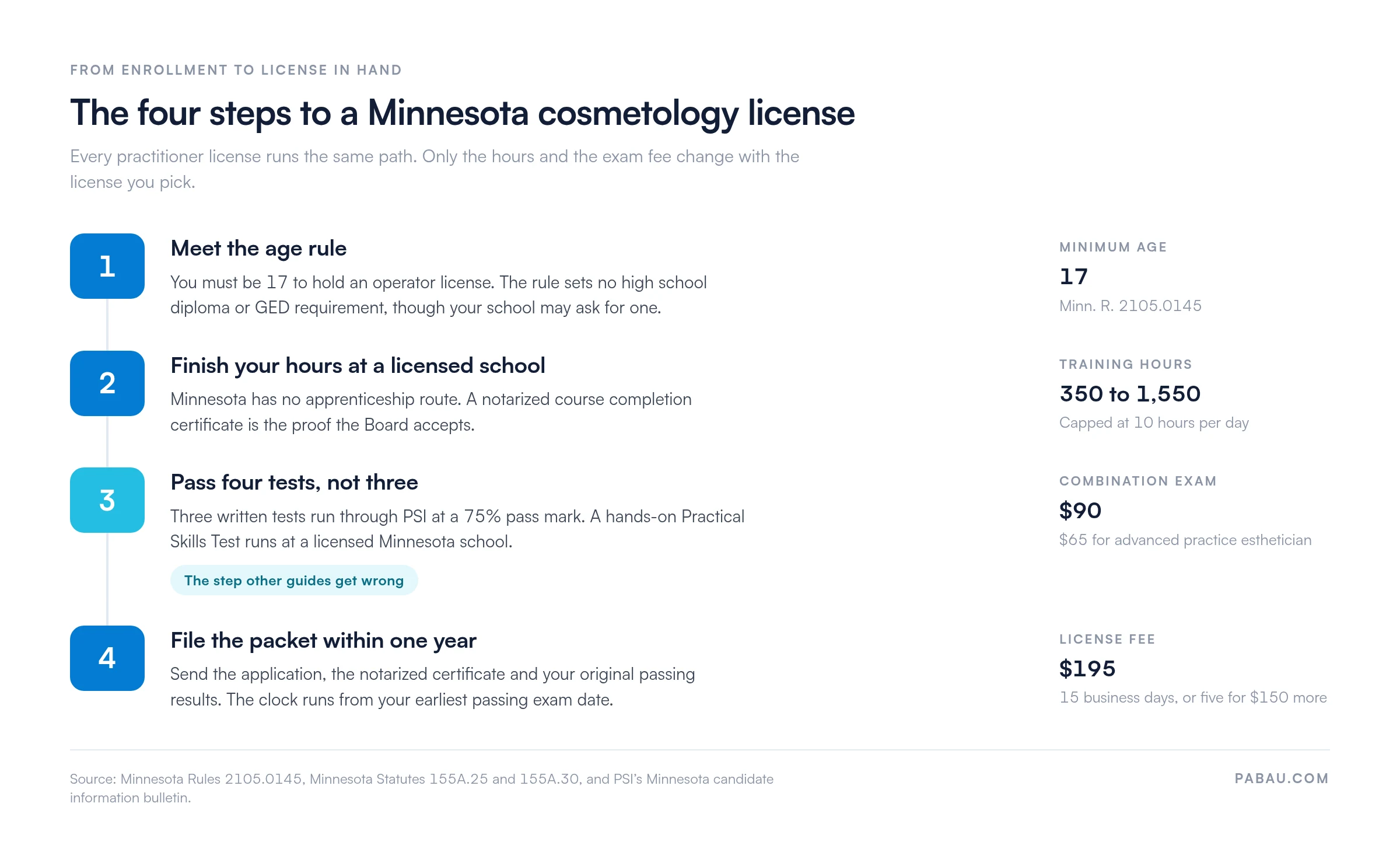
Minnesota licensure runs on four steps. Turn 17, finish your hours at a licensed school, pass the exams, then file the Initial Operator Application.
The path is identical for every practitioner license. Only the hours and the exam fee move, and the visual below shows what each step demands.
You must be at least 17 to hold a Minnesota operator license. Minnesota Rules 2105.0145 sets no high school diploma or GED requirement.
That second half is worth saying plainly. Plenty of guide pages repeat a diploma requirement without citing one. The rule lists an age, completed training, passing test results, notarized school documentation and the fee. Secondary education is not in it.
Your school may still ask for one. Admissions rules belong to the school, not the Board, so ask your program before you assume either way.
Your hours have to come from a Minnesota-licensed cosmetology school, and the figure comes straight off the license ladder above.
Minnesota offers no apprenticeship route. Rule 2105.0145 sends every operator license through school completion instead, and a notarized course completion certificate is the proof.
The hours are not a lump sum either. Minnesota Rules 2110.0510 splits the 1,550-hour cosmetology course into 1,130 hours of applied sciences and skills and 420 hours of related theory. The first 240 hours are preclinical.
Esthetics breaks down just as tightly. Minnesota Rules 2110.0520 puts the first 120 of the 600 hours in preclinical instruction. Another 200 go to applied sciences, and the rule even names clinical minimums of 60 facials, 40 makeup applications and 40 waxes.
One statutory limit shapes how fast you can finish. Minnesota Statutes 155A.30 lets a school deliver no more than 10 instructional hours per student per day. At that ceiling, 1,550 hours is 155 class days.
Training does not stay fresh forever. Minnesota Rules 2110.0525 accepts esthetics or cosmetology training finished in the past five years. An active Minnesota license works too.
Minnesota requires a hands-on Practical Skills Test at a licensed school, plus three written tests through PSI at a 75% passing score.
Some guides say Minnesota is unusual in requiring no hands-on practical exam. That reading confuses the written practical, one of the three PSI tests, with the hands-on test.
The Board publishes a Practical Skills Test page for the instructors who run it. You sit the test in person at a licensed Minnesota school. An instructor licensed in that subject scores it.
PSI’s Minnesota candidate information bulletin lists three written tests for a cosmetologist:
Every test needs 75% to pass. PSI offers the exams in English, Spanish and Vietnamese.
The advanced practice esthetician exam is the one exception. That combination covers general theory and the written practical only, with no state exam, for $65.
One deadline is easy to miss. PSI’s bulletin gives you one year from the passing exam date to file the license application. If you passed the parts on different dates, the year runs from the earliest one.
Send the Initial Operator Application with your payment, the original notarized Course Completion Certificate and your original passing exam results.
Salon manager applicants add their passing Salon Manager Exam result to the same packet. Standard applications process within 15 business days of receipt. Paying the $150 expedited fee brings that down to five business days.
So how long does licensure take end to end? Add the class days to the paperwork. At the 10-hour statutory ceiling, cosmetology is 155 class days, hair technology 90, esthetics 60 and nail technology 35.
Then add PSI scheduling and 15 business days of Board review. Most school calendars run well under 10 hours a day. Treat those class-day counts as a floor, not a forecast.
Most delays start in the packet rather than at the Board. Run this list before you seal the envelope:
Two mistakes come up again and again. Applicants send copies where the Board asked for originals. Others pick a license by course name rather than by the services they plan to sell.
Clear that list and the only number left is the bill.
An initial Minnesota practitioner license costs $195, which Minnesota Statutes 155A.25 splits into a $155 license fee and a $40 application fee.
That $195 is the same figure whichever practitioner license you hold. Even the advanced practice esthetician fee on the Board’s licensing page is $195, or $345 expedited. That second number is simply $195 plus the $150 expedited charge in the same statute.
Exam fees are separate and go to PSI. A cosmetologist combination exam is $90, so your total cosmetology license cost before tuition is $285.
Every state fee below sits in Minnesota Statutes 155A.25. Exam fees come from PSI’s Minnesota candidate information bulletin.
Run the numbers for a nail technician and the split gets obvious. The Board takes $195 and PSI takes $90. Tuition for 350 hours takes the rest, and only the school can quote it.
Salon and school licenses carry their own fees, which this page does not cover. Those figures also assume you are training in Minnesota. Arrive already licensed and the process changes shape.
A Minnesota cosmetology license transfer starts with the Domestic License Transfer Application. Each state that has licensed you then sends a Certification of Licensure to the Board.
Minnesota runs two documented pathways, and neither is a reciprocity list. The Board reads your paperwork rather than checking your state against a table.
Transferring from another US state takes three steps:
You carry none of those certifications yourself. Each state sends them straight to the Board. That detail trips up more hurried transfers than any other.
Training from outside the US runs four steps instead of three:
The Board names three approved evaluators. They are SpanTran, Josef Silny and Associates, and AEQUO International. Transfer forms come in English, Spanish and Vietnamese.
The hair technician license has its own transfer route, and folding it into the general process will cost you time.
The Board wants original training of 900 hours or more, or three or more years already licensed elsewhere. Either way, that training must have included chemical hair care.
Miss either condition and you enroll as a transfer student, finish the remaining hours of the 900-hour course, and meet every testing requirement. However you arrive, the license then runs on the same three-year clock.
Minnesota cosmetology license renewal runs on a three-year cycle. An individual license expires on the last day of your birth month.
Establishment licenses work off the anniversary month instead. You cannot expedite a renewal, but most licensees can renew online through a Board account.
Renewal requirements include continuing education, and Minnesota Statutes 155A.271 sets it at eight hours per three-year cycle. Four hours are core and four are elective.
The core four are prescribed, not open-ended. One hour covers the state laws and rules governing cosmetology practice. Three cover health, safety and infection control, consistent with Occupational Safety and Health Administration standards.
That requirement skips three license types. Instructor licenses, school manager licenses and inactive licenses carry no continuing education under the same statute.
Renewing late costs $45 and shortens your next cycle, so the penalty is not only the fee.
The Minnesota cosmetology license lookup tool searches practitioners, salons and schools by name, so an employer can verify a credential in seconds.
Two uses come up constantly. A hiring manager confirms an operator license is current before a first shift. Clients check whether an esthetician holds advanced practice status before booking a device treatment.
Searches often land on third-party directories instead. Use the Board’s own tool, because that is the record the Board keeps.
Lost the certificate? Order a duplicate for $20 through the same account management page you renew from.
Minnesota Statutes Chapter 155A and Minnesota Rules Chapters 2105 and 2110 set cosmetology practice, and the Board of Cosmetologist Examiners enforces them.
The split matters when you go looking. Statutes carry the licenses, the fees and the school standards. Rules carry the curriculum hour breakdowns and the application requirements.
Search results point at blog summaries more often than at the state board’s own text. Read the statute itself.
The most recent change landed on August 1, 2025. Laws 2025, chapter 39, article 4 defined textured hair in statute for the first time. That definition sits at Minnesota Statutes 155A.23, subdivision 22, and covers coiled, curly or wavy hair.
The same article changed what schools must teach. Cosmetologist and hair technician courses now have to include theoretical and clinical instruction on textured hair. That instruction covers curl, coil and wave patterns, strand thickness and volume.
If you are enrolling now, the textured hair content is part of the course you are paying for. Ask your school how it teaches the clinical portion, not just whether it appears on the syllabus.
Compliance does not stop at the Board’s rules once you offer medical-adjacent treatments. Then med spa compliance becomes its own body of state law.
Your license says what you may perform. How you record the work is your own problem. Practice management software like Pabau keeps the client record, the consent form, the treatment note and the payment on one timeline.
Open a follow-up appointment and the whole history is already on screen. Pabau was built as software for med spas and aesthetic practices. Its consent forms and before-and-after photo handling already match what a licensed practitioner files.
In the practices we onboard, the record that goes missing is almost always the paper note written between two clients. Pabau’s digital forms capture that signature on a tablet at check-in and file it against the client record.
Reporting is the part new owners underrate. It shows which services earn, and that decides whether another 500 training hours pays for itself. If you are still choosing a system, our roundup of the best aesthetic clinic software compares the options.

Pabau’s client records, digital consent forms and before-and-after photos sit on one timeline, so a licensed practitioner can open a full history mid-appointment. Payments and treatment notes land in the same file.

Cosmetology licensing in Minnesota is slow rather than hard. The rules are published and the fees are fixed. The one variable is how many hours your license demands, so pick that row carefully.
If you are moving to Minnesota, file the transfer paperwork before you start packing. Certifications of Licensure travel from each state’s board to Minnesota’s board, on their timeline rather than yours.
Once the license is in hand, the work turns into records, consents and payments. Book a demo to see how Pabau keeps a newly licensed practitioner’s paperwork on one client timeline.

Ready to open your own place? How to start a med spa walks the setup from business plan to first booking.
Wondering who can legally own the medical side? Who can open a medical spa explains the ownership models states allow.
Comparing states before you move? Med spa laws by state rounds up ownership and licensing rules state by state.
Hiring your first licensed staff? How to hire estheticians for a med spa covers where to look and what to check.
Budgeting the whole launch, not just the license? Costs of starting an aesthetics business breaks down the startup numbers line by line.
Yes. Minnesota issues a separate eyelash technician license, and it is the shortest on the ladder at 14 hours of training. The PSI exam for it costs $80, against $90 for the cosmetologist, esthetician and nail technician exams.
Not automatically. The Board issues a Certification of Licensure for $30 per certificate when another state asks it to verify you. That state then sets its own hours and testing rules. Check them before you give up a chair.
Only with a permit. The homebound service permit costs $50 and runs three years. A special event permit costs $75 per year. Both sit in the fee schedule at Minnesota Statutes 155A.25, alongside the license fees.
One exists for military applicants. Minnesota Statutes 155A.25 sets a temporary military license at $100, valid for one year. It buys time to work while the transfer paperwork moves through the Board. Everyone else applies for the standard $195 license.