Cytocare consent form
Cytocare is a hyaluronic acid-based mesotherapy skin booster from Revitacare, in...

1
Last Updated: Oct 27, 2026

New York licenses cosmetologists at 17 or older, after 1,000 approved training hours and a written and practical exam.
Getting licensed costs $55 in statutory fees, the $40 application fee plus the $15 written-exam fee.
The license runs four years, renews for $40, and requires no continuing education.
The Department of State licenses cosmetologists, while the State Education Department licenses your physicians and nurses.
Adding injectables raises a separate ownership question under New York’s corporate-practice-of-medicine rules.
New York cosmetology license requirements are set by the Department of State, because New York has no state board of cosmetology. You need to be 17 or older, finish 1,000 hours at an approved school, and pass a written and a practical exam. Before a cosmetology business adds medical treatments, see how our guide to medical spa software compares scheduling and HIPAA compliance. Fees come to $55, and the license lasts four years.
That part is simple. It gets harder the moment one front desk books a facial and a filler appointment. Your cosmetologists answer to one agency, your nurses answer to another, and neither office checks the other’s work.
Below is what the statute says about hours, fees, renewal, and lookups, plus what the split means for who can own the business.
To hold a New York cosmetology license, you need to be at least 17 and complete 1,000 hours of approved training. Then you pass the state’s written and practical exams. One statute and one set of regulations carry the whole list, so it stays short and fixed.
The full set of cosmetology license requirements in New York sits in General Business Law Article 27. Curriculum rules live in 19 NYCRR Parts 160 and 162. For the paperwork itself, the Department of State’s own page on becoming a cosmetologist covers the forms and where to send them.
The Department of State licenses cosmetologists, estheticians, nail specialists, natural hair stylists, and waxing specialists, through its Division of Licensing Services. Your physicians, nurse practitioners, and registered nurses answer to the State Education Department instead, through its Office of the Professions.
New York has no state board of cosmetology. Plenty of states license the occupation through a dedicated professional board, so people search for one here too. That search leads nowhere, because the Department of State issues the license itself under General Business Law Article 27.
The difference runs deeper than which office prints the certificate. Cosmetology is a business occupation, with its operating rules in 19 NYCRR Part 160 and its curriculum in Part 162.
Medicine and nursing are Title VIII professions instead. Article 131 of the Education Law covers medicine. It defines the practice of medicine at §6521 and creates the State Board for Medicine at §6523. Nursing gets the same treatment in Article 139, with the practice definition at §6902 and the State Board for Nursing at §6904.
Each of those professions has a board, and cosmetology does not. The two tracks stay separate right up to the point where somebody has to own the business.
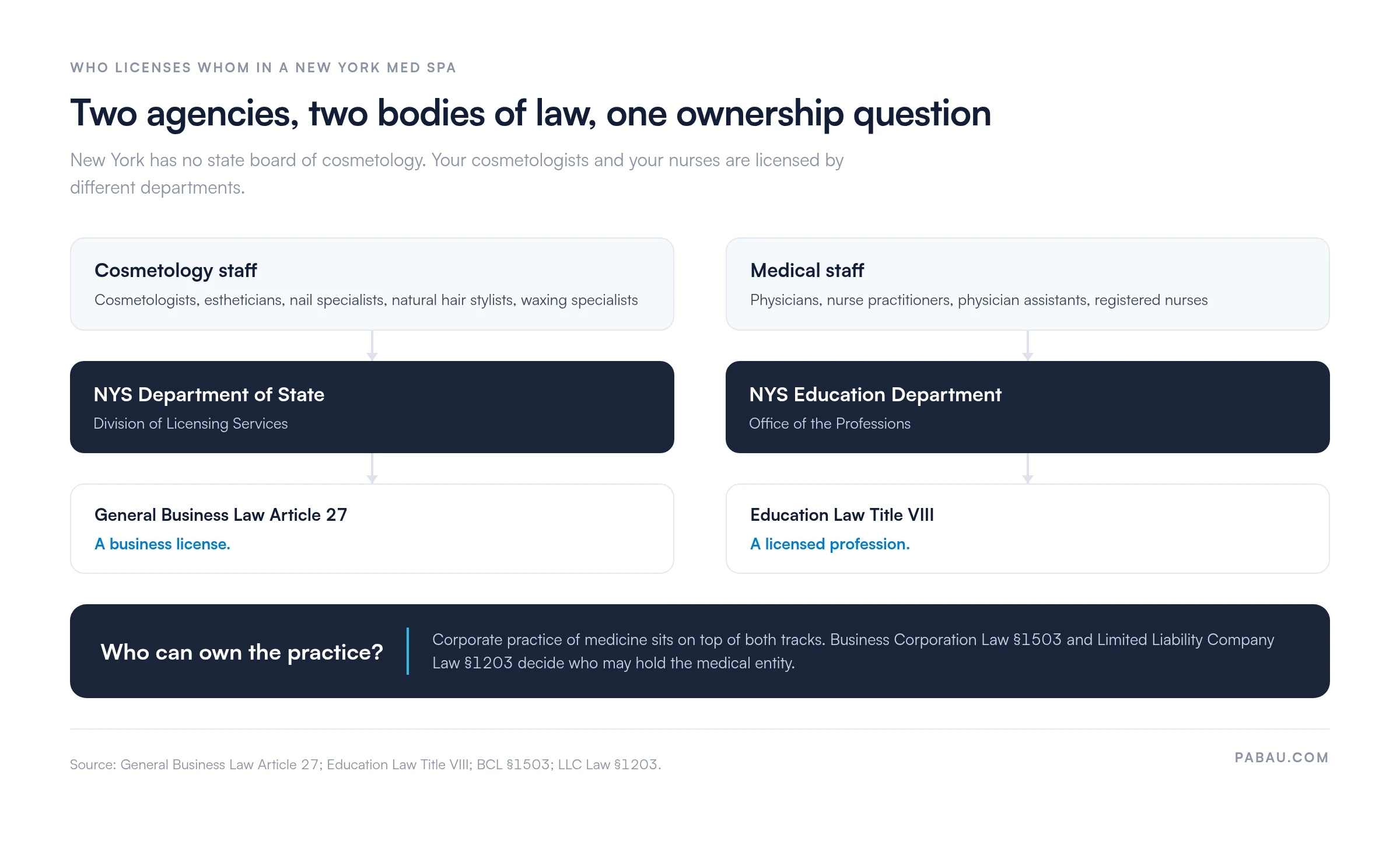
For a practice owner, the consequence is a split personnel file. You verify a cosmetologist through the Department of State and a nurse practitioner through the Office of the Professions. Neither office will tell you about the other, and neither checks whether your scope of practice lines up.
New York issues five appearance enhancement licenses to individual practitioners. Age, fees, and license term are identical across all five, so the training hours and the exam format are what separate them.
A cosmetology license is the broadest of the five. Even so, 19 NYCRR §162.4 assigns only 60 of its 1,000 hours to skin care, against 600 for esthetics. A cosmetologist is not a better esthetician for having trained longer.
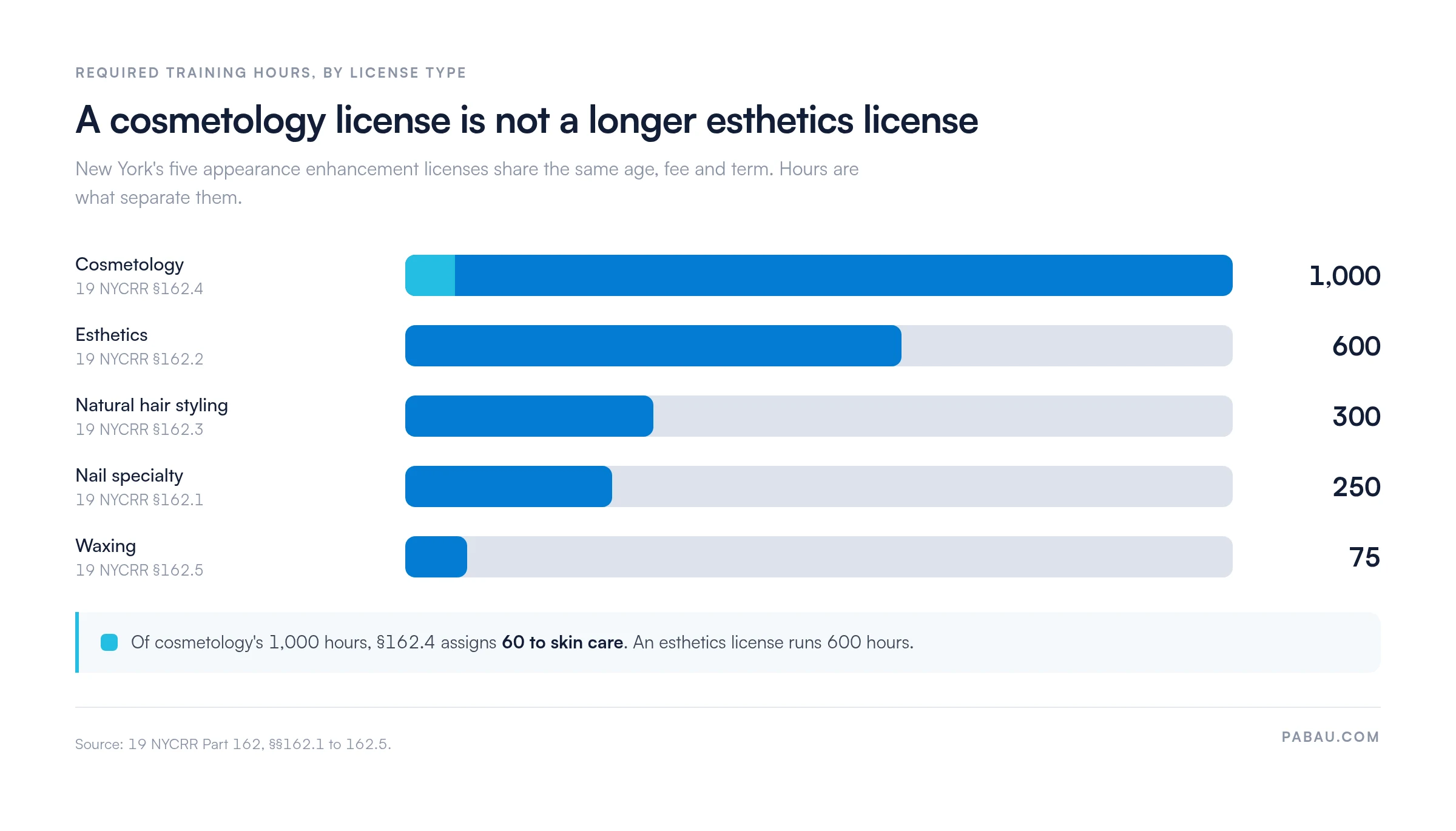
Renewal is $40 for all five, and none of them requires continuing education. All five use the same out-of-state route. Hour figures come from 19 NYCRR Part 162, and fees and term from General Business Law §409. Waxing is the one license that takes a written exam with no practical component.
The premises carry a license of their own. An appearance enhancement business license costs $60 initially and $60 at each renewal, and §406 sets a minimum applicant age of 18. General Business Law §405 also requires a bond or liability insurance for the whole license term.
The route runs in a fixed order. Finish an approved 1,000-hour course, apply with the $40 fee and your health certificate, then sit the written and practical exams.
Beauty school pages and round-ups repeat three numbers that the primary text does not support. Each one is worth checking before you budget or hire.
A New York cosmetology license runs four years from the date it was issued. Renewal costs $40, with no exam to retake and no continuing education to log. Under §408, payment alone buys another four-year period.
Two deadlines are worth marking in the calendar. Miss the expiration by more than a year and §408 adds a $10 fee on top. Let it run five years past expiration and the license cannot be renewed at all.
At that point the licensee has to pass the examination again before New York will issue a new one. Most people handle cosmetology license renewal online, through the Department of State’s own portal.
The department also notifies licensees at renewal about a voluntary domestic violence and sexual assault awareness course. Article 27 does not make completing it a condition of renewal.
For a practice owner, the five-year cliff is the one that bites. A stylist who let a license lapse during a career break cannot simply pay $40 and start on Monday. Renewing that far past expiration means sitting the exam again.
You verify a cosmetologist through the Department of State’s public license search, using the person’s name or their license number. The search also filters by license type, city, and county, which helps when a common name returns several matches.
No cosmetology board exists to check as a second source. A New York cosmetology license lookup starts and ends at the Department of State, the only agency holding the record.
One page on dos.ny.gov titled “Licensee Search” is a different tool, covering 22 occupations from security guards to home inspectors. Appearance enhancement licenses are not among them, so a lookup that starts there returns no match.
The obligation sits with the business, not the employee. General Business Law §405 lets one appearance enhancement business license cover several regulated practices at the same location. Each practitioner still has to be an appropriate licensee, and proving that at an inspection is your job.
Run the search before the first shift, not after a complaint. Five minutes on the results page covers most of what an inspector would ask you.
A cosmetology license number lookup is faster when you already have the number on file. Record it next to the expiration date, and purpose-built med spa software will keep that date beside the schedule.
You can transfer an out-of-state license into New York, but not through a fixed reciprocity list. General Business Law §406 accepts an equivalent license from another state on two conditions, and offers an experience route as an alternative.
A New York cosmetology license transfer therefore depends on where the applicant trained, not on a count of participating states. No published list of reciprocal or endorsement states exists in the statute or the regulation. Anyone quoting a state count is describing a system New York does not run.
There is also a military pathway in §406. It covers an applicant who was part of a military household in the licensing state before relocating to New York.
New York prepares its own examination. §407 has the Secretary of State write the examination questions, rather than adopting the National-Interstate Council exam many other states share. An out-of-state exam result does not carry over by itself. Leaving carries conditions too, since the Maryland cosmetology license requirements ask New York cosmetologists for six months of documented work experience.
State rules diverge more than the word reciprocity suggests. Texas cosmetology license requirements, for one, run through a different regulator entirely. An interstate move is rarely a paperwork formality.
New York does not let an unlicensed person own the part of your business that delivers medical treatments. No statute carries “corporate practice of medicine” in its title. Title VIII licensure and two ownership statutes build the doctrine between them, and it settles your entity structure first.
Business Corporation Law Article 15, §1503 governs the professional service corporation, or PC. Its certificate of incorporation has to carry proof that every proposed shareholder, director, and officer is licensed. That license has to cover the service the PC provides.
Limited Liability Company Law Article 12, §1203 does the same job for a professional limited liability company, or PLLC. Where the PLLC practices medicine, each member must be licensed under Education Law Article 131. A lay investor cannot hold a share of it.
Getting the structure wrong has already cost practices money. In 2005 the Court of Appeals decided State Farm Mutual Automobile Insurance Co. v. Mallela. It held that a carrier can look past a facially valid certificate of incorporation, then refuse to pay a fraudulently incorporated professional corporation.
The facts show what that looks like in practice. Non-physicians paid physicians to put their names on the incorporation paperwork, then ran the companies themselves. The money at stake was no-fault insurance reimbursement, and the court let the carrier withhold it.
Read the two statutes together and a Department of State appearance enhancement license looks like a business license rather than a Title VIII profession. On that reading it sits outside the PC and PLLC ownership restrictions. That is our analysis of the statutes, not a published regulator position, so treat it accordingly.
From there, most combined practices split the business in two. A PC or PLLC owned entirely by licensed medical professionals holds the clinical side and keeps every clinical decision.
Alongside it, a separate management company holds the lease, the equipment, the marketing, and the non-clinical staff. That company can have non-licensed owners.
A management services agreement ties the two together. No single New York statute defines a management services organization by that name, so treat this as a structuring pattern rather than a rule.
Picture an esthetician and a nurse practitioner opening together in Brooklyn, selling facials, waxing, and filler from one address. The nurse practitioner owns the PC that delivers the injectables and makes the clinical calls.
Meanwhile the esthetician owns the management company, which holds the lease, the equipment, and the front desk. One appearance enhancement business license covers the cosmetology services at that address, and the management services agreement connects the two entities.
If you are working out who can open a medical spa in your own case, that is the conversation to have before anything gets signed.
This is general information, not legal advice. Have a New York healthcare attorney structure the entities before you sign a lease or take an investment.
A cosmetology or esthetics license covers hair, nails, and non-medical skin work. Treatments involving a prescription, an injection, or a diagnosis sit with staff licensed under Title VIII.
Device-by-device rules come from scope-of-practice interpretation and delegation, not from one clean published list. Confirm each treatment with your medical director and your counsel before it goes on the menu.
That is also one reason the choice of clinical lead matters. Our guide to how to hire a medical director covers the supervision questions to settle first.
Who supervises whom also shifts over time. Education Law §6902(3)(b) currently exempts nurse practitioners with more than 3,600 hours of practice experience from the written practice agreement with a collaborating physician. That version runs until July 1, 2030, when a documented collaborative-relationships standard replaces it.
A combined practice runs two sets of rules through one schedule. The front desk has to know that a facial can go to an esthetician and a filler appointment cannot. That answer has to hold on a busy Saturday, not just in the staff handbook.
Practice management software like Pabau handles that with role-based permissions on the calendar. Each service is tied to the staff roles allowed to deliver it, so a booking that would break scope never reaches the schedule. Nobody has to catch it at the door.
Consent follows the same logic. A medical treatment can carry its own medical history and consent form, while a wax booking carries a shorter one. Both land on the same client record, so a patient who books across both sides has one file rather than two.
Staff license tracking closes the last loop. Keep each practitioner’s license number and expiration date on their staff profile, and the four-year renewal date sits next to the schedule. Your schedulers stop discovering a lapsed license on the morning of a shift.
Owners comparing options usually start with medical spa EMR software built for aesthetics rather than a general salon booking tool.

Pabau ties each service to the staff roles allowed to deliver it, and keeps consent forms on the client record. Your front desk books within scope by default.

The license itself is the straightforward part. Age, hours, exams, and fees are all published in statute, and none of them bends.
The expensive decision sits underneath it. If your practice sells a facial and a filler appointment from the same front desk, the ownership structure has to be right first. Fixing it after an audit costs far more than setting it up correctly.
So verify every license before a service is performed, and keep the expiration dates where your schedulers can see them. Then get a New York healthcare attorney to sign off on the entity structure. Book a demo to see how Pabau keeps cosmetology and medical bookings inside their own scope.

Opening a med spa in New York? See who can own one, and why the medical entity plays by different rules.
Need the wider compliance list? Work through the med spa compliance checklist before your next inspection.
Hiring your clinical lead? Hire a medical director who can cover the treatments you plan to sell.
Licensed in another state? Compare Texas cosmetology license requirements to see how far the rules move between states.
Expanding to the West Coast? Read California’s med spa licensing laws, which run on their own ownership rules.
Most students take several months to a year. The 1,000-hour requirement drives it, so a full-time schedule finishes well ahead of evenings and weekends. Exam scheduling adds a few more weeks, because the Department of State holds examinations at least quarterly.
No college degree is required. A Department of State-approved 1,000-hour vocational program satisfies the education requirement on its own. Out-of-state training or five years of equivalent practice can substitute under General Business Law §406.
Not automatically. Every state sets its own standards, and New York writes its own examination rather than using the shared National-Interstate Council exam. Expect to apply through the new state’s equivalence or endorsement route.
No. It licenses the premises for cosmetology, esthetics, nail, hair, and waxing services under General Business Law Article 27. Injectables, prescription peels, and diagnosis sit with staff licensed under Education Law Title VIII.
Not the medical side. New York’s corporate practice of medicine rules require the entity delivering medical treatments to be owned by licensed medical professionals. A cosmetologist can own the cosmetology business, or a non-clinical management company.