HD Brows consultation form: Free template and guide
HD Brows is a seven-step brow treatment that combines consultation, tinting, wax...

2
Last Updated: Oct 13, 2026

A Virginia cosmetologist license takes 1,000 clock hours, down from 1,500 under the curriculum effective December 1, 2025.
The application fee is $120, and renewal costs another $120 every two years.
Prov, Inc. has run the written and practical exams since January 1, 2025, replacing PSI Services.
Virginia attaches no continuing education requirement to cosmetology renewal, unlike most states.
The statute defines esthetics as work done with any nonlaser device, and says esthetics is not a healing art.
Virginia cosmetology license requirements changed twice in under two years, and most guidance online has not caught up. The cosmetologist curriculum now runs 1,000 clock hours, not 1,500, and the exams come from a new vendor.
The Virginia Board for Barbers and Cosmetology issues the license from inside the Department of Professional and Occupational Regulation, known as DPOR. House Bill 2669 also narrowed the license’s scope on July 1, 2025.
Virginia draws the medical-aesthetics boundary in its own words. Its definition of esthetics reaches only “any nonlaser device,” and says esthetics is not a healing art.
A Virginia cosmetologist license takes 1,000 clock hours, two exams, and a $120 application fee. Renewal is another $120 every two years, with no continuing education attached.
The hour count is the figure worth checking against any school brochure you were handed. Programs that started before December 1, 2025 ran on different numbers.
The Virginia Board for Barbers and Cosmetology regulates cosmetology licenses, and it sits inside DPOR. The board writes the rules, approves the schools, and issues the licenses from Richmond.
Medical and nursing licenses come from a different department. The Virginia Department of Health Professions houses the Board of Medicine and the Board of Nursing, and a laser answers to them rather than DPOR.
The governing statute is Va. Code Title 54.1, Chapter 7. Cosmetology sits in 18VAC41-20, and esthetics has its own chapter at 18VAC41-70.
Finish an approved 1,000-hour program, pass a written and a practical exam, then apply to DPOR with the $120 fee. Four steps, and the training is the long one.
The board requires an approved training program, and DPOR does not impose a high school diploma requirement. Schools set their own enrollment minimums, so age and education rules vary by program.
Confirm entry requirements with the school itself, since a board regulation and an admissions policy are separate documents.
A Virginia cosmetologist license requires 1,000 clock hours plus 365 minimum performances. That comes from 18VAC41-20-210 and 18VAC41-20-220, amended effective December 1, 2025, and the old figure was 1,500.
Pages about cosmetology school in Virginia still quote the old number. Here is how the 1,000 hours divide up, with hair work taking more than half:
Performances run alongside the clock hours rather than inside them, and the regulation says they have to cover all hair types, including textured hair.
One correction, because it circulates the other way round. The cut from 1,500 to 1,000 came from the board’s own rulemaking, not from House Bill 2669. The board voted in July 2022.
The Virginia cosmetology exam has two parts, a written theory exam and a practical exam, and Prov, Inc. administers both. Prov took over on January 1, 2025, from PSI Services, which had replaced Professional Credential Services.
Any page still naming PCS or PSI is out of date. The written exam is 110 multiple-choice questions with a 90-minute limit, at $99, and the practical costs $95.
Under 18VAC41-20-60, passing one part exempts you from retaking it, provided you pass both within one year of your first attempt. Fail to appear as scheduled and you forfeit the fee.
The application fee is $120, filed through DPOR Online Services. 18VAC41-20-140 sets that figure and says all fees are nonrefundable and will not be prorated.
An applicant already licensed elsewhere files for a license by endorsement instead, also $120. DPOR has separately introduced an annual technology fee, so check the current total on its fee schedule.
School is the common route, and it is not the only one. The board also accepts a registered apprenticeship, a Virginia high school cosmetology program, and approved training completed elsewhere.
A cosmetology apprenticeship in Virginia runs through a registered program coordinated by the Virginia Department of Labor and Industry. You train under a licensed cosmetologist and earn while you do it.
Hour totals for that route get quoted differently across directory sites, so take the figure from the sponsor and DPOR. Training completed abroad needs a transcript evaluation first.
Virginia’s license types run from 115 hours for a wax technician up to 1,000 for a cosmetologist. Every figure below reflects the curriculum effective December 1, 2025.
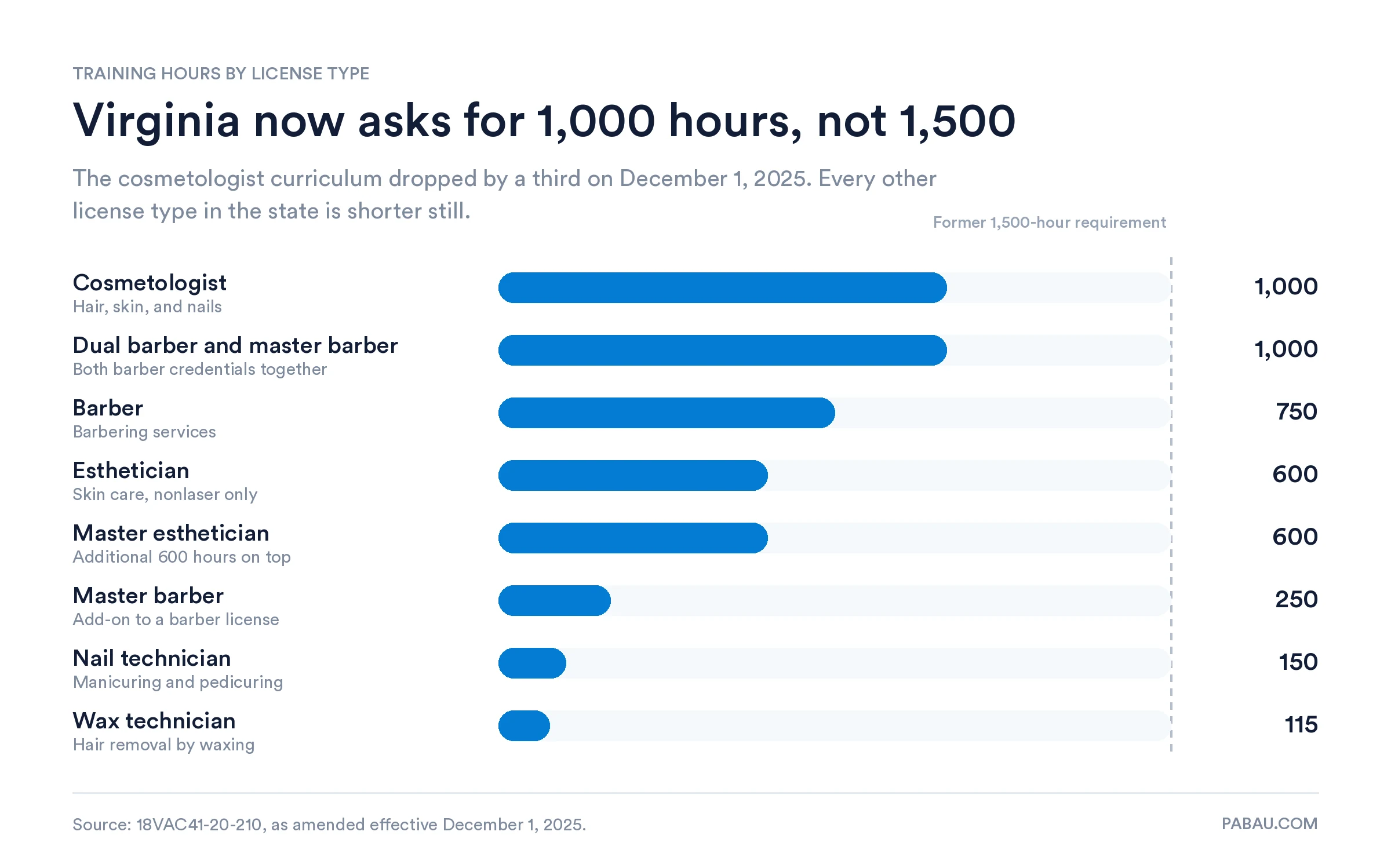
Esthetics fees sit in 18VAC41-70 rather than the cosmetology chapter, so take those two figures from DPOR. The instructor certificate costs $140 to apply and $45 to renew.
An esthetician license takes 600 hours of training, and a master esthetician license takes 600 more on top. Esthetics has its own regulations at 18VAC41-70.
The master esthetician credential is what unlocks chemical exfoliation. 18VAC41-70-250(B) lists exactly what a master esthetician in Virginia may use on the epidermis:
Read that list as a ceiling, because a stronger agent sits outside the license. Under 18VAC41-70-250(A), the spa or the school also has to make sure no licensee or student works beyond scope.
Both teach-out windows have closed, so every program now running in Virginia is a 1,000-hour program. The transition explains the stale numbers still circulating.
If you hold a partial transcript from a closed program, take it to DPOR rather than to a school’s admissions page. The board decides which hours still count.
A Virginia cosmetology license renews every two years for $120, and the Virginia Board for Barbers and Cosmetology requires no continuing education. Most state boards tie renewal to training hours, so this one is a fee and a form.
Note the expiration date when the license arrives. It expires on the last day of the month it was issued in, two years later.
Let it lapse and reinstatement costs $240. 18VAC41-20-140 splits that into a $120 renewal fee and a $120 reinstatement fee, and none of it is refundable.
Virginia issues a license by endorsement to practitioners already licensed elsewhere, for $120. The board reviews each application rather than honoring another state’s license automatically.
Virginia cosmetology license reciprocity turns on one test. The board asks whether your training and both exams were substantially equivalent to what Virginia requires. Where your hours fall short, proof of work experience is the usual fix.
Virginia has also enacted the Cosmetology Licensure Compact, designed to let a licensee practice across member states on one privilege. The commission was not yet issuing multistate licenses as of this writing, so check DPOR first.
Hour counts differ sharply between states, which is what creates the shortfall. Our guide to North Carolina cosmetology license requirements sets out the numbers next door.
Run a Virginia cosmetology license lookup through DPOR’s License Lookup tool. It takes a name or a license number, and returns license status plus any disciplinary history.
For a practice owner, that search belongs in hiring, before a new stylist or esthetician touches a client. A lapsed license is the common finding, and it is easier to fix before someone’s first shift.
Complaints travel the other way through the same system. Anyone can file one against a licensee or an establishment.
A Virginia salon needs its own license, separate from every practitioner license held by the people working in it. So a licensed cosmetologist opening a shop applies twice.
The establishment license covers the premises rather than the person. 18VAC41-20 sets the sanitation standards, DPOR inspects against them, and spas and schools sit in their own categories.
We could not confirm the salon, spa, and school fee figures against DPOR’s current schedule. Get those numbers from DPOR before you budget.
Virginia’s cosmetology and esthetics licenses stop at a nonlaser device, because the statute says so in those words. Va. Code § 54.1-700 defines esthetics as work done “by means of cosmetic preparations, treatments, or any nonlaser device.”
The same definition adds a sentence almost no guide quotes. “Esthetics” is not a healing art and shall not include any treatment that constitutes the practice of medicine, osteopathic medicine, or chiropractic.
So the license does not reach a laser, or anything that counts as practicing medicine. Cosmetology’s own definition narrowed further on July 1, 2025, when House Bill 2669 took effect.
Straight-razor shaving, body treatments, and machine facials came out of scope. Facial work became a cleanse, tone, and application of a mask or moisturizer. The statute also excludes hair braiding, so braiding needs no license in Virginia.
Laser hair removal in Virginia is regulated by the Board of Medicine, under 18VAC85-20-91. A cosmetology license plays no part in it.
A physician may perform or supervise the treatment after training in five areas. Skin physiology and histology, skin type and patient selection, laser safety, operating the device, and responding to complications.
The rule adds a hands-on threshold too, requiring a minimum of 10 proctored patient cases with demonstrated competency across skin types. Doctors performing laser hair removal before August 7, 2019 are exempt.
Delegation is where practices misread the rule. A doctor may delegate laser hair removal to a properly trained person under the doctor’s direction and supervision.
Direction and supervision means the doctor is readily available while the treatment happens. The rule states that the supervising doctor is not required to be physically present.
One exception is hard, though. The doctor has to see and evaluate any patient whose treatment resulted in complications before that treatment continues.
Delegates other than a licensed physician assistant or nurse practitioner need that same training. Va. Code § 54.1-2902 is the backstop, making it unlawful for any person to practice medicine without a Board of Medicine license.
So laser hair removal requirements in Virginia have nothing to do with hours banked at a cosmetology school. IPL, or intense pulsed light, is not strictly a laser, so check where your device sits before buying.
Botulinum toxin and dermal fillers are prescription products, so ordering them is the practice of medicine or advanced practice nursing. A cosmetology or esthetics license authorizes none of it.
Va. Code § 54.1-3303 requires a bona fide practitioner-patient relationship before any prescription. The prescriber takes a history and performs an appropriate examination first.
The Virginia Board of Nursing administers the Nurse Practice Act at Va. Code § 54.1-3000 et seq. Physician assistant supervision sits separately at § 54.1-2952.
Virginia has a quirk worth knowing if you are hiring an injector. Advanced practice registered nurses are licensed jointly by the Boards of Medicine and Nursing, under Va. Code § 54.1-2957.
Under that section, some nurse practitioners need no written or electronic practice agreement. It covers an NP who does not prescribe controlled substances or devices, practicing in their certified category. Conditions apply.
Virginia has no express corporate practice of medicine statute, so it is best described as permissive but constrained. Corporate practice of medicine, or CPOM, is the doctrine limiting who may own a medical practice.
No Virginia decision squarely settles whether a lay corporation may employ physicians, so the constraint comes from licensing law. Va. Code § 54.1-111(A)(1) makes it unlawful for any person, partnership, corporation, or other entity to practice a profession unlicensed.
Note where that entity language sits. It is in § 54.1-111(A), not in § 54.1-2902, which industry pages cite instead. That section says “any person.”
The second piece is the Professional Corporation Act, at Va. Code § 13.1-543. A professional corporation rendering healing-arts services has to keep every share in licensed hands, individual or professional entity.
That section also deems practitioners of the healing arts and advanced practice registered nurses to render the same professional service. So a nurse practitioner may lawfully co-own the clinical entity alongside a physician, and § 13.1-1102 covers a PLLC.
Then comes the carve-out. Va. Code § 54.1-111(F) protects a listed entity that employs or contracts with a licensed individual, letting it render professional services through that person.
It is subsection (F), not (D). Subsection (D) is the enforcement provision, and it has teeth. DPOR may seek an injunction plus a civil penalty of $200 to $5,000 per violation, capped at $25,000 a year.
A willful violation is worse again. Under § 54.1-111(B) it is a Class 1 misdemeanor, and a third conviction within 36 months is a Class 6 felony.
In practice the clinical entity is usually a professional corporation or PLLC owned by licensees, with administration in a separate management services organization. Take the structure to Virginia health care counsel.
A Virginia practice often runs both sides of that line under one roof. The cosmetology side answers to DPOR, while the laser room and the injectable list answer to two other boards.
Practice management software like Pabau keeps the paperwork behind that split in one place. Practitioner records hold each license number and its expiry date, so a lapsed license surfaces before a board or an insurer asks.
Treatment notes tie to the person who performed the service, so a laser session and a filler appointment each show who did the work. Both sit on the same client timeline as the consent form and the photos.
Injectables carry one more record. Batch and lot numbers log against the treatment note, so a product recall becomes a search rather than a week of digging.
Service and provider setup is where the boundary gets enforced day to day. In software for med spas, a laser appointment only reaches a provider you set up to deliver it.

Pabau holds each practitioner’s license number and expiry date. Consent forms, treatment notes, and injectable batch numbers file against the provider who did the work. One record per treatment, ready if a board asks.

The licensing half of this is arithmetic. 1,000 clock hours, two exams from Prov, $120 to apply, and $120 again every two years with no continuing education to chase.
The scope half is where Virginia is stricter than most of its neighbors, and where the statute does the talking. Esthetics reaches a nonlaser device and no further.
So a laser or a syringe means a second credential and a different board. Plan for that before you sign a device lease. This guide is general information rather than legal advice, so confirm any figure with DPOR first.
If your practice sits on both sides of that line, the records are what prove you stayed on the right side of it. Book a demo to see how license records, consent forms, and notes hold together.

Licensed just across the border? North Carolina cosmetology license requirements sets out the hours, fees, and exam route in the state next door.
Comparing Virginia with a longer program? Georgia cosmetology license requirements covers a state that still runs a 1,500-hour cosmetology curriculum.
Moving a license west? Washington cosmetology license requirements lays out how another state splits its license types and hours.
Hiring for the skin-care side of the practice? How to hire estheticians for a med spa walks through screening, scope, and onboarding.
Opening your own place? Esthetician business plan template gives you a structure for the numbers and the service menu.
1,000 clock hours, plus 365 minimum performances. That figure has applied since December 1, 2025, when the amended 18VAC41-20-210 replaced the old 1,500-hour curriculum.
Budget $314 in state and exam fees before tuition. That is $120 to apply, $99 for the written exam, and $95 for the practical. DPOR also charges an annual technology fee, so confirm the current total.
Two years. It expires on the last day of the month it was issued in, two years out, and renewal costs $120 through DPOR Online Services.
No. The Board for Barbers and Cosmetology attaches no training hours to renewal, which sets Virginia apart from most state boards.
No. Laser work sits with the Board of Medicine under 18VAC85-20-91, and the statutory definition of esthetics covers only a nonlaser device. A physician performs the treatment or delegates it while remaining readily available.
Yes, through license by endorsement, for $120. The board checks whether your training and both exams were substantially equivalent. Where hours fall short, proof of work experience can close the difference.
1,000 clock hours at 30 to 35 hours a week works out to roughly seven to nine months. Exam scheduling and board processing add time on top.