Ethical consent form: free template and what to add
An ethical consent form is a written record that a patient or participant agreed...

2
Last Updated: Oct 26, 2026

Texas requires a licensed physician, an MD or DO, to delegate any med spa treatment that counts as the practice of medicine.
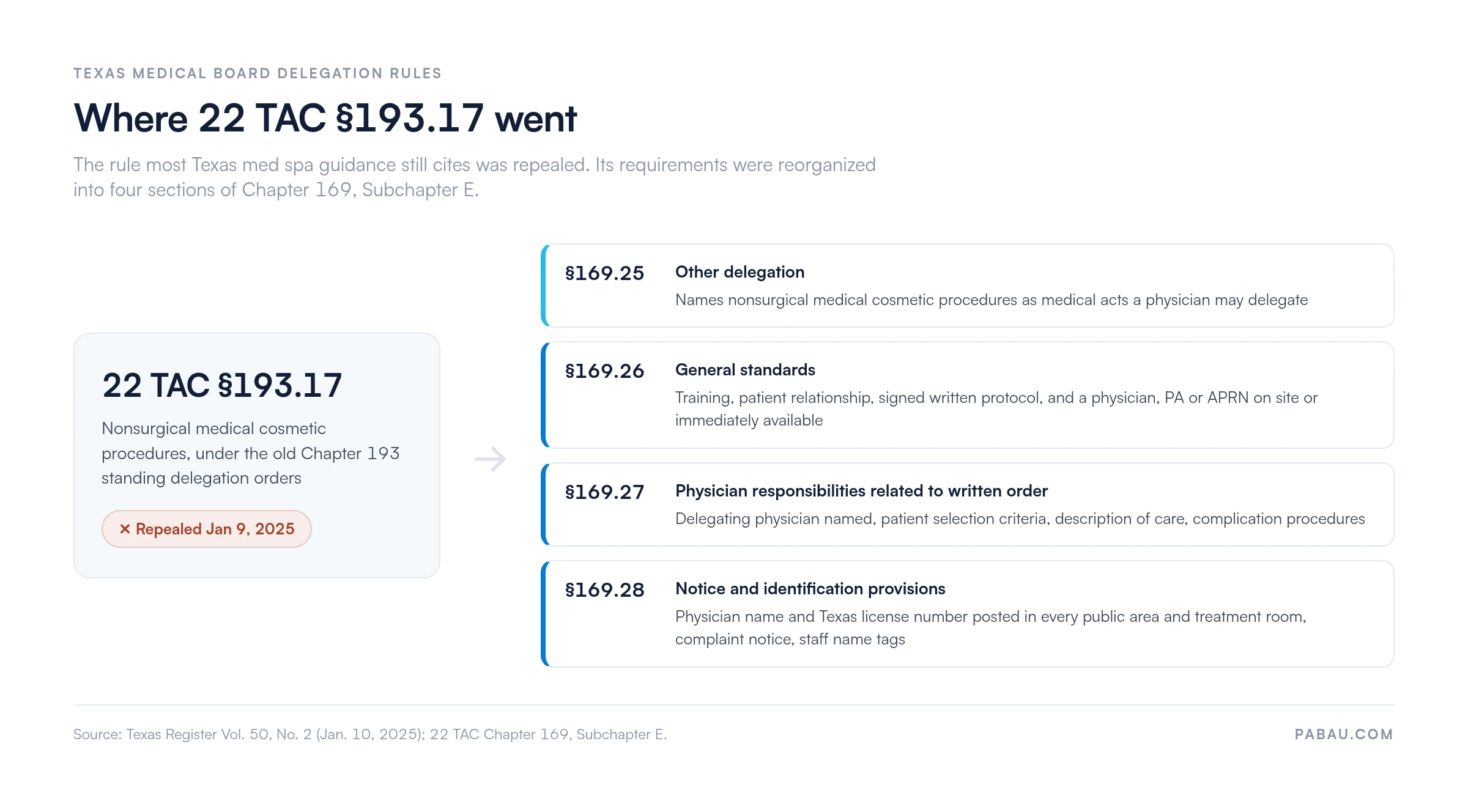
The rule most guidance still cites, 22 TAC 193.17, was repealed on January 9, 2025 and replaced by 22 TAC 169.25 through 169.28.
A nurse practitioner or physician assistant can perform delegated treatments, but neither can be the delegating physician.
Oversight costs roughly $500 to $1,500 a month when it is nominal, and $5,000 to $10,000 when the physician is regularly on site.
Since January 2025 you must post the delegating physician’s name and Texas license number in every treatment room.
Every med spa in Texas performing medical treatments needs a medical director. Texas law will not let that arrangement run on a signature alone. Botulinum toxin, dermal fillers and laser treatments all count as the practice of medicine here. A physician licensed in Texas has to delegate each one. One of the picks in our comparison of software for med spas is for medical-director-led practices.
The rule almost every compliance checklist still cites, 22 TAC 193.17, was repealed on January 9, 2025. Delegation now sits in Chapter 169, and the written-order and posted-notice duties got sharper.
For whoever runs the charts and the front desk, an invalid delegation puts a physician’s license at risk. So the first question is who qualifies.
A med spa medical director in Texas is the licensed physician who takes legal and clinical responsibility for delegated treatments. Texas statute never uses that job title. The law says delegating physician, and the difference matters when you draft the agreement.
Title matters because the duty is personal to the physician. A med spa can call someone its medical director on a website. Under Chapter 169, only the physician who delegated the act answers to the Texas Medical Board for it.
The physician needs an active, unrestricted Texas medical license, because a delegation from a restricted license is not valid. Consequently, under the corporate practice of medicine doctrine, that physician holds clinical control, not a non-physician owner.
The med spa requirements Texas enforces come from three separate agencies. None of them covers the whole business.
Which agency you answer to depends on the treatment, not on the sign above the door. Our guide to Texas med spa licensing walks through the facility and staff permits behind each one.
Texas bars corporations and non-physicians from practicing medicine or employing a physician to provide medical services.
That rule sits in the Occupations Code, at sections 155.001, 155.003, 157.001 and 165.156. For a fuller read, the Texas Medical Association’s whitepaper is the standard reference.
In practice that means two entities. A physician-owned PLLC or PA holds the medical practice. Alongside it, a management services organization, or MSO, handles the lease, the marketing, the payroll and the equipment. Whoever else is investing owns that MSO.
The medical director sits inside the medical entity, and the clinical decisions stay there. Who signs which document is a longer subject. Our breakdown of med spa ownership rules in Texas covers the entity structures in full.
As of January 9, 2025, the delegation rules for cosmetic treatments sit in Subchapter E of 22 TAC Chapter 169. The Board repealed the old Chapter 193, including section 193.17, on the same date. If a compliance checklist you are using still cites 193.17, it predates the change.
Four sections carry the work, and each one lands on the delegating physician:
Chapter 157 of the Occupations Code is the parent statute behind all of it. Section 169.28 also puts name tags on staff performing delegated acts, and requires a complaint notice on display. The diagram below maps the repealed rule onto its four replacements.
One more change landed on September 1, 2025. House Bill 3749, known as Jenifer’s Law, restricts elective IV therapy given outside a physician’s office or other licensed healthcare facility.
A physician can order it, or delegate the order to a PA or APRN under a prescriptive authority agreement. Administration is limited to a physician, PA, APRN or registered nurse. Medical assistants and licensed vocational nurses are off that list.
The medical director needs exactly one credential from the state. That is an active, unrestricted Texas medical license, in good standing with the Texas Medical Board. Board certification in dermatology, plastic surgery or aesthetic medicine is not required by law.
That is the legal floor, not the hiring standard. Section 169.26 makes the delegating physician confirm training for each delegated act. Doing that for a device they have never used is hard. So aesthetic experience is a practical requirement even where the statute is silent.
A Texas medical spa license is not a single document either. The medical side runs on the physician’s license and the delegation paperwork. Your facility may also need TDLR registration for cosmetology services. Laser hair removal needs separate TDLR certification on top.
The table cross-references who may perform medical-grade treatments, what Texas asks of them, and which board holds the license. No single agency answers all three questions.
Delegation runs on two documents. You need a written order for the procedure, plus a prescriptive authority agreement wherever prescribing is involved. Most medical directors for med spa practices sign both, and the second one carries statutory content requirements.
Section 157.0512 of the Occupations Code sets out what that agreement must contain.
Two more conditions sit outside the document. Under section 157.0511 the physician has to register the delegation with the Texas Medical Board. And the Texas Board of Nursing must already have approved the nurse practitioner’s prescriptive authority.
None of that makes the nurse practitioner the medical director. Delegation flows one way, from the physician down. A PA or NP performs delegated acts without being the source of the delegation.
Esthetician services that stay inside the cosmetology scope need no medical director at all. Facials, cosmetic-strength exfoliation and standard skincare sit under TDLR, in Occupations Code Chapters 1602 and 1603 and 16 TAC Chapter 83.
That line moves the moment a treatment becomes a nonsurgical medical cosmetic procedure. A prescription-strength peel, a botulinum toxin injection or an energy device used for a cosmetic result all cross it. Then TMB delegation rules apply, whoever holds the cosmetology license.
The diagram below shows where each service lands.
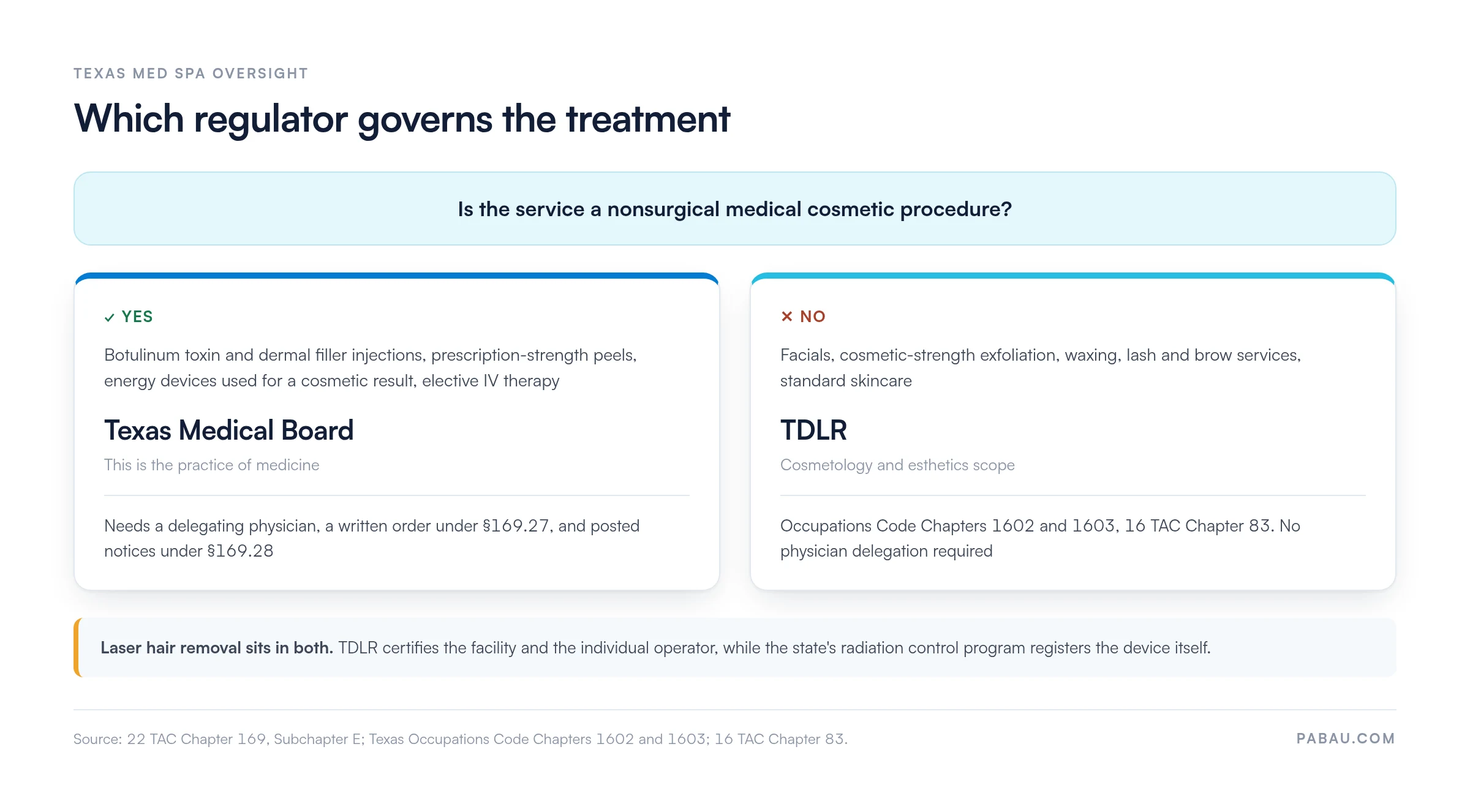
Laser hair removal is its own case. TDLR certifies both the facility and the individuals performing it, a change that took effect in 2019. The state’s radiation control program registers the laser device separately.
Six duties recur, and a monthly signature covers none of them:
Good faith exams sit near the front of that list for a reason. The physician relationship has to exist before the delegated act, under section 169.26, and the record has to show it. A director who signs off after treatment has the sequence backwards.
Oversight also follows the modality, not the treatment menu. Botulinum toxin, dermal fillers, laser resurfacing and IV therapy each carry different complications, and the protocol for each has to name them. HIPAA record-keeping applies across all of them.
Four slips are worth guarding against, because each one breaks a rule above:
Keeping protocols, audits and consent records straight across every modality is easier with software built for it. Dedicated medical spa EMR software keeps the good faith exam, the treatment note and the physician sign-off on one chart.
The shortest route is a referral from a Texas physician network. Verify the license next, then sign the delegation paperwork before anyone treats a patient.
The five steps below run in the order that saves you rework:
Run this check before a patient books, not after. Each item traces to a rule above.
One red flag is worth naming. A physician who will not commit to chart review, or who already directs a dozen practices, is offering a signature rather than oversight. What a signature costs, and what genuine oversight costs, comes next.
Expect $500 to $1,500 a month for nominal oversight. A physician who is regularly on site costs $5,000 to $10,000 or more a month. Published 2026 compensation guidance puts the middle band, chart reviews plus periodic site visits, at $2,000 to $5,000 a month.
The table compares the five engagement models a Texas med spa tends to use, with the annual equivalent where guidance publishes one.
Figures come from published 2026 med spa compensation guidance rather than our own data. Hourly arrangements run about $150 to $300 an hour, which suits an audit-only role but makes budgeting harder.
Here is how that plays out. Take a med spa in Austin with two injectors, offering botulinum toxin, fillers and one laser. Nurse practitioners do the treating, so that practice sits in the engaged band.
Budget toward the middle of that band, plus the physician’s time to build the first protocols. Add elective IV therapy and the number climbs, because Jenifer’s Law narrows who can order and administer it.
Two constraints shape what you can offer. American Med Spa Association guidance on physician pay says the fee should reflect fair market value for the oversight time. And it cannot be tied to referrals, patient volume or a share of treatment revenue, which counts as fee-splitting.
Staffing changes the number more than geography does. A practice where nurse practitioners and PAs do the treating needs less daily physician time. One running on RNs and medical assistants needs more, and pays for it.
An absentee arrangement creates exposure in three directions, with the Texas Medical Board, with your insurer, and in the criminal courts.
Improper delegation is a disciplinary matter for the physician’s license, not a fine for the business. Chapter 169 puts the duty on the delegating physician, so the physician is who the Board acts against.
Malpractice cover follows the scope described in the policy. Where a director has signed protocols for treatments they never reviewed, the claim can land outside that cover. Then the practice absorbs it.
Compensation structure is its own exposure. A percentage of treatment revenue looks like a partnership and reads as fee-splitting, which is why fixed fees are the norm.
Texas also has a live criminal case on this. In April 2026, two people surrendered on charges that include murder, manslaughter and criminally negligent homicide. One is the physician who served as medical director for Luxe Med Spa in Wortham. The other is the spa’s owner.
The charges follow the July 2023 death of Jenifer Cleveland, 47. She became unresponsive after an IV infusion at the facility and died at a nearby hospital. The American Med Spa Association reported the case in May 2026. Jenifer’s Law, the 2025 statute restricting elective IV therapy, carries her name.
Those charges have not been tried, and the facts will be settled in court. What the case shows now is that a Texas medical director’s name on a protocol is a clinical commitment.
Chart review only works if the chart is complete. In plenty of Texas med spas, one patient’s record is spread across four places.
Practice management software like Pabau, an all-in-one system for aesthetic and medical practices, keeps those four on one patient timeline. The delegating physician opens one record and sees the consent, the exam, the photos, the treatment note and who performed it.
That matters for the audit duty. Reviewing a sample of delegated treatments each month becomes a filter you can run, rather than a data-collection exercise. For a physician directing more than one location, the same view works across sites.
Every Pabau subscription includes the full platform, so consent, charting, photos and reporting never sit behind a higher tier. Our medical spa software page shows how the record fits together.

Pabau keeps consent forms, good faith exams, photos and treatment notes on one patient timeline. Your delegating physician can review delegated treatments without chasing four systems.

A Texas medical director is a clinical relationship with a paper trail, not a compliance line item. The physician who signs the written order is the one the Board and the courts look at.
So pay for the involvement you need, then check that you are getting it. A director on a $500 retainer who never reviews a chart costs less every month, and more the one time it matters.
And update your citations. If your protocols, contracts or wall notices still reference 22 TAC 193.17, they point at a rule that no longer exists. Book a demo to see how Pabau keeps delegated treatment records ready for your medical director’s review.

Working out who can legally own the business? Who can own a med spa in Texas sets out the PLLC and MSO structures the ownership rule allows.
Handling HIPAA across every modality? HIPAA compliance checklist for medical spas covers what a med spa’s records need to meet.
Need the wider Texas licensing picture? Texas med spa licensing laws covers scope of practice, facility permits and compliance.
Hiring outside Texas? How to hire a medical director for your med spa walks through the interview and contract stages.
Opening a new location? Medical spa requirements lists the licenses and permits a new med spa needs before it treats anyone.
Chapter 169 sets no cap on how many practices a physician may delegate to. The practical limit is section 169.26, which makes them confirm training for every delegated act and stay immediately available. Prescriptive authority is a separate limit. The Occupations Code holds a physician to seven full-time-equivalent PAs and APRNs, outside a few exempt settings.
A physician, or a PA or APRN acting under delegation. An RN, a medical assistant or an esthetician cannot. The exam has to happen before the delegated treatment, and the chart has to show that order of events.
Chapter 169 publishes no frequency. You set the schedule in the written protocol, and monthly review of a sample is a common standard. Whatever you write down, follow it, because the protocol is what an investigator reads first.
Yes. Prescribing and administering semaglutide or tirzepatide is the practice of medicine, so the same delegation rules apply. A physician, PA or APRN with prescriptive authority has to prescribe, and a written order governs who may inject.