Nurse conversion chart
What a nurse conversion chart covers A nurse conversion chart groups the unit co...

1
Last Updated: Nov 4, 2026
A physician assistant can open a med spa in many US states, but state law decides how much of the business the PA can own. In permissive states such as Arizona, a PA can be the majority owner and contract a physician as medical director. In strict states such as California, New York, and Texas, the PA usually owns a management company that serves a physician-owned medical practice.
The rule behind that split is the corporate practice of medicine (CPOM) doctrine, which limits who can own a business that delivers medical care. A physician medical director is required in nearly every state. In a few, such as Colorado, mainly payers or insurers require one. Confirm your structure with a healthcare attorney licensed in your state before you form any entity.

A PA can open a med spa in many states, but state CPOM rules decide which ownership structure is legal.
A physician medical director is required in nearly every state, even when the PA owns the business.
In strict CPOM states such as California, New York, and Texas, the PA owns a management company and a physician owns the clinical practice.
First-year startup costs for a PA-owned med spa typically run from $150,000 to $500,000, driven mostly by buildout and equipment.
Med spa software such as Pabau keeps bookings, consent forms, treatment notes, and payments in one system for a small PA-led team.
Opening a med spa means owning the business and controlling the clinical work. A PA can often own the first layer. The second always needs physician involvement, and state law sets how much.
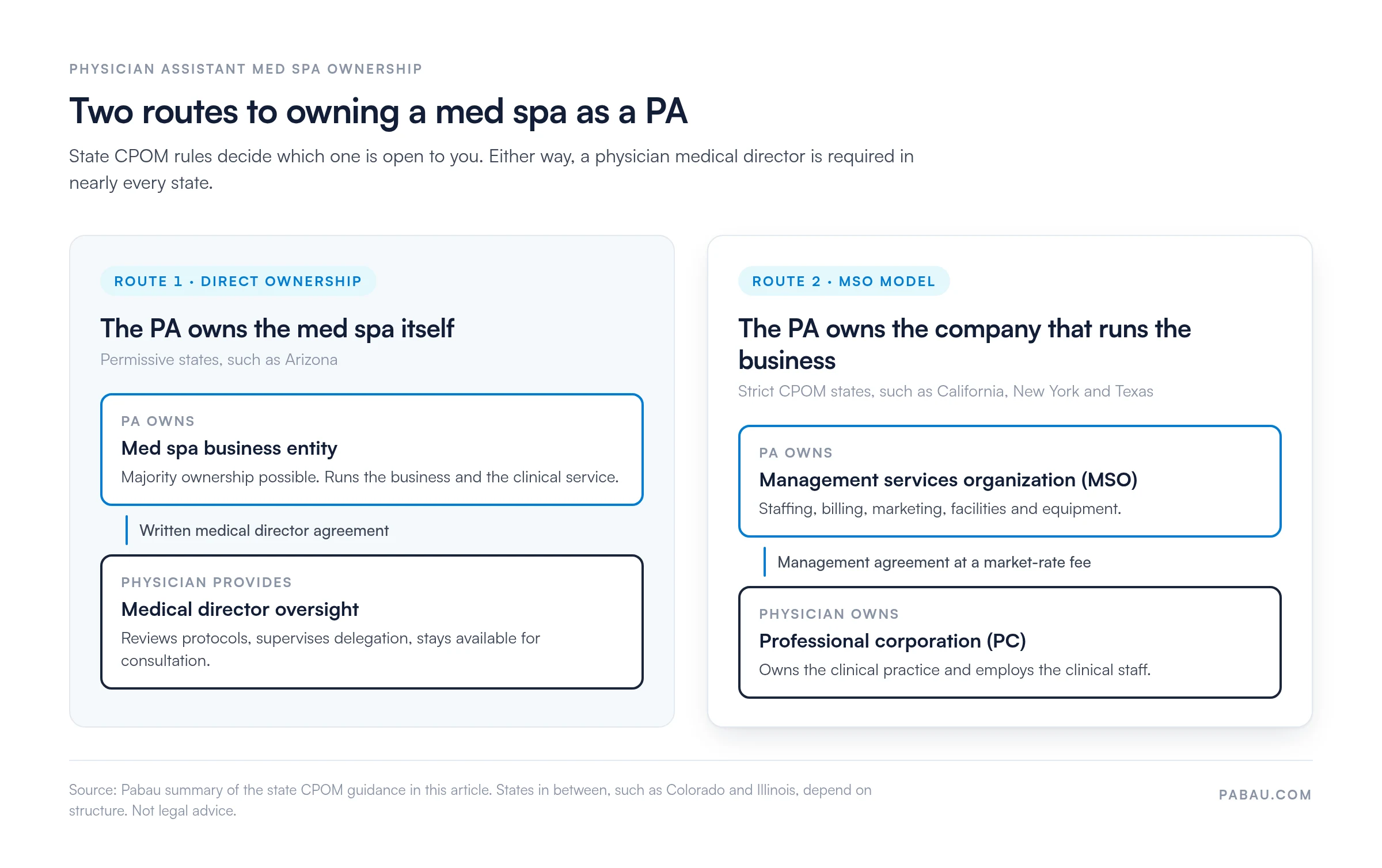
In permissive states, both layers can sit in one entity the PA controls, with a medical director overseeing clinical protocols. In strict states, the layers split into two companies, which is where the MSO model comes in. No federal rule settles the question, so the state you open in decides which route you can take.
The Corporate Practice of Medicine doctrine is a set of state laws that bar non-physicians from owning or controlling a medical practice. That includes corporations and LLCs. Its purpose is to keep business interests from overriding clinical judgment. Medical decisions stay with licensed physicians rather than with owners chasing profit.
CPOM laws vary widely. Some states enforce them through statute, while others rely on case law or administrative guidance, and a handful have no CPOM doctrine at all. For a PA, the CPOM answer decides which business structure is legally available. Getting it wrong can mean license sanctions, a forced restructure, or fraud penalties. Review your med spa compliance obligations for a broader view of the regulatory picture.
No two states handle PA ownership the same way. The table below summarizes the general framework in key states, based on published guidance. Rules change and attorneys read them differently, so treat it as a starting point, not legal advice. For the detail behind the Texas row, see our breakdown of Texas med spa ownership rules.
State medical board websites are the authoritative source for current rules. The American Med Spa Association (AmSpa) publishes state-specific regulatory guides that it updates regularly. They’re worth reviewing before you file any business paperwork.
A PA-owned med spa usually needs four layers of licensing: Professional licensure, business registration, facility permits, and equipment certifications. Missing one creates liability exposure. For how each layer works in your state, see our guide to state med spa laws.
The American Academy of Physician Associates (AAPA) publishes scope-of-practice resources by state. Read them before you decide which services your med spa can legally offer.
A medical director carries supervisory duties, not just a signature. The role is required in nearly every state, and in a few, such as Colorado, mainly payers or insurers require one. The duties include reviewing treatment protocols, co-signing prescriptions where required, being available for consultation, and taking part in quality assurance. A director who signs paperwork but stays uninvolved is a legal and regulatory risk for both the PA and the physician.
Look for a physician with direct experience in aesthetic medicine. Board certification in dermatology or plastic surgery is ideal, as is emergency medicine with aesthetic training. The agreement should specify supervision frequency, consultation availability, protocol review schedules, and compensation. Our guide to hiring a medical director walks through how to structure the relationship.
Draft the medical director agreement before you sign any lease. The physician’s availability and supervision level may shape your treatment menu, operating hours, and staffing model. Changing those after you’ve committed to a space is expensive.
A management services organization (MSO) is a legal structure that separates business management from clinical operations. It is the most common route in strict CPOM states. The PA owns the MSO, which is a standard for-profit business entity. The MSO then contracts with a physician-owned professional corporation (PC) to provide staffing, billing, marketing, facilities, and equipment.
The physician’s PC owns the clinical practice and employs the clinical staff. The MSO charges a management fee, typically a percentage of revenue or a flat monthly rate. That fee is where the PA’s economic interest sits. The diagram below sets this route beside direct ownership.
The structure has limits. Courts in some states have scrutinized MSO arrangements where the management fee captured nearly all the profit. In those cases, the physician’s PC was left in control only on paper. A med spa MSO structure must be drafted carefully, with clear business separation and market-rate management fees.
You need an attorney experienced in healthcare corporate law, not just general business law. Enforceability of MSO arrangements varies by state, so don’t treat the structure as settled until that attorney has reviewed it.
Most states let PAs perform a broad range of aesthetic procedures within their supervised scope of practice. The specific procedures depend on state medical board rules and the supervising physician’s delegation authority.
The National Commission on Certification of Physician Assistants (NCCPA) does not define scope of practice nationally. That authority sits with individual state medical boards, so confirm your treatment authority with your board before adding a service to your menu.
Startup costs for a PA-owned med spa typically total $150,000 to $500,000 in the first year. Location, treatment menu, and whether you build out a new space or buy an existing practice move the number most. The ranges below reflect published industry benchmarks. For financial modeling, a med spa business plan template gives you a structure for projecting costs and revenue.
Buildout and equipment make up most of that total, so many PA owners lease devices to cut the upfront capital. Financing options include Small Business Administration (SBA) loans, healthcare practice loans from specialty lenders, and co-investment from a physician partner.
PAs are not the only non-physician clinicians weighing med spa ownership. Nurse practitioners face rules that shift with each state’s NP practice authority, and registered nurses face more limits than PAs. Non-clinicians face the most restrictions but can still use MSO structures in many states.
The key variable for NPs is practice authority. NPs in full-practice-authority states need no supervisory or collaborative agreement with a physician. That often lets them own and run a med spa without an MSO. PAs in almost every state still need some form of physician oversight, whatever the ownership structure. That is the core difference between the PA and NP routes.
New PA owners tend to plan the clinical side in detail and the admin side at the last minute. Scheduling, consent documentation, treatment notes, follow-ups, inventory, and payments then end up spread across separate tools. Your medical director also needs records clean enough to review protocols against.
Purpose-built medical spa software puts those jobs in one system. Pabau, the med spa platform we build, handles online booking, digital consent forms with pre- and aftercare instructions, and injection plotting for treatment notes. It also covers before-and-after photos, automated recalls, inventory tracking, and payments.
For a PA running a one- or two-room practice without a large admin team, that means fewer tools to reconcile each evening. Pabau includes security controls that support a practice’s HIPAA compliance. The medical spa compliance checklist covers the documentation and operational requirements that apply whatever your ownership structure.
Set up your digital consent forms and treatment note templates before you open. PAs who build these workflows before the first patient avoid a documentation backlog that is hard to clear once the schedule fills up.

Pabau keeps bookings, consent forms, treatment notes, before-and-after photos, recalls, and payments in one platform built for aesthetic practices. Your team spends less time on admin and more time with patients.

If you’re a PA planning a med spa, settle the legal structure before you sign a lease or buy a laser. Your state’s CPOM rules decide whether you own the practice directly or own the MSO behind it. That choice shapes your margins, your exit options, and how much control you keep.
Start with a healthcare attorney and a medical director who will take an active role, because both are hard to replace once you’re open. The trade-off to remember is that an MSO buys you ownership in a strict state at the cost of clinical control.
Once the structure is settled, the daily work is admin as much as treatment. Book a demo to see how Pabau keeps bookings, consent forms, and treatment notes in one place for a PA-led med spa.

Need a compliance framework before you open? Medical spa compliance checklist covers the documentation and operational requirements that apply to every med spa, whatever its ownership structure.
Still mapping out the launch? How to start a med spa walks through the steps from business plan to opening day.
Comparing your options with other clinicians? Who can open a medical spa sets out the ownership rules for physicians, nurses, and non-clinical owners.
Thinking about hiring your first staff member? How to hire estheticians for your med spa walks through job descriptions, licensing checks, and commission structure options for your first aesthetic hire.
Want to understand med spa financing options? How to get a med spa business loan outlines SBA loan eligibility, specialty healthcare lenders, and what documentation lenders require from new med spa owners.
A physician assistant can open a med spa in many US states, but each state’s Corporate Practice of Medicine (CPOM) rules decide the ownership structure. In permissive states such as Arizona, a PA can be the majority business owner. In strict CPOM states such as California, New York, and Texas, an MSO with a physician-owned professional entity is typically required. Confirm the structure with a healthcare attorney in your state before you form any entity.
Physicians (MD/DO) can own a med spa in all states. Physician assistants and nurse practitioners can own one in many states, subject to CPOM rules and medical director requirements. Registered nurses and non-clinicians can typically own the business management entity through an MSO, while a physician owns the clinical professional entity. Ownership rules vary significantly across all 50 states, so state law decides.
In practice, no. Nearly every state requires a licensed physician as medical director for a med spa that offers prescription treatments or medical aesthetic procedures. In a few, such as Colorado, mainly payers or insurers require one. The relationship needs documented supervision, protocol review, and clinical availability. A director listed on paper with no involvement creates legal and licensing risk for both parties.
Yes. In full-practice-authority states such as Colorado, Oregon, and Montana, nurse practitioners have broader ownership rights than PAs because they need no supervisory physician agreement. Where NPs must hold a collaborative agreement with a physician, the ownership route looks more like a PA’s. Either way, the structure must comply with state CPOM rules and usually includes a medical director agreement.
A management services organization (MSO) is a business entity that owns the non-clinical side of a practice, including facilities, billing, staffing, marketing, and equipment. A PA can own the MSO, which contracts with a physician-owned professional corporation (PC) that employs the clinical staff. Strict CPOM states use this structure to give non-physician clinicians an economic stake in a med spa. Its legality depends on state law and careful drafting by a healthcare attorney.
First-year startup costs for a PA-owned med spa typically range from $150,000 to $500,000. Space buildout runs $50,000 to $200,000, and aesthetic equipment $30,000 to $150,000. Medical director fees run $12,000 to $60,000 a year, insurance $8,000 to $25,000 a year, and legal and licensing fees $5,000 to $20,000. Equipment leasing reduces upfront costs, and SBA or specialty healthcare loans are available to qualified applicants.