Social skills worksheet for autism
What is a social skills worksheet for autism? A social skills worksheet for auti...

1
Last Updated: Nov 18, 2026
The corporate practice of medicine is a state-law doctrine that bars non-physicians from owning or controlling a medical practice or directing a physician’s clinical judgment. It also limits how lay-owned companies can employ physicians. An AMA state advocacy update notes that some states have strengthened existing CPOM bans, so the doctrine’s strength differs by state.
For med spa and practice owners, a violation can void physician employment contracts, trigger license revocation, and expose the business to civil liability. The standard compliant setup pairs a physician-owned professional corporation with a management services organization (MSO). This guide covers which states enforce the doctrine most strictly and how that MSO model works. It also covers the common violations and the steps that protect a practice from day one.

The corporate practice of medicine doctrine bars non-physicians from owning, controlling, or directing licensed physicians, and its strength varies by state.
California, Texas, and New York apply the strictest enforcement, with contract voidability as a key penalty.
The Management Services Organization (MSO) model is the dominant compliance structure, separating business operations from clinical decisions.
Med spas offering prescription-based or physician-supervised services face the highest CPOM exposure of any aesthetic business type.
The corporate practice of medicine doctrine is a legal prohibition on non-physician entities employing physicians, owning medical practices, or controlling clinical decisions. For example, those entities include corporations, investors, and unlicensed individuals. Its core principle is that only licensed physicians can direct the professional judgment of other physicians.
The doctrine is rooted in state law, not federal law. Instead, it emerged from state statutes, medical practice acts, and court decisions dating back to the early twentieth century. Moreover, the AMA has long advocated for its preservation as a protection against profit-driven interference in patient care.
Three distinct prohibitions typically make up the doctrine:
Not every state codifies all three. For instance, some address only ownership, and others focus on employment. That variation is why state-level analysis matters before you structure any healthcare business.
The CPOM doctrine exists to protect physician clinical autonomy from commercial pressures that could compromise patient care. When a corporate investor controls a physician’s employment, financial incentives can override medical judgment. In practice, volume targets, cost-cutting, and service restrictions are the usual examples.
Courts and commentators typically cite three rationales:
Critics argue the doctrine has also been used to restrict competition and limit healthcare access in underserved markets. In addition, several states have experimented with reforms, particularly around nurse practitioner practice authority. The core CPOM prohibition still stands in most jurisdictions that adopted it.
CPOM laws by state fall into three broad tiers. In short, strict states actively enforce the doctrine, moderate states apply partial restrictions, and permissive states give it little practical enforcement. The table below reflects the general enforcement landscape as of 2026. State laws change, so consult a healthcare attorney for current guidance in your jurisdiction.
California operates under one of the strongest corporate practice of medicine prohibitions in the United States. California Business and Professions Code §2400 denies corporations professional rights, which bars them from employing physicians to practice medicine. Meanwhile, section 2402 sets the exception for professional medical corporations, and §2052 separately prohibits the unlicensed practice of medicine.
As a result, under California’s framework, only a licensed physician can own a medical corporation. Even hospitals and licensed clinics must not interfere with the clinical judgment of the physicians they employ. See California med spa licensing rules for the requirements specific to aesthetic businesses. For who can own a med spa in Texas, the requirements differ but are equally strict in their own right.
Exceptions exist in most states, but they are narrowly defined and jurisdiction-specific. The most common carve-outs include:
However, none of these exceptions apply universally. For example, a hospital exemption in one state may not exist in another. Confirm the precise carve-outs in your jurisdiction before relying on any exception as a compliance strategy.
The Management Services Organization (MSO) model is the most widely used structure for letting non-physician investors join a healthcare business without violating CPOM. The MSO structure for med spas has become particularly common as investor interest in aesthetics has grown.
The structure splits the business into two entities with a formal agreement between them:
The key legal boundary is that the MSA must not give the MSO any authority over clinical decisions. Consequently, the physician in the PC must keep documented control over hiring clinical staff, treatment protocols, and patient care decisions. The diagram below shows where that line falls.
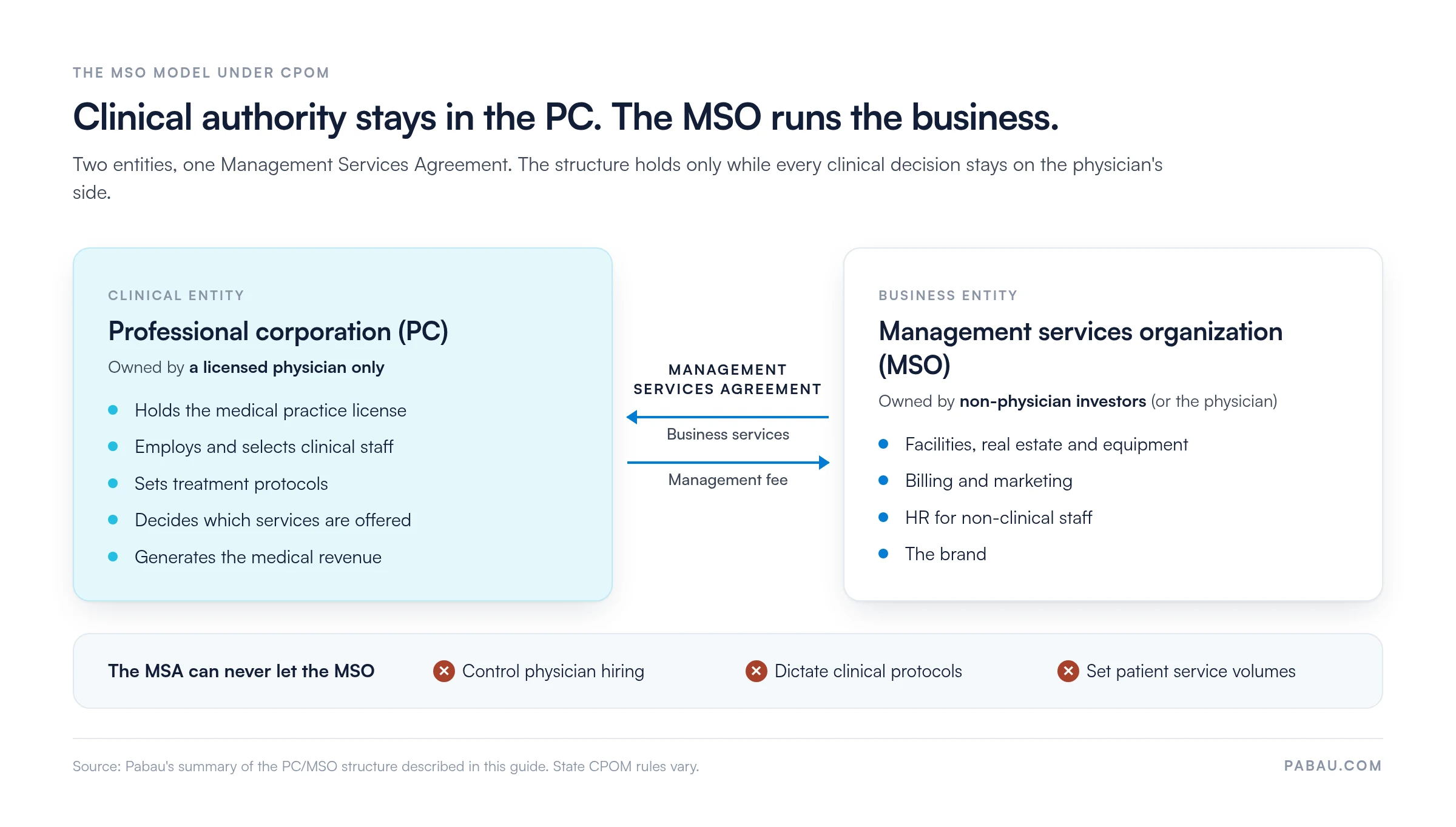
An MSA that lets the MSO control physician hiring, dictate clinical protocols, or set patient service volumes crosses into CPOM violation territory. However, the label on the entity does not change that.
MSO structures are permitted in most states but scrutinized carefully. Therefore, courts and medical boards look past the entity labels to the substance of the arrangement. If the PC exists in name only and the MSO controls clinical operations, the structure fails.
Med spas occupy a complicated position under the corporate practice of medicine framework, and the issue turns on which services the business offers. By contrast, non-medical aesthetic services such as facials, waxing, and non-laser exfoliation typically fall outside CPOM’s scope. Once a med spa adds services that need physician involvement, prescriptions, or supervision, CPOM applies directly.
Services that commonly trigger CPOM requirements in strict states include:
Consider a non-physician who opens a California med spa offering injectables without physician ownership or a compliant PC structure. Besides, the exposure goes well beyond a fine, to voided clinical employment contracts and potential criminal liability for unlicensed practice. See med spa compliance requirements for a broader breakdown of the obligations aesthetic businesses face.
The usual compliance path for a non-physician med spa founder has three parts. First, form a physician-owned PC as the clinical entity and enter an MSO agreement for business operations. Then make sure a qualified medical director holds hands-on oversight of clinical services. Hiring a medical director for your med spa therefore carries significant legal weight.
CPOM violations generally fall into four categories, each carrying distinct risks:
Penalties vary significantly by state, but they can include:
Moreover, contract voidability is particularly damaging for investors. In fact, it can render the entire business structure unenforceable, with no compensation mechanism.
Document every clinical decision independently. If your medical director is reviewing treatment protocols, records audits, and hiring clinical staff, keep timestamped records of that involvement. A well-documented audit trail is what separates a defensible MSO structure from one that collapses under board scrutiny.
CPOM compliance needs ongoing structural discipline long after the entities are formed. These steps apply whether you are launching a new practice or reviewing an existing arrangement:
The National Conference of State Legislatures tracks CPOM legislation across jurisdictions. It is a useful starting point for checking whether your state has recent statutory changes relevant to your practice type.
Software cannot make a structure compliant, but it can produce the evidence a structure depends on. When a medical board or a contract dispute asks who held clinical authority, the answer has to come from records. Pabau, the practice management platform we build, keeps those records on each patient file.
For a med spa running under an MSO, that means the physician’s oversight is on file before anyone asks for it. If you are comparing platforms, our guide to medical spa EMR software covers what to look for. You can also see how Pabau works as medical spa software across booking, records, and billing.

Pabau’s audit trails, role-based permissions, and prescriber-only approvals put clinical authority on record. Your PC and MSO teams each see only what their role needs.

Planning to offer injectables, lasers, IV therapy, or prescription weight loss? Settle your ownership structure before you sign a lease or hire a provider. In a strict state like California or Texas, a non-compliant arrangement can void contracts, trigger license actions, and unwind years of investment.
A physician-owned PC paired with an MSO works when the physician’s authority is hands-on and written down. However, the trade-off is control. Specifically, investors give up any say over clinical hiring, protocols, and volumes in exchange for a structure that survives scrutiny. Finally, build the records that prove that split from day one, and review them with counsel every year.
Book a demo to see how Pabau keeps physician oversight on record for your practice.

Need a compliance checklist for your med spa? Medical spa compliance checklist covers the core regulatory requirements aesthetic businesses must meet.
Considering an MSO structure for your practice? MSO for med spas explains how the management services model works in practice for aesthetic businesses.
Opening a med spa in a strict CPOM state? Medical spa license in California walks through the licensing and ownership rules in one of the strictest states.
Running a med spa in Florida? Who can own a med spa in Florida explains the ownership rules in a state with lighter CPOM enforcement.
Comparing rules across states? Med spa laws by state summarizes the supervision and ownership requirements state by state.
The corporate practice of medicine doctrine is a state-law prohibition on non-physicians owning a medical practice, directly employing physicians, or controlling clinical decisions. Its purpose is to ensure that licensed physicians retain clinical independence and that patient care decisions are not driven by commercial interests. Many US states recognize the doctrine in some form, though its strength varies significantly by state.
California, Texas, New York, Colorado, and Illinois are among the states with the strictest enforcement. California’s prohibition is rooted in the Business and Professions Code and has been reinforced through decades of judicial decisions. Texas enforces the doctrine through its Occupations Code and medical board rules. Both states recognize contract voidability as a consequence of CPOM violations, meaning employment agreements with physicians can be found unenforceable.
Penalties depend on the state and the severity of the violation. They typically include physician license suspension or revocation and civil fines imposed by the state medical board. Contract voidability can also apply, making employment or service agreements unenforceable from the start. In cases involving unlicensed practice of medicine, criminal charges are also possible.
Med spas offering prescription-based injectables, laser procedures, IV therapy, or weight management medications are subject to CPOM requirements in strict states. A non-physician cannot simply open a med spa and offer these services without a physician-owned entity structure. The standard solution is a physician-owned PC for clinical operations paired with an MSO for business operations. A medical director must also exercise hands-on, not nominal, clinical oversight.