Ethical consent form: free template and what to add
An ethical consent form is a written record that a patient or participant agreed...

2
Last Updated: Oct 26, 2026
Can a nurse open a med spa in Texas? Yes, but only the business half of it. A Texas nurse can own the management services organization (MSO) that runs the med spa. A licensed physician must own the clinical entity that delivers the treatments.
Texas treats botulinum toxin, dermal fillers, laser treatments, IV therapy and GLP-1 injections as the practice of medicine. That puts the clinical side under a physician-owned entity, whatever your nursing credential. The business side is still yours.
You will meet the phrase “corporate practice of medicine” everywhere, and it is rarely tied to the sections that do the work. This guide names them as the statutory chain. It also covers the ownership route Texas gives physician assistants but not nurses, and the delegation rule that breaks a nurse practitioner’s staffing plan.
One housekeeping note before you start. If your protocols still cite 22 TAC §193.17, they cite a rule the Texas Medical Board repealed in January 2025.

A Texas nurse can open and own the business side of a med spa, but not the clinical entity that performs treatments.
The statutory chain behind that answer runs through Occupations Code §155.001 and §165.156, and Business Organizations Code §301.007.
The lawful route is an MSO you own, a physician-owned PLLC, a management services agreement, and the physician’s written delegation orders.
Texas gives physician assistants a minority stake in a physician’s professional entity, and does not extend that route to nurses.
A nurse practitioner owner cannot write the standing delegation orders their own RN injectors work under, so a physician still has to.
The Texas Medical Board repealed 22 TAC §193.17 on January 9, 2025, and moved cosmetic delegation into §§169.25 through 169.28.
No nursing license in Texas permits owning the entity that delivers medical treatments. That holds for a licensed vocational nurse, a registered nurse, and an advanced practice registered nurse alike.
Texas has no single statute called the corporate practice of medicine doctrine. It sits across several provisions of the Medical Practice Act, and together they close the door:
Section 157.001 is the provision a med spa runs on. Delegation is the only lawful route by which a non-physician puts a needle in a patient’s face in Texas. It runs from the physician outward, and it never transfers ownership of the medicine.
The final link in the statutory chain sits in the Business Organizations Code, not the Medical Practice Act. A physician’s practice is a professional entity, either a professional association (PA) or a professional limited liability company (PLLC).
Two provisions decide who may hold a stake in one. Section 301.007(a) says a person may own a professional entity only if that person is an authorized person. Section 301.003(5) defines the qualifying individual as someone licensed to provide the same professional service the entity provides.
A registered nurse is not licensed to practice medicine. So an RN is not an authorized person for a medical PLLC, and the same reasoning covers an LVN and a nurse practitioner. Section 301.012(a-4) removes any doubt, requiring that an organizer be a physician and that physicians control and manage the entity.
Nurses are not shut out of the practice altogether. Section 301.006(d) says the rule may not be read to stop a professional entity from employing nurses. The clinical entity can pay you a salary. It cannot sell you a share.
Texas does carve out one non-physician ownership route, and nurses are not in it. Under §301.012(a-1), physicians and physician assistants may jointly form and own a PA or PLLC. Subsections (a-2), (a-3), and (a-6) cap it tightly:
Advanced practice registered nurses appear nowhere in that provision. Articles that group nurse practitioners and physician assistants together as permitted minority owners are reading a statute that names only one of the two.
Under 22 TAC §169.25, cosmetic injections, colonic irrigation, and cosmetic use of a prescription medical device are medical acts that a physician delegates and supervises. The rule calls them nonsurgical medical cosmetic procedures.
In practice, that captures most of a profitable treatment menu:
The last two carry an extra layer. Semaglutide and tirzepatide are prescription drugs, so each patient needs a prescriber’s order as well as a delegated injector. IV drips mix prescription fluids and additives, which puts them in the same position.
Elective IV therapy also gained its own statute in 2025. House Bill 3749, known as Jenifer’s Law, took effect on September 1, 2025. It regulates elective intravenous therapy specifically, and leaves the framework for neurotoxins and fillers unchanged.
Facials, manicures, and non-laser skincare sit elsewhere. That side of the menu falls under cosmetology rules administered by the Texas Department of Licensing and Regulation.
To open a med spa as a nurse in Texas, you set up two companies: an MSO you own and a physician-owned PLLC. A management services agreement and the physician’s written delegation orders join them.
The clinical entity employs the treating providers, holds the patient records, and makes every treatment decision. Your MSO owns the business a med spa needs in order to trade. Here is how to open a med spa as a nurse in Texas, step by step:
The diagram below shows how the two companies divide the work, and which way the delegation runs.
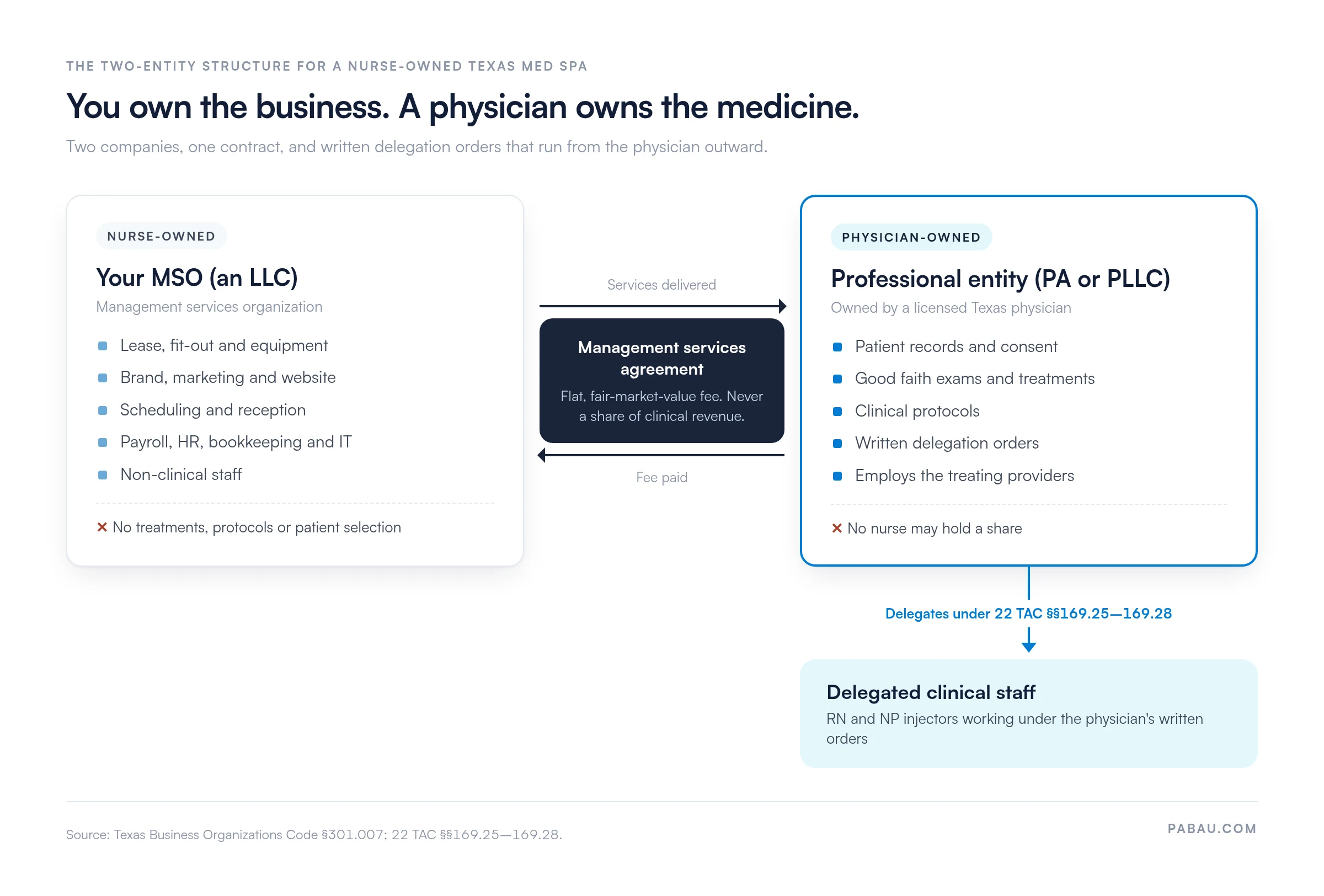
The dividing line is clinical judgment. Your MSO can hold the lease, the equipment, the brand, and the staff who never touch a patient clinically:
What the MSO must stay out of is narrower and firmer. It cannot:
The patient records belong to the clinical entity, not to your management company. A signed dermal filler consent form, for example, is the physician entity’s document, even when your front desk collects it.
Your MSO still touches patient data through scheduling and billing. Where the physician’s entity is a HIPAA covered entity, the MSO acts as its business associate and signs a business associate agreement.
Regulators read the substance of the arrangement rather than the labels on it. An MSA drafted from a generic template is where most of the risk collects:
Percentage-of-revenue fees concentrate the exposure. If the number is not defensible as fair market value, it starts to look like fee-splitting. Federal risk under the Anti-Kickback Statute sits behind that, on top of the state question.
Four Texas bodies regulate a nurse-owned med spa, and they do not coordinate with each other:
Satisfying one board does not satisfy another. A physician can lawfully delegate a procedure that your nursing license still does not allow you to perform. Both tests have to pass on the same patient, on the same day.
Ownership and scope are two separate questions, and the answers diverge by license. The table sets them side by side, with the provision that draws each limit.
| License | Can own the clinical entity? | Can inject under delegation? | Can prescribe? | The limit that bites | Legal basis |
|---|---|---|---|---|---|
| Licensed vocational nurse (LVN) | No | No | No | A directed scope requiring supervision, and injectables call for judgment beyond it | BON Position Statement 15.11 |
| Registered nurse (RN) | No | Yes, with training and written orders | No | No medical diagnosis and no prescribing | Occupations Code §301.002; BON Position Statement 15.11 |
| Nurse practitioner (APRN) | No | Yes | Yes, under a prescriptive authority agreement | Cannot write standing delegation orders for other staff | Occupations Code §157.0512; BON Position Statement 15.11 |
| Physician assistant (PA) | Minority stake only | Yes | Yes, under a prescriptive authority agreement | Cannot be an officer, or employ the supervising physician | Business Organizations Code §301.012(a-1) to (a-6) |
| Physician (MD or DO) | Yes, up to 100% | Yes | Yes | Remains responsible for every act delegated to staff | Occupations Code §157.001 |
| Esthetician | No | No | No | Cosmetology scope, with no medical procedures | Occupations Code Chapter 1603 (TDLR) |
The Texas Board of Nursing publishes no list of approved procedures. It expects you to reason the question through its Scope of Practice Decision-Making Model instead. Two nurses can therefore reach different answers on the same treatment.
Position Statement 15.11 draws the firmest line. RNs without APRN licensure, and LVNs, may not engage in acts of medical diagnosis or prescription of therapeutic or corrective measures. Those acts require independent medical judgment.
Position Statement 15.9 covers lasers. A nurse may deliver nonablative laser therapy with documented education in laser safety, a valid order, and medical backup on hand.
The order has to come from a physician, or from an APRN working in collaboration with one. Medical backup matters because treating a bad outcome falls outside nursing scope.
An RN can open a med spa in Texas as the owner of the MSO, but cannot own the clinical entity or prescribe.
Inside that structure, an RN can inject neurotoxins and fillers after documented training, under the physician’s written orders. What an RN cannot do is diagnose, choose the treatment plan alone, or write the orders other staff work under.
So the practical answer to “can an RN open a med spa in Texas?” is yes, with a physician partner signed before the first patient books. The RN owner runs the business and treats patients. The physician owns the medicine and the delegation behind every injection.
A nurse practitioner can open a med spa in Texas on the same MSO terms as any other nurse, and cannot own the clinical entity. Advanced practice does not change the ownership answer.
Can an NP open a medical spa in Texas without any physician involved? No. Texas is not a full practice authority state. An NP who prescribes needs a written prescriptive authority agreement (PAA) with a delegating physician under Occupations Code §157.0512.
That agreement covers most injectables, weight-loss prescribing, and IV formulations on a med spa menu.
The same statute caps the physician’s side of the arrangement. One physician may hold prescriptive authority agreements with no more than seven advanced practice registered nurses and physician assistants combined, counted as full-time equivalents. That ceiling shapes how many locations a single delegating physician can realistically carry.
An NP owner needs a delegating physician because Texas bars APRNs from writing the standing delegation orders their own RN injectors work under. Position Statement 15.11 says APRNs cannot create standing delegation orders for others to engage in medical aspects of care.
The Board’s own summary is blunter. What a physician delegates to an APRN cannot then be delegated onward by that APRN to someone else.
Read that against a staffing plan and the consequence is concrete. An NP owner who hires two RN injectors cannot write the orders those RNs inject under. A physician has to.
So your medical director’s work doesn’t end once the setup paperwork is signed. Every RN on your treatment floor injects under that physician’s orders, every day you are open.
Your medical director, the delegating physician, must ensure a good faith exam, sign written orders, and stay reachable for emergencies under 22 TAC Chapter 169.
The Texas Medical Board rewrote this framework in January 2025. It repealed 22 TAC §193.17 and moved the substance into §§169.25 through 169.28, effective January 9, 2025.
Rule §169.26 sets the general standards. Before a delegated act happens, a physician, physician assistant, or APRN acting under delegation must:
Each of those duties leaves a document behind. The good faith exam produces a signed assessment, and the disclosure puts a named treating provider on the record.
The same rule settles the on-site question that first-time owners ask most. The physician, PA, or APRN is either on site during the procedure, or immediately available for emergency consultation.
Where the second route applies, the physician must still be able to conduct an emergency appointment with the patient.
Rule §169.27 requires written orders, developed, reviewed, and approved by the delegating physician, describing care for injuries, complications, and emergencies. Rule §169.28 handles disclosure.
Your medical director’s name and Texas medical license number go in each public area and treatment room, beside the mandatory complaint notice. Staff name tags carry credentials. Our guide to choosing a medical director in Texas covers how to vet a candidate and structure the contract.
Two citations are worth checking before you copy a compliance checklist off the internet. Protocols citing §193.17 point at a repealed rule. The substance carried across, but a stale number tells a reviewer your documents have not been maintained.
The second is Senate Bill 378, which some 2026 articles present as a new Texas law on cosmetic injections. It is not law. The bill passed both chambers and the governor vetoed it on June 2, 2025, so the TMB’s Chapter 169 rules remain the framework.
Opening as a nurse in Texas means funding two entities plus a monthly medical director retainer, on top of equipment that usually dominates the budget.
The only fixed figures are the state filing fees, published on the Texas Secretary of State forms page. Every other line depends on quotes, so the table names who carries each cost and what moves it.
| Cost item | Which entity carries it | What drives the amount | Figure |
|---|---|---|---|
| MSO certificate of formation | Your MSO | One-time state filing for an LLC | $300 (Form 205) |
| Clinical entity certificate of formation | Physician’s PA or PLLC | Entity type the physician chooses | $300 for a PLLC (Form 206), $750 for a PA (Form 204) |
| Healthcare attorney | Usually your MSO | MSA, delegation orders, and the size of the treatment menu | Varies, quote from a Texas healthcare attorney |
| Medical director retainer | Physician’s PA or PLLC | Hours on site, number of delegated providers, and metro area | Varies, quote from the physician |
| Equipment and fit-out | Your MSO | Treatment menu, lasers above all | Varies, quote from device vendors |
| Laser registration | The entity that holds the device | Number and class of lasers | Varies, see the DSHS Radiation Control fee schedule |
| Insurance | Both entities | Malpractice for clinical work, general liability and property for the MSO | Varies, quote from a broker |
A lean, injectables-led build sits far below a device-heavy one, because equipment usually dominates the total. A single quality laser platform can reach six figures on its own.
The line first-time owners underestimate is the medical director retainer. Industry figures for an engaged Texas physician commonly sit in the low thousands of dollars a month. Houston, Dallas, and Austin cost more than secondary markets.
Treat a retainer priced like a software subscription as a warning. Rule §169.26 asks for a physician who is available when needed, and a fee that cheap usually buys a signature instead.
Insurance splits the same way the companies do, and our guide to med spa insurance breaks down the policy types. Put every line into a med spa business plan before you sign a lease. The attorney and the retainer both arrive before the first patient does.
The expensive mistakes are structural, and they tend to surface during a complaint investigation rather than a routine inspection:
Your nursing license is the asset most exposed here. The Board of Nursing can act on your practice under Position Statement 15.14. That statement puts your duty to promote a safe patient environment above an employer’s policy or a physician’s order.
A two-entity structure doubles the paperwork one front desk has to keep straight. The clinical record belongs to the physician’s entity, while your marketing, scheduling, and payments run through the MSO. Both sides have to be defensible if the Texas Medical Board asks a question.
When we onboard a practice running this two-entity model, our first setup question is simple. Which entity’s name goes on the patient record and the consent forms? Pabau, our software for med spas, then keeps the clinical half in one place. Each of these attaches to the same patient record:
That is what rules §169.26 and §169.28 ask you to evidence. When a record must show who performed a procedure and under whose order, Pabau shows the answer on the appointment itself. Pabau Scribe, our AI scribe, drafts the treatment note so your provider finishes charting in the room.
Patients complete forms and consents through the online booking portal before they arrive, so your team does not rekey them by hand. Your front desk stops chasing signatures between patients, and you get to finish the day on time.


Pabau ties consent forms, good faith exam notes, treating-provider details, and injection batch numbers to one patient record. Your delegation paperwork stands up without a second filing system.

In Texas, getting the structure right is most of the work. Draw the physician-owned entity and your MSO properly, then match the delegation paperwork to the treatment menu. After that, a nurse-owned med spa trades like any other business you own.
What that structure buys is narrower than it first appears. It buys you the business, the brand, and the profit from running it well. It does not widen your license, and it does not make your delegating physician optional.
Pay a Texas healthcare attorney to draft the MSA and the delegation documents together. That fee is small beside the cost of a complaint investigation that reaches your nursing license.
Book a demo to see how Pabau keeps consent, charting, and treating-provider records straight across a physician-owned practice and your management company.

Opening in California instead? Can a nurse open a med spa in California compares the ownership caps and the professional corporation rules that apply there.
Need to find and vet the physician? Medical director for a med spa in Texas covers what the role involves, what it costs, and how to structure the agreement.
Working through the permits next? Texas med spa licensing laws lays out the licenses, registrations, and board requirements in order.
Want the launch steps in sequence? How to open a med spa as a nurse walks the ten steps from credential check through to opening day.
Checking who else can hold a stake? Who can legally own a med spa in Texas breaks down physician ownership, MSOs, and the entity types Texas allows.
An RN in a Texas med spa can inject neurotoxins and fillers as delegated treatments, after documented training and under a physician’s written orders. Board of Nursing Position Statement 15.11 bars an RN from diagnosing, prescribing, or writing standing orders. Ownership is a separate question, and an RN can open a med spa in Texas only as the owner of the MSO.
No. Board of Nursing Position Statement 15.11 bars LVNs from acts of medical diagnosis or prescription of therapeutic or corrective measures. Those acts require independent medical judgment, and cosmetic injecting sits on the wrong side of that line. An LVN scope of practice is a directed one requiring supervision, and a written protocol from a physician does not extend it.
Not at all times. Rule 22 TAC §169.26 gives two options. The physician, physician assistant, or APRN is on site during the procedure, or immediately available for emergency consultation. Where the second route is used, the physician must still be able to conduct an emergency appointment. Someone trained in basic life support has to be present while the patient is on site.
No. The Texas Board of Nursing states that APRNs cannot create standing delegation orders for others to engage in medical aspects of care. What a physician delegates to an APRN cannot be delegated onward to another person. So an APRN who owns a med spa needs a delegating physician to write the orders their RN injectors work under. The APRN can still prescribe under their own prescriptive authority agreement.
A nurse with a Doctor of Nursing Practice can open a Texas med spa on the same terms as any nurse practitioner. The doctorate is an academic degree, not a license to practice medicine. It does not make a DNP an authorized owner of a medical professional entity under Business Organizations Code §301.007. The DNP owns the MSO, and a physician owns the clinical side.
Whether an NP can own a med spa depends on each state’s corporate practice of medicine rules, not on full practice authority alone. Some states let non-physicians own a medical practice, while others, including Texas and California, require physicians to own or control the clinical entity. In Texas, an NP can open a medical spa through an MSO but cannot own the clinical side. Check the state’s medical board rules and business entity statutes before you form either company.
Industry figures put an engaged Texas physician in the low thousands of dollars a month, with Houston, Dallas, and Austin at the higher end. The fee should be a flat amount reflecting fair market value for the work, never a share of treatment revenue. A retainer priced like a software subscription is a warning sign, because Chapter 169 expects a physician who is available when needed.
No. The Texas Medical Board repealed §193.17 and relocated its content to §§169.25 through 169.28, effective January 9, 2025. The delegation framework carried across largely intact, so the substance of your obligations has not changed much. Protocols that still cite the old number should be updated, since a stale citation suggests to a reviewer that the documents have not been maintained.