Facial skin treatment consent form template: Microneedling and phi-ion
A facial skin treatment consent form is the signed proof that a patient was scre...

2
Last Updated: Oct 21, 2026

Every LPN hire starts with an active state license, proof of a state-approved practical nursing program, and a passed NCLEX-PN exam.
What an LPN may legally do in a med spa varies sharply by state, so check the comparison table before you write the job description.
Texas lets LVNs inject under physician supervision, while Arkansas, Arizona, California, and Nevada keep injectables outside LPN scope.
Hiring runs in six steps: define the role, post it, screen resumes, interview, verify credentials, then make a competitive offer.
Practice management software like Pabau stores each license and certification on the staff profile and limits which treatments that member can be booked for.
A med spa runs without a Licensed Practical Nurse (LPN). Whoever handles the paperwork will work in a charting system like those in our ranking of the top med spa software. A med spa without an LPN just runs harder, because your injectors end up doing the prep, the aftercare, and the paperwork between appointments.
An LPN takes that work off them. They room patients, take histories, handle post-treatment care, and keep the documentation current.
Hiring one takes more than a resume check.
Three things have to line up, in this order:
That middle step is where most of the risk sits, because scope of practice swings hard from one state line to the next. A Texas LVN can inject botulinum toxin under a physician’s supervision. Two states over, the same qualification will not let them near a syringe.
Below you’ll find the credentials to look for, a state-by-state scope comparison, and the six-step hiring process.
An LPN needs an active license from your state’s Board of Nursing and proof of a state-approved practical nursing program. They also need training for the specific procedures you plan to assign. And your state has to allow an LPN to perform those procedures at all.
Those three requirements stack. A perfect resume is worthless if the state rules out the work.
Every LPN reaches licensure through the same route, so this part is quick to verify. Here are the credentials to ask for before anything else:
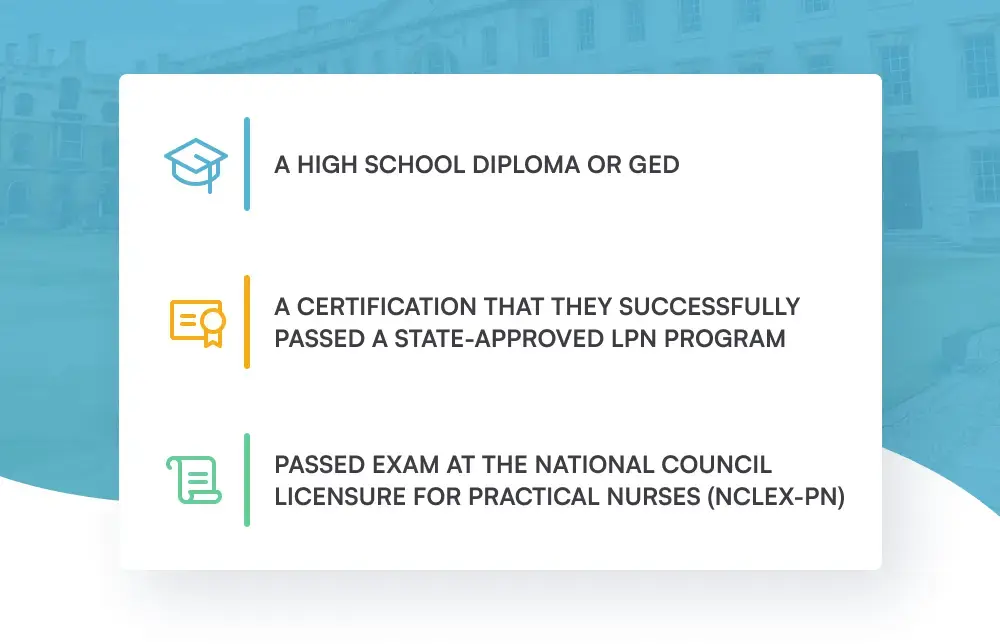
Ask for the NCLEX-PN result and the program certificate as documents, not as line items on a resume. You will need copies on file anyway.
In the US, nursing is a licensed profession, and each state runs its own Board of Nursing. That board sets the rules, issues the license, and decides which aesthetic procedures an LPN may perform.
The differences are not subtle. In Arkansas, the Nursing Board states that performing aesthetic procedures is not within the scope of practice for LPNs.
In Arizona, LPNs can’t perform injectables. They count as Level III (Advanced) procedures and must be done under the supervision of a licensed independent practitioner with specialized training.
Meanwhile, LPNs (LVNs) working under Texas med spa rules can perform medical procedures under a physician’s supervision, including injectables like Botox and dermal fillers.
Five states, five different answers. A “no” on injectables does not mean a “no” on aesthetics. Nevada and California draw that line in completely different places.
Rules change, so treat this as a starting point and confirm with your own Board of Nursing before you post the role.
The California position comes from the American Med Spa Association, which reports that LVNs cannot inject, use light-based devices, or provide microdermabrasion. Supervising physicians face discipline too.
Nevada is the most detailed of the five. Its Board of Nursing publishes a procedure-by-procedure grid approved in January 2025. LPNs are cleared for a long list of device and peel work under direct supervision. Neuromodulators and dermal fillers sit outside their scope.
That grid is the practical lesson here. Write the job description around the procedures your state permits, then hire for those. Not the other way around.
The same state-by-state logic governs who may own the business. Under California’s licensing laws, whether a nurse practitioner can open a med spa turns on corporate practice of medicine rules, not nursing scope.
Before hiring, run these three checks:
Put license checks on the same schedule as the rest of your compliance checks. A pre-hire file that nobody reopens is how an expired license slips through.
A license proves an LPN can nurse. It does not prove they can run a laser. Procedure-specific training comes from accredited courses, workshops, or supervised hands-on programs.
The American Society of Plastic Surgical Nurses (ASPSN) offers certification exams that validate a nurse’s expertise. Look for credentials in fields like:
Match the certificates to the treatments on your menu. A candidate certified in peels adds nothing to an injectables-heavy schedule, and states like Nevada tie clearance to each individual procedure.
An ideal LPN candidate is the full package. They’re skilled, warm with patients, and a good fit for your med spa culture.
That’s why, during the interview, focus on their qualities, such as:
One more to weigh: comfort with the scope limits of the role. An LPN who wants to inject, in a state that won’t allow it, will not stay long.
Six steps take you from an open role to a signed offer. Define the role, post it, screen resumes, interview, verify credentials, then make the offer.
Here’s what each one involves.
Start by writing down the procedures you want covered, then cross off anything your state won’t let an LPN perform. What’s left is the actual role.
Some of what’s left may suit an esthetician instead. Facials, peels, and skin care consults often sit in that bracket, so decide which role you are really filling.
Those four answers become the job description. Anything you can’t answer yet will read as vague in the posting.
Crafting a job description is like setting up an appealing med spa storefront. If it isn’t clear and eye-catching, no one will stop and look. Here are the key elements to include:
Name the procedures the role does and doesn’t include. Applicants self-select, and you stop wasting interview slots on injectors you can’t legally use.
Once the posting is live, the resumes and cover letters start arriving. Shortlist the candidates who meet your criteria by:
Check the license number against the state board register at this stage, not after the offer. It takes two minutes and removes the worst surprises.
Decide who will conduct the interview: the hiring manager, lead nurse, spa owner, or a combination. Involving multiple perspectives helps assess fit while reducing individual bias.
Start with an icebreaker question that is light and open-ended, such as:
“What inspired you to pursue a career as an LPN?”
Then move on to the LPN interview questions that show how the candidate thinks, such as:
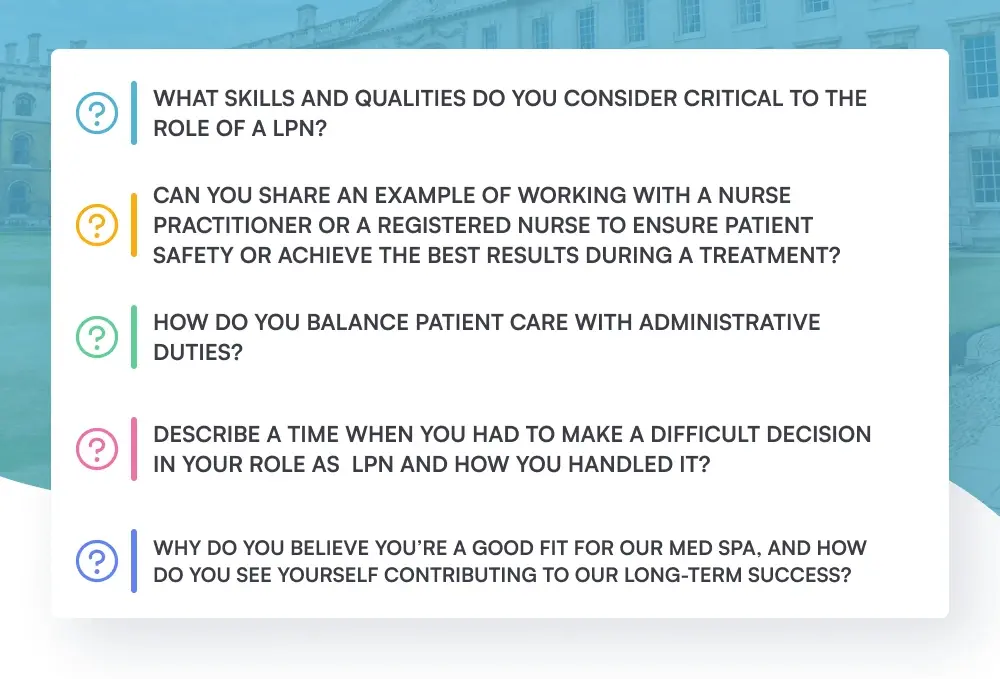
Describe a fully booked Saturday, then watch how the candidate reacts. Posture, eye contact, and comfort level tell you more about how they handle a busy treatment day than any rehearsed answer will.
Verify every document against the issuing body rather than the candidate. Nursing schools, training centers, and the state board will all confirm or deny in writing.
You can also run a criminal background check for healthcare-related offenses, such as fraud, abuse, neglect, or drug charges. The Fair Credit Reporting Act requires written permission first, so have the candidate sign a background screening consent form before you order it.
One step often runs alongside this one. Most states that let an LPN perform aesthetic procedures require a supervising physician to order and oversee them.
So if you don’t already have that oversight in place, add it to the plan. Learning how to hire a medical director matters as much as vetting the LPN. The LPN’s legal scope depends on that supervision existing.
To close out the hiring process for an LPN, offer a competitive salary.
Nursa reports the national average is $67,050 annually or $32.24 per hour. However, local factors can impact pay rates.
Check local job boards, and compare your number against what aesthetic nurses earn. That is what your offer competes with.
But a competitive offer isn’t just about the paycheck. It should also include some benefits to make your med spa stand out, such as:
Also, be upfront about job expectations. Let candidates know what shifts they’ll work, the types of patients they’ll care for, and whether you need weekend cover.
Spell out the scope of the role in the offer letter too. It sets expectations, and it gives you a written record of what the LPN was hired to do.
Hiring is the easy half. Once your LPN starts, someone has to keep proving they’re still licensed and still trained for every procedure they perform.
Licenses renew on a cycle. Certifications lapse. Boards update their scope decisions, as Nevada did in January 2025. In a shared spreadsheet, none of that surfaces until an audit or an incident forces it.
Pabau is an all-in-one practice management system for US med spas. Every team member gets a staff profile that holds the paperwork behind their scope:
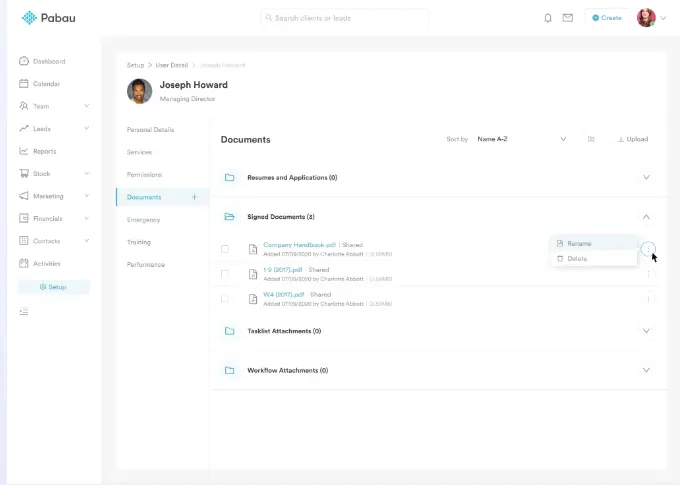
The Services setting is the one that matters most for a scope-limited LPN. Configure it once and your calendar and online booking can only assign them treatments they’re cleared to do. The same control decides who may operate each device in a laser practice.
Everything else follows from having the team in one system. Schedule shifts, track commission, and pay staff without a second spreadsheet. Run a quarterly license review as one screen per person, rather than an email hunt.

Pabau stores each team member’s license, certifications, and bookable treatments on one staff profile. Your front desk can only book procedures that practitioner is cleared to perform, so scope limits hold without anyone remembering them.

The expensive mistake in LPN hiring is taking on someone your state won’t allow to perform the work you hired them for. A personality mismatch is far cheaper to fix.
So run the scope check first. Read your Board of Nursing’s own position on aesthetic procedures, decide what the role can legally cover, then write the job description around that answer. Everything downstream gets simpler.
The trade-off is speed. Verifying a license with the board and calling two references adds a week to your timeline. That week costs far less than a board complaint or a lapsed certificate found during an inspection.
Get the vetting right once, then keep the evidence somewhere you can find it. Book a demo to see how Pabau keeps every practitioner’s license, training, and bookable treatments on one staff profile.

Wondering who may own the business? Who can open a medical spa breaks ownership rules down state by state, including NP and PA structures.
Adding Venus Freeze to your treatment menu? Venus Freeze consent form gives you a free consent and medical history template, plus the FDA clearance limits.
Planning a nurse-led practice in California? Can a nurse open a med spa in California covers the 49% ownership cap and what AB 890 changed.
Curious who is shaping the aesthetics field? Leading aesthetics experts profiles practitioners driving education as rules on who can practice tighten.
Staffing more than one location? Multi-location med spa management covers scheduling, oversight, and consistency across sites.
Yes, in every state, though what they may do varies widely. Some states allow injectables under physician supervision. Others limit LPNs to patient prep, post-treatment care, and documentation. Read your Board of Nursing’s own position on aesthetic procedures before you write the job description.
Only where the state allows it, and only under supervision. Texas lets LVNs administer botulinum toxin and dermal fillers as delegated medical acts. Arkansas, Arizona, California, and Nevada keep injectables outside LPN scope, whatever training the candidate holds.
Scope and supervision. In most states an RN’s scope covers more aesthetic procedures, often including injectables on a physician’s order. An LPN usually works from a shorter procedure list and closer oversight. Both still need procedure-specific training on top of the license.
Search your state Board of Nursing’s online license register by name or license number. It shows whether the license is active, when it expires, and any disciplinary action. Do this before the offer rather than after, and keep a copy on file.