HIPAA compliant texting: What you can send patients & how to communicate securely
HIPAA compliant texting is possible when a text holds no protected health inform...

Last Updated: Oct 16, 2026

Every EHR is an EMR, but not every EMR is an EHR.
An EMR keeps clinical data inside one practice, while an EHR is built to share it across providers.
Monthly exchange volume, your referral pattern, and your growth plans decide which system you need.
Above roughly 10 to 15 outside clinical exchanges a month, full EHR capability earns its cost premium.
ONC certification, not the EMR or EHR label, is what guarantees USCDI and FHIR data exchange.
An EMR holds a patient’s clinical record inside one practice. An EHR holds the same record and is built to move it between providers. Portability is the whole difference, and it drives cost, certification, and daily workflow.
So the decision is narrower than the definition makes it look. You are choosing whether your practice needs to send and receive structured clinical data, or whether documenting internally is enough. The checklist below settles that in three questions.
A solo physical therapy practice tracking treatment progress runs fine on EMR functionality. A multi-location aesthetic practice coordinating care with referring physicians needs EHR capabilities. That line decides vendor choice, implementation cost, and migration risk.
The naming is historical. According to HealthIT.gov, the EMR term came first and described clinical diagnosis and treatment. The word “health” points to the broader condition of being sound in body and mind. Because there are various types of EHR systems on the market, the label on the box tells you less than the certification behind it.
Three factors settle the choice: Your monthly outside-exchange volume, your referral pattern, and your growth plans.
Start with the count, because it settles most cases. Track how often you send or receive clinical information from an outside provider across a full month.
Above 10 to 15 exchanges, EHR interoperability earns its cost premium. Below that, a strong EMR with secure messaging covers the same ground for less.
The referral pattern is the second test. A practice receiving surgical notes, imaging reports, and post-operative restrictions is already doing EHR work by hand.
Growth is the third factor. Migrating from an EMR to a certified EHR later means data conversion, workflow redesign, and staff retraining. Paying for that twice is the expensive route.
The matrix below maps five practice profiles onto an answer.
| Practice profile | System that fits | Why |
|---|---|---|
| Solo or single-location practice with no outside coordination | EMR | Notes, consent, photos, and inventory all stay in-house, so certification adds cost without adding capability. |
| Fewer than 10 to 15 outside clinical exchanges a month | EMR plus secure messaging | Manual transfer at that volume still costs less than interface maintenance and HIE participation fees. |
| Referral-dependent specialty such as physical therapy or dermatology | EHR | Surgical notes, imaging reports, and post-operative restrictions arrive as structured data instead of faxes. |
| 10 or more providers across multiple locations | Enterprise-grade EHR | Centralized administration and reporting need one record set that every site can write into. |
| Planning expansion, a merger, or health system affiliation | Certified EHR from the start | Converting data and retraining staff mid-growth costs more than certifying up front. |
One row usually decides it. If two rows apply and disagree, the exchange count is the tiebreaker.
An electronic medical record stays with the practice that created it. An electronic health record is designed to be read by every provider treating that patient.
Four axes carry the difference between electronic health records and electronic medical records. The table below puts them side by side, with the full detail in the sections that follow.
| Axis | EMR | EHR |
|---|---|---|
| Data scope | One practice’s own records | Records from every provider treating the patient |
| Interoperability standard | Foundational exchange, with no mandated standard | USCDI Version 3 and FHIR-based APIs under ONC certification from January 2026 |
| Typical monthly cost | $50-200 for a solo practitioner | $300-1,000+ per provider, plus $5,000-50,000 to implement |
| Governing certification | HIPAA only, with no further certification | HIPAA plus ONC Certified EHR Technology (CEHRT) |
Read the certification row first. Vendors use electronic health record and electronic medical record almost interchangeably in their marketing. ONC validation is the line that separates them reliably.
An EMR captures the information generated inside one provider’s practice. It stores medical history, diagnoses, medications, immunization records, laboratory results, and clinician notes. Searchable digital records replace paper charts, so practitioners can track a patient over time and see when a screening is due.
The data stays where it originated. A physical therapy practice’s EMR does not automatically share treatment notes with the patient’s primary care physician.
EHRs reach past a single practice. They combine information from multiple providers into one view of a patient’s health. When a dermatologist documents a skin cancer diagnosis in an EHR, the primary care physician can open that record immediately.
EHRs also support patient portals where people view their history, request refills, and message their care team. That interoperability is the functional boundary between the two system types.
The consequence shows up in referral traffic. An EMR-only practice faxes records or prints summaries for specialists. An EHR-enabled practice sends the same information as structured data through a certified interface.
Every EHR is an EMR, but not all EMRs are EHRs. The hierarchy reflects architecture. EMR systems focus on clinical documentation inside a closed environment, while EHRs add Health Information Exchange (HIE) capabilities.
HIE infrastructure moves data securely between disparate systems using standardized protocols. Without it, practices fall back on printing records, scanning documents, or re-entering information by hand.
Interoperability is not one capability but three levels, and where a system stops on that ladder decides how much manual work is left.
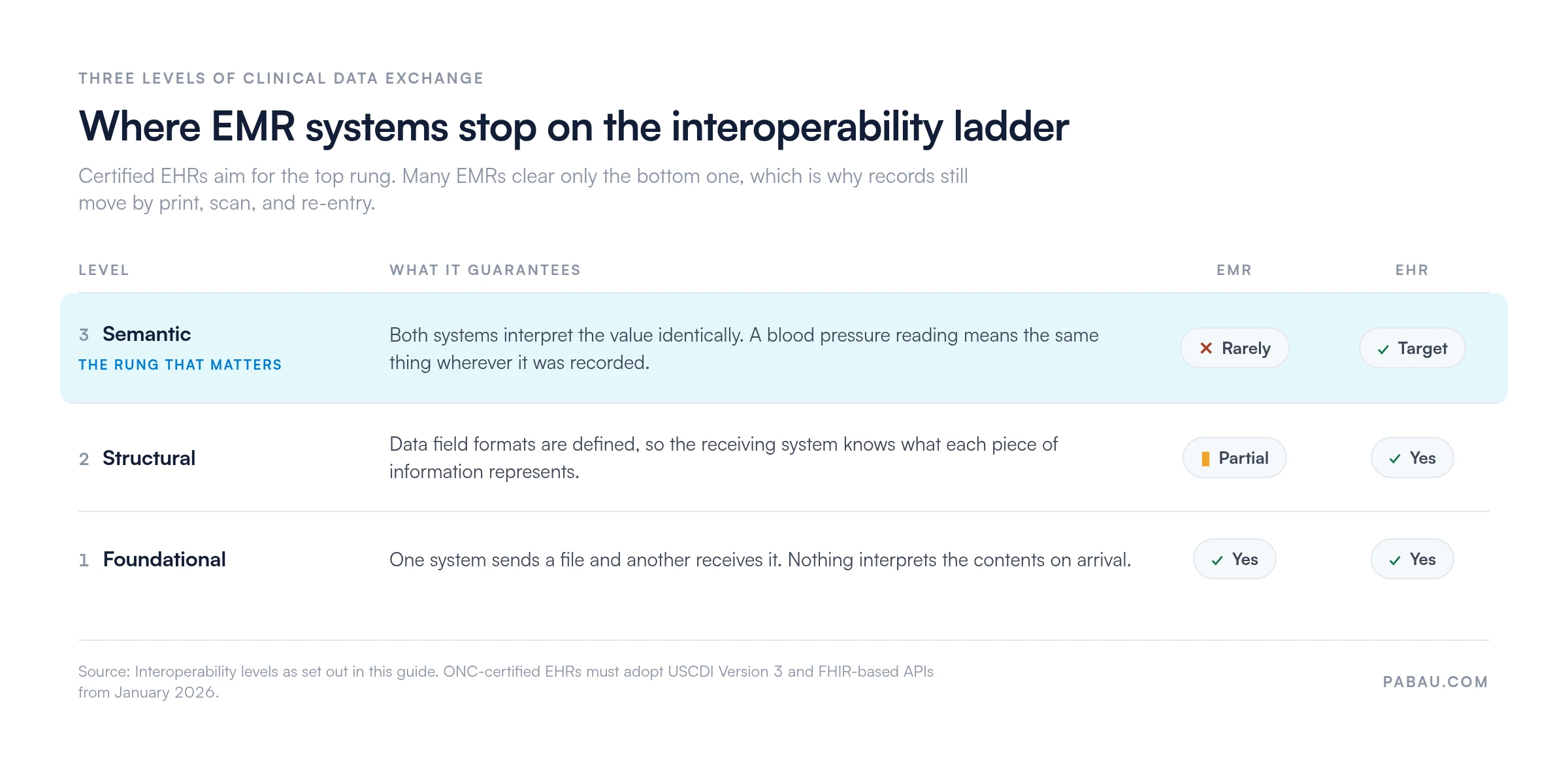
Foundational interoperability moves a file from one system to another with no interpretation. Structural interoperability defines the data field formats, so the receiving system knows what each value represents. Semantic interoperability means both systems read the value identically.
For a practice, this shows up as integration effort. A dermatology EMR might export a PDF to send by secure email, which somebody re-enters at the receiving end. An EHR-capable system pushes structured data through a standardized interface and populates the recipient’s fields.
The Office of the National Coordinator for Health Information Technology (ONC) mandates interoperability standards for certified EHR systems. Those include USCDI Version 3 data standards and FHIR-based APIs, effective January 2026. Certification creates a floor for cross-platform exchange that EMR-only systems do not have to meet.
Size matters less than referral traffic, but both push the decision in the same direction. Solo practitioners and single-location practices usually run well on EMR functionality. A boutique aesthetic practice performing cosmetic procedures may never need to exchange structured clinical data with anyone.
Their documentation centers on treatment protocols, consent forms, before-and-after photography, and inventory. An EMR handles all of that without external data exchange, so full EHR certification delivers marginal value.
Multi-practitioner groups and referral-driven specialties benefit from EHR capabilities. A physical therapy practice receiving referrals from orthopedic surgeons needs structured access to surgical notes, imaging reports, and post-operative restrictions.
An integrated care model needs real-time visibility across systems. That covers primary care physicians, specialists, and allied health providers coordinating a chronic condition together. These workflows justify the implementation cost of a certified EHR platform.
Practice size then shapes vendor selection. Practices with one to three clinicians often prioritize ease of use and a lower subscription, accepting limited interoperability. Practices with 10 or more providers across multiple locations usually need enterprise-grade EHR systems with robust integration, detailed reporting, and centralized administration.
Federal incentives tilt the math for some practices. The Centers for Medicare and Medicaid Services (CMS) rewards EHR adoption through its Promoting Interoperability Programs, formerly Meaningful Use. Those payments have reached nearly 550,000 healthcare providers since 2018.
They apply to eligible professionals in federal reimbursement systems. Private-pay aesthetic and wellness practices can usually ignore them.
EMR systems optimize for note-taking inside one practitioner’s workflow. Clinicians document encounters, record treatment plans, and track follow-ups without coordinating outside the practice. Increasingly that note-taking is automated, with AI scribes drafting structured notes from the visit conversation.
An aesthetic nurse using an EMR records injection sites, documents contraindications, and books the follow-up inside a closed system. The record leaves the practice only when somebody exports it deliberately.
EHR workflows carry multi-provider coordination. A patient seeing both a dermatologist and an aesthetic practitioner for skin cancer follow-up needs information moving in both directions. The dermatologist documents biopsy results and clearance. The aesthetic practitioner notes treatment modifications based on that history.
That exchange happens as structured data rather than phone calls and faxed summaries. Digital intake forms populated from existing EHR data cut repeated questioning and keep medical histories consistent across encounters.
Documentation burden runs the other way. EMRs allow practice-specific templates and shortcuts tuned to a single workflow. EHRs must accommodate standardized data fields, which sometimes forces clinicians into formats that feel restrictive.
A therapy practice on EMR functionality can write freeform progress notes that match its clinical approach. The same practice adopting certified EHR standards moves to problem-oriented record formats, standardized terminology, and discrete data elements. Documentation time goes up first, then data exchange becomes possible.
HIPAA applies identically to both system types, and only EHRs carry a certification requirement on top. Encryption, access controls, audit logging, and breach notification rules do not distinguish between an EMR and an EHR. The same four requirements apply to any system holding patient records, including a healthcare intranet your staff use to share them.
A practice storing records electronically must implement HIPAA safeguards whichever label its vendor uses. The American Health Information Management Association (AHIMA) adds that electronic documentation tools need processes keeping health information valid, accurate, complete, and timely.
Certification is where the two diverge. The ONC certifies systems that meet defined standards for data capture, interoperability, security, and clinical decision support. Certified EHR Technology (CEHRT) lets a practice join federal incentive programs and proves a baseline of functionality.
Certification costs vendors development and testing effort, which shows up in higher subscription fees. A private practice with no interest in federal incentives can skip it by choosing an EMR without ONC validation.
State rules vary on top of that. Some jurisdictions mandate electronic prescribing, which in practice requires EHR features. Others set data retention periods and patient access requirements that apply to both system types.
A practice owner who lets an out-of-scope provider handle injectables shares that provider’s legal exposure. State medical and nursing boards set the rules on Botox injectors, and those rules change from one jurisdiction to the next.
Compliance frameworks move faster than software release cycles. So vendor responsiveness to regulatory change is a selection criterion in itself. Ask a shortlisted vendor when they shipped support for USCDI Version 3, and how much notice their customers received.
Count the exchanges before you shortlist, not after. Pull one month of outgoing faxes and incoming referral documents from your front desk log. That number is the one figure a vendor demo cannot argue with, and it sets your budget.
EMR implementation costs less than EHR deployment. A basic EMR for a solo practitioner runs roughly $50-200 monthly with minimal setup fees. The practice buys licenses, trains a small team, and starts documenting within weeks.
Migrating from paper charts or a legacy system means manual entry, not interface mapping. Ongoing costs stay predictable, covering monthly subscriptions, occasional support tickets, and annual updates.

EHR implementations demand more. Enterprise systems with interoperability features cost $300-1,000+ monthly per provider. Implementation fees run from $5,000 to $50,000 depending on practice size and integration complexity.
Connecting to a Health Information Exchange requires interface development, testing, and continuing maintenance. Staff need training on structured documentation, standardized terminology, and new system workflows. A practice moving to a certified EHR should budget three to six months for deployment.
Planning carries most of that risk, which is why our guide to EHR implementation focuses on sequencing rather than software. Budget for EHR optimization afterwards too, since templates, integrations, and exchange processes all need refining once the system is live.
Hidden costs land after go-live. An EMR-only practice pays in staff time spent printing records, scanning incoming documents, and re-entering data from other providers. That overhead compounds as patient volume grows.
EHR systems trade that for interface maintenance fees, HIE participation charges, and retraining as standards evolve. Neither route is universally cheaper. The answer depends on how often you exchange clinical information and what automated coordination is worth to you.
EMR systems suit single-location practices with contained workflows. Boutique aesthetic practices, standalone spas, private counseling practices, and independent specialty providers all fit that shape. They document treatments, manage appointments, take payments, and track inventory without structured data exchange.
A medical spa offering injections, laser treatments, and skincare services rarely coordinates with outside physicians. Its clinical documentation stays internal.
EHR systems suit integrated care environments. The difference between ambulatory and inpatient EHRs matters here too, because an outpatient practice and a hospital ward structure the record differently. Multi-specialty groups, hospital-affiliated practices, and providers in coordinated care models all need interoperability.
A wellness practice offering functional medicine, IV therapy, and preventive care while coordinating with patients’ primary care physicians needs data flowing both ways. Physical therapy practices taking referrals from orthopedic surgeons and sports medicine physicians must reach diagnostic reports, surgical notes, and treatment protocols.
Growth trajectory is the third input. A solo practitioner planning to stay independent can prioritize EMR simplicity and lower cost. The same practitioner expecting expansion, a merger, or health system affiliation should evaluate EHR platforms early.
Migrating from EMR to EHR after implementation means data conversion, workflow redesign, and staff retraining. A 2020 review in the journal Life finds adoption challenges persisting across 25 years of EHR development.
Benefits often fall below expectations during migration periods. Practices hit by unplanned migrations see productivity decline for 18 to 24 months.
Pabau EMR is the clinical layer inside Pabau, an all-in-one practice management app built for aesthetic and private practices. It captures the record at the point of care, so the documentation a referral or an audit needs is already structured.
On a patchwork setup, a consent PDF gets printed, signed, scanned, and uploaded by hand. Photos sit in a practitioner’s camera roll. Treatment notes live in Word. Assembling a referral packet means visiting four places.
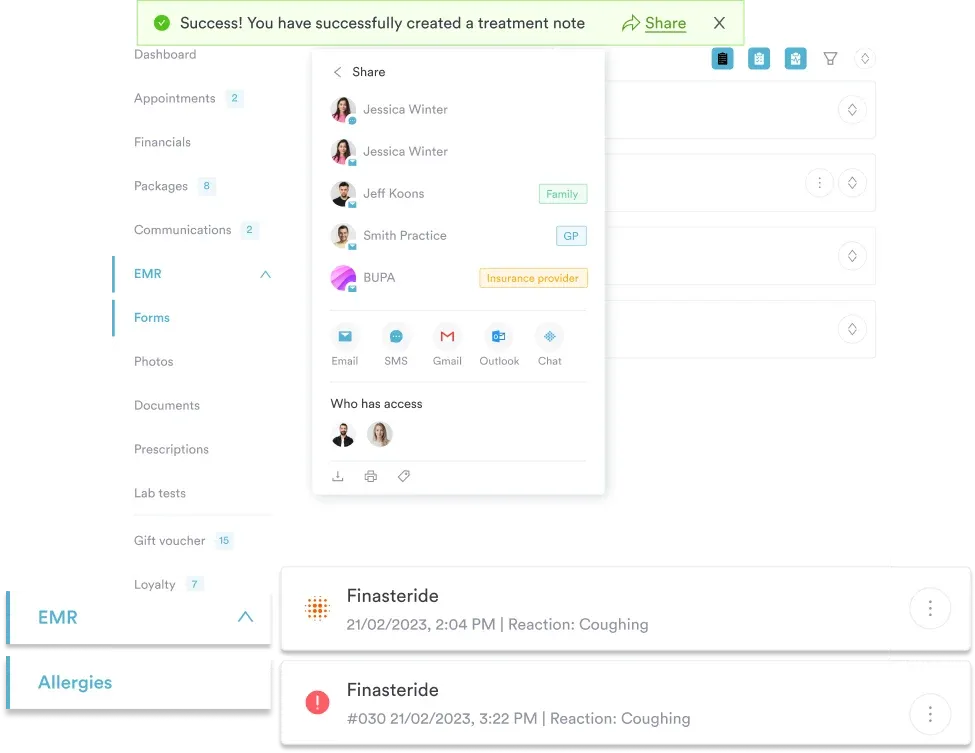
In Pabau, patients complete digital forms and consents before the visit, and each submission lands in their client record. Pabau Scribe, our AI scribe, drafts the treatment note from the visit conversation. Before-and-after photos attach to the same patient timeline.
The client portal gives patients their own view of that history, so the front desk stops fielding calls about past treatments. Access is logged, records sit on one timeline, and a referral packet is a search rather than a scavenger hunt.
Every Pabau subscription includes every feature, so documentation and compliance tools are not held back for a higher tier. Onboarding is structured rather than self-serve, because a clinical record set needs configuring around how your practice runs.


Pabau combines clinical documentation, patient records, and operational management in one platform. Book a demo to see how practices coordinate care without manual data transfer.

The label on the box matters less than the exchange volume behind it. Count your monthly outside exchanges before you shortlist a single vendor, because that number decides whether certification is an asset or overhead.
If the count is low and your specialty is self-contained, buy the EMR and put the savings into workflow. If it is high, or you expect it to become high, pay for certified interoperability now instead of converting data later.
The trade-off is worth remembering. A certified EHR buys structured exchange and costs you documentation flexibility, replacing freeform notes with fields somebody else specified.
Book a demo to see how Pabau structures notes, consents, and photos into one record your team can hand to a referring provider.

Choosing between shortlisted systems? EHR selection walks through evaluation criteria, demo questions, and the contract terms worth checking.
Need the cost side in detail? EHR software cost breaks down subscriptions, implementation fees, and the charges that land after go-live.
Moving off an existing EMR? EMR conversion covers data mapping, validation, and how to keep documenting during the switch.
Comparing specific vendors? Best EMR software ranks platforms by practice size, specialty, and interoperability depth.
EHR stands for electronic health record. The distinction between an electronic health record and electronic medical record is portability, since only the EHR is built to travel between providers. Certification is the second difference, because ONC-certified EHR technology must support USCDI Version 3 and FHIR-based APIs.
Hospitals use EHR systems because they coordinate care across multiple departments, specialties, and external providers. A hospital patient’s records must be accessible to emergency physicians, specialists, surgeons, and post-discharge care coordinators simultaneously. This requires interoperability features that EMR-only systems don’t provide.
Epic Systems operates as a comprehensive EHR platform with extensive interoperability capabilities. It enables data exchange across health systems, supports patient portals, and integrates with external laboratories, pharmacies, and referring providers. While Epic includes EMR functionality, its architecture and certification position it firmly as an EHR system.
Yes, compared with an EMR. Solo practitioners spend roughly $300-800 monthly on cloud-based EHR systems. Enterprise deployments for large practices can exceed $50,000 in implementation costs, plus $1,000+ per provider monthly. Certified systems with deeper interoperability features typically cost more than EMR-only platforms.
EHR transitions require vendor selection, data migration planning, staff training, and workflow redesign. Start by documenting current processes and identifying integration requirements. Select a vendor offering implementation support and data conversion services. Plan for 3-6 months between contract signing and full deployment. Reduce patient scheduling during the transition to make room for training and testing.
EMR systems can operate nationally within a single practice or organization. They do not automatically share data across unaffiliated providers without manual export and import. Multi-location practices using the same EMR platform access patient records across sites within their network. Exchanging information with external providers requires manual document transfer unless the EMR includes EHR-level interoperability features.