Health and wellness marketing: Strategies that actually work
Health and wellness marketing is how a practice promotes its treatments and clin...

Last Updated: Oct 2, 2026

Physician referral marketing builds structured, measurable relationships with referring physicians instead of relying on ad-hoc word of mouth.
Segment referring physicians into three tiers by referral volume before you spend outreach time or budget.
Referral leakage is as much a workflow problem as a relationship problem, and intake tech fixes it at the source.
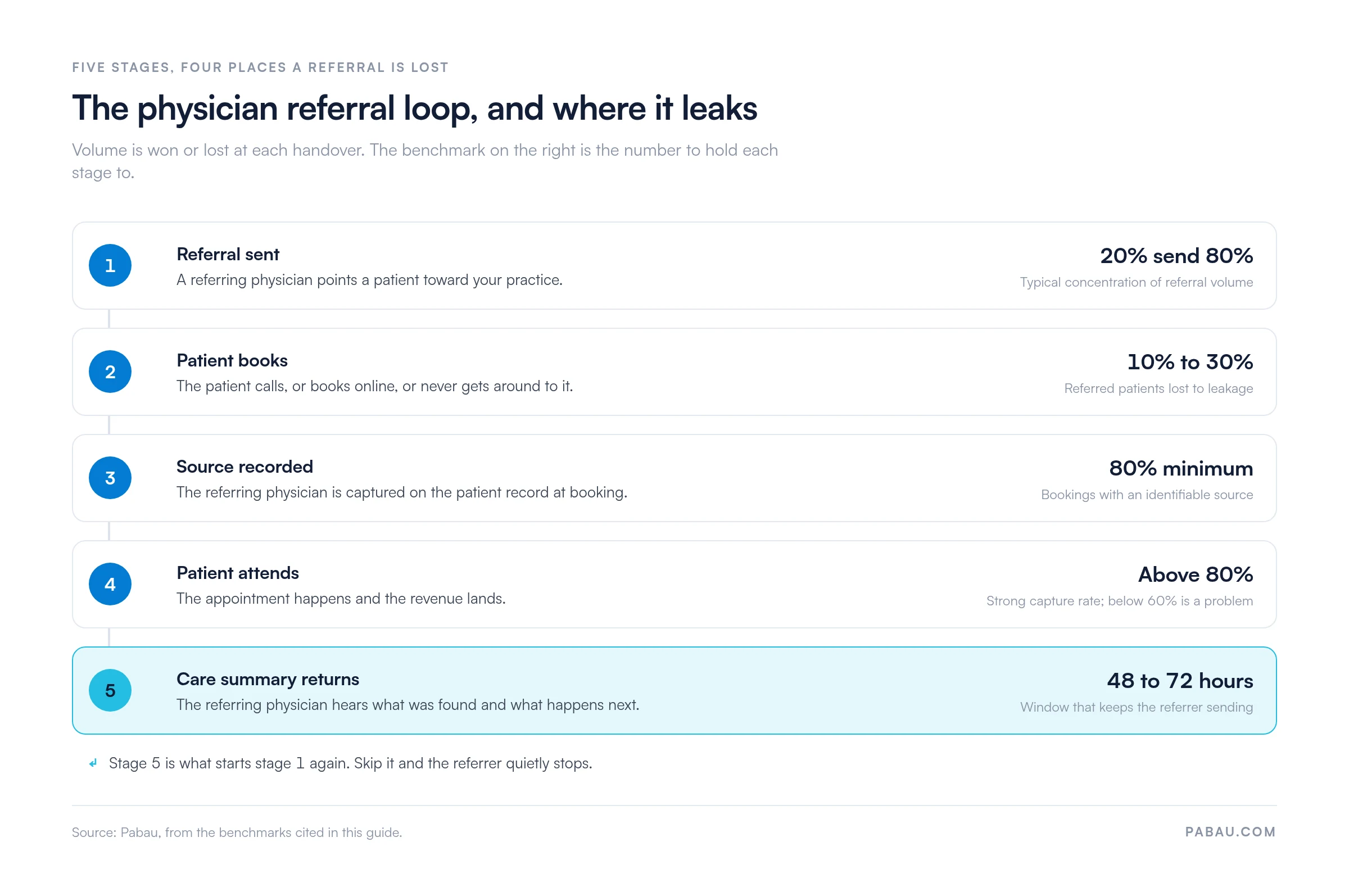
A care summary sent back within 48 to 72 hours is what keeps a referring physician sending.
Pabau records the referral source at booking and automates the follow-up, so every relationship compounds over time.
Physician referrals bring a large share of new patients to specialist practices. Most private practices still treat them as background noise rather than a managed growth channel. The result is inconsistent new patient flow, no visibility into which referring relationships perform, and revenue left on the table every quarter.
A disciplined approach changes that. This guide covers how to build a referral network, choose your outreach channels, reduce leakage, track performance, and measure return. It’s written for practice owners who want steady referral growth rather than a phone that rings when it feels like it.
Physician referral marketing is the structured practice of cultivating relationships with referring physicians so they consistently send patients to you. It works nothing like patient-facing marketing. You’re not running ads or posting on Instagram. You’re managing a network of clinical colleagues. Their trust and their awareness of what you treat drive referral volume, and so does how easy you make the act of referring.
For specialist practices, this matters more than almost any other growth activity. MGMA benchmarking data consistently shows that referral channels beat paid digital acquisition on cost per new patient for specialty practices. Fewer than half of specialist practices have a documented referral plan. That leaves room for anyone willing to run this as a system.
Physician referral marketing spans three distinct jobs. Building the network means identifying and segmenting partners. Nurturing it covers outreach, content, and communication. Closing the loop means tracking conversions, measuring return, and feeding the results back into the relationship. Plenty of marketing plans handle one of the three. The programs that hold up over years handle all three.
A single high-volume referring physician can be worth more in annual revenue than a paid search campaign costing tens of thousands of dollars. Ad spend stops the day you stop paying. A referral relationship compounds instead. Serve the patients they send well, and they send more. Your patient acquisition strategies should reflect that asymmetry.
Three reasons referrals outperform other acquisition channels for specialists:
Before you run any outreach, you need to know who is sending you patients and who could be. Pull your patient records for the past 12 months and categorize every patient by referral source. The concentration is usually steep. Around 20% of referring physicians generate 80% of referral volume.
Use a three-tier segmentation model to prioritize outreach:
Once segmented, assign each tier its own outreach cadence and budget. Tier 1 relationships get personal attention. Tier 3 relationships get systematized outreach at scale. Tier 2 usually gets the least attention and returns the most from an extra hour of effort.
Effective outreach mixes in-person and digital contact. In-person builds trust. Digital keeps that trust alive at a scale one person can manage.
In-person outreach remains the highest-trust channel. Office visits, lunch-and-learns, and grand rounds presentations all work, because they put referring physicians in direct contact with your clinicians. The catch is scale. They eat time, and they rarely stretch past a handful of Tier 1 relationships without a dedicated physician liaison.
Digital outreach scales. A targeted email sequence to 200 primary care physicians in your catchment area costs a fraction of 200 office visits. When a referring physician is ready to act, your name is already familiar. Effective digital tactics include:
Physician outreach runs on the same email and campaign tooling as the rest of your patient marketing. Keep it inside the marketing tools for practices you already use. The physician list, the sequences, and the reporting then sit next to your patient campaigns. If you’re starting from scratch, a healthcare marketing plan template gives you somewhere to record the channel mix and the budget per tier.
The American Medical Association’s ethical guidelines are worth reading before you finalize any benefit tied to outreach. Any meal, gift, or honorarium connected to a referral relationship has to be structured with the Anti-Kickback Statute in mind. The HHS Office of Inspector General publishes safe harbor guidance covering physician outreach programs. Talk to your compliance team before you offer anything of value to a referring physician.
Referral leakage is what happens when a physician refers a patient to you and the patient never books. Conservative estimates put the loss at 10% to 30% of referred patients for specialist practices, though the figure moves with specialty and geography. The causes are part relational and part operational.
It helps to see the whole loop at once, because a referral can fall out of it at four separate handovers.
Relational leakage happens when the patient doesn’t follow through, because your practice felt hard to reach or the booking process was fiddly. The fix is to make referring to you frictionless. A dedicated referral phone line, fast intake response, and a clear online referral pathway all help.
Operational leakage happens inside your own workflow. When the referral source isn’t captured at booking, you can’t tell how many referrals converted and how many dropped out. Capturing the source at the first patient touchpoint fixes that at the root. The referring physician then lives on the patient record from day one rather than as an afterthought.
Audit your last three months of new patient bookings. For what share can you name the exact referral source? If the answer is below 80%, you have an operational leakage problem before you have a relationship problem. Fix the intake workflow first.
A referral tracking stack connects three data points. It records where the referral came from, whether the patient booked, and what revenue followed. Most specialist practices track none of them consistently. The point of the stack is to make that connection automatic, so the data exists without staff logging it by hand.
A working setup usually combines:
Enterprise platforms like Salesforce Health Cloud assume a dedicated IT team behind them. For a small or mid-sized specialist practice, referral tracking embedded in the practice management platform usually wins. A second system is one more sync to maintain. Day to day, the follow-up automation matters more than a sophisticated standalone CRM.
One referral source field also serves more than one channel. The same record that credits a referring physician can credit a patient referral program. You don’t need a second tracking scheme when you add one.
Volume is the easy metric and the weakest one. A referral count says little about value until you connect it to revenue and cost. Five metrics are worth tracking:
CMS care management guidance treats referral pathway and outcome tracking as part of the care quality standards for practices in value-based care models. Building the measurement framework now puts you ahead of reporting requirements that keep spreading.
Run a referral source report monthly at minimum. Quarterly, review which Tier 2 physicians have moved up or down in referral frequency, and adjust your outreach priority to match. Once a year, check whether your outreach spend changed behavior or simply maintained the relationships you already had.
The strongest long-term referral driver runs in the opposite direction from your outreach. What decides repeat volume is the quality of the clinical communication you send back to the referring physician.
Refer a patient to a specialist and never hear back, and you stop referring. Receive a timely care summary saying the patient was seen, what was found, and what the plan is, and you refer again. That loop separates the practices that hold referral volume for years. The rest win new referrers, then slowly lose them.
So close the loop on every referred patient. A care summary sent within 48 to 72 hours of the appointment is one of the highest-return activities in the whole program. Once it’s automated, no one has to draft it. It tells the referring physician their patients are in good hands, and no email campaign earns that kind of trust.
Patient experience feeds the same loop. A satisfied patient reinforces the referring physician’s decision to send you the next one.
Most advice on this topic ends with “add a CRM”. For a solo or small group specialist practice, that means a second system to maintain and a sync problem to manage. Practice management software like Pabau takes a different route, and records the referral source inside the same workflow where the patient books.
When a referred patient books, the referring physician is written to the patient record. That data flows into Pabau’s built-in reporting, so you can see which referring physicians generate the most appointments and the most revenue. Referral work stops being a relationship favor and becomes a line you can defend in the budget.
On the communication side, Pabau automates post-appointment updates back to referring physicians. Care summaries, progress notes, and appointment outcome messages go out without a liaison drafting each one. A practice handling 20 referrals a month from eight referring physicians could never keep that up by hand. Automating it keeps the relationships warm at scale.
Patients refer too, and that channel runs on the same plumbing. Pabau’s referral marketing software tracks patient-to-patient referrals and any rewards attached to them, alongside the physician-side reporting above. Every Pabau subscription includes both.
For practices using digital intake forms, referral source can be a required field at the patient’s first touchpoint, before they walk through the door. That removes the most common cause of operational leakage, which is staff forgetting to ask or log it at check-in.


Pabau records the referral source at booking and carries it through the patient record. The care summary back to the referring physician goes out automatically. No separate CRM to sync.

Most specialist practices are sitting on referral potential they have never counted. The physicians who could send you ten patients a year are sending two. That’s rarely about trust. It’s usually because your referral pathway is unclear, your follow-up is patchy, and no data shows which relationships deserve investment.
Pick one thing to fix first, and make it the source field at booking. Tier segmentation, cost per referral, relationship lifetime value: all of it depends on knowing where each patient came from. The relationship work only pays once you can see which relationships are paying.
Want to see referral attribution and automated physician communications working inside one platform? Book a demo and we’ll walk through your referral workflow.

Need to build the whole marketing engine, not just referrals? Marketing for clinics covers the full channel mix in one strategic guide.
Want more new patients from channels you already run? Healthcare lead generation walks through the tactics that fill the top of the pipeline.
Looking for the wider practice marketing picture? Medical practice marketing sets out how the channels fit together across a year.
Ready to put this on paper? Marketing plan for private practice shows how to turn tactics into a budgeted plan.
Physician referral marketing is the structured practice of building relationships with referring physicians so they consistently send patients to your practice. It matters because practices that run referrals as a system see higher new patient volume. Passive word of mouth delivers less, and less predictably. MGMA benchmarks put referral cost per new patient below paid digital acquisition for specialty practices.
A capture rate above 80% is generally strong for a specialist practice. That means at least eight in ten referred patients book and attend. Practices below 60% usually have operational leakage, such as slow intake response or no online booking option, rather than a relationship problem.
Referral leakage is when a physician refers a patient to your practice and the patient never books or attends. Reduce it by capturing the referral source at the first booking touchpoint. Offer online self-scheduling so patients can act on the recommendation immediately. Then follow up with referred patients who have not booked within 48 hours.
Private practices usually run physician outreach through the owner or a physician liaison, with a smaller network and faster feedback loops. Hospitals operate at scale, with dedicated provider relations teams and formal physician engagement programs. For a private practice, referral tracking embedded in the practice management platform is usually more practical than a standalone CRM.
The Anti-Kickback Statute prohibits offering remuneration intended to induce referrals of federally funded healthcare services. Educational outreach, clinical content, and relationship-building that is not tied to referral volume is generally permissible. Review HHS OIG guidance and check with your compliance team before offering any meal, gift, or payment.