Anticoagulant medication list
An anticoagulant medication list is a clinical reference that groups blood thinn...

4
Last Updated: Oct 5, 2026
Fertility clinic marketing is how a fertility practice attracts, educates, and converts prospective patients through digital channels, clinical credibility, and empathetic communication.
The strategies that work best are local SEO, educational content, compliant paid search, email nurture, and physician referrals. Each one pays off only when every inquiry is tracked through to a booked consultation.
Fertility patients often research for months before they book, so the practice that answers their questions most clearly and sensitively usually wins the appointment. According to the HHS Office for Civil Rights, marketing that involves patient communications carries specific HIPAA obligations. Build compliance into the plan from day one.
This guide maps each channel to the stage of the patient journey it serves, and shows where inquiries tend to stall before they become consultations.

Fertility clinic marketing works best when the message matches where a patient is in their emotional journey, not just their buying intent.
Local SEO and a complete Google Business Profile are the highest-leverage starting points for most independent fertility practices.
Google and Meta restrict ad targeting based on health conditions, so ad copy should focus on education and access rather than diagnosis.
Practice software with built-in lead tracking connects marketing spend to booked consultations, so you can see which channels produce patients.
Fertility marketing differs from general healthcare marketing in three concrete ways. The decision cycle is long, often six to 18 months from first search to booked consultation. The emotional stakes are unusually high, and regulation restricts what practices can claim.
A practice marketing cholesterol screening can lead with statistics and outcome data. A fertility practice marketing IVF must lead with empathy and clinical trust. Its patients are often handling grief, hope, and financial pressure at the same time.
The Human Fertilisation and Embryology Authority (HFEA) requires UK IVF clinics to publish audited success rates. Marketing that cherry-picks or misrepresents those rates can trigger regulatory action.
In the US, the American Society for Reproductive Medicine (ASRM) provides ethical guidelines on how practices should present outcomes in advertising.
These rules shape which claims you can make, how you frame patient stories, and what consent language your intake forms need. The tactics below only work when the messaging behind them is honest, empathetic, and compliant.
Fertility patients move through five distinct stages before booking, and each stage calls for a different type of content and channel. Matching your messaging to the stage is the most effective way to improve conversion without increasing ad spend.
Paid ads tend to soak up budget at the consideration and intent stages, while awareness and research content gets little attention. Competitors who publish blog posts and educational videos earn the patient’s trust there, long before your ad appears.
Fertility clinic SEO works on two layers. Local search visibility helps patients in your area find you first. Informational content reaches patients researching IVF, egg freezing, or unexplained infertility. Both layers take time, but both compound. A blog post ranking for “how long does IVF take” drives qualified traffic for years with no ongoing spend.
Fertility patients search for condition and treatment terms long before they search for a practice by name. Ranking for “what is AMH level” or “IVF success rates by age” makes your practice a trusted authority at the research stage. Those readers turn into better-informed, higher-intent consultation requests.
Build a content calendar around the questions your consultants answer most often in first appointments. Those questions are your best future blog topics.
Paid search delivers immediate visibility for high-intent queries like “IVF clinic [city]” or “egg freezing consultation.” Cost per click in fertility is high, typically $15–50+ in competitive US markets. That makes landing page quality and tracking critical.
A campaign that sends 200 clicks to a generic homepage with no clear call to action generates a handful of inquiries. Point the same spend at a dedicated landing page with a specific offer, a patient story, and a simple booking form. It will convert three to five times better.
Ad policy constraints matter here. Google’s healthcare advertising policies restrict targeting based on health conditions and require certification for certain health ad categories.
You cannot retarget users based on infertility-related browsing history, and ad copy cannot imply diagnosis or guaranteed outcomes. Frame ads around access and support (“Talk to a specialist today”) rather than clinical outcomes (“Get pregnant with IVF”).
Track every Google Ads conversion back to a specific inquiry source in your practice management system. If you cannot see which ad groups generate booked consultations, and not just form fills, you are optimizing for the wrong metric. Click-to-form is a proxy. Click-to-consultation is the goal.
Instagram and Facebook are the main social platforms for fertility marketing, and YouTube is growing fast as a longer-form education channel. The content that performs best for fertility practices leans on education and community rather than promotion.
Content marketing works for fertility practices because the decision cycle is long. Picture a patient who reads your post on “how to prepare for a fertility consultation” in January and books in April. For those months, they have been reading your content, watching your videos, and comparing you to competitors.
The most effective content formats for fertility practices:
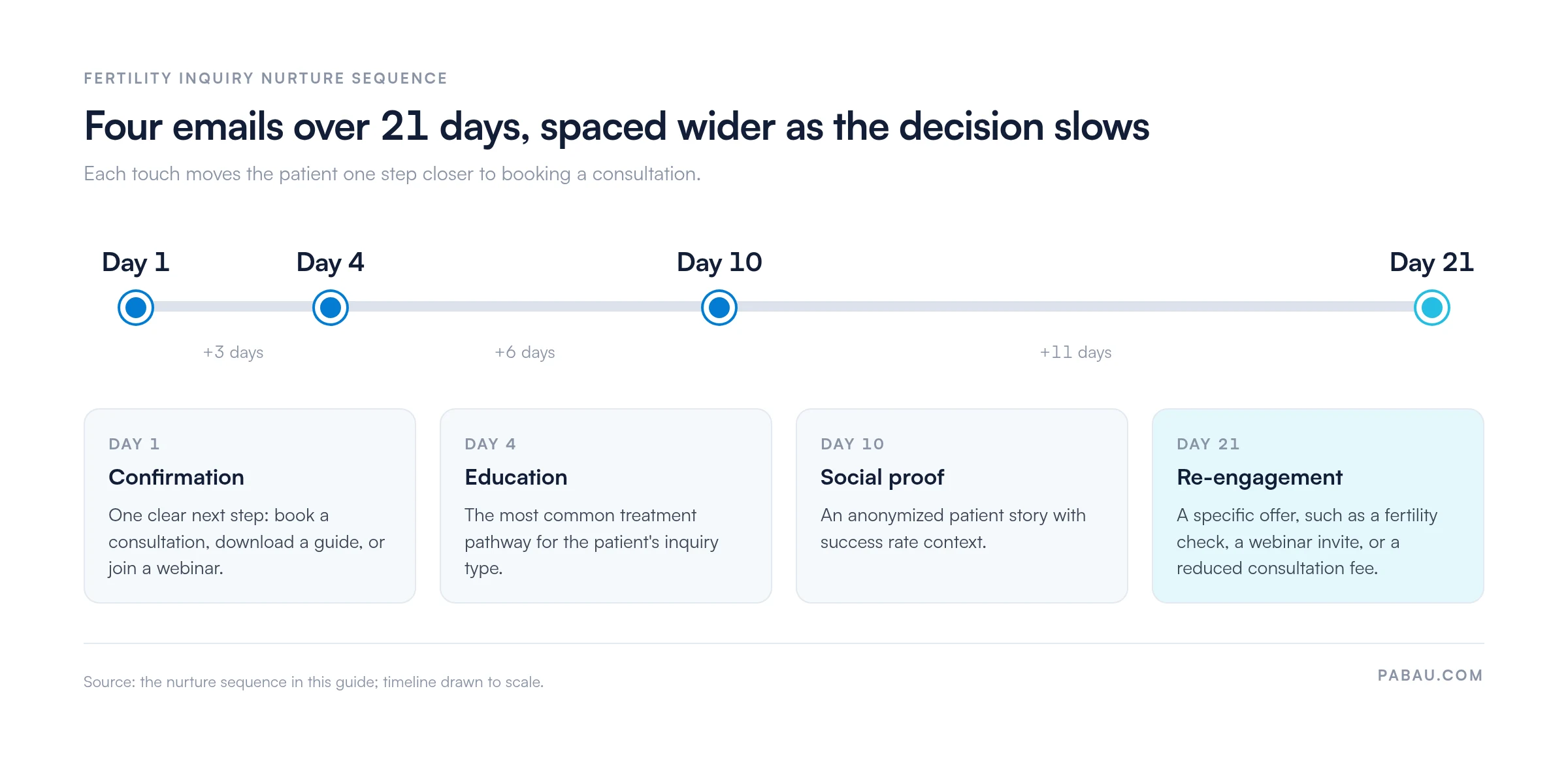
Most fertility inquiries do not convert to a booked appointment on first contact. Patients request information, then take weeks or months to decide. Automated email campaigns keep your practice in the patient’s consideration set during that period, without manual follow-up from your front desk.
A basic nurture sequence for fertility practices runs four emails over three weeks. Each one lands further from the last, because the patient’s decision slows as it gets closer:
Segment your list by inquiry type: IVF, egg freezing, male factor, and donor programs. Generic fertility emails convert poorly. A patient asking about donor eggs needs different information than a couple facing unexplained infertility after two years of trying.
Referrals from primary care physicians (GPs in the UK) and OB-GYNs are among the highest-quality acquisition channels in fertility. A referred patient arrives with clinical context, trust in the medical system, and a clearer sense of their diagnosis. Conversion rates from physician referrals typically run well above cold digital channels.
Building a referral program that works takes systematic effort:
Fertility reputation management covers Google reviews, Trustpilot profiles, and the fertility forums where patients openly discuss their experiences. Reviews often decide the outcome. Patients typically shortlist two or three practices from search or ads, then choose based on reviews and testimonials.
Three priorities for fertility reputation management:
Inquiry forms and phone calls are easy to count, but a fertility patient rarely converts in one step. One might take four months, contact the practice twice, and finally book through a third channel. Without tracking across that path, budget flows to the channels that look busy rather than the ones that convert.
Lead management tools fix this by capturing every inquiry at source, tracking each touchpoint through the pipeline, and crediting booked appointments to the originating channel. The metrics that matter in fertility marketing:
Audit your inquiry-to-consultation pipeline before investing more in top-of-funnel marketing. Say your practice receives 50 inquiries a month but books eight consultations. That pattern points to follow-up speed, follow-up consistency, or booking friction. Fix the funnel before scaling the spend.
Fertility marketing operates in a regulated and emotionally charged environment. Mishandling these considerations risks regulatory action, reputational damage, and harm to vulnerable patients.
Marketing channels generate inquiries, but each one still has to be captured, tracked, and followed up before it becomes a consultation. That work happens inside the practice, and no marketing agency can do it for you.
Without an integrated system, the patient’s path splits across tools:
Pabau, the practice management platform we build, handles this in one place. Its fertility clinic software combines lead management, automated follow-up, online booking, and a built-in marketing suite.
Say an inquiry arrives through your web form at 10 PM on a Friday. Pabau sends the confirmation email, adds the lead to the pipeline, and queues a follow-up task for Monday morning. The patient hears from you right away, and your team starts the week knowing who to call.
If you are comparing systems, our roundup of IVF clinic management software sets out what to look for in the US market.

Pabau captures every inquiry, sends automated follow-up, and books consultations online, so you can see which channels produce patients. You won’t need a separate marketing stack.

Fertility marketing rewards patience and precision. The inquiry you capture today may book in six months, so speed and consistency of follow-up matter as much as reach. Start with the channels that compound, local SEO and educational content, before adding paid search.
Then judge each channel by the consultations it books rather than the forms it fills. That one change usually moves budget toward referrals and content, and away from ads that only look busy.
Compliant, empathetic messaging rules out some aggressive tactics, and that trade-off is worth accepting. Those limits protect the trust that fertility patients base their choice on. Book a demo to see how Pabau tracks every fertility inquiry from first contact to booked consultation.

Planning condition guides for your content calendar? AMH levels interpretation explains what fertility practices need to know about one of the most searched fertility tests.
Want consistent notes from every first consultation? Infertility consultation notes template gives your team a structured record for the appointment your marketing works to book.
Building a PCOS pathway for new patients? PCOS hormone levels template helps you document the hormone results that shape a PCOS treatment plan.
Fertility clinic marketing is the process of attracting, educating, and converting prospective patients through digital and offline channels. It is tailored to the emotional weight and long decision cycles of reproductive medicine. It covers SEO, paid search, social media, content, email nurture, referral programs, and reputation management.
Start with local SEO and a fully optimized Google Business Profile, which drives the most new patient inquiries at the lowest cost. Add Google Ads for high-intent search terms once your landing page and follow-up process can convert that traffic. Then build educational guides that answer patients’ questions before they are ready to book. Set up an email nurture sequence for inquiries that do not convert right away.
Marketing budgets for fertility practices typically range from 5–15% of revenue, depending on growth stage and local competition. A practice in a competitive urban market running Google Ads will spend more than a rural one relying on physician referrals and SEO. Rather than benchmarking a percentage, calculate your cost per booked consultation by channel. Then shift budget toward the channels with the lowest cost and highest conversion rate.
Yes, with restrictions. Google requires healthcare advertisers to follow its healthcare and medicines policies, which restrict health-condition targeting and require certification for some ad categories. Meta restricts health-based custom audiences and may limit delivery for ads that reference health conditions. Both platforms allow fertility advertising framed around education, access, and clinical expertise rather than diagnosis or guaranteed outcomes.
ROI varies by channel. SEO and referral programs usually deliver the highest long-term return, because cost per acquisition falls as rankings and relationships mature. Paid search produces faster results but needs ongoing spend to keep its visibility. To measure ROI, track every inquiry from first contact to booked treatment in a practice management system that credits revenue to the original channel.