HD Brows consultation form: Free template and guide
HD Brows is a seven-step brow treatment that combines consultation, tinting, wax...

2
Last Updated: Oct 13, 2026
California cosmetology license requirements come to 1,000 training hours, one written exam and a $125 fee, all set by the Board of Barbering and Cosmetology. Barbering also takes 1,000 hours. Esthetics, hairstyling and electrology each take 600, and nails 400.
You need to be 17 with the 10th grade finished, or the 12th grade for electrology. California sets no upper age limit. Since SB 803 took effect on January 1, 2022, there is one written exam and no practical. A cosmetology license then renews every two years for $50 through BreEZe.
Those six credentials are the whole set, and this guide reads them side by side instead of across six application forms. Practice owners ask a second question that the Board’s pages leave open. What can a cosmetology-licensed employee legally do inside a California med spa?
We call that boundary the Med Spa Scope Line, and it decides who may hold the laser handpiece. Every figure below comes from the Board, the California Business and Professions Code, or a school’s own published cost of attendance.

The California Board of Barbering and Cosmetology licenses cosmetologists, barbers, estheticians, hairstylists, electrologists and manicurists.
Training runs to 1,000 hours for cosmetology and barbering, 600 for esthetics, hairstyling and electrology, and 400 for nails.
You need to be 17 with the 10th grade finished, or the 12th grade for electrology, and there is no upper age limit.
Since SB 803 took effect on January 1, 2022, there is no practical exam, only a written one.
Licenses renew every two years for $50 through BreEZe, and California requires no continuing education.
Threading, hair braiding, wig work and permanent makeup need no Board license, but shampooing a client for pay does.
A cosmetology license stops at the Med Spa Scope Line, so injectables and lasers need a licensed medical professional.
The CA Board of Barbering and Cosmetology, part of the Department of Consumer Affairs, licenses cosmetologists, barbers, estheticians, hairstylists, electrologists and manicurists.
The Board’s authority comes from the Barbering and Cosmetology Act, which is Chapter 10 of Division 3 of the California Business and Professions Code. Its regulations sit in Title 16 of the California Code of Regulations. Schools and candidates usually just call the agency the CA board of cosmetology, or the California cosmetology state board.
There is no single beauty license in California. The Board issues six separate credentials, and the one you need depends on the services you plan to sell. A manicurist license does not cover facials, and an esthetician license does not cover haircutting.
Every applicant must be at least 17 and have completed the 10th grade, or the 12th grade for electrology. The requirements for a cosmetology license in California carry no upper age limit. Starting at 35, 50 or 60 does not affect eligibility.
The cosmetology license requirements California sets are written into statute, not decided by individual schools. A school cannot shorten your hours, waive the exam, or sell you hours you did not sit. The Board asks students to report any school that offers to.
A criminal conviction does not automatically block an application. Business and Professions Code section 480 lets a board deny a license on two narrow grounds. The conviction has to fall within the seven years before you apply. The conviction also has to be substantially related to the work you would be licensed to do.
Section 480 rules several situations out entirely. A conviction dismissed or expunged under Penal Code section 1203.4 cannot be the basis for a denial. Neither can an arrest that did not end in a conviction. A certificate of rehabilitation or a pardon takes denial off the table as well.
Barbering and cosmetology is one of the chapters section 480 allows to ask about convictions on the application itself. So you disclose, using the Board’s Disclosure Statement Regarding Criminal Pleas or Convictions. The Board then weighs the time since the conviction, its nature, and any evidence of rehabilitation.
Three groups get their applications expedited. Honorably discharged veterans qualify, as do spouses and registered domestic partners of active-duty members. So do people admitted as refugees, granted asylum, or holding a special immigrant visa. A DD-214, discharge papers or current orders is the evidence the Board wants.
Military training can also count toward the exam. Applicants may submit Verification of Military Experience and Training records, known as V-MET, in place of a school transcript. A military spouse applying by reciprocity can have the license fee waived on top of the expedited handling.
The Board sits inside the Department of Consumer Affairs alongside the Medical Board of California. Those two agencies regulate different work, and the line between them decides what your staff may perform. The Med Spa Scope Line section below sets out where it falls.
California cosmetology license hours run to 1,000 for a cosmetologist or barber, 600 for an esthetician, hairstylist or electrologist, and 400 for a manicurist.
Every one of those hours has to come from a Board-approved school, or from the apprenticeship route covered further down. The table below puts the whole set in one place. Read across your own license type instead of hunting through six separate application forms.
California cosmetology hours total 1,000 for the cosmetologist license, and the table below sets that against the other five credentials the Board issues.
| License type | Minimum age | Education | Required hours | Written exam | Application fee | Renewal |
|---|---|---|---|---|---|---|
| Cosmetologist | 17 | 10th grade | 1,000 | 100 questions, 120 minutes | $125 | 2 years, $50 |
| Barber | 17 | 10th grade | 1,000 | 85 questions, 120 minutes | $125 | 2 years, $50 |
| Esthetician | 17 | 10th grade | 600 | 75 questions, 90 minutes | $115 | 2 years, $50 |
| Hairstylist | 17 | 10th grade | 600 | 50 questions, 90 minutes | $125 | 2 years, $50 |
| Electrologist | 17 | 12th grade | 600 | 50 questions, 90 minutes | $125 | 2 years, $50 |
| Manicurist | 17 | 10th grade | 400 | 60 questions, 90 minutes | $110 | 2 years, $50 |
Two cells in that table catch people out. Electrology is the only license that asks for the 12th grade rather than the 10th. The application fee is not flat either. Estheticians pay $115 and manicurists $110, while the other four pay $125.
The hour totals come from the Board’s license requirements page, and each fee from that license type’s own application form. The question counts are scored questions. Every exam carries 10 unscored pretest questions on top, so a cosmetologist answers 110.
California’s 1,000-hour floor is low by national standards. Florida’s Board of Cosmetology still requires 1,200 hours for the same license, and an Alabama cosmetology license takes 1,500 school hours. Texas cosmetology license requirements match California at 1,000, which is why the two states are the usual comparison.
Cosmetology hours in California are allocated by statute, which pins 900 of the 1,000 to named subjects and leaves the last 100 to the school.
People search for how many hours for cosmetology license in California and get a single number back. The statute is more specific than that. Business and Professions Code sections 7362.5 through 7366 set a minimum for each subject inside every course.
| Subject | Cosmetology | Barbering | Hairstyling | Esthetics | Nails | Electrology |
|---|---|---|---|---|---|---|
| Full course | 1,000 | 1,000 | 600 | 600 | 400 | 600 |
| Health and safety | 100 | 100 | 100 | 100 | 100 | 100 |
| Disinfection and sanitation | 100 | 100 | 100 | 100 | 100 | 100 |
| Chemical hair services | 200 | 200 | — | — | — | — |
| Hairstyling services | 200 | 200 | 200 | — | — | — |
| Shaving and beard trimming | — | 200 | — | — | — | — |
| Skin care | 150 | — | — | 350 | — | — |
| Hair removal, lash and brow | 50 | — | — | 50 | — | — |
| Manicure and pedicure | 100 | — | — | — | 150 | — |
| Electrolysis and electricity | — | — | — | — | — | 400 |
| Fixed by statute | 900 | 800 | 400 | 600 | 350 | 600 |
| Left to the school | 100 | 200 | 200 | 0 | 50 | 0 |
The bottom two rows show how much of each program the school controls. A cosmetology program has 100 discretionary hours to spend, a barbering program 200, and a hairstyling program 200. Esthetics and electrology have none, so those two curricula are fixed end to end by section 7362.5 and its neighbors.
The cosmetology education training requirements above are floors, not targets. A program may exceed any line in the table. It may not go under one, and a school that tries is operating outside its approval.
Two other routes convert into hours. The apprenticeship route substitutes 3,200 supervised on-the-job hours plus 220 related training hours for the 1,000 classroom hours. School hours and apprentice hours do not transfer in either direction.
Licensed practice in another state converts as well. Section 7321(d)(2) counts each three months of practice as 100 hours of training. Electrologists are the exception, needing 18 months of prior practice before the Board will look at experience at all.
Senate Bill 803 took effect on January 1, 2022, and it rewrote the numbers most older guides still quote. Cosmetology dropped from 1,600 hours to 1,000, and barbering from 1,500 to 1,000. The same bill created the 600-hour hairstylist license and removed the practical examination outright.
SB 803 also widened the esthetician scope. Lash perming, brow lamination and dermaplaning became esthetician services on that date, having previously been cosmetologist-only or unsettled. The Board’s own SB 803 questions and answers document spells out each change.
A California esthetician license takes 600 hours, a 10th-grade education, a 75-question written exam and a $115 application fee.
The 600 esthetician hours California requires break down further than most schools advertise. Skin care takes 350 of them, health and safety 100, disinfection and sanitation 100, and hair removal with lash and brow work the last 50. Esthetics runs 400 fewer hours than cosmetology, which makes it the fastest route into skin work.
The scope is where estheticians need to read carefully. Business and Professions Code section 7316(c) defines skin care as work that improves the appearance of the skin. That work must not result in the ablation or destruction of live tissue. Section 7316(c) also excludes hair removal by laser or light waves by name.
A California esthetician may run facials, superficial exfoliation, waxing, sugaring, lash and brow tinting, brow lamination and dermaplaning. Any service past the epidermis is a different license and a different board. Washington cosmetology license requirements put it more bluntly, ruling out injections at every esthetics tier.
A California nail tech license, which the Board calls the manicurist license, takes 400 hours, a 60-question written exam and a $110 application fee.
That makes it the shortest and cheapest of the six credentials. Only 350 of the 400 hours are set by statute, and 150 of those go to manicure and pedicure work itself. The remaining 50 hours are the school’s to allocate.
Section 7316(d) limits nail care to trimming, polishing, coloring, tinting, cleansing, manicuring and pedicuring. The section also covers massaging and beautifying from the elbow down and the knee down. A manicuring license in California does not extend to facials, waxing the face, or lash work.
Barber license requirements in California match cosmetology on hours, age and fee, and differ only in the exam and the scope.
Barbers sit 85 scored questions rather than 100, and their statutory scope adds shaving and trimming the beard. That difference shows up in the curriculum as 200 hours on shaving and beard work. Those 200 hours replace the skin care, nail and lash hours a cosmetology student sits.
Barbers and cosmetologists can also move between the two credentials. Section 7321 lets a licensed California barber qualify for the cosmetology exam by completing a crossover course at a Board-approved school. There is no second 1,000 hours to sit.
California has no cosmetology instructor license, because the Board of Barbering and Cosmetology issues six credentials and instructor is not among them.
Anyone searching for the requirements for cosmetology instructor license in California is looking for a credential the state does not issue. Teaching sits under school approval instead. A school must be approved by the Board first, and then by the Bureau for Private Postsecondary Education.
So the practical answer is to hold the license you intend to teach, then apply to the school. Ask what that school requires of its instructors, because the standard is the school’s rather than the state’s. Several states do license instructors separately, which is where the confusion starts.
Getting a California cosmetology license takes six steps, from meeting the age floor to sitting one written exam and renewing every two years.
The Board works through them in order, and skipping one stalls the application rather than speeding it up.
Filing online is the cheapest way to save weeks. The Board processes BreEZe applications two to four weeks faster than mailed ones. Once your application is approved, the PSI handbook that lets you book the exam arrives about six weeks later.
The exam itself is offered in English, Korean, Spanish, Vietnamese and Simplified Chinese. Candidates who read none of those five can apply to bring an interpreter. That request has to go in with the application, not afterwards.
Set against a calendar, those hours and fees fall into a fairly predictable sequence.
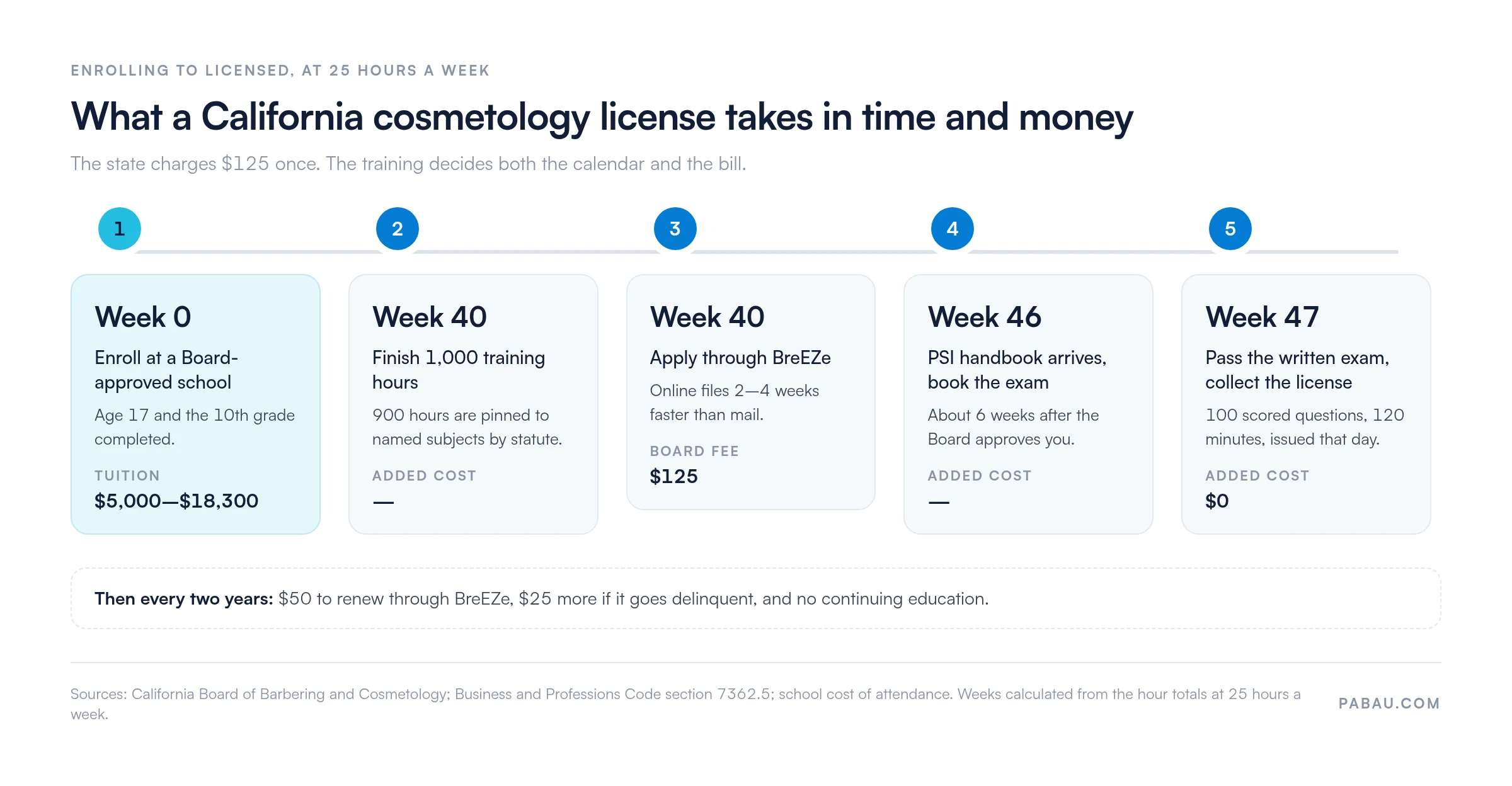
At 25 hours a week, 1,000 hours takes 40 weeks, so roughly nine to ten months of school. Full time at 35 hours a week pulls that down to about 29 weeks. The shorter licenses scale the same way.
A 600-hour esthetics program at that 25-hour pace runs about six months, and a 400-hour nail program about four. Those are calendar estimates from the hour totals, not a Board timetable. School holidays, student-salon scheduling and exam availability all push the finish date out.
A California cosmetology license costs $125 in state fees, but training pushes the full total to between roughly $5,100 and $18,400.
Quoting the state fee alone understates the bill by a factor of forty. How much is a cosmetology license, in practice, is a question about tuition. The table below adds the training, because that is where the money goes.
| Cost item | Amount | Where the figure comes from |
|---|---|---|
| Application, exam and initial cosmetologist license | $125 | Board cosmetologist application form |
| Training at a California community college | About $5,000 | Riverside City College published estimate, including two kits and books |
| Training at a private academy | $17,560 to $18,300 | Beyond 21st Century Beauty Academy and Coba Academy published cost of attendance |
| Reciprocity, if you already hold an out-of-state license | $35 to $50 | Board licensure by endorsement application |
| Renewal, every two years | $50 | Board fee, Business and Professions Code section 7423 |
| Late renewal penalty | $25 | Set at 50 percent of the renewal fee by section 7423 |
| Total to a first license | $5,125 to $18,425 | Board fee plus the training route you choose |
The spread between those two training routes is the biggest financial decision in the whole process. It arrives before you have written a word of the exam.
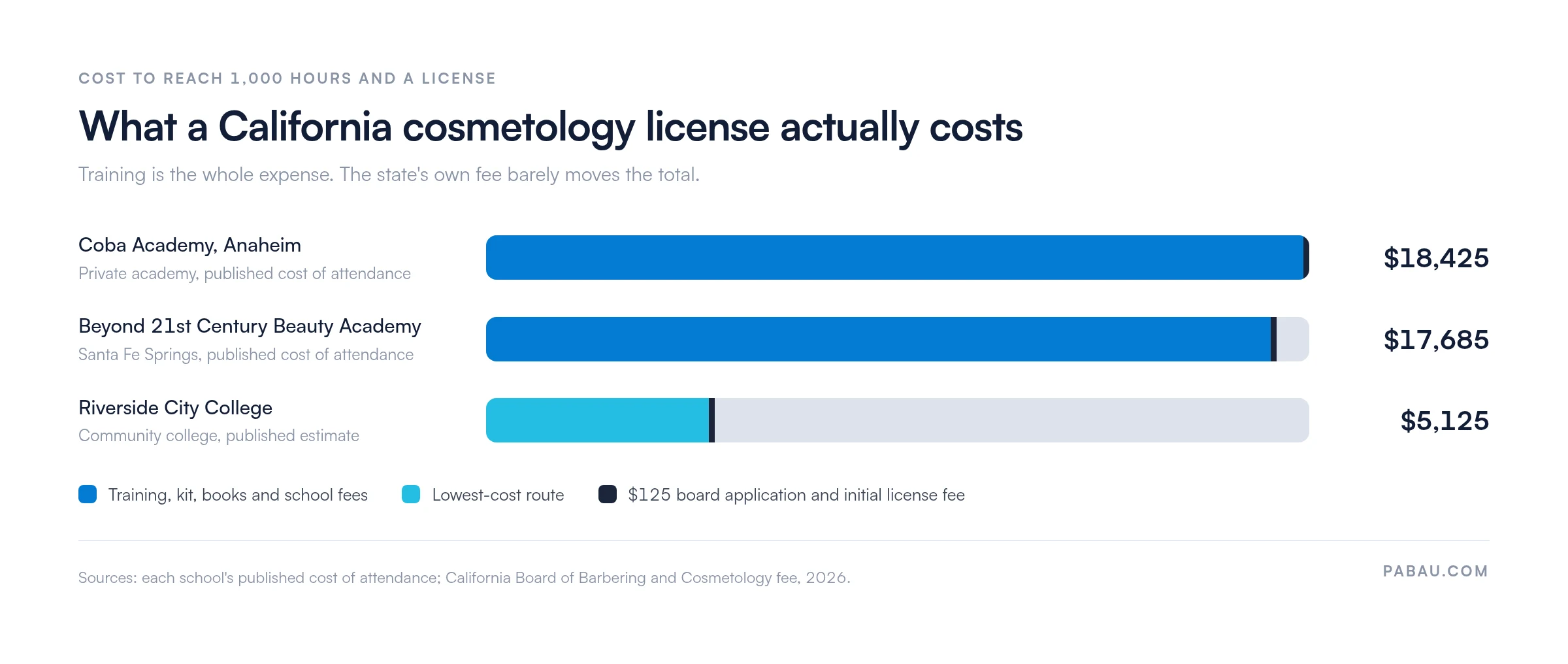
Community college seats are limited and waitlisted, which is the trade-off that does not show up in the price. Private academies enroll on a rolling basis and usually finish faster. Neither route changes the exam or the license you end up holding.
A California cosmetology license renewal costs $50, falls due every two years through BreEZe, and requires no continuing education.
The continuing education point is worth stating plainly. The Board’s own FAQ confirms it requires no continuing education credits to keep a license. Renewal is a fee and a form. An Indiana cosmetology license renews without coursework too, since Indiana repealed its continuing education rule in 2006.
The steps are short:
Miss the date and the license goes delinquent. A late CA cosmetology license renewal costs $75, the $50 fee plus a $25 penalty set at half the renewal fee. You can still renew a delinquent license for up to five years after expiry. Under Tennessee cosmetology license requirements, a lapsed license becomes invalid after three years instead.
Let five years pass and the Board cancels the license outright. Getting it back means applying and passing the written exam again, with the hours already behind you. That is the reason to know how much it costs to renew a cosmetology license before the reminder arrives.
Every cosmetology license California renewal runs on the same two-year cycle and the same $50 fee. An esthetician renews exactly as a cosmetologist does. Practices renewing an esthetician license and a manicurist license in the same month often assume the fees differ. They do not.
Diary the expiry rather than waiting for the reminder. A license expires at midnight on the last day of the month it was issued. That date is fixed the day the licensee first walks out of the PSI center.
You can verify any California cosmetology license free on the Department of Consumer Affairs license search, using the licensee’s name or license number.
A cosmetology license California lookup runs through the DCA license search at search.dca.ca.gov. The cosmetology license lookup covers every board inside the department, so one search checks a cosmetology license, an esthetician license and a nursing license. Four clicks get you there:
Employers verify cosmetology license California records through the same search consumers use, and the status wording is the Board’s own:
For a practice owner, that lookup is a hiring control. Run it before the first shift, and run it again at renewal. A candidate who says the renewal is in the mail is telling you the license has already expired.
Keep the result. Recording the license number and the expiry date against the staff record is the cheapest piece of med spa compliance available. It also means the next inspection does not start with a search through a folder.
Threading, hair braiding, wig work and permanent makeup need no California license, but almost every other salon service does, including shampooing.
The Board publishes the list itself. These services sit outside its jurisdiction entirely:
Unregulated by the Board is not the same as unregulated. Permanent makeup is body art, which your city or county health department permits. Check the local rules before you take a booking, because they carry their own registration and inspection.
California has no makeup license, and no permanent makeup license either. It has no waxing license and no eyelash extension license. Those last two sit inside the cosmetology and esthetician scopes, so the underlying credential is the one you need.
Shampooing is the one that surprises people. Only a licensed barber, cosmetologist, hairstylist or apprentice may wash a client’s hair for pay. The Board issues no shampooing license, so hiring someone purely to shampoo is not an option.
There is no single beauty license California issues, and no separate credential per service. A hair stylist license California recognizes is the 600-hour hairstylist credential SB 803 created. That one covers cutting, styling and blow drying, but not color or perms.
Working without the license a service needs carries a $1,000 fine. The Board cites unlicensed activity under Business and Professions Code section 7317, and the same $1,000 applies to running an unlicensed establishment. Whether haircutting needs a license is answered in the FAQ below.
Yes, California allows an apprenticeship instead of school, at 3,200 supervised on-the-job hours plus 220 related training hours.
The Division of Apprenticeship Standards sets that 3,200-hour figure, and SB 803 did not reduce it. On top of the job hours, the Board requires 220 related training hours of classroom instruction. Apprentices also complete 39 hours of pre-apprentice training before they serve the public.
That brings the full apprenticeship to 3,420 hours, more than three times the school route. School hours and apprentice hours do not transfer in either direction, so switching route means starting the count again. By contrast, the Missouri cosmetology license requirements set a two-to-one ratio, with 3,000 apprentice hours against 1,500 at a board-approved school.
Apprentices need to be 16 and to have completed the 10th grade, a year younger than the school route allows. The apprentice license itself expires two years from issue. Once training ends, an apprentice may not work more than three months without applying for the exam.
The route suits someone already working in a licensed establishment who cannot stop earning to attend school. It suits almost nobody else, because 3,420 hours against 1,000 is a long way to walk to avoid tuition.
California grants a license to any applicant holding a current, unrestricted, good-standing license from another state, with no California exam and no extra training hours. Colorado cosmetology license requirements are stricter, with a transfer by endorsement that can still mean sitting Colorado’s written exam.
SB 803 rewrote Business and Professions Code section 7331 to say exactly that. The Board shall grant a license to an applicant who submits a completed application, the fees, and proof of a current out-of-state license. That license must not be revoked, suspended or otherwise restricted.
Four kinds of license are excluded, and this is the part that catches people mid-move:
The Board can only issue a license type that already exists in California. There is no California waxing license and no eyelash extension license, so neither one transfers. An applicant holding one of those applies for the esthetician license instead.
Reciprocity also costs less than a first license. The fee is $50 for a barber, cosmetologist, electrologist or hairstylist, $40 for an esthetician and $35 for a manicurist. Filing through BreEZe is processed up to three weeks faster than mail.
The practical steps are unusually simple:
Two details trip people up here. The certification letter has to come from the other state board directly, not from you. And a lapsed or restricted license does not qualify, so renew it at home before applying in California.
Reciprocity is not the only out-of-state route. An applicant who trained out of state but holds no current license can still sit the California exam. Licensed work experience can make up the missing hours, and section 7321(d)(2) counts each three months of practice as 100 hours of training.
That credit is not automatic. The Board applies it only after deciding you covered every required subject area. The Board also wants documentation, such as pay stubs, an employment contract or a salon lease.
A California cosmetology license covers hair, nail, skin and makeup services that stay on the surface, and stops at any service that destroys live tissue.
We call that boundary the Med Spa Scope Line, and it is a decision rule rather than a banned list. Ask three questions of any service on your menu. Does it destroy or ablate live tissue? Does it use a laser or another light-based device? Does it need a prescription-strength product or a clinical judgment about the patient?
One yes puts the service on the medical side, whoever performs it and whatever the treatment menu calls it. Renaming a medium-depth peel a signature facial does not move it.
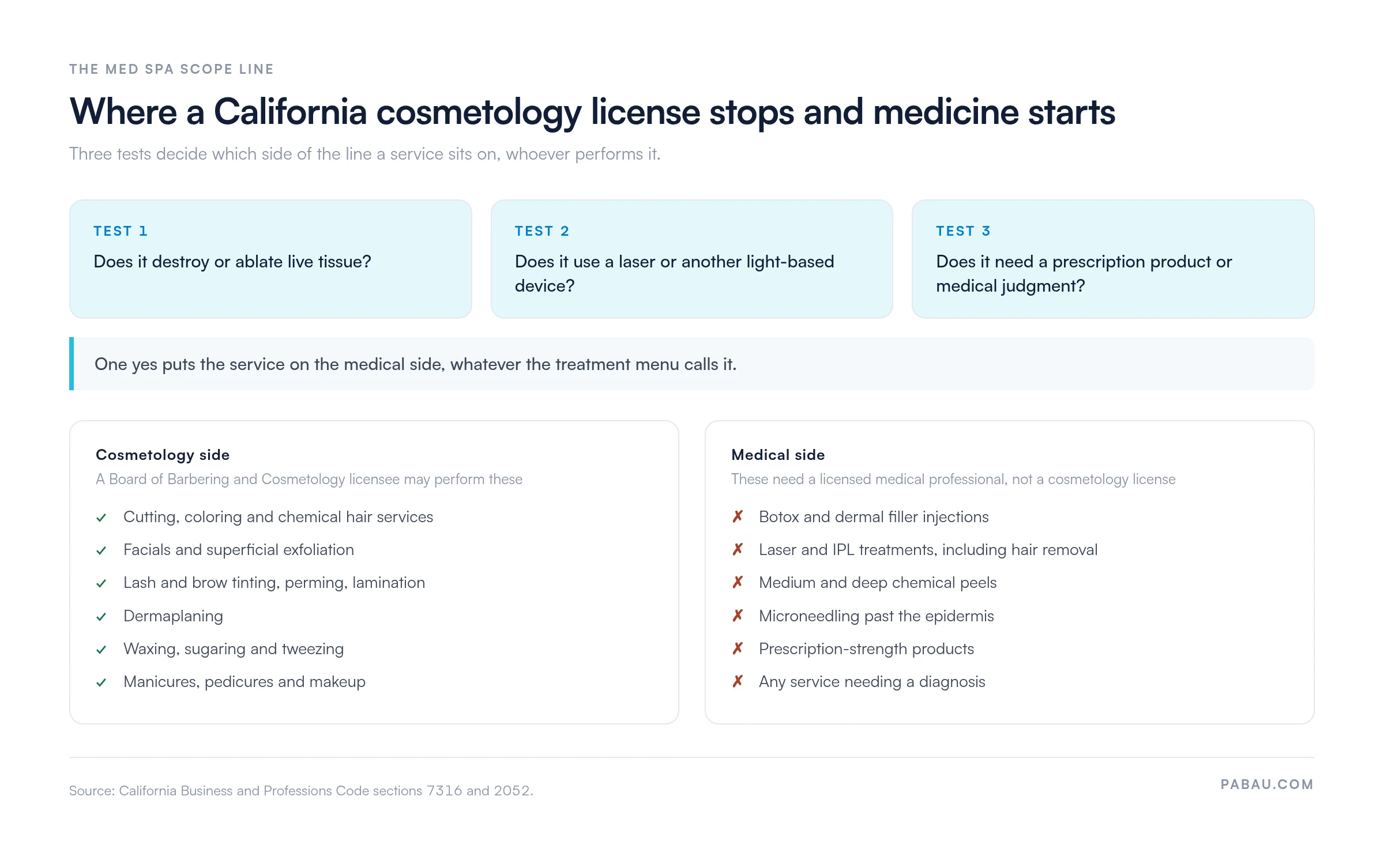
The statute does the work. Section 7316 defines skin care as improving the appearance of the skin without ablating or destroying live tissue. The same section carves laser and light-wave hair removal out of both the esthetician and cosmetologist scopes. You can read the scope definitions in section 7316 in full.
On the other side of the line sits the Medical Practice Act, in Division 2 of the same code. The Medical Board of California enforces it. Section 2052 makes it a criminal offense to treat, operate on or prescribe for a physical condition without a medical certificate. The penalty runs to a $10,000 fine and imprisonment.
Botox, dermal fillers, laser and IPL treatments, medium and deep peels, and microneedling that passes the epidermis all sit on the medical side. A cosmetology or esthetician license does not authorize any of them, and no amount of manufacturer training changes that.
Ownership carries its own constraint. Business and Professions Code section 2400 states that corporations and other artificial legal entities have no professional rights, privileges or powers. Section 2400 is California’s corporate practice of medicine doctrine in one sentence. Wisconsin enforces the doctrine strictly too, yet anyone there may own a salon run by a manager holding a Wisconsin cosmetology license.
Med spas offering medical treatments usually structure around section 2400. A physician-owned professional corporation takes the clinical side, and a management services organization handles the business side. Getting that structure right is a job for a California healthcare attorney, and this guide is general information rather than legal advice.
Our guide to California med spa licensing covers the ownership question in more depth. The practical takeaway for staffing is narrower. A cosmetology-licensed employee builds the treatment relationship, delivers every service on the cosmetology side, and hands over at the Med Spa Scope Line.
In the practices we onboard, staff license numbers usually sit in a paper folder or a shared spreadsheet, not in the booking system. That works until an esthetician’s renewal slips past the expiry date and nobody notices for two weeks, because the calendar never knew about it.
Practice management software like Pabau keeps the staff record and the calendar in the same system. Each practitioner’s details, credentials and renewal date sit on their own record. A manager reviewing who is due to renew opens one screen instead of a second spreadsheet.
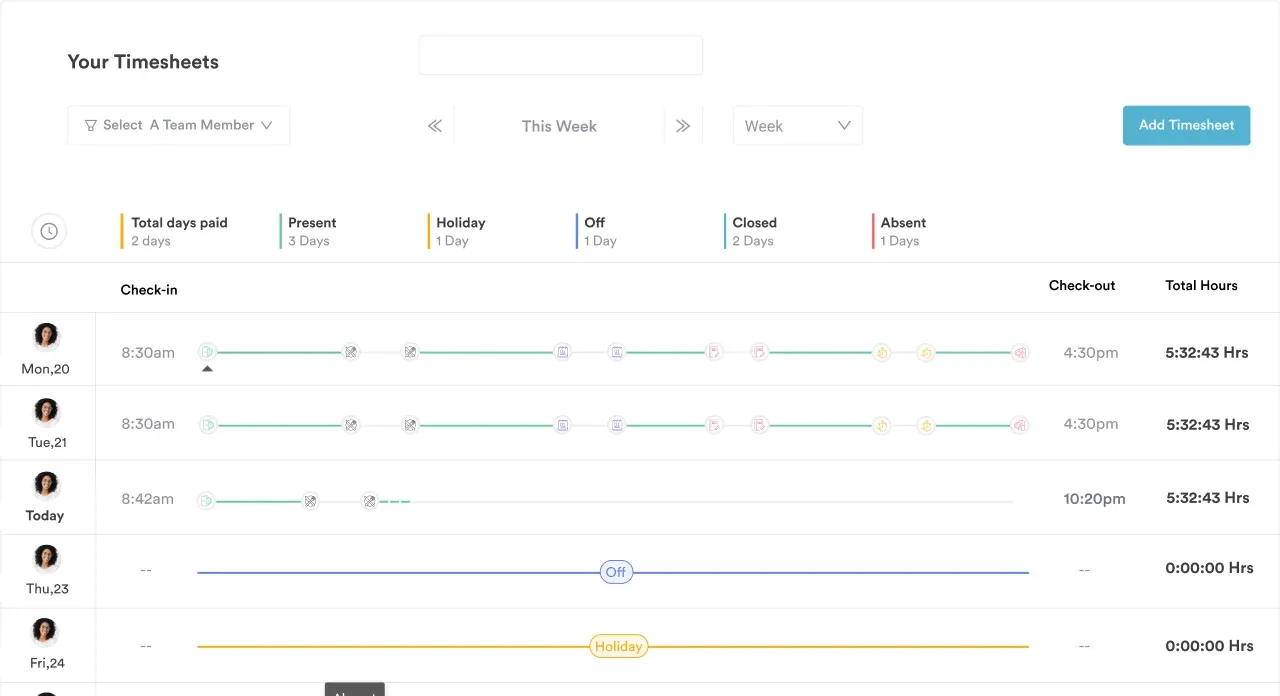
The scope side is where the Med Spa Scope Line becomes an operational control rather than a policy. Pabau lets you set which services each staff member can be booked for. Online booking then never offers a laser slot under an esthetician’s name, so the rule stops depending on the front desk remembering it.
Pabau’s digital consent forms attach to the treatment record too. The consent for a regulated treatment sits with the note, the photos and the practitioner who performed it. That is exactly what an inspector asks to see. If you are comparing systems, our roundup of the best aesthetic clinic software covers how the main platforms handle staff records and consent.
Practices running more than one location get the sharpest benefit. Running every site on scalable med spa software keeps the same scope rules and staff records across all of them.

Pabau holds each practitioner’s credentials on their staff record and controls which services they can be booked for. An expired license or an out-of-scope treatment never reaches the calendar. Your compliance evidence and your schedule stop living in different places.

The licensing part of this is genuinely straightforward. Pick the credential that matches the services you want to sell. Complete the hours at a Board-approved school, pass one written exam, and renew for $50 every two years. California asks less of you than most states do.
The part worth slowing down for is the scope. A cosmetology license is permission to work on the surface of the body. California enforces that boundary through the Medical Board, not the Board of Barbering and Cosmetology. So hiring a well-trained esthetician does not buy you a laser service.
Run the Med Spa Scope Line over your treatment menu before you build the schedule around it. Book a demo to see how Pabau tracks staff credentials and controls which services each practitioner can be booked for.

Opening a med spa in California? Medical spa license California sets out the business, medical and practitioner licenses you need before the first booking.
Need a compliance checklist you can work through? Medical spa compliance checklist covers documentation, consent, staff records and the checks an inspector asks about.
Wondering whether a nurse can own the practice? Can a nurse open a med spa in California works through the corporate practice of medicine rules for non-physician owners.
Comparing state rules before you expand? Texas med spa licensing laws shows how a second state handles medical direction, delegation and scope.
Running more than one site? Multi-location med spa management explains how to keep staffing, scope and standards consistent across locations.
Search the Department of Consumer Affairs license lookup at search.dca.ca.gov by name or license number. The result shows the license type, its status, the expiry date and any disciplinary action. The DCA search is the fastest way to verify a cosmetology license in California before a hire.
Yes. Cutting hair for pay in California requires a license, either a cosmetologist license or the 600-hour hairstylist license created by SB 803. The hairstylist license covers cutting, styling and blow drying, but not chemical services such as color or perms.
Yes, through an apprenticeship. The apprentice route replaces 1,000 classroom hours with 3,200 supervised hours in a licensed establishment. It also requires 220 related training hours and 39 hours of Board pre-apprentice training. School and apprentice hours do not transfer between the routes.
The Board charges $125 for the application, exam and initial license. Training is the larger cost, from about $5,000 at a California community college to $18,300 at a private academy. Renewal is $50 every two years.
About 11 months in California, studying 25 hours a week. The 1,000 training hours take roughly 40 weeks at that pace. The Board then takes about six weeks to approve the application and send the PSI handbook. The license is issued at the test center on the day you pass.
No. Botox, fillers and lasers sit on the medical side of the Med Spa Scope Line. California requires a licensed medical professional to perform them. Business and Professions Code section 2052 makes unlicensed practice of medicine a criminal offense.