Patient financing: How to offer it and stay compliant
Patient financing lets patients spread the cost of treatment over weeks or month...

Last Updated: Oct 7, 2026

Washington cosmetology license requirements are set directly by the Department of Licensing (DOL) under RCW 18.16 and WAC 308-20 — there’s no separate “Board of Cosmetology,” only an advisory board with no licensing authority (RCW 18.16.050).
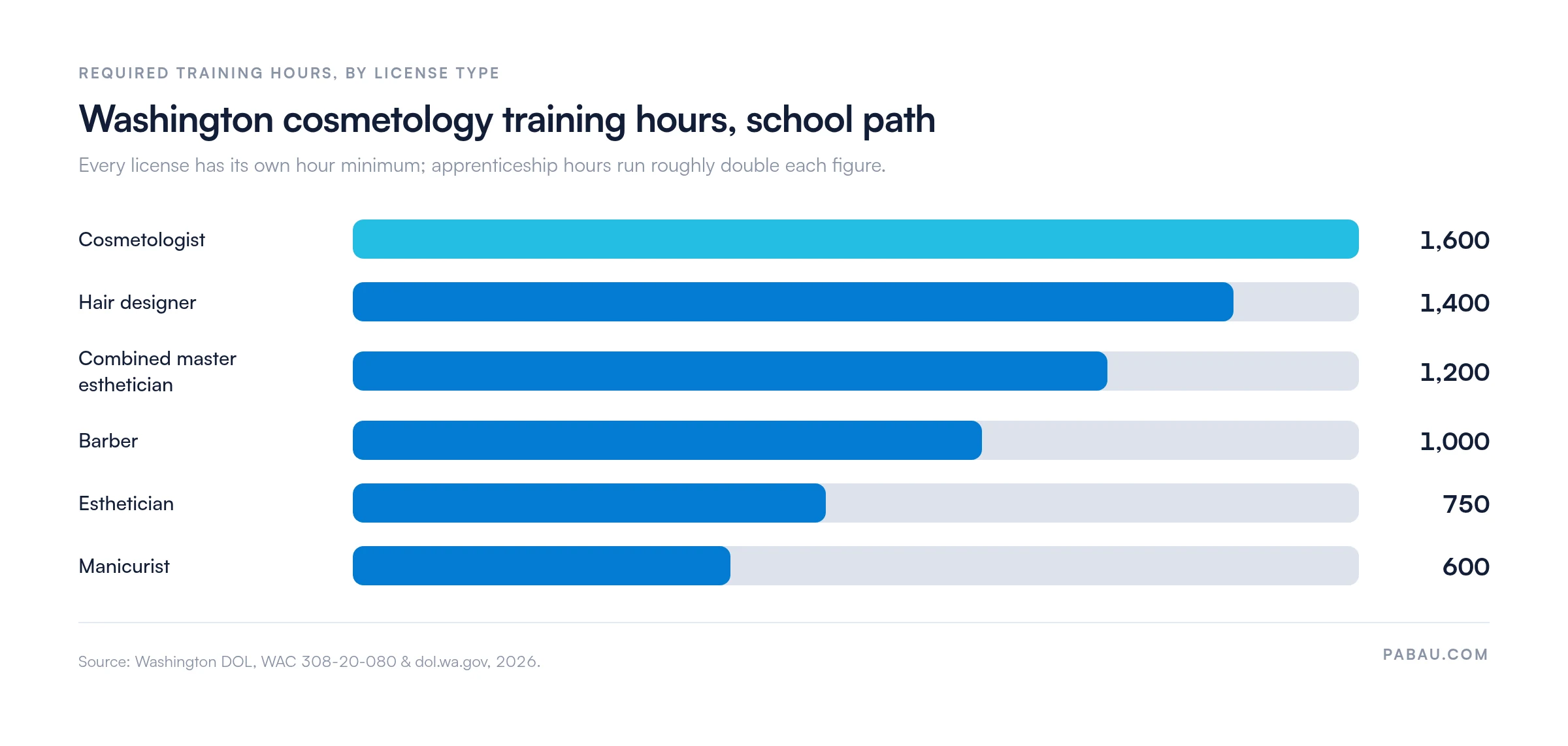
Training hours vary by license type: 1,600 for a full cosmetologist license, 1,400 for hair design, 1,000 for barbering, 750 for esthetics (plus 450 more for master esthetics), and 600 for manicuring, or a longer apprenticeship path for each.
Washington switched cosmetology exam vendors to Prov on May 1, 2026. Budget roughly $323 in total state costs: $169 for the written exam, $119 for the practical, and a $35 DOL application fee.
A cosmetology or esthetics license never covers injections — RCW 18.16.020 excludes them outright. Botox, fillers, and prescription-strength lasers fall under the Washington Medical Commission and the Washington State Board of Nursing instead.
Washington has no statute banning the corporate practice of medicine. The restriction exists only in case law, and a 2025 bill to codify it, 2SSB 5387, stalled without a floor vote.
Washington cosmetology license requirements start with the Department of Licensing, not a state board, and they cover hair, skin, and nail services only — never medicine.
Getting licensed means the training hours DOL sets for your specific license type, then the National-Interstate Council’s written and practical exams, now run by a vendor that changed mid-2026.
That part is a checklist. The part most guides to this topic skip is where the license’s authority actually stops. An injectable or a prescription-strength laser crosses into medicine under Washington law. A different pair of state boards takes over from there, plus a corporate-practice rule that exists nowhere in the statute books.
This guide covers both: the licensing steps every applicant needs, and the scope-of-practice line that matters most to anyone building a salon or med-spa business in Washington. For the broader question of which licenses a med-spa needs before it opens its doors, see our guide to licensing requirements for opening a medical spa.
No board reviews an individual Washington cosmetology application. The DOL Director issues every license directly, under RCW 18.16.030. An advisory-only body, the state cosmetology, hair design, barbering, esthetics, and manicuring advisory board (RCW 18.16.050), has up to 10 members serving 3-year terms. It recommends rule changes, and doesn’t vote on individual licenses.
That split is why “Washington state board of cosmetology” is a common search even though the entity doesn’t exist under that name. Medicine and nursing each run through an actual board. Cosmetology is a director-run licensing program instead — worth knowing before a scope question ends up in front of the wrong office.
Hours are the requirement most applicants ask about first, and Washington sets a different number for each license, with a longer apprenticeship option behind every one of them.
Other states land on different totals for the same license types — see how Utah cosmetology license requirements and Arizona cosmetology license requirements set their own hours.
Every school track pairs hands-on technical training with sanitation, disinfection, and a laws-and-rules module covering RCW 18.16 itself.
The apprenticeship path swaps classroom time for supervised on-the-job hours at a licensed shop, at roughly double the school-hour figure. It suits someone already working under a licensed practitioner, at the cost of a longer timeline.
A Washington state esthetician license requires 750 hours of training in skin care: facials, exfoliation, waxing, and non-prescription hair removal. Master esthetician training adds 450 hours covering medium-depth peels and specific devices — lasers, IPL, radiofrequency, plasma, and ultrasound.
That additional scope only applies when the device isn’t FDA prescription-only. RCW 18.16.020 is explicit that esthetics, at any tier, never includes injections. That line is the subject of the next section, because it’s the one that trips up growing med-spa practices.
House Bill 1874, effective March 1, 2026, amended RCW 18.16.020 and 18.16.030 to expand what a Washington cosmetology curriculum must cover.
Schools now have to teach textured-hair cutting, styling, and chemical treatment techniques, the tools and products those services need, hair and scalp health, and cultural competency and history. It’s a curriculum requirement for schools, not an extra step for individual applicants. It does change what “1,600 hours” now has to include.
A Washington cosmetology or esthetics license authorizes cosmetic services — never medicine. RCW 18.16.020 says so directly: “under no circumstances does the practice of esthetics include the administration of injections.” That single line is the scope-of-practice line every med-spa owner in Washington needs to know before adding a treatment to the menu.
Two Washington Medical Commission rules set what happens on the other side of that line. WAC 246-919-605 covers laser and light-based devices. A physician may perform the treatment or delegate it to a properly trained, licensed professional, but must be on the premises for that patient’s initial treatment.
After that, a local backup physician has to be reachable within 60 minutes if the delegating physician isn’t there. WAC 246-919-606 covers nonsurgical medical cosmetic procedures — Botox, dermal fillers, and similar injectables.
Those are delegable only to a trained PA, RN, or LPN, never to a cosmetologist or esthetician at any license tier. For an FDA-approved, on-label injectable, the physician needs to be reachable by phone within 30 minutes.
Off-label use requires the physician on-site instead. Both rules require a written office protocol and a patient consent form naming the delegate. For what this same delegation relationship looks like from the physician’s side in another state, see medical director for med spa Texas.
Washington also has no statute banning the corporate practice of medicine. That restriction lives entirely in case law, including Morelli v. Ehsan (1988) and Washington Imaging Services, LLC v. Department of Revenue, 171 Wn.2d 548 (2011).
Both cases held that a business entity generally can’t employ physicians or own a medical practice without legislative authorization. A 2025 bill, 2SSB 5387, would have written that restriction into statute explicitly. As of this writing it has stalled in Senate Rules without reaching a floor vote.
Separately, RCW 19.68.010 bars rebates or commissions tied to patient referrals — relevant to any fee arrangement between a med-spa business and the physician delegating its medical services.
Washington requires both a written and a practical NIC exam, and the vendor administering them changed on May 1, 2026. DOL’s own site confirms the switch from D.L. Roope Administrations to Prov, describing it as “the same NIC exams” candidates have always taken.
Under the prior vendor, Washington required a scaled score of 75 on each exam. DOL’s continuity language implies that threshold carries over under Prov, though anyone testing soon should confirm the current figure directly with Prov before exam day.
Prov’s April 2026 Washington candidate bulletin lists the exam fees at $169 for the written exam and $119 for the practical. Both are paid to Prov directly, separate from DOL’s $35 application fee.
To transfer a cosmetology license to Washington, apply under RCW 18.16.130 with proof of an active license in good standing from another state and pay a $60 reciprocity fee.
If you already passed a written and practical exam elsewhere, Washington waives its own exam and processes the application as a reciprocity case. Without that, you’ll sit Washington’s exam as an out-of-state applicant instead.
Washington has also enacted the Cosmetology Licensure Compact under House Bill 1023, codified at RCW 18.16.400 and effective June 1, 2028. Once the compact is operational, a license from another member state will carry directly into Washington without a separate application. That’s a faster path than today’s reciprocity process, though it isn’t live yet.
Washington cosmetology licenses renew every two years under RCW 18.16.110. Each license carries its own expiration date rather than a single date shared by every licensee, and the renewal window opens up to 120 days before that date.
Unlike several other states, Washington requires no continuing education for a standard renewal. DOL’s renewal checklist covers only updated contact information, the renewal fee, and a legal-background question. The fee is $66 on time, rising to $131 for a late renewal.
Anyone can run a Washington cosmetology license lookup through DOL’s public license verification tool, searching by the licensee’s name or license number.
It returns the license’s current status, its expiration date, and any public disciplinary action on file. A salon owner can use it to check a new hire before their first shift, and a client can use it to confirm a provider is actually licensed before booking.
Beyond the individual practitioner’s license, Washington requires a separate location license for the salon, shop, personal service business, or mobile unit itself, defined at RCW 18.16.020. The business or premises operator applies for it, not the individual cosmetologist working there.
RCW 18.16.175 requires at least $100,000 in public liability insurance and registration with the Department of Revenue, plus a periodic premises inspection. The location license costs $121 to obtain or renew, $181 if renewed late, and renews annually under WAC 308-20-560.
Workplace safety sits under a separate rulebook from licensing. An OSHA safety handbook gathers the written exposure control plan, hazard assessment, and training records an employer keeps.
Practice management software like Pabau gives a Washington salon or med-spa one place to store every provider’s license number, license type, and expiration date against their staff profile.
That covers a cosmetologist, esthetician, RN, ARNP, or physician, all in the same system. Role-based permissions then keep booking honest. An esthetician’s calendar shows only the services their license covers, so nobody schedules an injectable against a provider the scope-of-practice line doesn’t authorize to perform.
That matters more in Washington than in a state with a single combined board. The gap between “cosmetic” and “medical” here is enforced by DOL, the Washington Medical Commission, and the State Board of Nursing separately, each with its own paperwork.
A Washington business running cosmetology staff alongside a physician-delegated medical spa needs one system tracking all three, rather than a spreadsheet per license type.
The same record ties a treatment to its consent form and the treating provider’s notes — exactly what a Medical Commission delegation review asks for first. That system should cover the basics on a medical spa compliance checklist, from HIPAA-compliant recordkeeping to the insurance coverage a delegated-service practice needs to carry.

Pabau stores each provider’s license number, type, and expiration date on their staff profile, and role-based permissions keep booking limited to what that license actually covers. Consent forms and treatment notes tie to the same patient record.

Washington cosmetology license requirements aren’t complicated once you know which office to ask. The DOL Director sets your hours, your exam, and your renewal cycle, under RCW 18.16 and WAC 308-20.
Growing practices rarely trip over the cosmetology license itself. They trip by assuming that license stretches to cover Botox, fillers, or laser work RCW 18.16.020 was never written to authorize.
That line is enforced by the Washington Medical Commission and a corporate-practice restriction that exists only in case law, not by anything in the cosmetology statute.
Get the license-type requirements right, respect the scope-of-practice line, and a Washington health care attorney’s advice on the medical side costs far less than a Medical Commission investigation.
Book a demo to see how Pabau helps a Washington salon or med-spa manage licensing, staff, and compliance records in one system.

Wondering who can legally own the medical side of your practice? Who Can Open a Medical Spa? State Ownership Rules breaks down the ownership models most states allow.
Comparing how other states draw this line? Med spa laws by state: Ownership, licensing, and compliance guide rounds up ownership and licensing rules state by state.
Need a physician to delegate injectables under WAC 246-919-606? How to hire a medical director for your med spa walks through finding and contracting one.
No. Washington cosmetology license requirements are set by the Department of Licensing’s Director directly, under RCW 18.16.030. An advisory board exists under RCW 18.16.050, but it only recommends rule changes — it doesn’t review or vote on individual licenses.
Yes, through an apprenticeship. Washington accepts supervised on-the-job training at a licensed shop instead of school hours, at roughly double the school-hour figure for each license type. A cosmetologist apprentice needs 3,000 hours, against 1,600 school hours, for example.
Requirements vary by state, and some set their cosmetologist minimum around 1,200 hours. Washington requires more: 1,600 hours for a full cosmetologist license, or 3,000 through the apprenticeship path.
No. RCW 18.16.100 sets only a minimum age of 17 for licensure — there’s no maximum age to enroll in a cosmetology program or apply for a license in Washington.
No. RCW 18.16.020 excludes injections from the practice of esthetics under any circumstances, and prescription-strength lasers are only delegable to a physician’s trained designee under WAC 246-919-605 — never to a cosmetology or esthetics license on its own.
Budget around $323 in state-level costs: $169 for the written exam and $119 for the practical, both paid to Prov, plus a $35 DOL application fee. That figure covers licensing fees only — it doesn’t include school tuition.