Patient financing: How to offer it and stay compliant
Patient financing lets patients spread the cost of treatment over weeks or month...

Last Updated: Oct 7, 2026

Wisconsin requires 1,550 training hours over at least 10 months, or a 4,000-hour apprenticeship, before you take the exam.
The Cosmetology Examining Board issues the license under Wis. Stat. ch. 454, and DSPS processes applications in the LicensE portal.
Renewal falls on March 31 of every odd-numbered year and costs $11, rising to $36 once the late fee applies.
DSPS lists no continuing-education hours for renewing an active cosmetology license, which contradicts several third-party renewal guides.
The Wisconsin Scope Line is the rule to remember: anyone may own a salon, but only licensed physicians may own a medical practice.
Wisconsin cosmetology license requirements come down to 1,550 training hours, a written and practical state board exam, and an $11 credential fee. That is the checklist. The rest is sequencing.
A Wisconsin cosmetology license and a Wisconsin medical license answer to two different boards. Both boards sit inside the same department, which is why practitioners conflate them. The two credentials also carry different ownership rules, and that boundary is what we call the Wisconsin Scope Line.
This guide covers what a cosmetology license in Wisconsin requires: the hours, the exam, the fees, the lookup, renewal, endorsement and the establishment license. It then covers where that authority ends. A practice that adds injectables or laser answers to a different board, under a different ownership rule.
A Wisconsin cosmetology license takes 1,550 training hours, a high school diploma or GED, and a passing state board exam. The cosmetology license requirements in Wisconsin, with the current fees and dates, sit in the table below.
Neither DSPS’s cosmetologist page nor a school’s program page carries all of this in one place. Assembling it takes three separate documents. This table is that assembly.
| Requirement | Detail |
|---|---|
| Training hours | 1,550 hours over at least 10 months, at a school licensed in Wisconsin |
| Alternate route | A 4,000-hour apprenticeship: 3,712 practical hours plus 288 theoretical hours |
| Education | High school diploma or GED, or age 18 and over under the ability-to-benefit rule |
| Exam | Written and practical, both administered by DL Roope Administrations Inc. |
| Application | Online in the LicensE portal at license.wi.gov |
| Initial credential fee | $11. On the exam route your first license fee sits inside the DL Roope exam fee |
| Renewal date | March 31 of every odd-numbered year |
| Renewal fee | $11, or $36 once the $25 late fee applies |
| Continuing education | None listed by DSPS for an active license |
| Regulator | Cosmetology Examining Board, part of DSPS |
| Governing statute | Wis. Stat. ch. 454 |
Every fee above comes from DSPS’s own Renewal Dates and Fees document, revised August 7, 2025, and from the Cosmetology Examining Board’s endorsement application form.
The Cosmetology Examining Board licenses Wisconsin cosmetologists, and the Department of Safety and Professional Services processes every application and renewal.
The Department of Safety and Professional Services, known as DSPS, is the umbrella agency. DSPS houses the Cosmetology Examining Board, the Medical Examining Board and the Board of Nursing. The Cosmetology Examining Board writes the practice rules under Wis. Stat. ch. 454, and DSPS handles the credentialing mechanics under Wis. Stat. § 440.08(2).
One portal does all the work. LicensE, at license.wi.gov, is where you apply, renew, report a change of manager, and look up any credential DSPS has issued. The same board also licenses cosmetology establishments and cosmetology schools, so a salon owner and a school owner file with the same office.
Wisconsin requires 1,550 hours of cosmetology training spread over at least 10 months, at a school licensed in Wisconsin.
The 10-month floor matters as much as the hour count. A school cannot compress 1,550 hours into a summer. The fastest honest timeline to a Wisconsin cosmetology license is roughly a year from your first day of class.
On the education side, DSPS accepts a high school diploma or a GED. Applicants without either can qualify if they are at least 18 and meet the federal ability-to-benefit standard at 20 USC 1091(d). Wisconsin sets no maximum age at any point in the process.
You can qualify for a Wisconsin cosmetology license without attending a cosmetology school, through the apprenticeship route under Wis. Stat. § 454.10 and Wis. Admin. Code SPS 50.340.
Read those two numbers together before you choose. The apprenticeship costs no tuition and pays as you go. But it asks for roughly two and a half times the hours a school does, over a far longer calendar.
Trained at a school in another state with matching hours? Then you skip school entirely. You take the Wisconsin exams, and your school submits a Certification of Training, Form 3044, directly to DSPS.
The Wisconsin cosmetology exam has two parts, a written test and a practical test, both administered by DL Roope Administrations Inc.
DL Roope Administrations Inc. is the board’s exam vendor, not a study provider. You apply for the exam with DL Roope rather than with DSPS, and you pay their exam fee rather than a state exam fee. The vendor’s candidate handbook carries the content outline and the booking process.
One detail saves people a duplicate payment. The DL Roope exam fee already includes the fee for your first license. A candidate on the exam route does not pay DSPS a separate $11 on top.
Candidates who trained out of state can also apply for a temporary permit, for an extra $10 paid to DL Roope. That permit lets you work while DSPS reviews the file.
The sequence runs school first, exam second, application third. Jumping ahead stalls the file, because the Cosmetology Examining Board reviews eligibility only once the school and the exam vendor have reported.
DSPS does not publish a turnaround time for step seven, so treat any figure you see quoted elsewhere with suspicion. Applicants who trained out of state and want to start earning immediately should take the temporary permit rather than guess at the wait.
A Wisconsin cosmetology license lookup runs through the DSPS LicensE portal at license.wi.gov, which returns the credential number, its current status and its expiry date.
The lookup is the same public search DSPS uses across every profession it credentials. Search by name or by license number. A cosmetologist and a nurse can be verified on the same screen, which helps a practice hiring on both sides of its business.
Two results confuse people. An expired credential shows its status rather than vanishing from the search, and a credential on Inactive 454 status appears with that status named. Neither status is a license to practice, so read the status line rather than the presence of a record.
Running the search takes under a minute, and it is worth running at three points.
Wisconsin cosmetology license renewal falls on March 31 of every odd-numbered year and costs $11, or $36 once the late fee applies.
Renewal happens in LicensE, the same portal that handled your first application. Online renewal is the only route DSPS documents. The $25 late fee is what takes the $11 to $36.
Wisconsin sets one renewal date across the whole profession, rather than dating each credential from the day it was issued. The cycle is biennial, so the deadline only lands in odd-numbered years.
The fee is the same $11 whether you renew a cosmetologist credential or a cosmetology establishment license. Each one renews separately, on the same date. DSPS sends the renewal notice to the email address on your credential record, so an out-of-date address is worth fixing before March.
DSPS lists no continuing-education hours for renewing an active Wisconsin cosmetology license.
The absence is worth stating plainly, because several third-party renewal guides advertise four CE hours every two years for Wisconsin cosmetologists. DSPS’s own cosmetologist page lists none, and neither do its renewal documents.
What renewal does carry is an attestation. You confirm that you have reviewed the changes to the Wisconsin statutes and rules governing barbering, cosmetology, aesthetics, manicuring and electrology. DSPS publishes those changes as a digest rather than as a course you buy.
Renewing an expired credential is the exception. DSPS applies the requirements in force at the time you catch up, which can include continuing education, plus the $25 late fee.
Inactive 454 status keeps a credential current for $5.50 while you are not practicing. Cosmetologists, aestheticians, electrologists and manicurists can all request it. You must refrain from the practice the license authorizes, and you pay the remaining $5.50 to return to active status.
You transfer an out-of-state cosmetology license to Wisconsin through licensure by endorsement, which needs a current license elsewhere plus a one-hour Wisconsin law course.
Endorsement is the route 2017 Wisconsin Act 81 created, and it is far shorter than starting over. The Cosmetology Examining Board’s endorsement form lists four items that must reach DSPS before the file is complete.
Two details trip people up. You have to hold a current license in at least one state, so a lapsed out-of-state credential will not carry you. And the law course certificate has to come from the school, not from you, so order it early. DSPS publishes the list of approved courses.
If you do not qualify for endorsement, the exam route still works. Graduates of an out-of-state school with hours matching Wisconsin’s pass the DL Roope written and practical exams, and their school sends Form 3044. No additional DSPS fee applies, because the license fee sat inside the exam fee.
Any person may own a cosmetology establishment in Wisconsin, licensed or not, provided the salon employs a full-time manager who holds a cosmetology license.
Wis. Stat. § 454.06 sets the rule. The owner must employ at least one manager who holds a cosmetology license, and that manager must run the establishment on a full-time basis. An unlicensed owner can hire, invest and run the business, but cannot personally perform cosmetology, aesthetics, electrology or manicuring.
There is no separate manager credential to chase. DSPS’s current credential list carries three entries on the cosmetology side: Cosmetologist, Cosmetology Establishment and Cosmetology School. The manager on your establishment application holds an ordinary cosmetology license.
An application for establishment license is filed in LicensE for $11. The Wisconsin establishment license then renews on March 31 of odd-numbered years for another $11. The DSPS establishment page lists the supporting forms.
Mobile salons work differently. Wisconsin ties a mobile establishment license to one specific vehicle, and it cannot be transferred to another. The application asks for a vehicle description, interior and exterior photographs, and the vehicle registration certificate.
A Wisconsin cosmetology license covers hair, skin, nail and hair-removal services, but not injectables, laser or any procedure that counts as practicing medicine.
That sentence is where the Wisconsin Scope Line starts, and the line runs in two directions. One is scope of practice: what you are allowed to do. The other is ownership: who is allowed to own the business doing it. Both matter, and the second one decides what kind of company you have to form.
Wisconsin puts hair removal inside cosmetology, with one carve-out: removal by electric needle. Electrology is a separate credential, with its own 450 training hours and its own exam. A cosmetology license does not reach it.
Lash work sits on the other side of the same logic. DSPS’s credential and fee schedules list no lash-technician license at all. Eyelash extensions in Wisconsin are therefore performed under a cosmetology or aesthetician license rather than one of their own. City ordinances can add conditions, so check the municipality as well as the state.
Injectables, laser and prescription-strength treatments are the practice of medicine in Wisconsin. The Medical Examining Board regulates them under Wis. Stat. ch. 448, and Wisconsin enforces the corporate-practice-of-medicine doctrine strictly.
Only a professional corporation or a professional limited liability company owned entirely by Wisconsin-licensed physicians may practice medicine. The rule sits across Wis. Stat. §§ 448.02, 448.03(1), 448.05 and 448.08(1), grounded in Wisconsin Attorney General Opinion OAG 39-86.
Wis. Stat. § 180.1911 adds a same-field rule, which restricts professionals from different fields co-owning one practice entity. Where a nurse performs a delegated procedure under physician supervision, the Board of Nursing governs that nurse under Wis. Stat. ch. 441.
All three boards sit inside DSPS, which is exactly why the conflation is so easy. One department, one portal, three legally distinct authorities with three different statutes. The comparison below sets the two ownership regimes against each other.
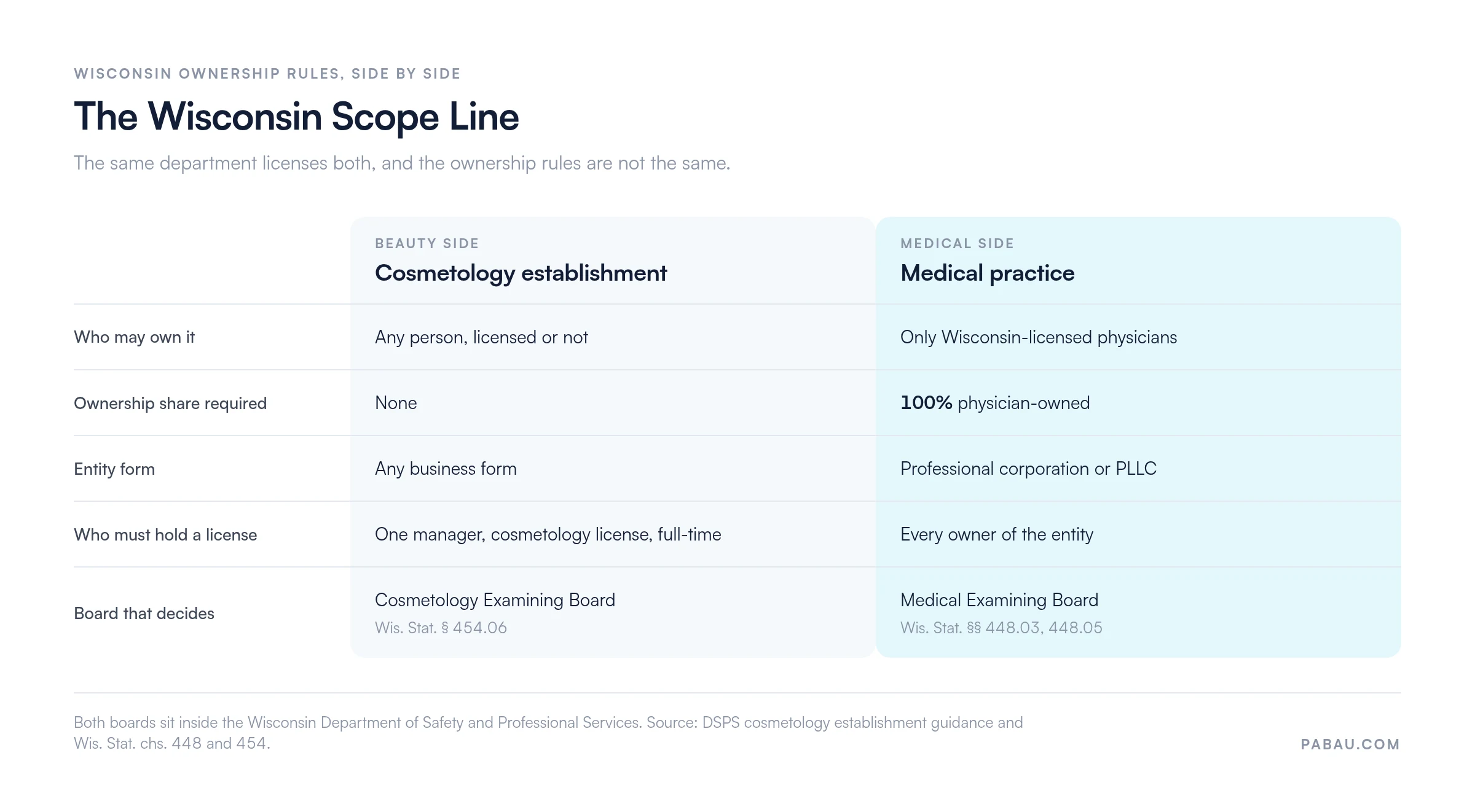
Read the two columns and the practical consequence falls out. A salon owner who adds a Botox room needs a second entity, physician-owned, standing beside the first. That entity answers to its own board, under its own statute.
That is a business decision more than a paperwork one. The Scope Line is the point at which opening a medical spa becomes a different project from opening a salon. The system changes too. Purpose-built medical spa software carries consent, charting and prescriber records that a salon booking tool never needed.
In the multi-service practices we onboard, staff credentials tend to live in three places at once: a spreadsheet, a shared drive, and somebody’s memory. That holds up until an inspector asks for the manager’s license number, or a renewal slides past March 31.
Practice management software like Pabau keeps the practitioner record and the calendar in one system. Pabau’s team management holds each staff member’s details and permissions, so whoever books a laser appointment can see who is cleared to take it.
Pabau’s digital forms and consent tools cover the client-facing half. Consent forms, medical questionnaires and before-and-after photos land on the client record automatically. Consent records are the paperwork an inspector asks for first, and the paperwork a paper-based salon spends longest hunting for.
Pabau’s reporting closes the loop. A practice running a salon alongside a physician-owned treatment room can show which practitioner performed which treatment, rather than describe the split from memory. Weighing systems for that setup? Our roundup of the best medical spa EMR software compares the options. The medical spa compliance checklist covers what the medical side needs on day one.

Pabau holds staff records, permissions, consent forms and treatment notes in one system. A practice running salon and medical services side by side can produce the right document fast. Reporting shows who performed what, per practitioner.

The licensing part of this is genuinely simple, and cheaper than the internet suggests. Wisconsin asks for 1,550 hours, two exams and $11. The numbers that look alarming online, $82 and $315 among them, are a stale 2017 renewal fee and a school’s rough estimate.
The part worth planning around is the Scope Line. Two licenses, two boards, two ownership rules. Anyone can own the salon; only physicians can own the medical practice. Decide which side of that line your business plan sits on before you sign a lease. The entity you form is hard to unpick later.
Whichever side you land on, the credentials and the consent forms have to be findable on demand. Book a demo to see how Pabau keeps staff licenses, renewal dates and client consent in one record for salon and medical services alike.

Licensed in Texas too, or moving there next? Texas cosmetology license requirements sets out the 1,000-hour path and how TDLR handles an out-of-state license.
Comparing states before you commit? Understanding California cosmetology laws covers the hours, the board and the scope rules in the strictest state in the country.
Adding medical treatments to a salon? Med spa compliance for owners walks through supervision, documentation and the inspections that follow the medical side of the business.
Shopping for a system to run it all? Best aesthetic clinic software reviews the platforms that handle bookings, records and consent in one place.
Wisconsin issues no separate lash-technician credential. Eyelash work therefore runs under a cosmetology or an aesthetician license. Check your city’s ordinances as well as the state rules.
No. Wisconsin sets no maximum age for a cosmetology license. The only age condition is the minimum of 18 attached to the ability-to-benefit route, which applies to applicants without a diploma or GED.
The cosmetology board license lookup returns the credential number, the profession, the current status and the expiry date. An expired credential, or one on Inactive 454 status, shows that status rather than disappearing from the search.
You sign in to the LicensE portal at license.wi.gov using the account tied to your credential. From there you can renew the credential online and pay the $11 fee by card.
No. Wisconsin licenses the credential as aesthetician and sets it at 450 training hours, against 1,550 for cosmetology. The esthetician and cosmetology credentials carry separate scopes, and neither one is a tier of the other.