HD Brows consultation form: Free template and guide
HD Brows is a seven-step brow treatment that combines consultation, tinting, wax...

2
Last Updated: Oct 13, 2026

Indiana requires 1,500 training hours for a cosmetologist license, and since July 2024 a registered apprenticeship also qualifies you to sit the exam.
A beauty culture license costs $40 to apply for and $40 to renew every four years, with no continuing education attached.
You need 75% on both the written and the practical exam, and PSI administers only the written half.
Reciprocity sets a different hour floor for each license type, so the flat 1,000-hour figure fits only two of the six.
Practice owners can check a hire’s license free through Indiana’s Search and Verify tool before the first shift.
Indiana cosmetology license requirements come down to four checks: your age, your education, 1,500 training hours and two exams. Both exams pass at 75%. The Indiana Professional Licensing Agency issues the license once you clear all four, and the application costs $40.
The detail matters more than it looks. Published guides disagree on Indiana’s renewal cycle, its continuing education hours and its exam length. One wrong figure can cost an applicant a year, or leave a practice owner with an unlicensed stylist on shift.
Every number below traces to the Indiana Code, the Indiana Administrative Code, the PLA or PSI’s current bulletin. Each stage runs in order, from a first day of school to the renewal notice four years later.
A cosmetologist can apply at 17, once tenth grade or its equivalent is finished. That floor sits in IC 25-8-9-3. A blanket minimum age of 18 does not reach this license, and neither does a minimum of 16.
The other five licenses set their own floors. A manicurist must be 18 with eighth grade behind them. A barber can start at 17 with a high school diploma, or at 18 without one.
Education is the lighter of the two checks. IC 25-8-9-4 even lets the board waive the tenth-grade requirement on a hardship petition. After that, hours do the work.
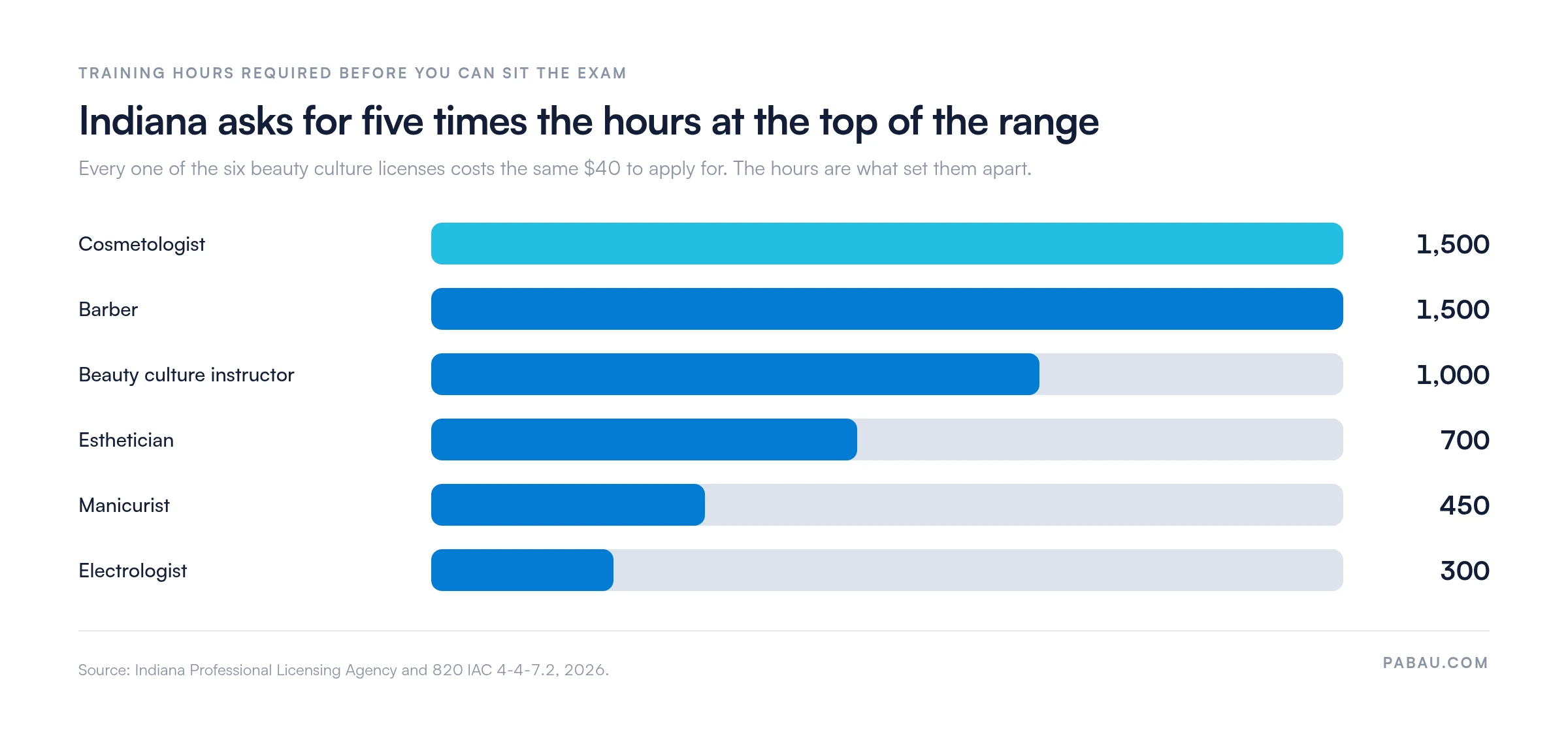
The table below pulls the age rule, the education rule, the training hours and the application fee together for all six beauty culture licenses.
Ages come from IC 25-8-9-3, IC 25-8-11-4, IC 25-8-12.1-3, IC 25-8-12.5-4 and IC 25-8-6-3. Hours come from the PLA, with the instructor curriculum set out at 820 IAC 4-4-7.2. Fees come from 820 IAC 7-1-1, and every individual application costs the same $40.
So the fee column is flat all the way down. The hours column runs from 300 to 1,500, and that spread is what separates the six licenses.
Indiana used to require graduation from a beauty culture school, with no alternative. That changed on July 1, 2024. IC 25-8-9-4.5, added by P.L.82-2024, opened a second route to the same exam.
Finish a US Department of Labor registered apprenticeship in cosmetology and you qualify to sit the licensing exam. The same act amended IC 25-8-9-3 to accept an apprenticeship in place of school graduation.
That route covers the cosmetologist license only. Esthetician, manicurist, barber, electrologist and instructor applicants still graduate from a beauty culture school program.
There is one practical caution. The PLA’s own licensing page still describes the school route, so confirm the paperwork with the board before you commit to an apprenticeship.
The Indiana State Board of Cosmetology and Barber Examiners writes these rules, and the PLA administers them. Two license types have to sit on top of another one.
An electrologist must already hold a cosmetologist or esthetician license under IC 25-8-10-3. An instructor must already hold one of the five practitioner licenses under IC 25-8-6-3. Both hour figures buy additional training, not a standalone program.
Barbering runs through the same board on a separate track, with its own age rule and its own written exam. The barber rows above are there for comparison.
Indiana publishes no official timeline. A full-time student clearing 1,500 hours at 30 to 35 hours a week finishes school in roughly 43 to 50 weeks.
Call it 10 to 12 months of classroom time, then add the exam and the application. Treat that as an estimate built from the hour requirement, not a duration the PLA publishes.
One deadline is fixed and easy to miss. An application not completed within one year of filing is automatically abandoned, and the board takes no action on it. Filing early, before your hours are finished, starts that clock.
Part-time study stretches the same 1,500 hours across two years or more. Hours are the constraint, and the calendar follows them.
Laid out end to end, the path runs through five checks, and each one carries a number worth knowing before you start.
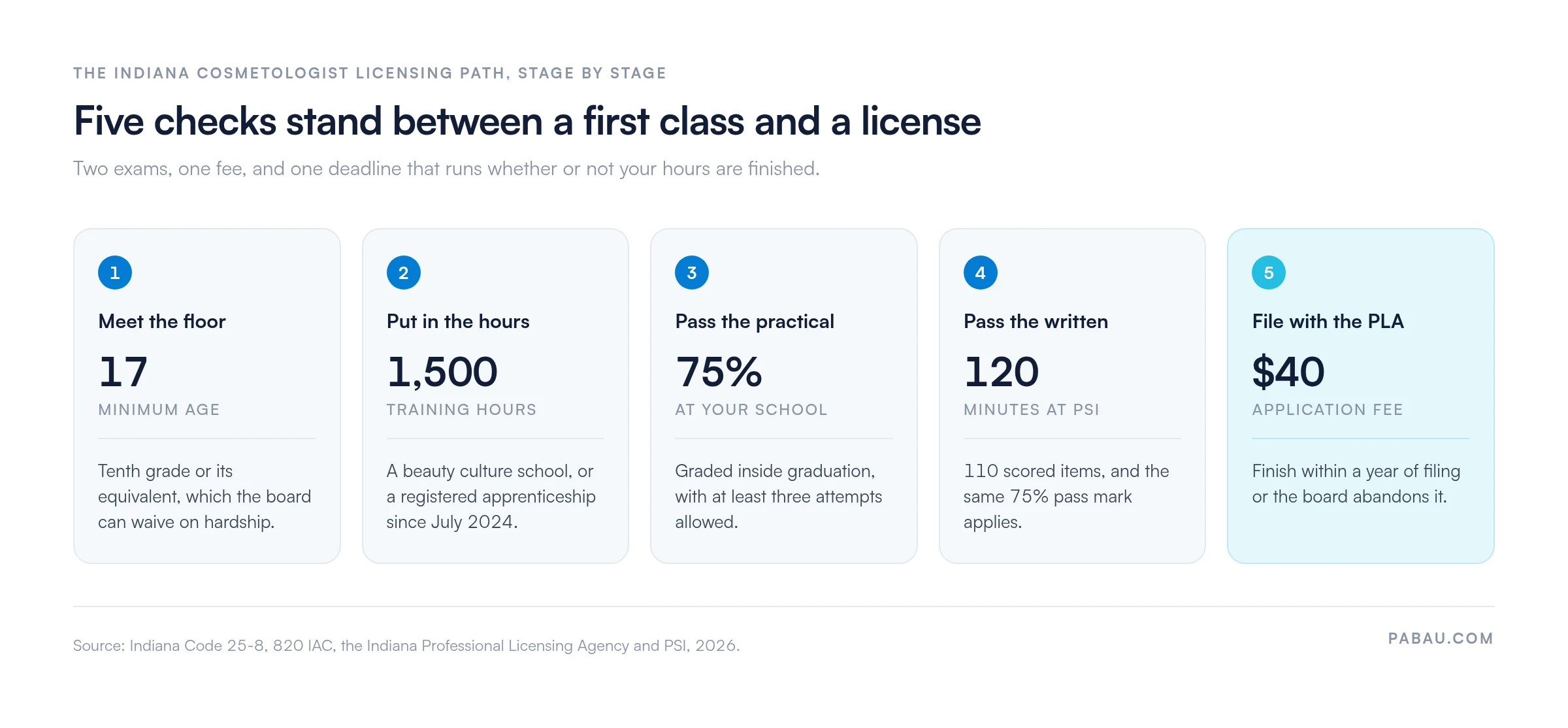
Different people grade each half. PSI runs the written test at a testing center. Your beauty culture school runs the practical demonstration, and you need 75% on each.
That split is where published guides go wrong. PSI’s candidate bulletin for Indiana is titled for the written examinations, and it covers nothing else.
IC 25-8-5-4.2 puts the practical demonstration inside the school’s graduation requirements. The same section sets its pass mark at 75% and gives every student at least three attempts. IC 25-8-4-9 is where the 75% on both exams comes from.
The written exam also runs longer than most guides state. PSI gives cosmetologist candidates 120 minutes rather than 90, and 110 scored items rather than 100.
Item counts, time limits and fees come from PSI’s current candidate information bulletin for the Indiana board. Every exam on that list passes at 75%.
The exam fee goes to PSI, not to the PLA, and it sits outside the $40 application fee. Check PSI’s current bulletin before you budget, because PSI sets that number rather than the state.
Those figures turn into a checklist the moment you sit down to apply. Run through these five first:
Two errors travel further than the rest, because published guides keep repeating them. One is a $100 reciprocity fee, which does not appear on the board’s own schedule at 820 IAC 7-1-1. The other is a continuing education requirement, which Indiana repealed in 2006.
Applying from another state adds one more figure to check, and it decides whether your existing hours travel with you.
Indiana grants reciprocity when your current state’s requirements are substantially equal to its own. That state must also require at least 70% to pass its written and practical exams.
IC 25-8-4-2 sets the substantially-equal test, and the PLA adds the 70% standard on its licensing page. Read that 70% carefully. It describes what the other state demands of its own candidates, while Indiana’s pass mark stays at 75%.
Short on hours? Indiana credits licensed practice at 100 education hours per year. The credit only starts once you already hold a minimum number of hours, and that minimum changes with the license.
Almost every published guide states a flat 1,000-hour minimum, as though one number covered everyone. IC 25-8-4-2 sets it separately in subsections (b) through (g), and 1,000 is right for only two of the six licenses.
Take an esthetician licensed elsewhere with 500 training hours and two years of practice. Two years buys 200 hours. Because 500 already clears the esthetician floor of 400, the credit applies and the total reaches Indiana’s 700.
A manicurist with 20 years behind them needs only 100 hours on the books before the credit starts. The same person at 19 years needs 300.
Instructors face one extra step. 820 IAC 2-2-1 requires an examination on Indiana statutes and rules, passed at 75%, on top of IC 25-8-4-2.
Guides that apply that law exam to every reciprocity applicant overstate it. Indiana rules do reach every candidate, but as the Indiana items inside the PSI written exam.
The reciprocity application fee is $40, matching every other individual application. A $100 reciprocity fee appears on some pages and does not match the board’s schedule at 820 IAC 7-1-1.
Hiring across state lines comes down to hours against hours. Our guide to Texas cosmetology license requirements sets out the same figures for Texas.
An Indiana cosmetology license renews every four years for $40, with no continuing education hours attached. The state repealed its continuing education rule in 2006 and never replaced it.
That four-year cycle is statutory. IC 25-8-4-17 says a license expires four years after its initial expiration date. 820 IAC 7-1-3 charges the renewal fee on the same four-year rhythm.
Continuing education is where guides disagree most, with claims of 16 hours and of 4 hours both in circulation. Article 6 of 820 IAC held those rules and was repealed in 2006. The board’s own 2024 compilation still lists the article as repealed, with no replacement.
About 90 days before the expiration date, the PLA emails renewal information to the address on file. Licensees without a valid email address get it by mail.
You renew online through MyLicense One, the PLA’s portal for every profession it regulates.
Let a license lapse and the price changes. Reinstating an individual license costs $80, which the PLA breaks out as the $40 renewal fee plus the $40 application fee.
Past three years, IC 25-8-4-21 and IC 25-1-8-6(d) add whatever remediation and additional training the board considers appropriate. Past five years, the PLA requires the written exam again, passed within one year of applying to reinstate.
Cheap and infrequent is exactly where the risk sits. A four-year cycle makes an expiry date easy to lose track of, and that is the employer’s problem as much as the licensee’s.
Put a candidate’s name or license number through Indiana’s free Search and Verify tool before they start. The tool covers every profession the PLA regulates and updates in real time.
No ranking guide on this topic writes for the employer, so here is the routine we use with practices we onboard. Call it the staff license check, and run it in three steps.
In the practices we onboard, the expiry that gets missed is rarely the owner’s. Risk sits with the part-time stylist hired halfway through a renewal cycle, whose paperwork was checked once and never again.
The PLA sends the renewal notice to the licensee, not to the employer. No warning reaches the practice when a stylist’s license is 90 days from expiring. Holding the license number and expiry date on the staff record inside software for med spas is what closes that off.
A lapsed license becomes a scheduling problem before it becomes a compliance one. Keeping credentials on the same record as the shift is why staff fields matter when you compare med spa scheduling software.
The lookup itself is free and needs no account. Some states run a separate cosmetology board lookup, while Indiana verifies every regulated profession through the one PLA portal.
The PLA describes verification through that portal as an original source for accreditation purposes. A lookup is still only worth as much as the day you run it, so repeat it at each renewal.
The same page carries a facility search for salon, mobile salon and tanning licenses. Staff licensing is one strand of med spa compliance, and the state licenses the premises separately.
Opening those premises needs its own license, and a temporary salon permit runs for three months while the full application is processed. When another state asks for official primary-source verification, the free search will not do, and the PLA sells a digital certification for it.
Staff licenses usually live in a spreadsheet, or in the manager’s memory. That holds until someone is hired between renewal cycles, or until the manager who kept the spreadsheet leaves.
Practice management software like Pabau keeps each practitioner’s credentials on their staff record, alongside the services they are cleared to deliver. Booking rules follow that record, so a treatment nobody on shift is licensed for never reaches the calendar.
The outcome shows up on a Monday morning. Your front desk books from the same record that holds the license, so nobody has to remember which stylist is due to renew.
That turns the staff license check from a once-a-year scramble into something the schedule already enforces.

Pabau holds each practitioner’s credentials on their staff record and controls which services they can be booked for. Renewal dates sit next to the schedule, so a lapsed Indiana license never reaches the calendar.

The licensing path is the easy half. Indiana wrote it down, the figures above are the whole of it, and none of it moves quickly.
The employer’s half never finishes. A four-year cycle makes renewal cheap and an expiry date easy to lose. The PLA sends that notice to the licensee, not to you.
So run the staff license check on every hire, and put the renewal date where the schedule can see it. Book a demo to see how Pabau keeps practitioner licenses and booking rules on the same staff record.

Hiring from California? California cosmetology license requirements sets out that state’s hours, fees and apprenticeship route.
Working out who can do what? Aesthetic qualifications maps the training behind each role an aesthetics practice hires for.
Need the wider compliance picture? Med spa compliance covers the facility, record-keeping and staffing rules around a licensed team.
Licensing the premises, not just the people? Texas med spa licensing laws shows how one state regulates the facility and its medical oversight.
Running commission on services? Commission laws for med spas sets out how service commission has to be structured.
Two fees, paid to two different bodies. The PLA charges $40 for the application, and PSI charges $49 for the cosmetologist written exam. Renewal is another $40 every four years. Tuition at a beauty culture school sits on top of all of it and varies by program.
Yes. Indiana licenses the premises separately from the people working in them. Salon, mobile salon and tanning licenses each appear in the PLA’s facility search. A temporary salon permit covers you for three months while the full application is processed.
The receiving state decides, using its own version of the substantially-equal test. Indiana’s free Search and Verify record answers most requests. Where a state insists on official primary-source verification, the free lookup will not meet that standard, and the PLA sells a digital certification instead.