HD Brows consultation form: Free template and guide
HD Brows is a seven-step brow treatment that combines consultation, tinting, wax...

2
Last Updated: Oct 13, 2026

Tennessee licenses a cosmetologist at 16, after 1,500 hours of practice and theory at a school of cosmetology.
The Initial Cosmetologist Application costs $60 at core.tn.gov, and PSI charges $67 each for the theory and practical exams.
A Tennessee cosmetology license renews every two years for $60, and an individual licensee pays a $25 late fee after the expiration date.
Reciprocity turns on active practice for 1 of the last 3 years or 2 of the last 5, not a flat five years.
Continuing education applies only to instructors, who need 16 approved hours every two years plus a $70 renewal fee.
Tennessee cosmetology license requirements come down to three numbers: 16, 1,500 and 70. You must be 16 years old and finish 1,500 hours at a school of cosmetology. Both PSI exams then need a score of 70%. Applying costs $60 at core.tn.gov.
Those numbers are the easy part. The trouble starts when a stylist moving in from Georgia assumes those school rules apply to her. They do not.
Tennessee runs four routes into the same credential, and the wrong one costs months. Work out which route is yours first, because the requirements only make sense from there.
Tennessee licenses a cosmetologist who is 16 or older, has finished 1,500 hours at a licensed school, and has passed both PSI exams.
Those five points come from the Board’s own cosmetologist license page and its licensing rules. Hours differ sharply from one state to the next, so never carry a number over from where you trained.
Tennessee cosmetology license hours come with a required split. Rule 0440-01-.03(3)(a) apportions the 1,500 clock hours across three subcategories, and a school has to deliver all three.
So ask a school how it logs your hours against those three subcategories. The apportionment works per category, not as one running total. A shortfall in any single category will hold up your application.
No, the Board’s cosmetologist page lists no diploma or equivalency requirement. The check happens earlier instead. Rule 0440-01-.04(2) makes the school responsible for verifying each student’s education before enrollment, under T.C.A. § 62-4-122.
So the schooling bar is an admissions question rather than a licensing one. Ask the school you plan to attend what level of high school completion or equivalency score it accepts. Do that before you pay a deposit.
PSI administers both Tennessee cosmetology exams, and the Board sets the passing score at 70%. One is a written theory paper. The other is a practical.
Your school submits the examination application to PSI, not you. PSI then approves your eligibility and emails instructions on how to pay and schedule. Both exams use national content, and both are available with remote proctoring.
Candidates without a computer that supports the camera and software can test at a PSI center instead. The Board’s PSI and exam information page publishes the fees, which the individual license pages do not.
Every license type the Board examines pays the same $67, from manicurist to master barber. Reinstatement exams cost half that, so coming back from a long lapse is cheaper to sit than a first attempt.
The first one is short. PSI needs at least 10 business days’ notice to move a booked exam, and a rescheduling fee applies below that. The Board does not publish the amount, so confirm it with PSI.
The second is longer and harder. Under Rule 0440-01-.09(3), you must pass every examination within three years of passing the initial theory exam. Miss that window and your earlier passing scores are vacated.
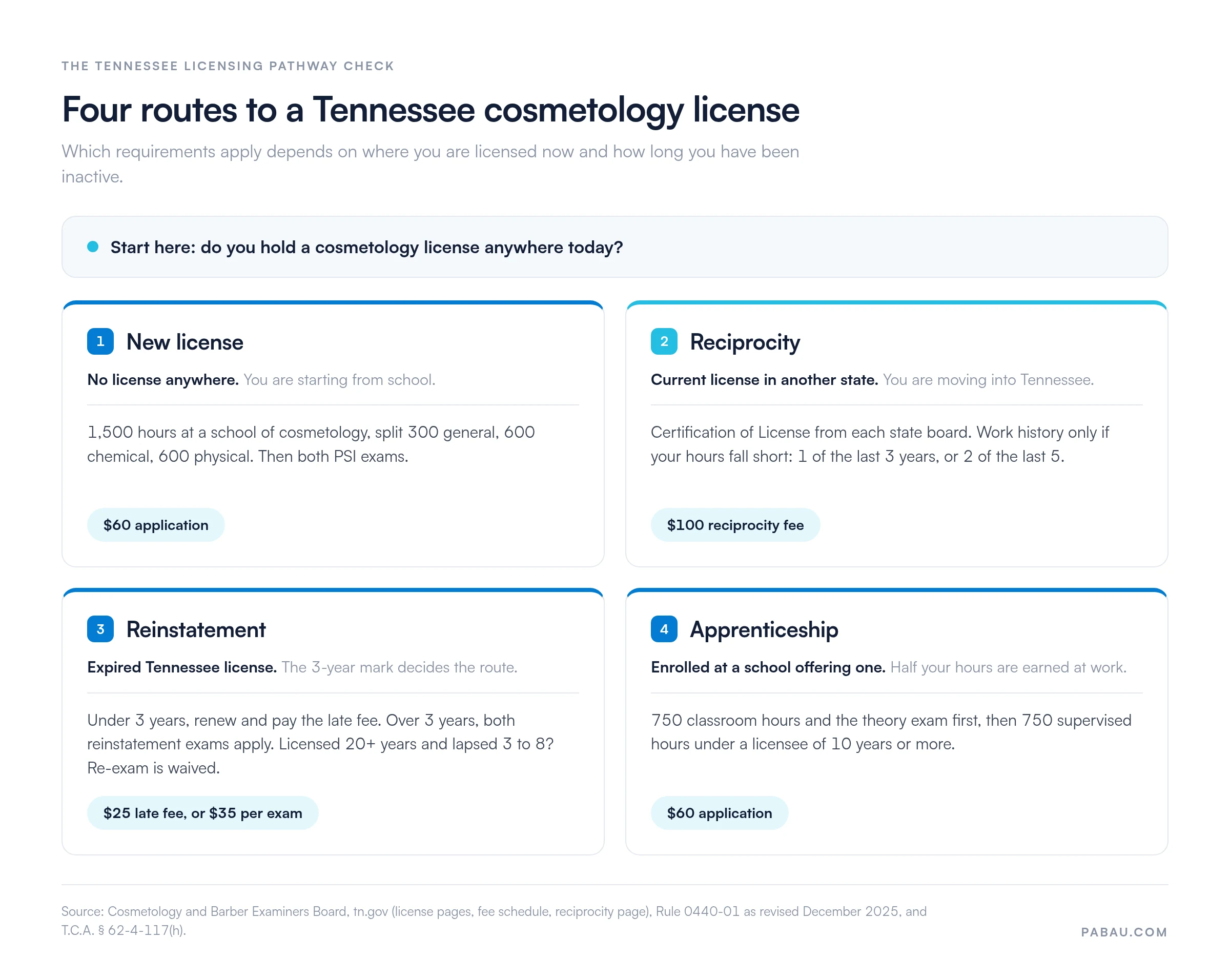
Tennessee licenses cosmetologists through four routes. There is a new license, reciprocity from another state, reinstatement after a lapse, and a school’s apprenticeship curriculum.
Requirements usually get published as one flat list, which leaves a transferring stylist reading rules written for a first-year student. The pathway check below sorts you into the route that governs your application.
The same four routes, drawn as a decision:
Apprenticeship is the least documented of the four. Rule 0440-01-.03(6) opens the door. Any school under the Tennessee Cosmetology Act may build a curriculum where half the hours are earned in a salon.
For a cosmetologist that means 750 classroom hours and 750 supervised hours. The supervising licensee needs 10 years in the field and a current Tennessee license. One licensee may hold responsible charge for only one apprentice at a time.
Sequence matters more than the split. Under Rule 0440-01-.09(4), an apprenticeship student finishes the classroom hours and passes the initial theory exam before starting any salon activity. Both provisions sit in the Board’s licensing rules.
Master barbers get a fifth, narrower door. Rule 0440-01-.03(5)(a) lets a Tennessee master barber sit the cosmetology exam after only 300 cosmetology-school hours. Those hours cover technique and pedicuring, and the Board credits the other 1,200.
Tennessee grants a reciprocal license to anyone who holds a current license elsewhere and submits a Certification of License from that state board.
A transfer runs in three steps. Ask each state board that has licensed you to send its Certification of License, and only one of them needs to be current. Then file the Out of State application at core.tn.gov.
The Board’s reciprocity page asks for three to four weeks of processing, because certifications arrive from other states at unpredictable speeds. Your license then arrives by mail at the address on the application.
Rule 0440-01-.13(9) sets the reciprocity fee at $100 for all license types. The same rule says an application arriving without that fee is incomplete and will not be considered. So send the two together.
Several licensing guides tell out-of-state applicants that five years of continuous work experience can replace training hours below Tennessee’s 1,500. No such rule appears on the Board’s reciprocity page.
What the Board does publish is narrower and easier to satisfy. Work history only comes into it when your completed hours fall short of Tennessee’s minimum. The test is then either of two options.
Tax returns showing your occupation, or letters from previous employers on company letterhead, are the two proof types the Board names.
The five-year figure does exist in Tennessee’s rules, which is probably how it leaked into reciprocity advice. Rule 0440-01-.03(5)(b) lets a master barber who has held the certificate for five continuous years sit the cosmetology exam.
That crossover is a training-credit provision, and a reciprocity applicant cannot use it. In the practices we onboard, the difference decides whether a new hire starts next week or in six months.
One more caution on timing. You may not work in Tennessee until the license arrives, or until the state’s verification search shows your status as active. A transfer is not complete on submission.
The interstate route may get simpler. Tennessee became the sixth state to enact the Cosmetology Licensure Compact in May 2024, but the Compact is not yet issuing multistate licenses. Reciprocity remains the only working path.
Hours differ enough between states that a comparison is worth making before you file. Our guides to Texas cosmetology license requirements and the California cosmetology license set out what each state asks of the same practitioner.
A Tennessee cosmetology license expires every two years. Renewal costs $60 for an individual licensee, and a $25 late fee applies once the expiration date passes.
Renewal runs entirely through CORE. The application appears in your account 60 days before the expiration date, and the same account handles address changes.
Renewing online at core.tn.gov is the route the Board directs individual licensees to. Some older guides still mention a mail-in form, which does not appear on the Board’s current page.
The Board’s fee schedule is worth reading rather than trusting a summary. Several third-party guides still quote a $50 renewal, which the official schedule does not support.
Continuing education is the part of renewal people budget for and then never need. Tennessee asks for none from cosmetologists, aestheticians, manicurists or natural hair stylists. Only instructors need CE, at 16 Board-approved hours every two years.
Those instructor sessions run yearly, one in each of Tennessee’s three Grand Divisions. A shop owner planning cover should book early, because each division hosts a single session a year.
The hard deadline sits at three years. A license expired more than three years becomes invalid. Reinstatement then means both reinstatement exams plus the Application to Test form.
One exception exists, and the state has published it. T.C.A. § 62-4-117(h) requires the Board to waive re-examination for a licensee of 20 years or more. The lapse has to sit between three and eight years.
That waiver reached the statute books as SB 1247 and HB 1291 in 2024. The Board’s Customer Service Center sets out how it works in its “Reinstatement Special Cases” article. Outside those two thresholds, no waivers apply past three years.
The Cosmetology and Barber Examiners Board licenses nine individual credentials, and every one renews on the same two-year cycle. Only the hours, the minimum age and the fees move.
Hair braiding is a registration rather than a license, and at 14 it is the only credential the Board opens below 16. A registrant attests to the one-time training at each biennial registration and shows the certificate on request.
The eyelash specialist license is the only individual credential whose required hours must include domestic violence awareness training. It runs to one hour at most, free to the applicant, and comes from a recognized nonprofit provider.
Shampoo technician and electrologist appear on some state guides but not on the Board’s current list. If a school offers either, ask which credential the Board will issue at the end.
The Cosmetology and Barber Examiners Board licenses Tennessee cosmetologists from inside the Tennessee Department of Commerce and Insurance, known as TDCI.
Applications, renewals, address changes and record requests all run through CORE at core.tn.gov, inside a single account. Most of the smaller requests carry their own fee.
Two obligations sit outside the portal. A licensee must tell the Board about an address change within 30 days. Shop closures go to the Department by mail, at 500 James Robertson Parkway in Nashville.
A license lookup runs through the state’s verification search at verify.tn.gov. That search is how a salon or med spa owner confirms a candidate is active before a first shift. The check matters most when you hire estheticians mid-season.
Plenty of Tennessee practices still track staff credentials on paper. License numbers and expiration dates sit in a spreadsheet, certificates sit in a folder, and the schedule sits somewhere else. A renewal date can pass unnoticed until an inspector asks.
Practice management software like Pabau puts each practitioner’s record in the same system as the calendar. A staff profile holds their details, their services and their permissions. What you know about a licensee sits next to what you have booked them for.
That proximity is the point. Say a two-year renewal date passes and the license is not yet current. Permissions let you take that practitioner off bookable services in one place. The front desk stops guessing who is cleared to work.
Treatment notes also carry the practitioner who performed the service, which is the record you want if the Board ever asks. For a wider view of the category, see our roundup of aesthetic clinic software, or our overview of all-in-one med spa software.

Pabau holds staff profiles, permissions, schedules and treatment notes in the same system as your calendar. Renewal dates and who performed which service stop living in a separate spreadsheet.

The core path is short enough to memorize. You need to be 16, finish 1,500 hours, and pass two exams at 70%. Applying costs $60, and renewal costs the same every two years.
What decides your next move is which of the four pathways you are on. Run the pathway check first, then read only the requirements attached to your route. A transferring stylist who reads the school rules loses months over hours she already holds.
One trade-off is worth remembering. Tennessee’s fees are low and cosmetologists need no continuing education, but the three-year deadlines are absolute. Put the exam window and the renewal date in your calendar the week you get licensed.
Once your team is licensed, the admin shifts to keeping those dates and records straight. Book a demo to see how Pabau keeps staff licenses, schedules and treatment notes in one system.

Licensed in Texas and heading east? Texas cosmetology license requirements sets out the hours, fees and exams Tennessee will be comparing against.
Moving a California license across? Cosmetology license California covers the training hours and exam route that state requires.
Building a team in a med spa? How to hire estheticians for your med spa walks through screening, credentials and onboarding.
Worried about more than licensing? Med spa compliance explains the wider rules a treatment room has to satisfy.
Need something to work from? Medical spa compliance checklist turns those rules into items you can tick off before an inspection.
The 1,500 training hours set the pace. At 30 hours a week that is roughly a year, and part-time study takes longer. Add exam scheduling and a few weeks of processing.
You retake it, and PSI charges the full $67 again for every attempt. Rule 0440-01-.09(3) sets the outer limit. Each exam has to be passed within three years of your first theory pass, or the earlier scores are vacated.
Not directly. The receiving state decides, usually through its own reciprocity process. Tennessee sends a license certification to another board for $50. The Cosmetology Licensure Compact may change that, but it is not issuing multistate licenses yet.
Only hair braiding, and it still needs a registration. Braiders register with the Board from age 14, after 16 hours of health and hygiene training, at $30. Cutting, coloring and chemical services all need a full license.
The Board licenses schools but does not set their tuition, so the number comes from the school. Ask for the total, including kit, books and what happens to the fee if you need extra time.
Hours vary widely, and several states sit nearer 1,000 or 1,200 than Tennessee’s 1,500. Check the board that licensed you. That mismatch is why Tennessee tests work history instead of matching hours one for one.