HD Brows consultation form: Free template and guide
HD Brows is a seven-step brow treatment that combines consultation, tinting, wax...

2
Last Updated: Oct 13, 2026

Alabama requires 1,500 school clock hours or 3,000 apprentice hours for a cosmetology license, and a minimum age of 16.
Board fees total $255: a $75 written exam, a $130 practical exam, and a $50 original license fee.
An Alabama cosmetology license covers hair, nails, facials, and waxing, while an esthetics license reaches only facials and waxing. Neither license authorizes injectables or ablative laser work.
Personal licenses renew every two years during your birth month, in odd-numbered years for cosmetologists and estheticians.
Alabama enacted the Cosmetology Licensure Compact in 2023, but the commission is not yet issuing multistate licenses.
Alabama cosmetology license requirements start at age 16 and a 10th-grade education, then run through 1,500 school hours, two exams, and $255 in fees. The Alabama Board of Cosmetology and Barbering issues the license. An apprenticeship of 3,000 hours replaces beauty school entirely.
That list is the whole job if you are the one getting licensed. If you own the salon or med spa, the license is the easier half. The harder half is scope.
An Alabama esthetics license covers facials and body waxing. Add laser or Botox to the menu and the Alabama Board of Medical Examiners takes over, not the cosmetology board. Hiring a licensed esthetician does not buy you either service.
So this guide walks the requirements in the order you meet them. Then it maps which services each Alabama license tier may legally perform, and which ones need a physician.
The Alabama Board of Cosmetology and Barbering, shortened to ABOCB, licenses every individual practitioner, shop, and school in the beauty trades. ABOCB’s authority comes from the Alabama Cosmetology Act at Code of Alabama 1975, Title 34, Chapter 7B, section 34-7B-1 and following.
Older pages still call it the Alabama state board of cosmetology, or the State of Alabama Board of Cosmetology. Both names point at the same agency. The full legal name added barbering, so barbers and cosmetologists now answer to one regulator.
ABOCB issues personal licenses in these categories:
Your personal license lets you practice. A separate shop license lets a premises trade. ABOCB charges $200 for a new shop, $150 to renew one, and $300 to license a new school. Every figure on this page comes from the board’s own fee schedule, current as of August 1, 2023.
The rule that catches new owners is salon suites. ABOCB treats each suite as its own shop where tenants trade under separate business names or entities. Each of those suites needs its own shop license. One shop license only covers tenants operating under a single business name.
The board works from Montgomery, AL, and answers the phone on 1-800-815-7453 between 8:30 AM and 4:30 PM on weekdays. Questions about premises, inspections, or hours reporting start there.
Alabama issues a separate license for each discipline, and the cosmetology license needs the most training: 1,500 school hours or 3,000 apprentice hours. Every category shares the same entry bar of age 16 and a 10th-grade education.
The table below pulls hours, age, both exam fees, the license fee, and the renewal cycle into one place. The board publishes these on separate pages, so no single source shows the combination.
| License type | School hours | Apprentice hours (time limit) | Min age | Written exam | Practical exam | License fee | Renews in |
|---|---|---|---|---|---|---|---|
| Cosmetologist | 1,500 | 3,000 (within 3 years) | 16 | $75 | $130 | $50 | Odd years |
| Esthetician | 1,000 | 2,000 (within 3 years) | 16 | $75 | $130 | $50 | Odd years |
| Manicurist | 750 | 1,200 (within 2 years) | 16 | $75 | $130 | $50 | Odd years |
| Natural hair stylist | 210 | 420 (within 6 months) | 16 | $75 | $130 | $50 | Odd years |
| Barber | 1,000 | 2,000 (within 2 years) | 16 | $75 | $130 | $50 | Even years |
Hours and the entry bar come from the board’s exam requirements page. Renewal years come from its published FAQs. Threader and shampoo assistant licenses sit outside this table, and ABOCB does not publish clock hours for either.
Alabama is not a 1,200-hour state, which is a common mix-up with neighboring boards. The state requires 1,500 hours for cosmetology, and 1,200 is the apprentice figure for a manicurist.
Alabama lets you skip beauty school. Register as an apprentice for $75, work 3,000 hours under a sponsor, and you qualify for the same exams. The rules around the sponsor are stricter than the hour count suggests.
That reporting deadline is the one that costs people months. A sponsor who forgets a postmark loses the apprentice’s whole month, per the board’s apprentice rules. Changing your sponsor, salon, or both costs $25.
The $255 figure is accurate for the board’s share of the cost. It is nowhere near the total for the school route.
Tuition varies widely by school, so treat the Birmingham figure as one published example rather than a state average. The cost difference between the two routes is the reason the apprenticeship exists, and the reason its sponsor rules are tight.
A full-time student clears Alabama’s 1,500 school hours in roughly 10 months, studying 35 hours a week. Exams and license issuance add a few more weeks on the end.
Here is the sequence a school-route candidate works through:
The pending exam permit is the clock that bites. ABOCB grants one permit only, with no extension, and it expires after six months. Once it lapses you cannot work in a salon until the original license arrives.
The apprentice route runs longer. Alabama caps the 3,000 hours at three years, and a 40-hour week gets you there in about 17 months. A manicurist apprentice needs 1,200 hours, so a similar week finishes in roughly seven months.
ABOCB contracts PSI Services to deliver both exams, using the national examinations written by the National-Interstate Council of State Boards of Cosmetology. So Alabama uses the same national test as many other states.
The written cosmetology exam runs 90 minutes, and you must score 70 to pass. PSI prints an unofficial score report at the test center before you leave. A handful of unscored pretest questions sit inside the exam and do not count against your time.
Four rules decide whether the exam stage goes smoothly:
A retake costs the same as the first attempt. ABOCB lists the written examination or reexamination at $75, and the practical examination or reexamination at $130. Failing the practical therefore means another $130 payment before you can rebook.
ABOCB publishes no mandatory waiting period between attempts. What does constrain you is the two-year window and the six-month exam permit, so a second failure costs you weeks rather than a set penalty.
An Alabama cosmetology license covers hair, nails, facials, and waxing, and an esthetics license covers facials and waxing only. Laser and injectable treatments need a physician or a physician-supervised delegate.
That single line decides more service menus than any hour requirement does. Two different Alabama regulators split the work, and the map below shows where the line falls.
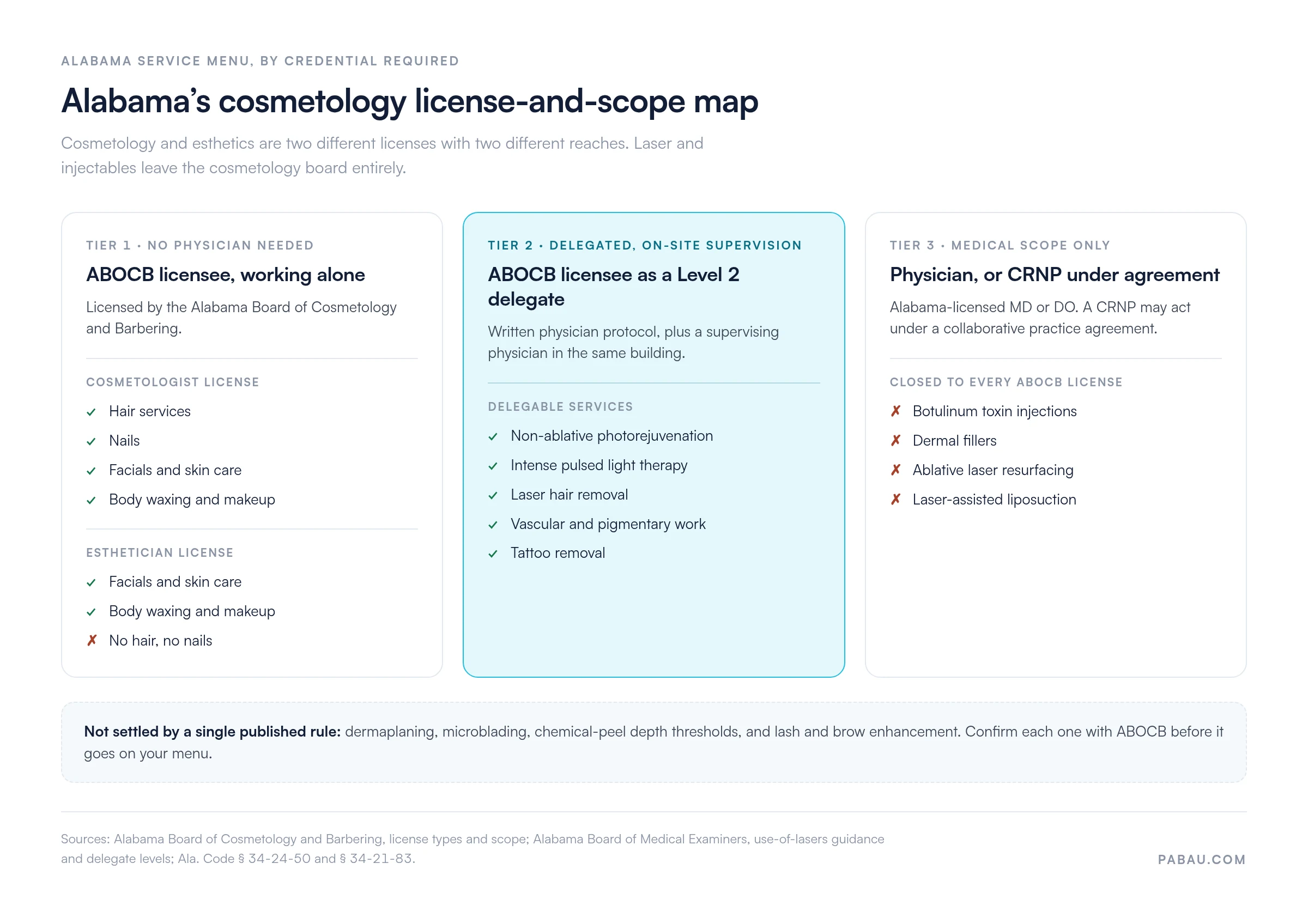
ABOCB puts facials, general skin care, body waxing, and makeup inside the esthetics license. That license stops at the skin surface, with no hair services and no nails.
The cosmetologist license reaches further. It already covers hair, skin, and nails together, which is how ABOCB defines the discipline. The standalone manicurist license exists for practitioners who want a nails-only scope, not because cosmetologists lack nail authority.
Waxing in Alabama needs an esthetics license at minimum, and a cosmetology license covers it too. Neither one reaches past the skin into medical-scope work.
The Alabama Board of Medical Examiners, known as ALBME, governs laser and light-based devices. ALBME’s use-of-lasers guidance splits procedures into two groups, and the split is not about the machine.
Ablative procedures belong to an Alabama-licensed physician alone. ALBME names ablative laser skin resurfacing, endovascular radiofrequency ablation, laser-assisted liposuction, and laser-assisted surgery. No delegate may perform any of them.
Non-ablative procedures may be delegated under a written protocol. That group covers photorejuvenation, intense pulsed light, laser hair removal, vascular and pigmentary treatments, and tattoo removal. ALBME sorts delegates into two levels.
That two-level split changes your staffing math. Locally remote supervision is available for Level 1 delegates only. An esthetician or cosmetologist is a Level 2 delegate, so the supervising physician must be physically present in the same building.
The written protocol has to name the supervising physician, the procedures, patient selection criteria, device settings, complication management, and the consent process. Physicians also register with ALBME before performing laser procedures, then renew that registration every January.
Botulinum toxin and dermal fillers are prescription-drug medical procedures. Alabama treats them as the practice of medicine under Ala. Code section 34-24-50, so no cosmetology or esthetics license authorizes them at any tier.
Two credentials can perform them. An Alabama-licensed physician can, and so can a certified registered nurse practitioner working under a collaborative practice agreement with a physician. That authority sits in Ala. Code section 34-21-83, with the rules in Alabama Administrative Code chapters 610-X-5 and 540-X-8.
In practices we onboard, this is where the service menu and the staff roster stop matching. The menu was written from what the equipment can do, and the roster was hired from what the cosmetology board licenses. Those are two different lists.
Alabama publishes clear rules for laser and for injectables. Four other service categories have no single clearly published rule: dermaplaning, microblading, chemical-peel depth thresholds, and lash and brow enhancement.
Call ABOCB and ask about the specific service before it goes on your menu. Three assumptions are the ones that cost owners money:
Get the classification from the board, then build the menu around what it tells you.
Alabama has no explicit corporate-practice-of-medicine statute. Anyone telling you otherwise is describing a law the state never codified. The position is assembled from three places instead.
Physicians who incorporate do so under the Revised Alabama Professional Corporation Act in Title 10A, and under Alabama Administrative Code rule 540-X-9-.01. That rule governs how physicians incorporate, and does not ban outside ownership.
For a med spa the practical shape is straightforward. A non-physician can usually own the business and the brand, while a physician or supervising nurse practitioner keeps independent clinical control of every medical-scope service.
Owners commonly structure that through a management services organization with a named medical director. Our guide to med spa licensing works through the same question across states.
Search the License Verification tool on the ABOCB website by name or license number to confirm that any Alabama license is active. The board hosts the search publicly, so no account is needed.
Every license carries a RED number in its top right corner, which is the record ID the board uses on all correspondence. Quoting that number removes any doubt about which licensee you found.
Run the check twice for every hire. Once before the first shift, then again after the person’s birth month in a renewal year. That second check catches the license that quietly lapsed into its $54 late-fee window.
The public search will not verify an Alabama license for another state’s board. That needs a Letter of Certification, which ABOCB charges $25 per state request and accepts by money order only.
Alabama personal licenses renew every two years during your birth month, in odd-numbered years for cosmetologists and even-numbered years for barbers. The personal renewal fee is $100.
Cosmetologists, estheticians, manicurists, eyebrow threaders, esthetician/manicurists, manicurist/waxers, and natural hair stylists all sit on the odd-year cycle. Barbers are the exception, on even years. Alabama law caps any license at two years. So a first-time licensee renews at the next birth month, not two years after issue.
Miss the deadline and the arithmetic gets unpleasant:
Renewal is a fee-and-form exercise. The board’s renewal instructions list no continuing-education hours for a personal cosmetology license, which surprises licensees arriving from states that require them. The board’s online payment portal is the fastest route.
One rule matters if you trained partly online. ABOCB has accepted distance education since March 16, 2020, for up to 50% of total coursework. Students must be given a disclaimer that distance-education hours may not be accepted for licensure or reciprocity in other states.
Alabama charges $100 for out-of-state reciprocity and $175 for out-of-country reciprocity. Both routes go through ABOCB rather than through any national body.
Applicants transferring from another country must also pass the Alabama written and practical exams, per the board’s FAQ. Moving an Alabama license outward is cheaper. A Letter of Certification runs $25 per state request, and ABOCB takes it by money order.
Military families get a separate route. Alabama’s military-spouse licensing provisions at Ala. Code section 31-1-6 can waive licensing fees, and the federal Servicemembers Civil Relief Act supports portability across a permanent-change-of-station move. Ask ABOCB about the waiver before paying the license fee.
Alabama enacted the Cosmetology Licensure Compact through House Bill 246 in 2023. The compact reached activation on June 6, 2024, once a seventh state signed on. Thirteen states are now members, Alabama among them. Pennsylvania became the 13th in July 2026.
The compact commission is still writing rules and building the shared data system, so multistate licenses are not being issued yet. Enacting the compact is not the same as being able to use it.
So a licensee moving to Alabama today still uses the $100 reciprocity route. Plan around reciprocity, and treat the compact as the route that replaces reciprocity later.
Estheticians got further news in 2026. Governor Kay Ivey signed Senate Bill 163, making Alabama the first state to enact the Esthetics Licensure Compact. Six more states must enact it before any multistate esthetics license can be issued, so the same waiting game applies.
In plenty of Alabama practices the scope line lives in the owner’s head. The owner knows the esthetician cannot inject, the front desk mostly knows, and the online booking form does not know at all. Then a filler appointment lands on the wrong calendar.
Practice management software like Pabau moves that rule out of memory and into the system. Pabau sets permissions per user, so each staff record carries the services that person may deliver and the client information they may see. A cosmetology-licensed team member simply cannot be booked for a medical-scope service.
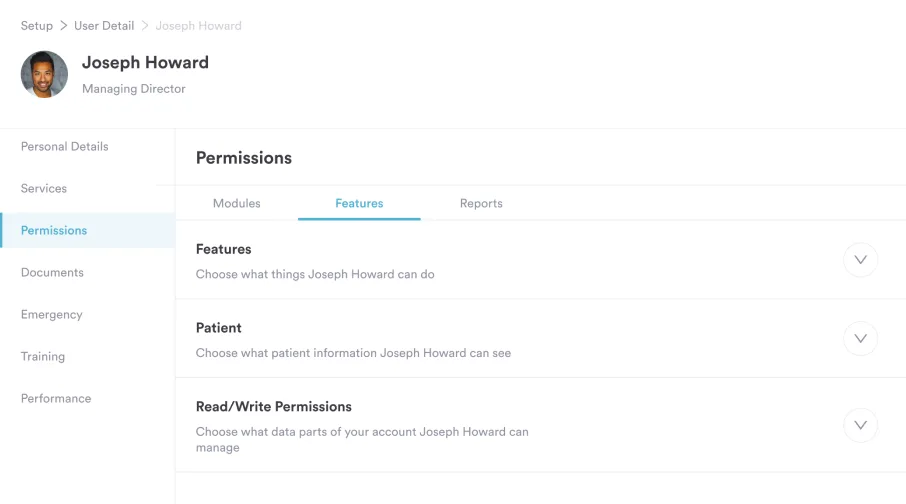
The same staff record holds training and credential details, which is where a license number and its renewal month belong. A practice that runs its odd-year birth-month renewals off one screen stops discovering a lapsed license during an inspection.
Documentation is the other half. Pabau ties consent forms and treatment notes to the service being delivered. A delegated non-ablative laser treatment then records the protocol, the supervising physician, and the client’s consent. All three land in one client record, which is the documentation ALBME expects to exist.
Owners comparing platforms for a mixed practice can start with our review of the best medical spa software. A practice running hair services and medical-scope treatments needs one system for both, which our medical spa software page walks through.

Pabau sets permissions per staff member and ties consent and treatment notes to the service delivered, so scope and documentation match on every appointment. Your team books only what its licenses allow.

The licensing half of this is genuinely straightforward. Alabama publishes its hours, its fees, and its renewal cycle, and the apprenticeship route is a working alternative rather than a technicality. Follow the order and the license arrives.
The scope half is where owners lose money. A service menu built around equipment will outrun what your ABOCB-licensed staff may legally perform. Fixing that after the fact is expensive. The fix means a supervising physician on site, a written protocol, or a service pulled from the menu. Decide it before you buy the device.
The trade-off worth remembering is that Alabama gives you a clear line and no shortcut across it. Build the roster to the menu, or the menu to the roster. Book a demo to see how Pabau keeps each team member’s bookings inside the scope their Alabama license allows.

Hiring from out of state? Texas cosmetology license requirements sets out the hours, exams, and fees a Texas-trained applicant will have behind them.
Comparing state rules? Understanding California cosmetology laws covers a state that regulates scope and salon operations far more tightly than Alabama does.
Adding medical-scope services? Licensing requirements for opening a medical spa explains the medical director and supervision questions that follow.
Opening a new location? The ultimate medical spa requirements checklist walks the premises, staffing, and documentation items an inspector looks for.
About 10 months full-time. Alabama’s 1,500 school hours take roughly 43 weeks at 35 hours a week. Scheduling both exams and paying the $50 license fee adds a few weeks. The apprentice route runs 3,000 hours instead, capped at three years.
You need at least a 10th-grade education, plus 1,500 clock hours at an ABOCB-licensed school. An apprenticeship of 3,000 hours substitutes for the school hours. School hours and apprentice hours may not be combined.
Yes. The board runs a public License Verification search on its website, so you can check any Alabama licensee by name or license number. Salon owners use it to confirm a new hire is active before the first shift.
Yes. Alabama registers apprentices for $75, and 3,000 apprentice hours replace the 1,500 school hours. Your sponsor must have held a license for five years and may train only one apprentice at a time.
Alabama publishes no single rule that settles lash and brow enhancement, unlike laser and injectables. Confirm the classification with ABOCB before adding the service. Do not assume a cosmetology license covers it, and do not assume it is exempt.