Ethical consent form: free template and what to add
An ethical consent form is a written record that a patient or participant agreed...

2
Last Updated: Oct 26, 2026

California issues no medical spa license. Licensure attaches to the physician, the professional medical corporation, and every person who treats a patient.
A lay person cannot own a med spa offering medical treatments. Business and Professions Code section 2400 gives corporations no professional rights.
Non-physician licensees such as RNs, NPs and PAs may hold shares capped at 49% in aggregate under Corporations Code section 13401.5(a).
An RN may inject Botox only on a patient-specific order, under written standardized procedures, after someone else performs the prior examination.
Permanent makeup and microblading are body art. The practitioner registers annually with the county, not with any state board.
California does not issue a medical spa license. There is no medical spa license California application to file. For a med spa led by a medical director, our guide to med spa software includes a dedicated pick. California licenses the physician, the professional medical corporation and every person who treats a patient, across six agencies.
So you are not filing one application. You are assembling a stack of registrations, each from a different body, with its own fee and deadline.
This guide maps that stack. Who may own the business, who may treat patients, what it costs, and which claims the statutes do not support. For the plain-English walkthrough, read our complete guide to California med spa licensing laws. This is general information, not legal advice, so have a California healthcare attorney review your structure.
No. California issues no medical spa license, and the Medical Board of California does not license, register or certify med spa facilities at all.
The Medical Board puts it bluntly. Med spas “are marketing vehicles for medical procedures,” and “if they are offering medical procedures, they must be owned by physicians.”
That is what separates a medical spa from a day spa. A day spa sells massage, facials and waxing, inside a cosmetology scope. A med spa sells medicine.
One establishment license does exist, and it is easy to miss. Business and Professions Code section 7347 requires a Board of Barbering and Cosmetology establishment license, filed on Form 1020.
Per the Board, its licensees may work in a physician’s office only if that office holds one.
California medical spa laws are not gathered in one chapter. They sit across the Business and Professions Code, the Corporations Code and the Health and Safety Code. Title 16 of the California Code of Regulations adds detail, and each body enforces only its own slice.
| What gets licensed or registered | Issuing body | Statute or rule | Who it attaches to | Fee and deadline |
|---|---|---|---|---|
| Professional medical corporation, Form ARTS-PC | California Secretary of State | Corp. Code § 13400 et seq. | The corporation | $100, filed before you trade |
| Statement of Information, Form SI-550 | California Secretary of State | Corp. Code § 1502(a) | The corporation | $25, within 90 days, then annually |
| Physician license | Medical Board of California | Medical Practice Act | The individual physician | Renewed on the Board’s cycle |
| Fictitious name permit | Medical Board of California | B&P § 2272 | The physician | Before advertising a trade name |
| RN and nurse practitioner license | Board of Registered Nursing | B&P § 2725, §§ 2837.103–2837.104 | The individual | Renewed on the Board’s cycle |
| PA license and practice agreement | Physician Assistant Board | B&P § 3502, § 3502.3 | The individual | Agreement signed before practice |
| Esthetician license | Board of Barbering and Cosmetology | B&P § 7316 | The individual | Renewed on the Board’s cycle |
| Establishment license, Form 1020 | Board of Barbering and Cosmetology | B&P § 7347 | The premises | Before estheticians work there |
| Fictitious business name | County clerk | B&P § 17910, § 17915 | The business | Within 40 days of trading |
| Seller’s permit | CDTFA | Required to retail product | The business | No fee to register |
| City or county business license | Local government | Local ordinance, check CalGold | The business | Varies by jurisdiction |
| Body art practitioner registration | Local enforcement agency | H&S § 119306 | The individual | Renewed annually |
| Body art facility permit | Local enforcement agency | H&S § 119312 | The premises | Before any body art is performed |
One row often assumed to belong here does not. Health and Safety Code section 1248 requires outpatient-setting accreditation only where anesthesia risks losing protective reflexes. A local-anesthetic practice falls outside it.
The med spa license requirements only make sense in sequence. This order covers the spa license requirements that California applies to a medical practice, plus the spa business license requirements every retailer faces.
Founders researching how to own a med spa often stop after step two. Enforcement finds its problems in the steps that turn on documentation.
A physician must hold majority ownership of the medical corporation. California prohibits the corporate practice of medicine, and section 2401 carries narrow exceptions only. Business and Professions Code section 2400 says corporations and other artificial legal entities “shall have no professional rights, privileges, or powers.”
Section 2052 bites hardest in medical spa California regulations. It makes unlicensed practice a public offense, and section 2052(b) reaches anyone who aids or abets it.
Entity form matters just as much. The Moscone-Knox Professional Corporation Act, Corporations Code sections 13400 to 13410, governs professional corporations. Section 17701.04(e) bars an LLC from professional services, so use a professional medical corporation.
Corporations Code section 13401.5(a) lists the non-physician licensees who may hold shares. Registered nurses, physician assistants, psychologists, podiatrists, optometrists and pharmacists are among them.
Two limits apply together. Those shareholders are capped at 49% in aggregate and cannot outnumber the physicians. A lay person may hold no stock. Under section 13406, shares issued to an unlicensed person are void.
So can an RN open a med spa here? Not alone. An RN may co-own inside the cap, but cannot hold the practice. A nursing corporation under section 2775 confers no authority to practice medicine. California is not one of the states where an RN can own a med spa outright.
Not outright. A nurse practitioner can co-own up to the 49% cap. But AB 890 independent practice authority is freedom from standardized procedures, not permission to own a medical corporation.
AB 890 created two categories. Section 2837.103, the 103 NP, may drop standardized procedures only in six settings. Those are a clinic, a health facility, a medical group practice, a professional medical corporation, a home health agency and hospice.
Qualifying takes three full-time-equivalent years, or 4,600 hours, of transition to practice. A med spa is not one of the six, and the Board of Registered Nursing says a 103 NP typically cannot work in one.
Section 2837.104, the 104 NP, goes further. It adds a master’s or doctorate and three more years, and permits those functions anywhere.
Neither category unlocks ownership. Section 2837.104(h) repeats that corporations and other artificial legal entities “shall have no professional rights, privileges, or powers.”
Opening a med spa as a nurse practitioner in California still means finding a physician majority shareholder. The same applies to opening one as a nurse. California is not among the states where an NP can own a med spa outright.
Section 1191 bars a private equity group or hedge fund involved with a physician or dental practice from interfering with clinical judgment. It also bars control over records, clinical hiring, payer contracting, coding and equipment approval.
The bill passed as Chapter 409, filed October 6, 2025. It adds Health and Safety Code Division 1.7, sections 1190 to 1192, operative January 1, 2026.
Contracts enabling such control are void, as are post-termination noncompetes and gag clauses. Only the California Attorney General enforces it. Section 1191(g) states that it does not change the corporate practice bar.
The lawful boundary is unchanged. An MSO may provide administrative services. The Medical Board says an MSO that arranges advertising, or provides medical rather than administrative services, is engaging in illegal conduct.
Fee-splitting is the other trap. Section 650 bars rebates or commissions offered to induce referrals. Percentage-of-gross payments are permitted only where commensurate with service value or fair rental value. Section 650(i) carries a year in jail and $50,000.
There is no licensed or statutorily defined medical director role in California. The title is a business convention, so it cannot cure an ownership defect.
The Medical Board is explicit, citing Precedential Decision MBC-2007-01-Q, against Joseph F. Basile. “The current practice of lay-owned businesses hiring medical directors is also prohibited. A physician who acts as medical director of a lay-owned business is aiding and abetting the unlicensed practice of medicine.”
Supervision has no statutory definition, so plain meaning applies: to oversee, direct, inspect and guide. Real supervision means setting protocols, reviewing charts and staying reachable during treatment hours. Paper supervision is only a signature.
Filings rarely trigger an investigation. The medical spa requirements California regulators pursue are operational: who examined the patient, and who treated them.
Business and Professions Code section 2242 requires an appropriate prior examination and a medical indication before prescribing dangerous drugs, defined in section 4022. Asynchronous review is expressly permitted, including a self-screening questionnaire.
The industry calls this a good faith exam, or GFE. That is trade usage. The statutory phrase is “appropriate prior examination,” so use that in your protocols.
Delegation has one hard limit. An NP under standardized procedures may perform it, and so may a PA. But the Board says that examination “may not be delegated to registered nurses.”
Lasers follow the same logic. No unlicensed staff may use them, whatever their training, and delegation to estheticians is prohibited. The Board says lasers and other prescriptive devices “must only be utilized by licensed registered nurses, nurse practitioners, or physician assistants.”
16 CCR section 1364.50 adds a staffing rule for elective cosmetic procedures. A physician with relevant training must be immediately available: contactable without delay, interruptible, and able to furnish assistance.
The short version: only a physician, nurse practitioner or physician assistant may examine and order. Those three plus a registered nurse may inject and use lasers.
| Role | Botox and dermal fillers | Lasers and IPL | May perform the prior examination | Supervision required | Statute or rule |
|---|---|---|---|---|---|
| Physician, MD or DO | Yes | Yes | Yes | None | Medical Practice Act |
| 104 nurse practitioner | Yes | Yes | Yes | No standardized procedures needed | B&P § 2837.104 |
| 103 nurse practitioner | Yes | Yes | Yes | Only in the six listed settings | B&P § 2837.103 |
| Registered nurse | Yes, on a patient-specific order | Yes, on a patient-specific order | No | Written standardized procedures | B&P § 2725(b)(2), 16 CCR § 1474 |
| Physician assistant | Yes | Yes | Yes | Physician supervision and practice agreement | B&P § 3502, § 3502.3 |
| Medical assistant | No | No | No | Physician present in the facility | B&P § 2069, § 2070 |
| Licensed esthetician | No | No | No | Not applicable, outside scope | B&P § 7316(c), 16 CCR § 991 |
Yes, but only on a patient-specific order from whoever performed the prior examination, under written standardized procedures.
The authority is a dependent function. Section 2725(b)(2) covers administering medication to implement an ordered regimen, and section 2725(c) defines standardized procedures.
Those procedures are formal documents. 16 CCR sections 1474 and 1379 set eleven required elements, developed by nursing, medicine and administration. No board pre-approves them, and section 1472 requires them first.
Setting matters too. The function must occur in an organized healthcare system. Nurses may not “set up a practice in a salon, hire a physician supervisor, or perform medical procedures independently.”
Because the examination cannot be delegated to an RN, prescriptive authority assesses the patient first. An organized healthcare system, per the Board, “is not a salon, spa, or other facility not under the control of the physician.”
Business and Professions Code section 7316(c) defines skin care for estheticians. It covers facials, massage, exfoliation and cleansing above the waist, lash and brow tinting, and hair removal by tweezers, sugaring or waxing.
It excludes hair removal “by the use of lasers or light waves,” and no technique may destroy live tissue.
16 CCR section 991 goes further. No licensee may use a device or substance that removes, destroys or pierces skin beyond the epidermis. Invasive procedures include electricity that visibly contracts muscle, substances needing a medical license, and metal needles.
16 CCR section 992 covers exfoliation, and each section carries a $500 fine per violation. Anyone researching how to become a medical aesthetician in California should read that scope, because the title is marketing language.
Two corrections matter. The Board’s 2014 bulletin banning dermaplaning is superseded, and dermaplaning has been in scope since January 1, 2022. Microneedling remains out of scope.
Medical assistants have a narrower lane than most assume. Section 2069 covers the unlicensed medical assistant, aged 18 or over and trained. They may inject only intradermally, subcutaneously or intramuscularly, and perform skin tests.
That needs specific authorization, a charted written or standing order, with the supervisor physically present. Section 2069 does not authorize local anesthetics, and section 2070 covers venipuncture only. The rules sit at 16 CCR sections 1366 to 1366.4.
Not a state license. Permanent makeup, microblading and cosmetic tattooing are body art under the Safe Body Art Act, registered with the county.
The Act sits at Health and Safety Code sections 119300 to 119328. Section 119301(c) includes permanent cosmetics in body art, and section 119301(o) puts enforcement with the county health agency. So a California permanent makeup license is a county registration.
Two registrations are needed. Under section 119306 the practitioner registers annually, with hepatitis B and bloodborne pathogen training, and works only at a permitted facility. Under section 119312 the facility needs a health permit.
Section 119304 exempts physicians and physician assistants, so a physician performing the same procedure sits outside this track.
The Board of Barbering and Cosmetology has no jurisdiction. Its scope flier says cosmetic tattooing is not Board-regulated.
That settles the licensing question for microblading. California issues no permanent makeup license at the state level, and the microblading regulations it enforces are county rules.
The exposure runs to criminal fines, license revocation and void equity, and it reaches whoever helped.
| Violation | Authority | Exposure |
|---|---|---|
| Unlicensed practice of medicine | B&P § 2052(a) | Public offense, fine up to $10,000, county jail up to one year, or both |
| Conspiring, aiding or abetting it | B&P § 2052(b) | The same punishment as the principal offense |
| Employing or aiding an unlicensed person to practice | B&P § 2264 | Unprofessional conduct, so discipline up to license revocation |
| Kickbacks for patient referrals | B&P § 650(i) | Up to one year in county jail and up to $50,000 |
| Shares issued to a lay owner | Corp. Code § 13406 | The shares are void |
| Esthetician performing an invasive procedure | 16 CCR § 991 | $500 fine per violation |
Section 2052(c) makes these remedies cumulative. One arrangement can draw a criminal charge, board discipline and void shares at once.
Five claims circulate widely enough to shape business plans. None survives the primary source.
1. “Hire a medical director and a non-physician can own the med spa.” No. The Medical Board calls that physician aiding and abetting the unlicensed practice of medicine, citing Precedential Decision MBC-2007-01-Q.
2. “An AB 890 nurse practitioner can own a med spa.” No. Section 2837.104(h) applies the no-corporate-rights rule to NPs. Independent practice is freedom from standardized procedures, and the 49% cap still applies.
3. “SB 351 bans private equity and MSOs in med spas.” No. It covers physician and dental practices and never uses the term MSO. Only the Attorney General enforces it, and it does not change the corporate practice bar.
4. “An RN can run an independent injectables business through a nursing LLC.” No. Section 17701.04(e) bars an LLC from rendering professional services at all. The setting must also be an organized healthcare system, not a salon or spa.
5. “Microblading needs an esthetician license from the state.” No. It is a county registration under section 119306, and the Board of Barbering and Cosmetology does not regulate permanent makeup.
Every rule above becomes a documentation question during an investigation. Who examined this patient, who ordered the treatment, who performed it. Practice management software like Pabau answers it.
The examination and the patient-specific order sit on the patient timeline, so you can show what authorized an RN injection. Role-based permissions map to your delegation rules, so an esthetician cannot chart outside scope.
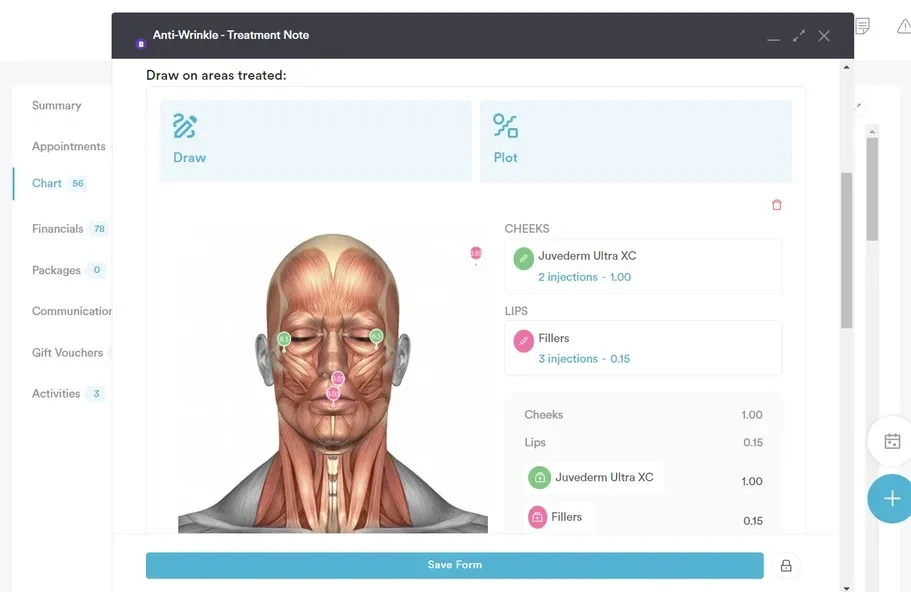
Digital consents and treatment notes capture batch and lot numbers, so a recall becomes a search rather than a fire drill.
Pabau Scribe, our AI scribe, drafts consultation notes from the conversation. Audit trails record who did what and when, so you evidence supervision rather than assert it.
Every Pabau subscription includes every feature, so a growing med spa business never pays extra for compliance tooling.

Pabau keeps prior examinations, patient-specific orders, standardized procedures and consent forms on one patient timeline, with role-based permissions and full audit trails. See how a California med spa documents delegation in practice.

The question was never which medical spa license to apply for. It is whether your ownership, delegation paperwork and staff scopes match what each agency requires.
Get the entity right first, because void shares cannot be patched later. Then treat supervision as records you keep, not titles you hand out. Book a demo to see that evidence in one place.

Where does an MSO stop being administrative? Our guide to MSOs in healthcare sets out what these structures may and may not control.
Can a nurse practitioner hold the oversight role? Read whether an NP can be a medical director before you write the job description.
Hiring estheticians in California? Our guide to the California cosmetology license covers training hours, exams and renewals.
Opening a second location out of state? Compare the rules in our Texas med spa licensing guide, where ownership works differently.
Ready to bring a physician in? See how to hire a medical director and what genuine supervision involves.
There is no single one. You need a physician-owned professional medical corporation, a current license for every treating practitioner, and a local business license. Add a Board of Barbering and Cosmetology establishment license if estheticians work on site.
A physician majority owner and a professional medical corporation filed on Form ARTS-PC. Then a Statement of Information within 90 days, a county fictitious business name filing within 40 days, standardized procedures and insurance.
Not as the owner. An RN or nurse practitioner may hold shares in a professional medical corporation alongside a physician majority. Corporations Code section 13401.5(a) caps them at 49% in aggregate.
Not alone in California. Corporations Code section 13401.5(a) makes a physician assistant an eligible minority shareholder. The PA practices under a practice agreement per Business and Professions Code sections 3502 and 3502.3.
A dentist may own a professional dental corporation, and Business and Professions Code section 1638.1 permits an elective facial cosmetic surgery permit. Ownership of a medical corporation still requires physician majority ownership under section 2400.
No. The Board does not license, register or certify med spa facilities, so there is no facility inspection program. It disciplines its own licensees and pursues the unlicensed practice of medicine under section 2052.