HD Brows consultation form: Free template and guide
HD Brows is a seven-step brow treatment that combines consultation, tinting, wax...

2
Last Updated: Oct 13, 2026

Missouri licenses a cosmetologist after 1,500 hours at a board-approved school, 1,220 hours at a public vo-tech, or 3,000 hours as an apprentice.
You must be at least 17 and hold an education equal to a completed tenth grade.
The two-part NIC exam costs $90 for the written test and $60 for the practical, both booked through Prov.
Every Missouri cosmetology license expires on September 30 of an odd-numbered year, and renewal costs $50 with no continuing education.
Missouri waives most requirements for anyone licensed at least a year in another state, under its universal reciprocity law.
Missouri cosmetology license requirements start with a number you choose up front. You need 1,500 hours at a board-approved school, 1,220 at a public vocational-technical school, or 3,000 as a supervised apprentice. That choice sets both your tuition bill and your calendar.
Then comes a two-part state exam booked through Prov, at $90 written and $60 practical. Two changes are recent enough that older guides miss them. Missouri moved licensing onto its MOPRO portal in January 2025, and Prov now holds the exam contract.
Budget from an out-of-date page and you will plan around the wrong renewal fee. The hours, fees, exam tasks, renewal dates and transfer routes below all come from the statute and the Board’s current bulletin.
The Missouri Board of Cosmetology and Barber Examiners licenses and disciplines every cosmetologist in the state. It sits inside the Division of Professional Registration.
Chapter 329 of the Revised Statutes of Missouri sets the training hours, the eligibility rules and the exam requirement. The Board’s own regulations, in 20 CSR 2085, fill in the detail on renewal, reciprocity and fees.
A Class CA cosmetology license covers hair, skin and nail services. That makes it the credential a salon, spa or med spa asks a new hire to produce.
Application questions go to the Board directly, so keep its number to hand. Reach the office at 573-751-1052, toll-free at 866-762-9432, or by email at [email protected]. Mail goes to PO Box 1062, Jefferson City, MO 65102.
Missouri applicants must be at least 17 with a tenth-grade education, then finish 1,500 school hours, 1,220 vo-tech hours or 3,000 apprentice hours.
Both figures sit in RSMo 329.050, which lists the qualifications for examination. The statute asks for an education equivalent to a completed tenth grade, not a high school diploma.
Individual schools often set a higher bar and ask for a diploma or GED before they enroll you. That is an admissions rule, so check it with the school rather than the Board.
Chapter 329 sets no maximum age. Someone starting at 35, or at 55, faces the same hour and exam requirements as a 17-year-old.
| Path | Minimum hours | Where the hours are earned | Who it suits |
|---|---|---|---|
| Board-approved school | 1,500 | Licensed private cosmetology school | Most applicants, and anyone who wants a fixed timetable |
| Public vocational-technical school | 1,220 | Public vo-tech program | Students who can get a public program place |
| Apprenticeship | 3,000 | Under a licensed cosmetologist in an establishment | Anyone avoiding tuition, if a slot exists |
The vo-tech figure is the lowest of the three, and it comes straight from statute. RSMo 329.040 sets the course of study at no less than 1,500 hours, or 1,220 hours for a student in a public vocational-technical school.
Inside a school program, the first 160 hours are classroom hours. A student cannot perform cosmetology services on a paying patron until those 160 hours are on the record.
The 3,000-hour apprenticeship needs no school at all. RSMo 329.040 attaches three conditions that thin out the supply of places:
That third condition is the trade-off in a sentence. An apprenticeship costs no tuition by law, and a salon has no financial reason to offer one.
You log apprentice hours on the Board’s weekly or monthly timesheets, filed under Class CA or Class CH. Your supervising cosmetologist also files an Apprentice Supervisor application, which carries a $75 fee.
The Missouri cosmetology exam has two parts, a computer-based written test and a hands-on practical, and Prov charges $90 and $60 for them.
Both papers come from the National-Interstate Council of State Boards of Cosmetology, known as NIC. Missouri uses NIC exams exclusively and contracts Prov, Inc. to administer them.
Four NIC domains make up the written test. They are scientific concepts, hair care and services, skin care and services, and nail care and services. Scientific concepts pulls in infection control, anatomy, physiology and product chemistry.
The Board’s current bulletin sets out ten timed sections for a Class CA candidate. Guide sites disagree on this list, and some publish six tasks while others publish eight.
Those sections add up to 155 minutes of timed work, so plan for a long morning. The chemical services are simulated, and only the disinfectants and sanitizers have to be genuine.
Mannequins are now the only heads allowed. Live models are no longer accepted for any category, and a junior or minikin head will be turned away.
Two more rules catch candidates out. Thermal curling is demonstrated with a cold iron, and your whole kit must fit inside 30 inches by 30 inches.
NIC scores each part against a 75 scaled mark. Missouri’s bulletin is explicit that a written part score is a standardized number, so treat a flat 75% pass mark with care.
Unofficial written results appear at the testing center as soon as you finish. Official results for both parts arrive by email within three business days.
Three attempts come with each eligibility. Fail three times and you return to school for extra training, which the school then reports to both the Board and Prov.
Rescheduling is free on either exam if you give at least three business days’ notice. Prov applies that same window to the written test and to the practical. Miss it and the fee is gone.
Getting licensed costs $155 in state-side fees on any path, and a 1,500-hour school program runs about a year at 30 hours a week.
That $155 breaks into a $5 enrollment application and $150 in Prov exam fees. Tuition sits on top, and it is the only figure on this page the state does not set.
| Fee | Amount | When it applies |
|---|---|---|
| Enrollment application | $5 | Filed with the Board before you can test |
| NIC written exam | $90 | Paid to Prov when you schedule |
| NIC practical exam | $60 | Paid to Prov when you schedule |
| Operator renewal | $50 | Every September 30 of an odd-numbered year |
| Late renewal fee | $30 | Added when you renew after the deadline |
| Reinstatement | $80 | Within two years of expiry, late fee included |
| Inactive status | $20 | While you hold a license but do not practice |
| Standard reciprocity | $100 | Transferring in without universal reciprocity |
| Apprentice supervisor application | $75 | Filed by the supervising cosmetologist |
| Establishment registration | $100 | Up to three operators, plus $10 for each extra |
| Establishment renewal | $50 | On the same September 30 cycle |
| Delinquent establishment fee | $100 | Charged if you open before registering |
Only the first three rows stand between you and a first shift. The renewal line is the one that repeats for the rest of your career.
Hours are where the three routes diverge, and the distance is wide.
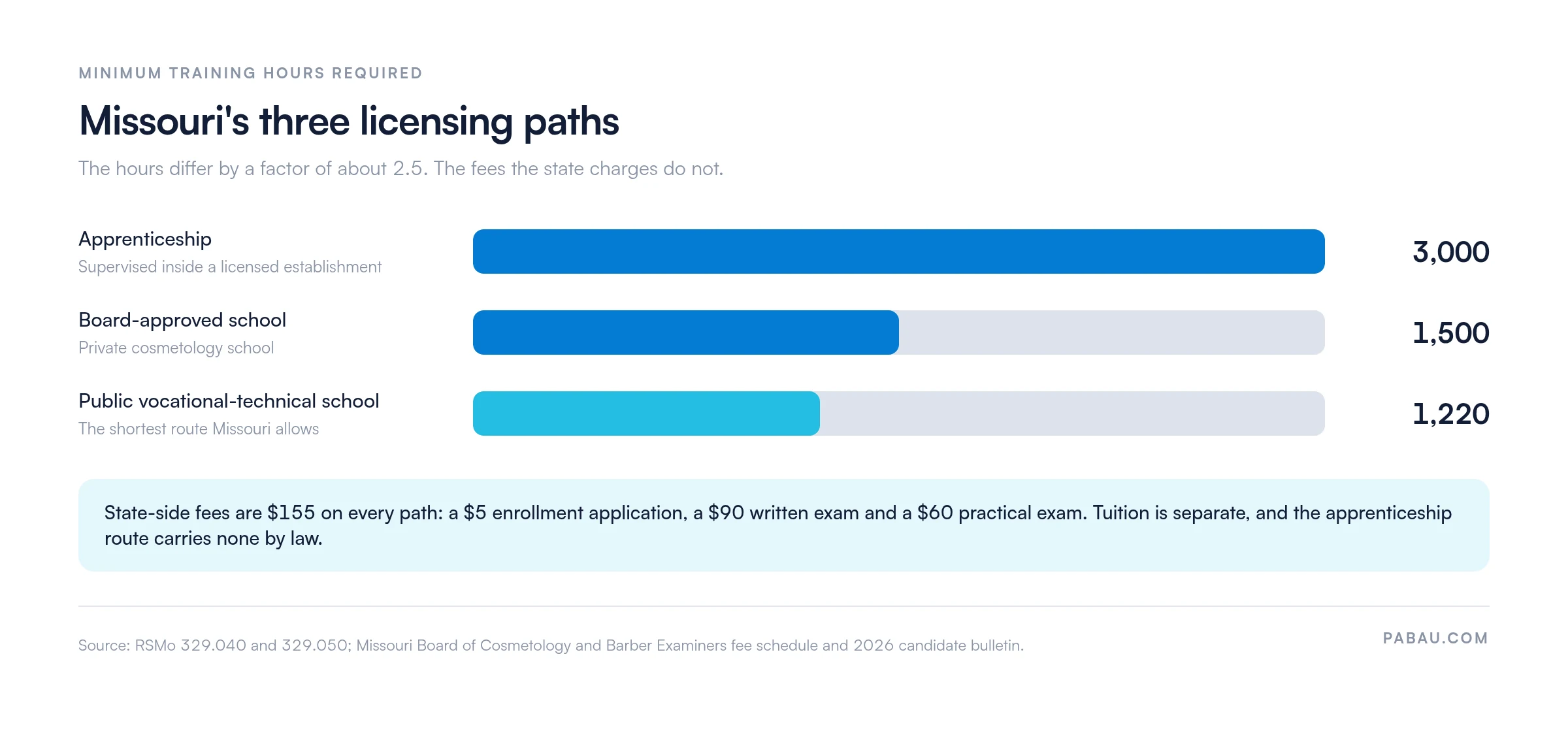
Calendar time depends on the weekly schedule rather than on the total. RSMo 329.040 allows a school to schedule 15 to 72 hours a week.
A 72-hour week clears 1,500 hours in about 21 weeks. Drop to 15 hours a week and the same total takes roughly 100. Ask a school for its weekly schedule before you ask for its graduation date.
The Board’s published fee schedule lists no separate first-license fee for a cosmetology operator. That $25 issuance fee some guides quote has no line to sit on.
Renewal is the bigger error. A cosmetology operator renewal is $50, not $30. The $30 figure on several guide pages is the instructor renewal fee, which also happens to match the generic late fee.
Missouri runs applications, renewals and payments through MOPRO, the state portal that opened on January 14, 2025. Registration needs an email address the Board already holds for you.
That last condition trips up new applicants and lapsed licensees alike. If no email from the Board has ever arrived, call the office and get your record updated before you try to register.
Here is the sequence from application to license:
Processing takes three to five business days either way, whether you file on MOPRO or on paper. An application needing a fee or a notary still has to go by mail.
A returned application costs days rather than dollars, and the same few items send most of them back. Run through this list before you file:
Set the $155 aside at the same time. Prov takes payment at the point you schedule, so the exam fees leave your account well before the license arrives.
Every license the Board issues expires on September 30 of an odd-numbered year. Renewal is biennial, costs $50 for a cosmetology operator, and carries no continuing-education requirement.
MOPRO handles Missouri cosmetology license renewal online, on time or late. A late renewal adds a $30 late fee, and reinstatement after the deadline costs $80 including that late fee.
The two-year window matters more than the fee. RSMo 329.120 lets you restore an expired license without re-examination for two years from the expiry date, and after that you sit the exams again.
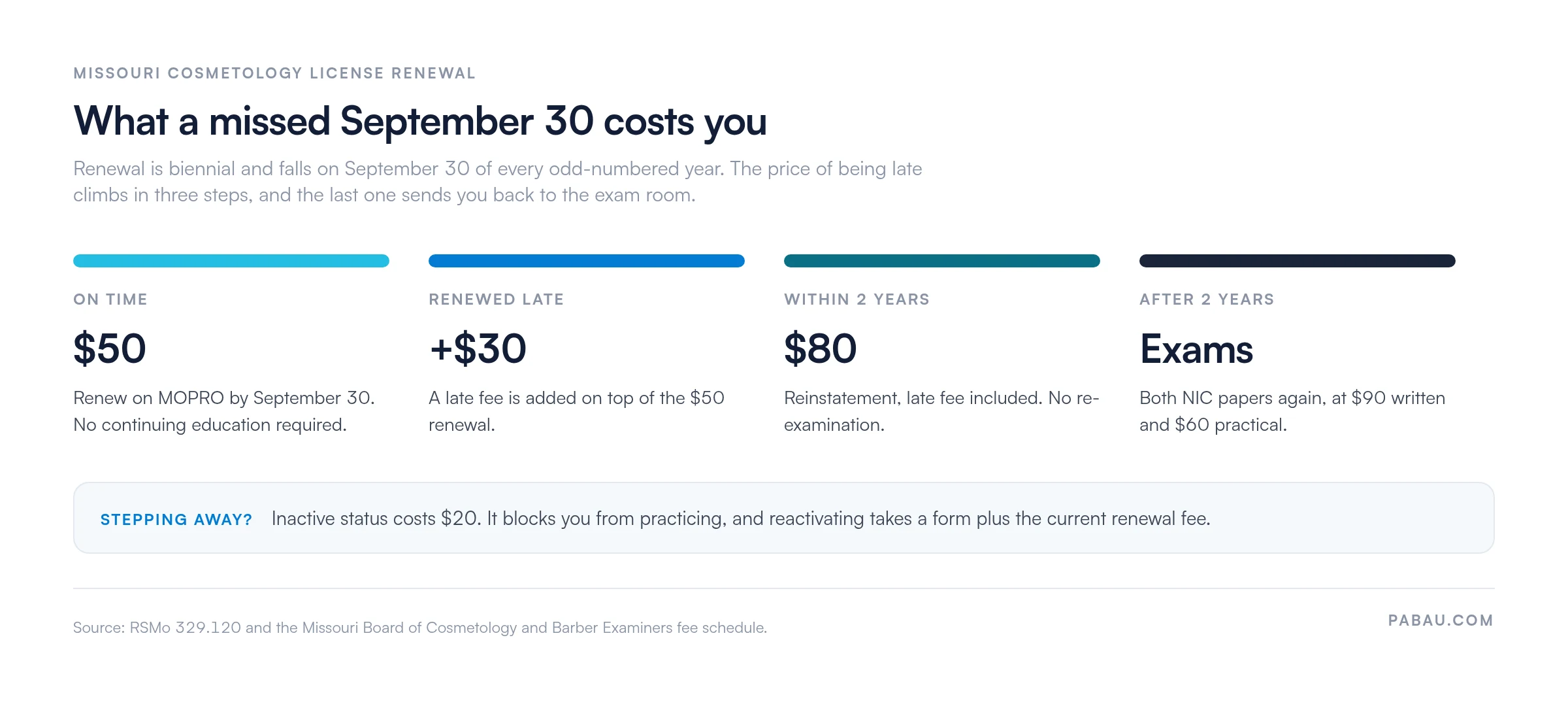
Stepping away rather than lapsing? Ask about inactive status instead. It costs $20, blocks you from practicing, and reactivates on a form plus the current renewal fee.
The Board is blunt about the alternative. Practicing on an expired license breaks state law and may lead to disciplinary action. Complete the renewal and pay every fee before you go back to work.
A Missouri cosmetology license lookup runs through the Division of Professional Registration’s licensee search, and MOPRO shows a licensee their own record. The Division also publishes downloadable licensee listings.
Check the license class, the current status and the expiry date, in that order. Those three answers tell an employer whether a new hire can be booked for the services already on the schedule.
Missouri runs two transfer routes. Universal reciprocity covers anyone licensed at least a year elsewhere, and standard reciprocity costs $100.
Start with universal reciprocity, because the bar is lower. HB 2046, signed on August 28, 2020, created it, and the rule now sits in RSMo 324.009.
Under that section, anyone holding a current out-of-state license for at least a year can apply at the same practice level. The Board must then waive Missouri’s examination, education and experience requirements within six months.
Two conditions attach. Your home state must have had minimum education requirements and must verify that you met them. Missouri may also make you sit an exam on state law.
Military and law-enforcement spouses get a faster clock. For a qualifying spouse, RSMo 324.009 gives the Board 30 days rather than six months.
A disciplinary problem removes the waiver entirely. A revoked license, an open investigation, a pending complaint or current discipline all disqualify you.
Missouri cosmetology license reciprocity under RSMo 329.130 works on training hours or on experience. You qualify with a current license from a state whose requirements are similar to Missouri’s, or with two consecutive years of practice.
The regulation puts a number on “similar”. Under 20 CSR 2085-7.030, a state counts as substantially equal when its training runs to 95% or more of the hours Missouri requires.
The paperwork is specific, and an incomplete file is easy to send. Expect to supply four items:
The open-book law test arrives with the reciprocity application, so it needs no revision. Rules differ sharply by state, and reading the Texas cosmetology license requirements next to Missouri’s shows how far apart two states can sit.
Missouri splits beauty work into classes rather than issuing one broad license. The table below sets out what each one covers and what it costs.
| Credential | Training hours | What it covers | State fee |
|---|---|---|---|
| Class CA cosmetologist | 1,500 school or 3,000 apprentice | Hair, skin and nail services | $150 in exam fees |
| Class CH hairdresser | 1,500 school or 3,000 apprentice | Hair services, without nail work | $150 in exam fees |
| Class E esthetician | 750 school or 1,500 apprentice | Skin care, makeup and hair removal | $150 in exam fees |
| Class MO manicurist | 400 school or 800 apprentice | Nails only | $150 in exam fees |
| Barber | 1,000 school or 2,000 apprentice | Barbering, including razor shaving | $150 in exam fees |
| Cosmetology instructor | Three years licensed, or 600 training hours | Teaching inside a licensed school | $30 license, $30 renewal |
| Hair braider registration | None, but a Board video first | Braiding for pay, no cutting or chemicals | Capped at $20 by statute |
| Establishment registration | Not a personal license | The premises where services happen | $100, then $50 renewal |
A licensed Missouri barber moving to cosmetology completes 500 hours of extra training. Two years of barber experience substitutes for 250 of those hours, and three years substitutes for all 500.
The crossover exam is narrower than a full sitting. A barber crossing over takes the nail technician written and practical papers rather than the whole cosmetology exam.
Going the other way is cheaper in hours. A Class CA or CH licensee adds 45 hours of barber training, and anyone licensed more than a year sits only the shaving task.
An instructor license sits on top of a base license rather than replacing it. The Board admits anyone who has held a current cosmetology, esthetics, hairdresser or manicure license for three years.
Licensed for less than three years? Add 600 hours in a board-approved instructor training course, then sit the instructor exams.
Instructor renewal is often quoted wrongly as eight continuing-education hours a year. RSMo 329.085 asks instead for proof of a teacher training seminar or workshop attended at least once every two years.
Hair braiding sits outside cosmetology and barbering altogether. RSMo 329.275 puts braiding for compensation on a certificate of registration, with a fee capped at $20 and a Board instructional video to watch first.
That video runs four to six hours and covers infection control and diseases of the scalp. A licensed cosmetologist can braid without the separate registration.
Personal licenses cover people, and an Establishment Registration covers the place. Registration costs $100 for up to three operators, plus $10 for each additional operator, and renews at $50.
What people call a Missouri cosmetology booth rental license is a rental-station establishment registration, filed on the premises rather than the person. Opening before you register adds a $100 delinquent fee.
The Board also asks for supporting documents with the application, including a floor plan, a lease or bill of sale, and a business license. If the plan is a med spa rather than a salon, a medical spa compliance checklist covers rules that reach well beyond Chapter 329.
Once someone is licensed, the record-keeping moves to the practice. A salon or med spa needs the class, the number and the September 30 renewal date for every person on the schedule.
In the practices we onboard, those details usually sit in an email folder rather than beside the booking calendar. That works until a client books a service the practitioner is not licensed to perform.
Practice management software like Pabau keeps staff records and the calendar in one system. You set which services each team member can be booked for, so the schedule reflects who holds which class.
A salon can run that on a staff list. A med spa carries more services, more staff and more rules on top, which is where medical spa software earns its place.
Choosing a platform for the first time is its own piece of work. Our roundup of the best aesthetic clinic software compares the options on scheduling, records and reporting.

Pabau holds each practitioner’s staff record next to the calendar, and you set which services they can be booked for. Your front desk stops guessing who is licensed to deliver what.

The choice between paths is really a choice between tuition and time. A school program reaches the exam in roughly a year and charges you for it. An apprenticeship carries no fee for instruction and takes about twice as long.
Whichever route you take, put $155 aside for state fees before tuition. Then mark September 30 of the next odd year, because the two-year restoration window closes quietly and sends you back to the exam.
Already licensed in another state? Try universal reciprocity before the hours route. One year of licensure in good standing is a far lower bar than 95% of Missouri’s training hours.
Running a team of licensed practitioners is a scheduling problem as much as a paperwork one. Book a demo to see how Pabau tracks each practitioner’s class and renewal date against the services they can be booked for.

Hiring or moving to Texas instead? Texas cosmetology license requirements sets out that state’s hour rule, exams and fees in the same order.
Comparing state hour requirements? Cosmetology license in California covers the hours, the exam and the renewal cycle on the West Coast.
Licensing a hire in Georgia? Georgia cosmetology license requirements lays out the hours, exams and renewal rules that state applies.
Paying a licensed team on commission? med spa commission laws explains how commission and hourly pay have to be structured.
Building an aesthetics team? Aesthetic qualifications explains which credentials let a practitioner deliver which treatments.
Not automatically. Each state licenses on its own terms, so you apply to that board and it measures your Missouri hours against its own minimum. Ask whether it runs a universal recognition law like Missouri’s before you plan the move.
The state’s share is fixed at $155 on every route. Tuition is the variable, and each school sets its own. Only the 3,000-hour apprenticeship is free of instruction fees, because RSMo 329.040 bars the trainer from charging.
A Class CH hairdresser license covers hair services without nail work, at the same 1,500 school hours. A barber license takes 1,000 hours and adds razor shaving. Braiding alone needs only a $20 registration.
After the Board approves your eligibility. It reviews the training your school or supervisor reports, then emails a voucher letter and a candidate ID. You need both to schedule with Prov.
Ask for its Board license number and confirm it with the office at 573-751-1052 before you pay a deposit. Hours only count toward the 1,500 when a board-licensed school teaches them.