Cytocare consent form
Cytocare is a hyaluronic acid-based mesotherapy skin booster from Revitacare, in...

1
Last Updated: Oct 27, 2026

Colorado cosmetology license requirements are set by a single state Director, not a multi-member board. The Office of Barber and Cosmetology Licensure sits inside the Division of Professions and Occupations at the Colorado Department of Regulatory Agencies (DORA). That office licenses under C.R.S. § 12-105-101 et seq. and rule 4 CCR 731-1.
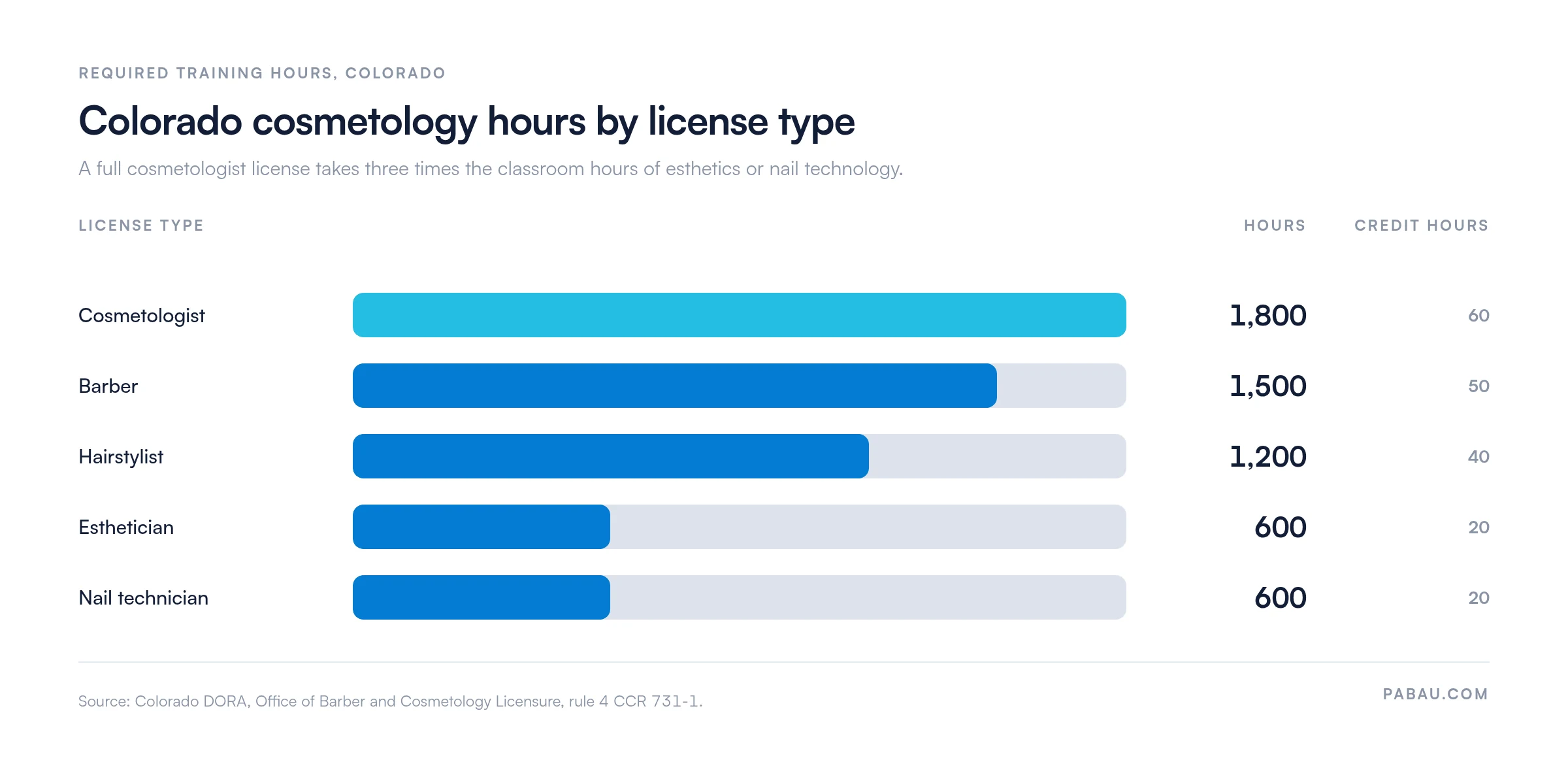
Training hours vary by license type. A full cosmetologist license takes 1,800 hours, barbering 1,500, and hairstyling 1,200. Esthetics and nail technology each take 600.
A cosmetology or esthetics license covers non-medical services only. Botox, dermal fillers, and Class IIIb-or-higher lasers are Medical-Aesthetic Services under Colorado Medical Board rule. Only a licensed physician, or someone the physician delegates to under that rule, may perform or supervise them.
Colorado follows the corporate practice of medicine doctrine, so a non-physician cannot own the entity delivering those medical treatments. The unprofessional-conduct provision at C.R.S. § 12-240-121 is what makes that true. A management services organization can legally run the business side, never the clinical side.
Colorado licenses nurse practitioners for full practice authority. No physician collaboration agreement is required once a nurse practitioner holds full prescriptive authority under C.R.S. § 12-255-112, through the Colorado Board of Nursing.
Colorado cosmetology license requirements start somewhere most other states’ don’t: with the fact that there’s no “Colorado State Board of Cosmetology” to apply to.
A single Director licenses every cosmetologist, barber, hairstylist, esthetician, and nail technician in the state. A professional and public advisory committee advises that Director under the Barbers and Cosmetologists Act, C.R.S. § 12-105-101 et seq.
Colorado regulates medicine and nursing differently: both run through a standing board. That difference matters the moment a salon or spa adds a medical-grade treatment to its menu.
The hours, the exam, and the renewal fee are the easy part of this topic. The harder part is the boundary where a cosmetology or esthetics license stops carrying you.
Colorado’s corporate-practice-of-medicine rules and its physician-delegation framework for injectables and lasers pick up from there. A salon can meet every license-type requirement and still cross that line, and the cosmetology license is not what fails.
No board hears a Colorado cosmetology application. The Director of the Division of Professions and Occupations issues every license, acting through the Office of Barber and Cosmetology Licensure at DORA.
The authority comes from the Barbers and Cosmetologists Act, C.R.S. § 12-105-101 et seq., and the implementing rule, 4 CCR 731-1.
An advisory committee of licensed professionals and public members reviews rule changes. That committee doesn’t vote on individual licenses the way a board would.
That three-way split is why searchers still look for a Colorado state board of cosmetology. The entity doesn’t formally exist under that name. Searchers assume every licensed profession in Colorado has a board because medicine and nursing do.
Cosmetology, barbering, hairstyling, esthetics, and nail technology run as a director-led program instead. That distinction is worth knowing before you call the wrong office with a licensing question.
Colorado cosmetology hours are the requirement most applicants ask about first, and they differ sharply by license. Rule 4 CCR 731-1 sets a required number of hours, or equivalent credit hours, of instruction.
That instruction has to come from a school approved by the Division of Private Occupational Schools or the Colorado Community College System. Only then can an applicant sit for the PSI exam.
Every track combines hands-on technical training with Colorado-specific sanitation, disinfection, and safety instruction. The technical side covers cutting, chemical texture services, skin care, and nail services, depending on the license. Every applicant also takes a laws-and-rules module covering the Barbers and Cosmetologists Act itself.
Applicants must be at least 16 years old. Colorado doesn’t require a high school diploma or GED to enroll, though most approved schools ask for one. Makeup artistry isn’t a separate license category. A makeup artist practices under a cosmetology or esthetician license, depending on the services offered.
An applicant trained outside the US can substitute documented work experience for part of the contact hours, at a ratio set in rule. That substitution never applies to the hours the rule assigns to disinfection, safety, or the laws-and-rules module. Every applicant completes those hours regardless of prior experience.
A Colorado esthetician license covers 600 hours of surface skin care and stops at the medical line. That scope includes facials, manual and chemical resurfacing exfoliation, dermaplaning, body wraps, waxing, and non-laser hair removal.
An esthetician license does not extend to any service the Colorado Medical Board classifies as Medical-Aesthetic. Deep chemical peels, Botox, and laser treatments sit outside an esthetician’s scope no matter how much on-the-job training a practitioner has picked up.
The section below covers that boundary in detail. Crossing it is a common route to a DORA or Medical Board investigation, and extra training does not change the answer.
A Colorado barber license requires 1,500 hours at an approved school, covering haircutting, shaving, and facial hair services. Barber training includes the same disinfection and laws-and-rules instruction every license track shares.
Barbering and cosmetology are licensed under the same statute and the same office. A barber and a cosmetologist file with the same Director and sit the same PSI testing network. The hour requirement is what separates the two tracks.
A nail tech license in Colorado needs 600 hours, matching the esthetician track, and covers manicures, pedicures, and artificial nail applications.
Like esthetics, the nail technology license stops at cosmetic nail services. The license doesn’t authorize any treatment that punctures skin beyond standard manicure and pedicure practice. Nor does it cover a procedure the state classifies as medical.
To get a cosmetology license in Colorado, complete the required school hours, apply to the Director, and pass the PSI written and practical exams.
Budget roughly $155 for the written exam, practical exam, and application combined. Expect the full process, training plus testing, to run 12 to 18 months. The exact timeline depends on your school’s schedule and the license type you’re pursuing.
Anyone can run a Colorado cosmetology license lookup through DORA’s online license verification tool. The tool returns a license’s status, expiration date, and any public discipline on file.
Salon owners use it to confirm a new hire’s license before scheduling their first client. Clients use it to confirm a provider is licensed before booking. The same lookup covers every DORA-regulated profession, cosmetology included, so search by the licensee’s name or license number rather than by profession.
Colorado cosmetology license renewal runs on a two-year cycle and costs $40, regardless of license type. Every license issued under the Barbers and Cosmetologists Act expires April 30 of the renewal year.
Unusually, Colorado doesn’t require continuing education for a routine renewal. Several other states do. Continuing education only becomes mandatory if a license lapses for more than two years. Reinstatement then requires 16 hours of coursework and a $55 reinstatement fee.
A late renewal, filed after April 30 but before the license lapses outright, costs an additional $15. Renewal happens through DORA’s online licensing portal, the same system the Office of Barber and Cosmetology Licensure uses for new applications.
Colorado offers licensure by endorsement rather than automatic reciprocity, so a cosmetology license transfer to Colorado still requires an application. To qualify, you need an active license in good standing from another state. You also need training substantially equivalent to Colorado’s hour requirements for the license type you’re transferring.
If your original training falls short of Colorado’s hours, documented work experience can cover part of the shortfall. That substitution never applies to the disinfection, safety, or laws-and-rules hours, which every applicant completes. If your prior training doesn’t align closely enough, Colorado requires you to sit its written exam before endorsement is granted.
Two 2024 changes are reshaping this path. HB24-1111 puts Colorado into the Cosmetology Licensure Compact. Multistate licensing is expected to come online roughly 18 to 24 months after activation. That path should be meaningfully faster than endorsement once it’s live.
HB24-1097 lets military spouses holding an active out-of-state license practice in Colorado for up to a year without a Colorado license. The same bill offers a free six-year temporary license as a bridge.
A cosmetology or esthetics license authorizes cosmetic services. That license does not authorize medicine. Colorado Medical Board rule 3 CCR 713-1.17, the successor to what practitioners still call “Rule 800”, defines Medical-Aesthetic Services.
The definition covers any use of a Class IIIb or higher laser, a radiofrequency device, or intense pulsed light. That applies where the device alters tissue structure or removes hair. The definition also covers injection of Botox, collagen, dermal fillers, or any other substance for a cosmetic purpose.
Performing any of that under a cosmetology or esthetics license, with no medical delegation behind it, is practicing medicine without a license. That is a different and more serious problem than a cosmetology violation.
Colorado also follows the corporate practice of medicine doctrine. The Colorado Medical Practice Act’s unprofessional-conduct provision sits at C.R.S. § 12-240-121. Under that provision, a physician commits unprofessional conduct by practicing medicine as the employee, partner, or agent of an unlicensed person.
That is why a non-physician can’t own the clinical entity delivering Medical-Aesthetic Services in Colorado. States vary in how far that restriction reaches, so confirm who can open a medical spa before you form an entity.
The Act carves out one structure at C.R.S. § 12-240-138. A professional service corporation qualifies when all its owners are licensed physicians. Physician assistants may hold shares in certain roles, with physicians holding majority ownership.
A management services organization lets a non-physician own and run the business side, covering marketing, scheduling, and facilities. The physician-owned entity keeps every clinical decision, exactly the split the doctrine requires. How MSOs for med spas are structured decides which costs and decisions sit on each side of that line.
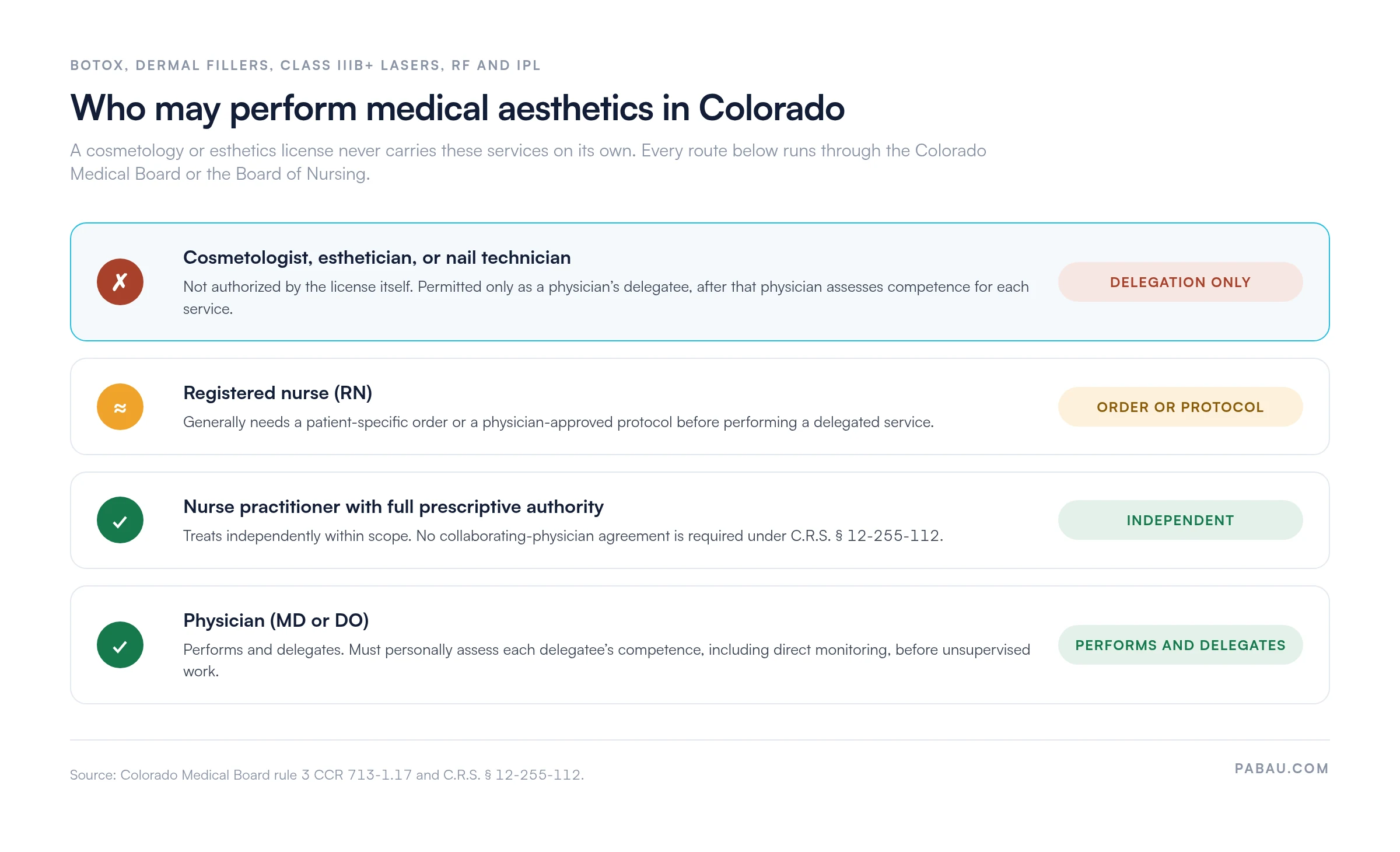
Delegation is its own rule, not a formality. Under 3 CCR 713-1.17, a delegating physician must personally assess a delegatee’s competence for each Medical-Aesthetic Service. That assessment includes direct, over-the-shoulder monitoring before the delegatee performs the service unsupervised.
A cosmetology or esthetics license plays no role in that judgment. The call belongs to the delegating physician under Colorado Medical Board rule.
Nursing sits on its own track. The Colorado Board of Nursing licenses registered nurses (RNs) and nurse practitioners (NPs) under Title 12, Article 255. Colorado grants nurse practitioners full practice authority. Once an NP holds full prescriptive authority under C.R.S. § 12-255-112, no collaborating-physician agreement is required to treat patients independently.
That independence covers many cosmetic treatments within an NP’s scope. An RN, by contrast, generally needs a patient-specific order or physician-approved protocol to perform a delegated Medical-Aesthetic Service. Nursing licensure on its own doesn’t grant the same independence an NP holds under Colorado’s practice act.
Four routes exist for injectables and medical lasers in Colorado, and the chart below sets out what each one requires.
Yes, practicing cosmetology without a license in Colorado is illegal, and it carries criminal exposure. C.R.S. § 12-105-117 requires an active license to practice barbering, hairstyling, esthetics, manicuring, or cosmetology in Colorado. C.R.S. § 12-20-407(1)(a) makes a first offense a class 2 misdemeanor and any repeat violation a class 6 felony.
DORA investigates complaints against unlicensed practitioners the same way it investigates licensed ones with a compliance problem. “I didn’t know I needed a license for that service” isn’t a defense regulators tend to accept.
That comes up for services like lash extensions or certain hair treatments, which new practitioners sometimes assume fall outside the licensing requirement.
Practice management software like Pabau gives a Colorado salon or med spa one place to store provider credentials. Each staff profile holds the license number, license type, and expiration date. One system covers cosmetologists, estheticians, nail technicians, RNs, NPs, and physicians.
Role-based permissions then keep booking honest. An esthetician’s calendar shows only the services their license covers, so nobody books a Medical-Aesthetic Service against a cosmetology-only provider.
That matters more in Colorado than in a state with looser scope rules. Two separate boards plus a director-run office police the line between cosmetic and medical work, each with its own paperwork.
A multi-location Colorado business running cosmetology staff alongside a physician-led medical spa needs one system that tracks both. Purpose-built medical spa software handles that, where the alternative is a spreadsheet per location and per license type.
The same record ties a treatment to its consent form and the treating provider’s notes. That is the documentation a Colorado Medical Board delegation review or a DORA complaint asks for first.
If the medical side of the business needs its own charting, compare medical spa EMR software before you commit.

Pabau stores each provider’s license type and expiration against their staff profile, and role-based permissions limit bookings to the services that license covers. Colorado salons and med spas keep credentialing and scope in one record.

Colorado cosmetology license requirements aren’t complicated once you know which office to ask. A Director within DORA’s Office of Barber and Cosmetology Licensure sets your hours, your exam, and your renewal cycle. That authority runs through C.R.S. § 12-105-101 et seq. and 4 CCR 731-1.
Growing practices rarely get tripped up by the cosmetology license itself. The mistake is assuming that license stretches to cover Botox, fillers, or laser work it was never meant to authorize. The Colorado Medical Board draws that line, and the state’s corporate-practice-of-medicine rules enforce it. The Barbers and Cosmetologists Act plays no part in it.
Get the license-type requirements right, respect the scope boundary, and bring in a Colorado health care attorney on the medical side. That advice costs far less than a Medical Board or DORA investigation. Book a demo to see how Pabau helps a Colorado salon or med spa manage licensing, staff, and compliance records in one system.

Looking for a delegating physician? How to hire a medical director for your med spa covers what to check before you sign an agreement.
Comparing another state’s rules? Texas cosmetology license requirements sets out the hours, exams, and renewal cycle Texas uses instead.
Building your compliance paperwork from scratch? The ultimate medical spa requirements checklist lists the records and policies an inspection asks for.
Most applicants finish in 12 to 18 months. A full cosmetologist license requires 1,800 training hours, the largest hour requirement of any Colorado beauty license. An esthetician or nail technician license takes 600 hours, so it usually takes less time before you can sit the PSI exam.
Apply for licensure by endorsement with an active out-of-state license in good standing and training substantially equivalent to Colorado’s hours for that license type. If your training falls short, documented work experience can cover part of the shortfall. Colorado’s 2024 Cosmetology Licensure Compact legislation (HB24-1111) is expected to add a faster multistate path once it’s fully active.
Use DORA’s online license verification tool and search by the licensee’s name or license number. The tool returns license status, expiration date, and any public disciplinary history. The same tool covers every DORA-regulated profession, not just cosmetology.
DORA is the Colorado Department of Regulatory Agencies. DORA cosmetology refers to its Office of Barber and Cosmetology Licensure. That office runs under a Director rather than a board. The office issues and renews every cosmetologist, barber, hairstylist, esthetician, and nail technician license in the state.
There’s no separate state board process. Renewal runs through the same Office of Barber and Cosmetology Licensure at DORA that issued the original license. Every license type renews biennially by April 30 for a $40 fee. No continuing education is required unless the license has lapsed more than two years.
No, cutting hair for pay in Colorado requires an active license. C.R.S. § 12-105-117 requires an active license to practice cosmetology, barbering, hairstyling, esthetics, or manicuring in Colorado. C.R.S. § 12-20-407(1)(a) makes a violation a class 2 misdemeanor for a first offense. Repeat violations escalate to a class 6 felony.
No, a Colorado cosmetology license does not cover Botox or laser treatments. Colorado Medical Board rule classifies Botox, dermal fillers, and Class IIIb-or-higher lasers as Medical-Aesthetic Services. Only a licensed physician may perform or delegate those services under 3 CCR 713-1.17. A cosmetology or esthetics license has no authority over those treatments, regardless of additional training.