Emotional awareness worksheet
An emotional awareness worksheet is a structured psychoeducational tool that hel...

3
Last Updated: Oct 16, 2026

Paul Ekman identified 6 universal primary emotions: happiness, sadness, fear, disgust, anger, and surprise.
Robert Plutchik’s wheel adds trust and anticipation, and those 8 emotions combine into 24 emotion dyads (primary, secondary, and tertiary combinations).
Primary emotions are immediate biological responses, while secondary emotions form once a client judges or interprets the first one.
Naming the primary emotion first makes the layer on top easier to treat, and it gives your notes something measurable.
The free chart covers Ekman’s 6, with space for a recent example and the physical sensation the client noticed.
A printable worksheet covering Ekman’s 6 primary emotions: happiness, sadness, fear, anger, surprise, and disgust. Each one has space for a recent example and the physical sensation the client noticed, plus two reflection questions to close.
Download templateA primary emotions list gives you a short, fixed set of core emotional states to work from in session. It matters because loose language stalls treatment. When a client says “I feel bad,” you cannot target a response, chart it cleanly, or measure whether it shifts.
The most useful move is narrowing that phrase to one named emotion before you go further. Two frameworks dominate the field, Paul Ekman’s six and Robert Plutchik’s eight, and each suits a different kind of work.
This guide covers both, plus how to run the list with a client and what to write down afterward.
Primary emotions list names the core emotional states psychologists treat as innate, so a broad complaint becomes one word you can work with. Researchers hold that these states appear the same way across cultures, whether the client is in New York, rural Kenya, or Japan.
In assessment, the chart helps you classify what a client is presenting in seconds. In education, it hands the client vocabulary they can carry out of the room. Therapists lean on it in cognitive behavioral therapy (CBT), dialectical behavior therapy (DBT), and emotion-focused therapy (EFT).
When a client says she feels bad in a real life scenario, you slide the chart across and ask which word sits closest. When the client points at an emotion like fear for instance, you then have a target to aim for.
From there, the next question writes itself: what is she afraid of, and what happened just before it arrived?
The whole sequence takes about five minutes in a first session, and less once a client knows the chart.
Work through it in order, because each step depends on the one before it:
Both models hold up under evidence, so the choice comes down to how much nuance your caseload needs. Ekman’s six are quicker to teach and quicker to score. Plutchik’s eight track how emotions blend, which matters when a client’s state keeps shifting mid-session.
The overlap is also wider than the numbers suggest. Plutchik keeps every one of Ekman’s six and adds two more, and those two are what make the blended states below readable.
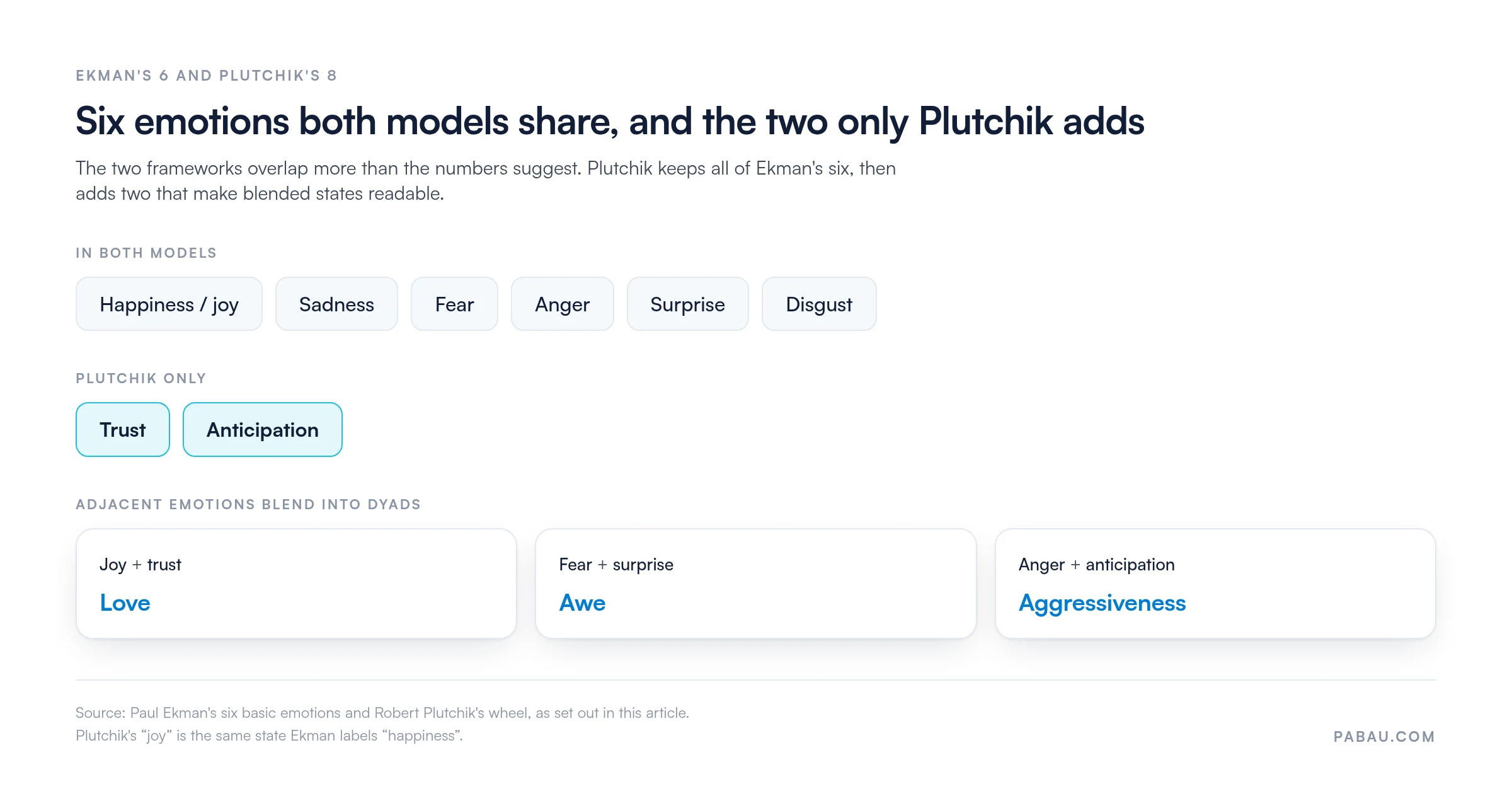
So which should you use? Rapid triage work, like crisis counseling or urgent care, runs better on Ekman’s six. Deeper therapeutic work rewards Plutchik’s eight, where combinations carry clinical meaning, such as fear plus surprise producing awe. Plutchik laid his eight out as a circle, and an emotion wheel worksheet is the version most clients read comfortably.
Shame is a primary emotion underneath, usually fear or sadness, plus a judgment the client has laid on top of it. Pulling those two layers apart changes what you treat.
Take a client who has just lost a job. The primary emotion is fear, an immediate threat to safety. Then the layers arrive: shame at being a failure, guilt about letting people down, anger at the situation.
Name the fear first and the rest loses some of its weight. A primary and secondary emotions worksheet gives clients a structure for practicing that split at home.
Is anger primary or secondary? In both models, anger is primary. Some therapists still treat it as secondary when it covers fear or sadness, as an angry response to grief often does. Judge it by sequence: did the anger arrive first, or did it arrive in response to something else?
Run the checklist below before the chart leaves your desk:
Three mistakes come up again and again. Clinicians accept the first word a client points at without testing it. They record the secondary emotion, because that is the word the client used out loud. Or they run the exercise at intake and never again, which throws away the tracking value entirely.
Any practitioner whose work depends on a client naming their own state gets value from it. Six roles use it most:
Ekman’s six came out of decades of cross-cultural fieldwork. Even in remote communities with little media exposure, people read the same six emotions off a face. The American Psychological Association keeps a readable summary of that line of research.
Neuroscience lines up with the primary and secondary split too. Primary emotions fire in older regions, the limbic system and amygdala, which react to threat and reward.
Secondary emotions recruit the prefrontal cortex, where judgment and reflection happen. That is why a client’s fear lands before they can think, and why cognitive work can reshape what follows it.
Most practices still run the emotions chart on paper. It gets filled in, discussed, then filed in a folder, and the next clinician never sees it. Tracking a client’s change across six sessions means leafing back through the whole file.
Practice management software like Pabau moves that work into the client record itself. You can build the emotion check-in as a digital form, so a client completes it before the session and the answers land in their chart. Repeat check-ins then sit in one place, alongside the notes and the appointment history.
Two things change day to day. Your whole care team sees the same emotional history, so hand-offs stop losing detail between sessions. You can also show a client their own trend on screen, which usually lands harder than a summary read aloud.

Pabau’s digital forms capture emotion check-ins and store them against the client record. Your whole team can then see how a client’s state shifts across a course of treatment.

The chart earns its keep at one specific moment, when a client’s language is too broad to act on. Move them from “I feel terrible” to “I feel afraid,” and the session gains a direction it did not have a minute earlier.
The trade-off worth remembering is simple. A named emotion is only useful once it gets recorded. A word spoken in the room and never written down cannot be tracked, compared, or handed to a colleague.
So print the chart, agree on one model with your team, and decide now where the answers will live. Book a demo to see how Pabau stores emotion check-ins alongside your clinical notes.

Working with the harder end of the list? Negative emotions list covers the vocabulary clients reach for when a session gets difficult.
Documenting affect as well as emotion? Mood and affect list gives you the descriptors a mental status exam expects.
Working with children or non-verbal clients? Emotions card swaps the word list for something a young client can point at.
Want to measure regulation, not just name the emotion? Emotion regulation questionnaire turns the work into a score you can repeat each month.
Teaching skills after the naming step? DBT distress tolerance skills sets out what to do once a client can name what they feel.
Yes. Researchers use both terms for the same idea, a small set of innate emotional states. Ekman’s own papers say basic emotions, while clinical writing leans toward primary. The list itself does not change.
No. Plutchik treats love as a dyad, a blend of joy and trust rather than a state of its own. That is why love appears on neither the 6-emotion list nor the 8-emotion list.
Yes, and it happens often. Plutchik built his wheel around exactly that. Sadness with surprise reads as disapproval, and anger with anticipation reads as aggressiveness.
Plutchik arranged his eight into four opposing pairs: joy against sadness, trust against disgust, fear against anger, and surprise against anticipation. The pairs help a client see how far a state has swung.
An emotion is the automatic response, including the physical changes that arrive with it. A feeling is what the client makes of that response once they notice it. Work on the emotion first.
Fear often arrives as a tight chest or a racing heart, anger as heat and clenching, sadness as heaviness. Asking a client where they feel it usually gets an answer faster than asking what it is.