Acupuncture practice management software runs the scheduling, patient records, SOAP notes, TCM charting and billing of an acupuncture practice in one place.
We compared five platforms, and Pabau, the practice management platform we build, is the best pick for practices that offer acupuncture alongside other disciplines.
If acupuncture and traditional Chinese medicine (TCM) are all you do, Unified Practice is the stronger fit. It is the only platform here with meridian charts and tongue and pulse fields built in. Jane App, Zanda and AcuSimple suit smaller practices that put simplicity first.
Key takeaways
1. Pabau — best for practices that run acupuncture alongside aesthetics, wellness or other disciplines from one system.
2. Unified Practice — best for TCM-only practices that want meridian charting and tongue and pulse fields out of the box.
3. Jane App — best for solo and small multi-disciplinary practices that put easy scheduling first.
4. Zanda — best budget pick for allied health practices in Australia and New Zealand.
5. AcuSimple — best for solo US acupuncturists who want simple acupuncture notes and superbills.
Found our content helpful?
Top acupuncture practice management software at a glance
Here is where each platform fits before the full reviews.
Platform
Best for
Standout feature
Starting price
Pabau
Multi-modality practices combining acupuncture with aesthetics, wellness or other disciplines
One system for patient records, clinical notes, automated workflows, online booking and insurance billing
Pricing depends on your setup — see pabau.com/pricing
Unified Practice
Dedicated acupuncture and TCM-only practices
Native meridian charting, acupuncture point diagrams, tongue and pulse diagnosis fields
From $49/month (Starter, with UnifiedPay)
Jane App
Solo and small multi-disciplinary allied health practices
Intuitive scheduling with built-in telehealth
From CAD $59/month (Balance plan; Practice CAD $79); check jane.app/pricing
Zanda
Allied health practices wanting simple scheduling and telehealth
Built-in video telehealth with a straightforward patient portal
From US$29/month (Starter)
AcuSimple
Solo acupuncturists wanting acupuncture-specific simplicity
Purpose-built acupuncture SOAP notes and superbill generation
From $19.99/month (scheduling only); EHR plans from $59.99/month
What to look for in acupuncture practice management software
Not every practice management platform handles the workflows specific to acupuncture. Check any tool against these six criteria before you book a demo.
TCM-specific clinical documentation: Look for acupuncture point templates, meridian body charts and dedicated tongue and pulse diagnosis fields. General SOAP note builders can be adapted, but built-in TCM documentation saves hours every week.
Scheduling built for treatment series: Acupuncture patients often attend weekly or every other week across a treatment course. Look for recurring series booking, room allocation, and deposit or cancellation policy enforcement.
Billing and superbill generation: If you bill insurance in the US, you need support for acupuncture CPT codes (97810, 97811, 97813, 97814). At minimum, the software should generate superbills patients can submit themselves.
HIPAA compliance and data security: Any platform handling US patient data needs a signed Business Associate Agreement (BAA) and encryption in transit and at rest.
Online intake and patient portal: Digital intake forms cut front-desk time, because new patients complete their health history before the first visit. An acupuncture intake form shows which questions to carry over.
A pricing model that fits your size: A solo practitioner and a four-room, multi-practitioner practice have very different economics. Per-practitioner pricing suits small practices, while plan tiers suit growing ones.
1. Pabau — best acupuncture practice management software for multi-modality practices
Pabau is an all-in-one practice management system for practices that offer several disciplines under one roof. Acupuncture, aesthetics, functional medicine, physical therapy and wellness services all run from a single system, with no separate tools to stitch together.
That matters when the same patient books acupuncture one week and a facial or a physio session the next. A practice that pairs acupuncture with physio can keep both disciplines in one shared EMR. Pabau serves solo practitioners through to multi-location groups in the UK, US, Australia and beyond.
For acupuncturists, Pabau’s customizable clinical notes and canvas-based body charting can be set up to record point placement and treatment protocols. It isn’t purpose-built for TCM in the way Unified Practice is. Its range across disciplines is what makes it the stronger choice for a multi-modality practice.
Key features
Customizable clinical notes: Build SOAP note templates for acupuncture, with fields for chief complaint, TCM diagnosis, point selection and treatment response.
Canvas-based body charting: Mark acupuncture points directly on a body diagram within the patient record.
Online booking portal: Fully branded, with multi-location support, deposit enforcement and cancellation policy controls.
Digital intake forms: Patients complete digital intake forms before their first appointment, so the front desk spends less time on paperwork.
Automated appointment reminders: SMS and email reminders reduce no-shows across recurring treatment series.
Telehealth: Built-in telehealth consultations handle initial assessments and follow-ups that don’t need an in-person visit.
Insurance billing: Pabau supports insurance billing in the US, UK, Australia and Canada through its claims management software.
Invoicing, packages and memberships: Supports self-pay, package-based and membership pricing, all common in acupuncture and wellness practices.
Integrations: Connects with Stripe, Xero, Google Calendar and Zapier, and an open API is available for custom integrations.
Where Pabau shines
Multi-modality breadth: A practice offering acupuncture, facial aesthetics and naturopathy runs all three from one patient record, one calendar and one reporting dashboard.
Automation depth: Recall workflows, pre-care and aftercare messages, and rebooking nudges fire automatically based on service type and treatment interval.
Room to grow: Multi-location support, role-based staff access and detailed reporting keep Pabau a fit as the practice adds practitioners and sites.
Business tools in one place: A built-in marketing suite, Xero for accounting and Stripe for payments cover the commercial side without switching tools.
Where Pabau falls short
No native TCM charting out of the box: Meridian diagrams, point libraries and tongue and pulse fields aren’t preloaded. You set them up with the custom template builder.
No public price list: Pricing depends on your setup — see pabau.com/pricing. You get an exact quote on a short demo call rather than from a published plan table.
Customer reviews
According to Capterra reviewers, Pabau stands out for its automation and the depth of its patient records. Practitioners often mention the time saved by automated reminders and pre-care messages. Some reviewers note a learning curve at setup, particularly when building custom note templates.
Who Pabau is best for
Multi-modality wellness practices where acupuncture is one of several disciplines
Aesthetics-plus-acupuncture practices that want one system for both service lines
Growing practices planning to add locations or practitioners
Practices that rely on packages, memberships or recurring treatment programs
Pricing
Plan
Price
Key inclusions
All plans
Pricing depends on your setup — see pabau.com/pricing
Core features in every plan; add-ons enhance the experience
Pabau publishes no fixed figures, so you confirm the right plan and an accurate price on a demo call. Usage-based credits for SMS and telehealth sit on top of the subscription.
2. Unified Practice — best acupuncture software for dedicated TCM practices
Unified Practice is built for acupuncturists and TCM practitioners. It is designed around the clinical workflows of traditional Chinese medicine rather than adapted from a general-purpose health platform.
Its defining advantage is native TCM documentation. Acupuncture point diagrams, meridian body charts, tongue and pulse diagnosis fields and TCM diagnosis coding are built into the clinical workflow. For a solo acupuncturist or a TCM-only group, documentation is faster because the tool already uses the practitioner’s terms.
Key features
Native meridian charting: Clickable acupuncture point diagrams and meridian charts built into the note-taking workflow.
Tongue and pulse diagnosis fields: Structured fields for TCM diagnostic observations, so less goes into free text.
Preloaded TCM templates: Treatment protocol templates for common TCM conditions are available from day one.
US insurance billing: Insurance claims with acupuncture CPT code support (97810, 97811, 97813, 97814) on the Enhanced and Premium plans.
Appointment scheduling: Scheduling tuned to acupuncture workflows, including recurring treatment series.
Patient portal: Online intake and patient communication tools.
Where Unified Practice shines
TCM-specific from the start: No configuration is needed to document acupuncture treatments in TCM terms.
US insurance billing: Native acupuncture CPT code support for practices that bill insurers directly.
Practitioner-designed workflows: The platform is built by practitioners, and it shows in the clinical documentation design.
Where Unified Practice falls short
Narrow specialization: Its acupuncture focus suits TCM-only practices but limits multi-modality practices that need a broader tool.
Smaller integration list: It offers fewer general business integrations than Pabau or Jane App.
US-centered: Billing and compliance features are built mainly for the US market.
Customer reviews
Acupuncturists often cite Unified Practice’s TCM charting as the main reason they chose it over general platforms. The most common criticism in community discussions is the depth of non-clinical features, such as marketing and business reporting.
Who Unified Practice is best for
Dedicated acupuncture and TCM-only practices in the US
Practitioners who bill insurance and need native acupuncture CPT code support
Practices where every practitioner works only in TCM and acupuncture
Pricing
Plan
Price
Key inclusions
Starter
$49/month with UnifiedPay ($74 without)
Invoicing, payments and superbills; extra practitioner $32/month
Enhanced
$74/month with UnifiedPay ($114 without)
Adds insurance claims; extra practitioner $38/month
Premium
$99/month with UnifiedPay ($152 without)
Adds Office Ally integration; extra practitioner $38/month
Prices drop when you process payments through UnifiedPay, and a seven-day free trial is available. See unifiedpractice.com for current pricing.
3. Jane App — best acupuncture software for solo and small multi-disciplinary practices
Jane App is a Canadian practice management platform used across allied health disciplines, including acupuncture. It isn’t acupuncture-specific, but its scheduling is among the most praised in its segment.
Built-in telehealth, general SOAP notes and straightforward billing make it practical for solo acupuncturists and small multi-disciplinary practices. It suits practices that don’t need TCM-specific charting.
Key features
Scheduling: An intuitive calendar, widely praised for quick setup and easy day-to-day use.
Built-in telehealth: Video appointments run inside the platform, with no third-party integration.
SOAP notes: Customizable SOAP note templates you can adapt for acupuncture documentation.
Insurance billing: Billing tools for Canadian provincial health plans and some US insurance workflows, plus superbill generation.
Patient portal: Online intake forms and self-service booking for patients.
Automated reminders: SMS and email reminders for scheduled appointments.
Where Jane App shines
Scheduling experience: Reviewers mention the calendar first, because it is fast to learn and easy to manage.
Built-in telehealth: One of the strongest telehealth setups in this segment, with 1:1 video included in every plan.
Published pricing: Published per-practitioner pricing with optional add-ons.
Where Jane App falls short
No TCM-specific charting: There are no meridian diagrams, point libraries or tongue and pulse fields, so you build custom templates.
Less automation: Recall workflows and post-treatment messaging are less developed than in Pabau.
Lighter business management: Memberships, packages and reporting are less robust than in Pabau for growing practices.
Customer reviews
According to Capterra reviewers, Jane App does particularly well on its interface and onboarding. Practitioners across allied health cite the scheduling calendar as a standout. Some reviews note limits with complex US insurance billing and no specialized documentation for acupuncture and TCM.
Who Jane App is best for
Solo acupuncturists who prioritize simple scheduling and ease of use
Small multi-disciplinary practices in Canada or the UK where general SOAP notes are enough
Practices where telehealth consultations are a regular part of the offering
Pricing
Plan
Price
Key inclusions
Balance
CAD $59/month
One practitioner, up to 20 appointments a month
Practice
CAD $79/month
One full-time practitioner, unlimited appointments
Thrive
CAD $99/month
Adds rooms, waitlist, packages and memberships
Prices are in Canadian dollars, and extra practitioners and add-ons such as insurance billing (from CAD $20/month) cost more. Check jane.app/pricing for current rates.
4. Zanda — best acupuncture practice software for budget-conscious allied health practices
Zanda, formerly Power Diary, is an Australian practice management platform for allied health. It is a general-purpose tool rather than an acupuncture-specific one.
It still covers the core needs of an acupuncture practice at one of the lowest prices in this review. Those include:
Scheduling and online booking
Basic SOAP notes
Invoicing
Automated reminders
Built-in telehealth
Key features
Calendar and scheduling: Appointment management with online booking and automated SMS reminders.
Clinical notes: SOAP note templates you can customize for acupuncture, with no TCM-specific templates included.
Telehealth: Built-in video appointments.
Client portal: Online intake forms and self-service appointment management for patients.
Invoicing and billing: Invoicing for self-pay and some insurance workflows, with superbills in some configurations.
Where Zanda shines
Low entry price: From US$29/month (Starter) for one practitioner, one of the lowest entry prices here.
Built-in telehealth: Video appointments come with the platform, with a Telehealth Pro add-on for heavier use.
Simple and approachable: It suits practitioners who want core functions without complexity.
Where Zanda falls short
No TCM or acupuncture-specific charting: You build documentation templates from scratch.
Lighter business management: Packages, memberships and marketing automation are limited.
Australia and New Zealand focus: Billing and compliance features are geared to Australian allied health, and US insurance billing is not a strength.
Customer reviews
Zanda is well regarded in Australian allied health for ease of use and responsive support. Reviewers on Capterra and G2 cite its telehealth and clean scheduling interface as standouts. The most common criticism is limited reporting depth and few marketing or automation features for growing practices.
Who Zanda is best for
Solo or small-team acupuncture practices in Australia or New Zealand
Practitioners wanting a simple, affordable allied health tool with telehealth included
Early-stage practices that don’t yet need detailed automation or business reporting
Pricing
Plan
Price
Key inclusions
Starter
US$29/month (US$14.50 for the first six months)
One practitioner, up to 1,000 appointments
Growth
US$49/month base, plus US$29 per extra practitioner
Unlimited appointments and admin users
Zanda offers a 14-day free trial, and Telehealth Pro costs an extra US$9 per practitioner each month.
5. AcuSimple — best software for acupuncturists wanting a purpose-built, simple tool
AcuSimple is a US practice management platform built only for acupuncturists. It fills a similar niche to Unified Practice but puts simplicity ahead of depth.
For a solo acupuncturist who wants acupuncture-specific SOAP notes and superbills without learning a complex system, AcuSimple is worth a look.
Key features
Acupuncture SOAP notes: Note templates designed for acupuncture clinical documentation.
Billing and claims: Superbills with acupuncture CPT codes, plus CMS-1500 forms and electronic claim submission, per acusimple.com’s feature list.
Scheduling: Appointment scheduling with online booking.
Patient records: An EHR covering acupuncture-specific clinical history.
Where AcuSimple shines
Acupuncture-specific from day one: No configuration is needed to document in acupuncture terms.
Superbill generation: Practical for US acupuncturists whose patients submit their own insurance claims.
Simplicity: It is quicker to learn than more feature-dense platforms.
Where AcuSimple falls short
Limited scope: It does not suit multi-modality practices or practices with complex operations.
Fewer integrations: Its integration list is shorter than Pabau’s or Jane App’s.
Business management depth: Marketing, memberships and detailed reporting sit outside its core focus.
Customer reviews
AcuSimple has fewer reviews on major platforms than Unified Practice or Jane App. Practitioners who use it typically cite simplicity and acupuncture-specific note templates as their main reasons for choosing it.
Who AcuSimple is best for
Solo acupuncturists in the US who want a simple, purpose-built tool
Practices where patients submit their own insurance claims using a superbill
New acupuncture practices looking for a low-complexity starting point
Pricing
Plan
Price
Key inclusions
Scheduling
$19.99/month
Online scheduling, calendar sync and reminders
Basic, Plus and Premium
$59.99 to $79.99/month
EHR plans; extra practitioner $29/month
AcuSimple offers a 15-day free trial with no payment required. See acusimple.com for current pricing.
How the five platforms compare feature by feature
This table compares all five platforms on the features that matter most to acupuncture and TCM practices. Clinical documentation is where they differ most.
Feature
Pabau
Unified Practice
Jane App
Zanda
AcuSimple
Online scheduling
✅
✅
✅
✅
✅
SOAP notes
✅ Customizable
✅ TCM-specific
✅ Customizable
✅ Customizable
✅ Acupuncture-specific
Native meridian charting
⚠️ Via custom template setup
✅ Built-in
❌
❌
⚠️ Limited point templates
Tongue/pulse diagnosis fields
⚠️ Via custom fields
✅ Built-in
❌
❌
❌
Insurance billing / superbills
✅
✅ Native US billing (Enhanced and Premium)
✅ Superbills + provincial billing (Canada)
⚠️ Limited insurance workflows
✅ Superbills + electronic claims
Telehealth
✅
✅
✅ Built-in, well-rated
✅
❌ Not confirmed
Patient portal / online intake
✅
✅
✅
✅
⚠️ Basic only
Automated reminders
✅
✅
✅
✅
⚠️ Basic reminders
Memberships and packages
✅
⚠️ Limited
⚠️ Limited
⚠️ Limited
❌
Multi-location support
✅
⚠️ Limited
✅
⚠️ Limited
❌
SOAP notes and TCM charting by platform
All five platforms support SOAP notes (Subjective, Objective, Assessment, Plan). TCM-specific charting varies far more, and it is the documentation that matters most to an acupuncturist or Chinese medicine practitioner.
Here is what each platform provides:
Platform
SOAP notes
Meridian/point charting
Tongue/pulse fields
TCM diagnosis coding
Pabau
Fully customizable templates
Canvas body chart — requires configuration
Via custom fields
Not native; add via custom fields
Unified Practice
TCM-specific templates built in
Native clickable meridian charts
Dedicated structured fields
Built-in TCM diagnosis fields
Jane App
Customizable templates
Not available natively
Not available
Not available
Zanda
Customizable templates
Not available natively
Not available
Not available
AcuSimple
Acupuncture-specific templates
Basic point templates
Not confirmed
Not confirmed
The practical implication: Do you record tongue, pulse and meridian findings at every encounter? Then Unified Practice is the only platform here that needs no setup work. Every other platform needs those fields built into custom note templates.
That is achievable, but it adds setup time, and the documentation is only as good as the templates. An acupuncture SOAP note template gives you a tested structure to rebuild in any platform.
Pro Tip
Build your acupuncture SOAP note template before seeing your first patient on any new platform. Document one full treatment encounter in it, from chief complaint through TCM diagnosis and point selection. If it isn’t clinically accurate and done in under five minutes, refine the template before it becomes a habit.
Does acupuncture software work for traditional Chinese medicine practitioners?
Partly. Every platform here handles acupuncture, but only Unified Practice structures the wider TCM diagnostic workflow, and none manages herbal prescribing. TCM spans acupuncture, Chinese herbal medicine, dietary therapy and other modalities beyond acupuncture-only software.
These are the TCM tasks where the platforms differ:
Herbal formula management: None of the platforms reviewed natively manages Chinese herbal prescriptions with granule or raw herb dosing. Practitioners usually handle herbal prescribing separately or in a specialist tool.
Five-element and zang-fu diagnostic frameworks: Unified Practice provides structured TCM diagnosis fields. On other platforms, practitioners build them into free text or custom fields.
Treatment principle documentation: Unified Practice records the treatment principle, such as “tonify Kidney Yang, clear Liver Heat”, as a structured field. Elsewhere it lives in free text.
Eight principles and pattern differentiation: Unified Practice is the only platform reviewed here that treats this as a distinct documentation layer.
For a practitioner who works only in Chinese medicine, Unified Practice covers the most clinical ground. In a practice where other practitioners work in different modalities, Pabau’s range across disciplines makes it the stronger operational choice. The trade-off is upfront configuration for TCM-specific documentation.
Which acupuncture practice management software is right for your practice?
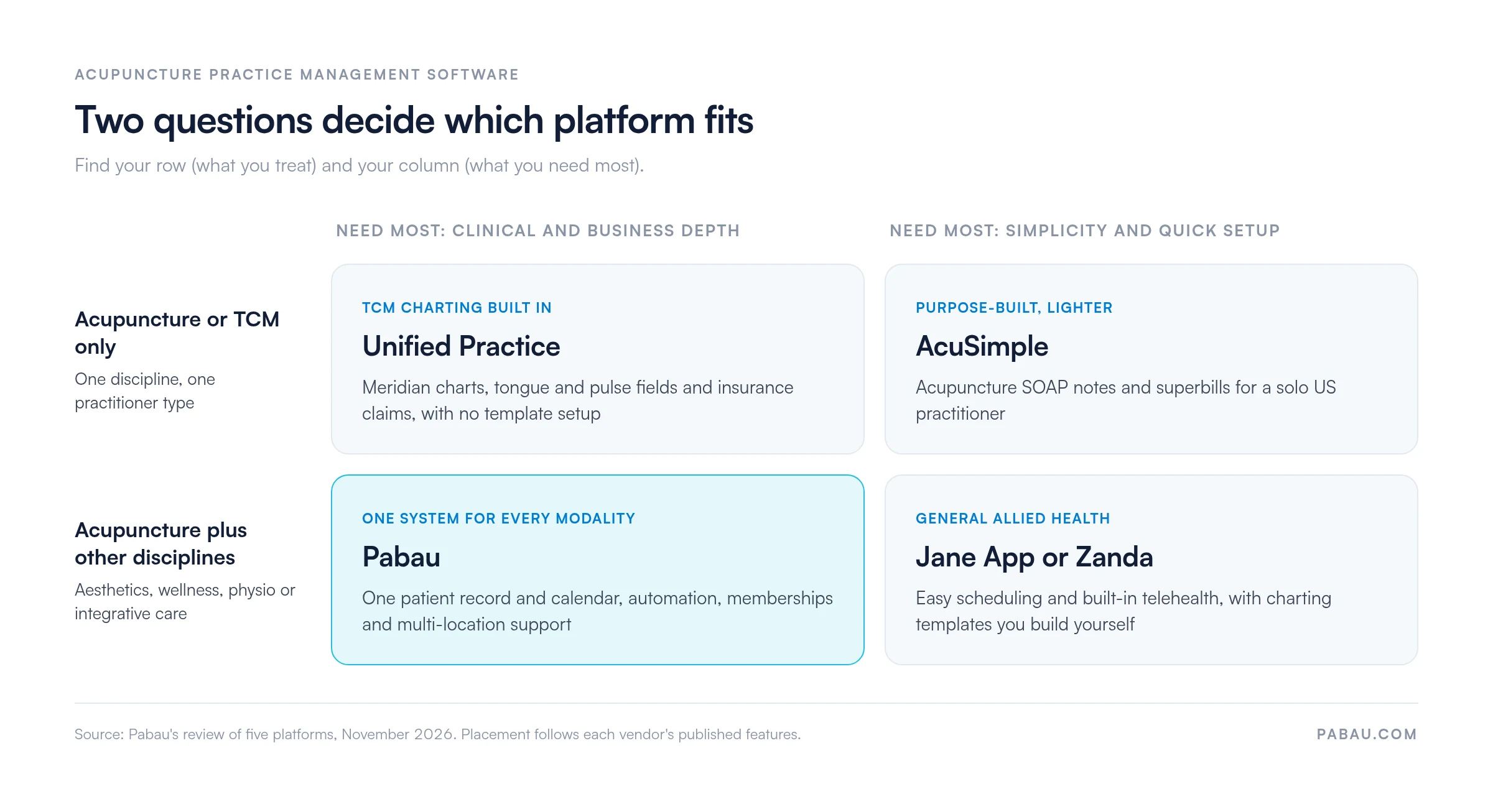
Two questions settle most decisions: is acupuncture your only discipline, and do you need depth or simplicity most? The grid below maps each answer to a platform.
Depth versus simplicity splits each practice type in two, so the same answer rarely fits a TCM-only practice and a mixed one. Placement follows each vendor’s published features.
For situations the grid doesn’t cover, such as insurance billing or an Australian practice, use this table.
Practice type
Best choice
Why
Solo US acupuncturist, billing insurance
Unified Practice or AcuSimple
Native US insurance billing and acupuncture-specific CPT code support
Dedicated TCM practice (any size)
Unified Practice
Only platform with native meridian charting, tongue/pulse fields and TCM diagnosis coding
Multi-modality practice (acupuncture + aesthetics, wellness or physio)
Pabau
One system for every modality, with no-show automation, memberships and multi-location support
Solo or small practice, simplicity first
Jane App or Zanda
Strong scheduling, quick setup, built-in telehealth, published per-practitioner pricing with optional add-ons
Budget-conscious solo practitioner (AU/NZ)
Zanda
One of the lowest entry prices here; allied health focus with telehealth included
Integrative medicine practice adding acupuncture as a new discipline
Pabau
The note builder adapts to new disciplines, and existing patient records stay in the same system
Five questions to settle before you choose
Work through these five questions before you commit. They narrow the field faster than any feature checklist.
Is acupuncture your only modality? If yes, start with an acupuncture-specific platform such as Unified Practice or AcuSimple. If not, a multi-modality platform such as Pabau or Jane App serves the whole practice without a second system.
Do you bill insurance directly? US practitioners who submit claims need acupuncture CPT code support. Unified Practice and AcuSimple build this in, and Pabau supports insurance billing in the US, UK, Australia and Canada.
How important is TCM charting depth? If tongue, pulse and meridian documentation are core to your workflow, Unified Practice is the only platform that delivers them natively. Every other option needs configuration.
What is your growth plan? A platform that fits a two-room solo practice in year one may not fit a three-location group in year four. If you plan to grow, prioritize multi-location support, role-based access and reporting that scales.
Where do you practice, and under which rules? HIPAA compliance and a BAA are non-negotiable for US practices handling protected health information. The NIH’s National Center for Complementary and Integrative Health notes that acupuncture is increasingly part of mainstream healthcare, which brings formal compliance obligations. Confirm BAA availability before you sign up.
How Pabau runs acupuncture alongside your other disciplines
In a mixed practice, the acupuncturist often charts in one tool while the aesthetics or physio team books and bills in another. Patient details get typed twice, and nobody sees the full treatment history.
Pabau puts every discipline on one calendar and one patient record. You build an acupuncture note template once, with point selection and TCM diagnosis fields, and it sits beside your other treatment notes.
Reminders, aftercare messages and rebooking nudges then run by treatment type, so a weekly acupuncture course rebooks itself. You get one view of each patient and less admin across the team.
Run acupuncture and every other discipline together
Pabau keeps acupuncture notes, bookings and billing in the same patient record as your other services. Book a demo to see it set up for a multi-modality practice.
Decide by what you treat, not by the longest feature list. A TCM-only practice loses more time building charting fields than it gains from extra business tools, so Unified Practice earns its place there.
Once acupuncture shares a practice with other disciplines, the cost moves to running two systems. That is where one patient record, shared automation and memberships pay back the setup time. The trade-off is clear: you configure TCM templates once in exchange for one system everywhere else.
If your practice already mixes acupuncture with aesthetics, wellness or physio, start there. Book a demo to see how Pabau handles acupuncture notes and rebooking alongside your other services.
Continue your research
Building your acupuncture notes from scratch?Acupuncture SOAP note template gives you a ready structure for chief complaint, TCM diagnosis and point selection.
Need a consent form for new patients?Acupuncture consent form covers the risks and agreements to collect before the first needle.
Sending patients home with clear instructions?Acupuncture aftercare guide lists what patients should and shouldn’t do after a session.
Charting auricular treatments?Ear acupuncture chart maps the auricular points you record in each treatment note.
Acupuncture practice management software runs scheduling, health records, SOAP notes, billing and administration for acupuncture and TCM practices. It adds acupuncture-specific features such as treatment series scheduling and superbills with acupuncture CPT codes. Some platforms also include TCM charting, such as meridian diagrams and tongue and pulse fields.
What is the best practice management software for acupuncturists?
Pabau is the best pick for practices that combine acupuncture with aesthetics, wellness or other disciplines. Unified Practice is best for TCM-only practices that need native meridian charting and US insurance billing. Jane App suits small practices that prioritize simple scheduling, Zanda is the budget pick in Australia and New Zealand, and AcuSimple suits solo US acupuncturists.
Does acupuncture software support SOAP notes and TCM-specific charting?
All five platforms reviewed support SOAP notes, but TCM charting varies. Unified Practice is the only one with native meridian charts, point diagrams and structured tongue and pulse fields. Pabau and Jane App offer customizable templates you can adapt for TCM, while Zanda and AcuSimple offer general or basic acupuncture templates.
Is there free acupuncture practice management software?
No platform in this review offers a permanently free plan for full practice management. Zanda offers a 14-day trial, AcuSimple a 15-day trial and Unified Practice a seven-day trial. Pabau offers a demo and structured onboarding instead of a trial. Paid plans start at US$29/month for Zanda and CAD $59/month for Jane App, while Pabau pricing depends on your setup — see pabau.com/pricing.
Can acupuncture software handle insurance billing and superbills?
Yes, though the depth varies. Unified Practice offers US insurance claims with acupuncture CPT codes (97810, 97811, 97813, 97814) on its Enhanced and Premium plans. AcuSimple generates superbills and claims, and Jane App supports superbills and Canadian provincial billing. Pabau supports insurance billing in the US, UK, Australia and Canada, while Zanda has limited insurance support.
What is the best EHR for acupuncture and Chinese medicine?
Unified Practice is the most complete EHR for dedicated acupuncture and Chinese medicine practices. It combines meridian charting, tongue and pulse fields, TCM diagnosis coding and US insurance billing. In a multi-modality practice, Pabau’s customizable EHR keeps one patient record across every discipline, at the cost of upfront TCM template setup.
Is naturopathic practice management software different from acupuncture software?
The two categories overlap heavily, sharing scheduling, SOAP notes, billing and patient portal needs. The main difference is specialty documentation, because acupuncture software may include meridian charting and point templates. General allied health platforms such as Jane App, Zanda and Pabau serve both disciplines, while Unified Practice focuses on acupuncture and TCM.