Mental health self-care checklist
A mental health self-care checklist is a structured daily tool for tracking the ...

6
Last Updated: Oct 20, 2026

The polyvagal ladder maps three autonomic nervous system states: Ventral vagal (safe and social), sympathetic (fight or flight), and dorsal vagal (shutdown and freeze).
The rungs run in a fixed order, so a client in shutdown reaches safety through sympathetic mobilization rather than around it.
Neuroception is the body’s subconscious threat-detection system. It decides which rung a client occupies at any given moment.
Therapists use the worksheet to identify client triggers, map personal resources, and choose the regulation strategy that fits the current rung.
Practice management software like Pabau stores completed worksheets in the client record, so the form is available in every session.
A ready-to-use clinical assessment tool for mapping autonomic nervous system states, identifying personal triggers and glimmers, and planning trauma-informed regulation interventions.
Download templateThe polyvagal ladder is a therapeutic framework that helps clinicians and clients visualize the autonomic nervous system’s three distinct states. Developed by Deb Dana and rooted in Stephen Porges’ Polyvagal Theory, it has become a standard tool in trauma-informed mental health practice.
Knowing which rung a client occupies changes how you assess them and how you plan the work. The rungs also run in a fixed order, so a client in shutdown cannot jump straight to connection. That sequence decides which regulation technique you reach for, and when.
The polyvagal ladder is a visual metaphor for the hierarchical organization of the autonomic nervous system. It maps three states as rungs, running from top to bottom: Safety, mobilization, and shutdown. Each rung carries its own behaviors, emotions, and physical sensations.
Traditional nervous system models treat fight-or-flight and freeze as equivalent responses. The ladder does not. It sets the states in a sequence, which changes what you do next.
The top rung, ventral vagal, is your client’s goal state. It is the window where healing, connection, and regulation happen. The middle rung, sympathetic, reflects survival mobilization. The bottom rung, dorsal vagal, indicates full system shutdown.
Stephen Porges developed Polyvagal Theory by mapping the vagus nerve’s anatomy and its connection to emotional and social engagement. Deb Dana, a clinical social worker, translated that neuroscience into the ladder metaphor now used in clinical practice. That made it usable by therapists and clients alike.
Each rung represents a different autonomic state. Knowing the characteristics of each one helps you recognize where a client is operating, and which regulation strategies will work from there.
Clients with trauma histories often become “stuck” on lower rungs. A triggering event or a reminder of past threat locks the nervous system into sympathetic or dorsal vagal states. That holds even when the external danger has passed. The ladder helps clients recognize that pattern and build the skills to climb back toward safety.
Neuroception is Stephen Porges’ term for the body’s automatic threat-detection system. Conscious perception involves thinking and analyzing. Neuroception happens instantly, below awareness.
Your client’s nervous system scans the environment constantly for safety cues and threat cues. A calm therapist’s voice, a familiar face, or soft lighting reads as safe. A raised voice, a sudden movement, or a smell linked to past trauma reads as danger. Those cues shift the nervous system up or down the ladder with no conscious decision involved.
This is why talk therapy alone often fails trauma survivors. Talking about safety does not activate the neuroception system. You have to build an environment the body reads as safe, using warm tone, slow speech, and predictable movements. Then you teach clients to spot their own neuroception triggers.
Trauma dysregulates the autonomic nervous system. A single overwhelming event or chronic stress can teach the nervous system to read ordinary situations as threats. Clients then get stuck in sympathetic activation, with hypervigilance, anxiety and rage, or in dorsal vagal collapse, with dissociation, numbness and hopelessness.
The framework helps you show a client that this is not a character flaw or a lack of willpower. The nervous system is doing what it was built to do, which is protect against perceived threat. Once you map where trauma has lodged it, you can work together on retraining it toward safety.
Clinical experience also turns the framework back on the therapist. Watching your own state during a session is one of the standard guards against clinician burnout. When you can name your own rung, you stay more regulated, and you model the safe state your client is learning to reach.
Moving up the ladder takes top-down (thinking-based) and bottom-up (body-based) strategies. Which one fits depends on the rung the client is standing on, as the diagram below sets out.
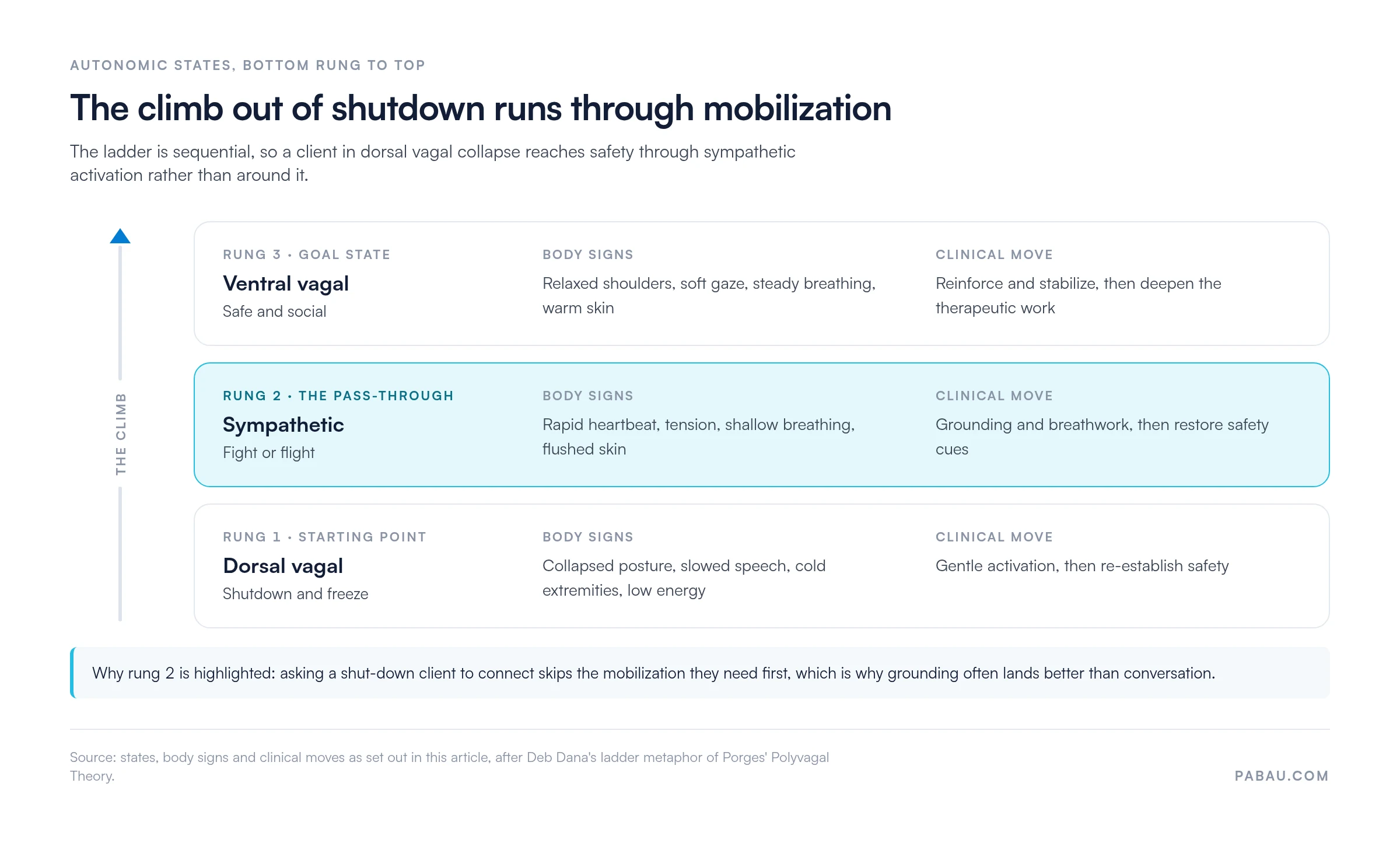
The worksheet gives the client somewhere to record which of these techniques actually shifts their state.
Different clients respond to different techniques. The worksheet asks them to record which strategies reliably shift their state, and which people or places act as glimmers. A glimmer is a small moment of felt safety that supports the climb back up.
The free template works in individual and group sessions. Here is how to bring it into the room:
Many therapists photocopy the worksheet or share a digital version before sessions. Filing each completed copy in the client’s chart supports clinical documentation best practices. It also gives you a record of how the client’s self-awareness changed over time.
The ladder scales well to group work. Teaching every member the three-state model creates a shared language for peer support and collective nervous system awareness.
Some therapists use it as a check-in at the start of a group session, asking where everyone is on the ladder today. That primes the group for connection and signals that safety is being prioritized. Members often recognize themselves in each other’s answers, which reduces the shame around dysregulation.
For group therapy informed consent, explain the ladder as the framework behind how the group supports nervous system healing. That helps members understand why you might slow down, check the pacing, or name group states aloud.
Polyvagal Theory has generated debate in academic neuroscience. Some researchers question the neuroanatomical claims. The specific point of dispute is whether the vagus nerve divisions Porges describes match human anatomy.
What holds up in the room is the ladder metaphor. Clients report feeling recognized when a therapist names their state out loud, and the language gives a session somewhere to go when talking has stalled. The underlying neuroscience may yet be revised. The shared vocabulary still does work.
Use the ladder as a clinical tool rather than a diagnostic instrument. It supports observation and treatment planning. It does not diagnose nervous system pathology, and it does not replace medical evaluation for conditions such as dysautonomia.
Most therapists print or handwrite the worksheet and file the paper copy in a client chart. The next copy starts blank, so the pattern across six months of sessions lives in a folder rather than in front of you.
Practice management software like Pabau turns the worksheet into a digital clinical form attached to the client record. You send it ahead of the session, the client fills it in, and the completed version lands on their file with a date on it.
That gives you the sequence instead of a snapshot. During treatment planning you can open the last three ladders together. You see whether a client who used to land in dorsal vagal now stops at sympathetic.

Hosting the worksheet in your practice management system lets you:
That workflow supports patient care management built on continuity and measurable progress. Clients watch their own nervous system literacy build session to session, which reinforces hope and agency in their recovery.

Pabau’s digital forms send the polyvagal ladder out before a session and file the completed copy on the client’s record. Session notes, worksheets and state patterns stay in one place, so you can see how a client’s regulation changed over time.

The ladder earns its place because it gives a dysregulated client something to point at. Naming the rung is usually easier than describing the feeling, and that is what makes the framework worth the session time.
Print the worksheet, use it in your next intake, and keep the completed copies together so the sequence stays readable. The trade-off worth remembering is that this maps a client’s state rather than diagnosing it, so it guides the plan without settling it.
Book a demo to see how Pabau stores completed worksheets and tracks a client’s nervous system patterns from one session to the next.

Want to deepen your nervous system knowledge? Psychiatric evaluation templates help you document baseline nervous system functioning before and after interventions.
Looking for trauma-informed consent frameworks? Group therapy informed consent templates explain polyvagal-based treatment approaches in clear language.
Need to track client progress over time? Secure clinical documentation in digital forms keeps all polyvagal ladder worksheets, notes, and progress metrics organized and accessible.
The polyvagal ladder maps three hierarchical autonomic nervous system states: Ventral vagal (safety, connection), sympathetic (fight or flight), and dorsal vagal (shutdown, freeze). It works by helping clinicians and clients recognize which state they are in, then choose a strategy that moves them toward the safety rung.
Therapists who use it report that clients build a shared vocabulary for their own states quickly. That vocabulary makes it easier to agree on which regulation technique to try next. Controlled trials of the ladder on its own are limited, so treat the worksheet as a clinical aid.
The ladder works well with trauma survivors, anxious clients, and people managing chronic stress. Adapt the language for age and developmental level. For young children, use simpler names: “Ready” (ventral), “Alert” (sympathetic), “Stuck” (dorsal).
Neuroception is the body’s automatic, subconscious threat-detection system. It decides which rung your nervous system occupies by scanning for safety cues and threat cues. Understanding it helps clients recognize the triggers that shift their state without conscious awareness.
The neuroanatomical claims are debated in peer-reviewed literature. The clinical framework built on top of them is far more widely accepted in trauma work. Use the ladder as an evidence-informed tool for mapping and regulating nervous system states, rather than as settled neuroscience.