Trauma response test: Free template for clinicians
A trauma response test is a structured screening questionnaire that helps clinic...

3
Last Updated: Oct 15, 2026

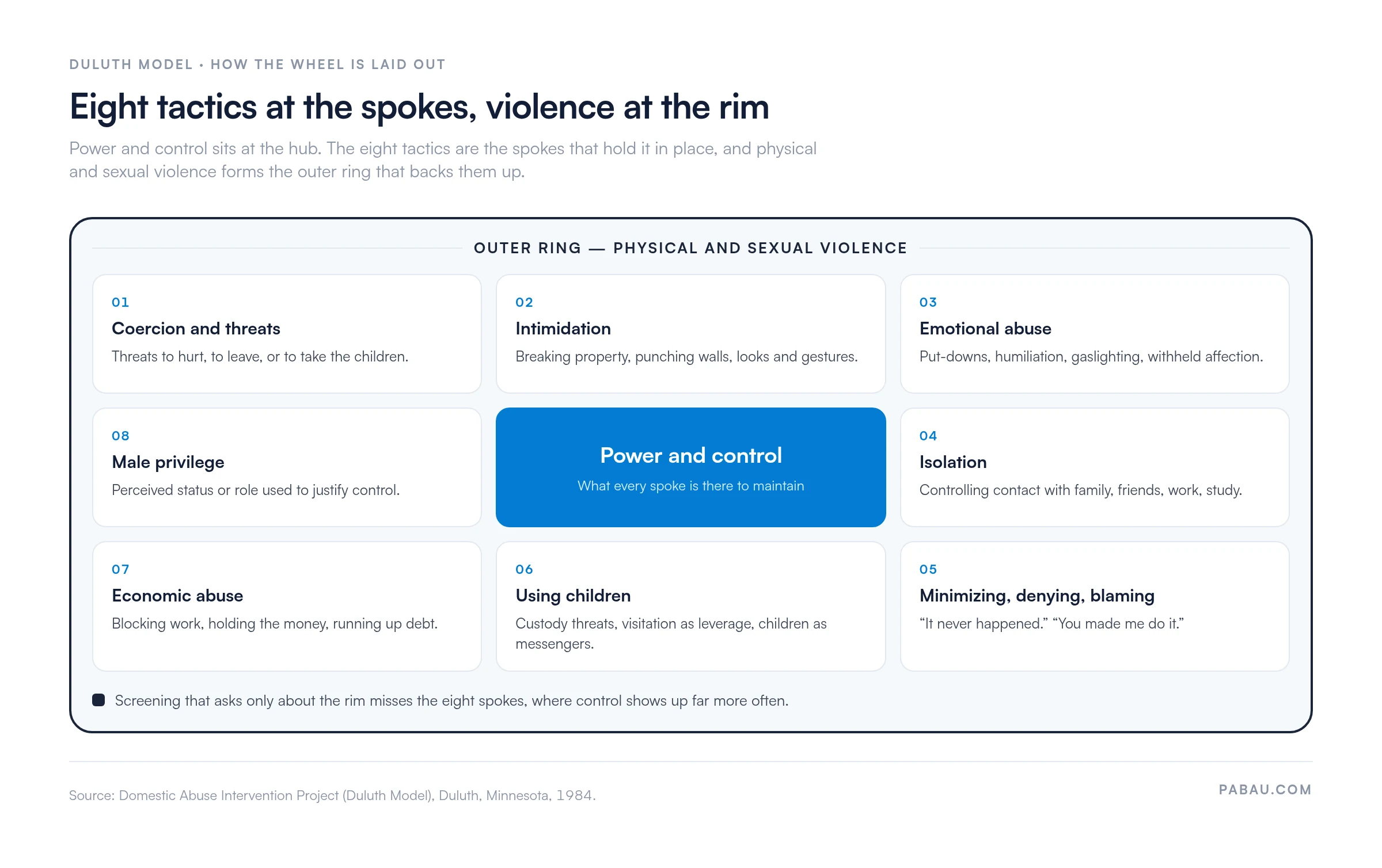
The power and control wheel is a diagnostic framework from the Duluth Model that names eight tactics abusers use to hold control.
The eight tactics are coercion and threats, intimidation, emotional abuse, isolation, minimizing and blaming, using children, economic abuse, and male privilege.
Those tactics sit as spokes around a hub of power and control, surrounded by an outer ring of physical and sexual violence.
Practitioners use the wheel for IPV screening, safety planning, clinical documentation, and staff training on abuse dynamics.
Pabau supports wheel-based assessment with secure patient records and digital clinical forms, so disclosures are captured and stored under access control.
A one-page assessment tool showing the eight tactics of control inside an outer ring of physical and sexual violence. It comes with prompts for each tactic and guidance on using the wheel in healthcare, advocacy, and batterer intervention settings.
Download templateThe power and control wheel is a diagnostic tool that maps eight tactics abusers use to hold control over a partner.
It was built from survivor interviews in Duluth, Minnesota, in 1984. Clinicians reach for it because it surfaces abuse that a yes-or-no question about violence never reaches.
This page gives you the wheel as a free download, plus the clinical detail around it. You will find what each tactic looks like in a patient’s account, and how to run a tactic-by-tactic screen. It also covers which adapted version to use, and where a disclosure should live in your records.
The power and control wheel is a visual diagnostic tool that maps the tactics abusers use to hold power over their intimate partners. The Domestic Abuse Intervention Project (DAIP) in Duluth, Minnesota, developed it in 1984. It shows how non-physical tactics work alongside physical and sexual violence to build a system of domination.
The wheel has eight spokes, one for each tactic of control. Those spokes are surrounded by an outer ring of physical and sexual violence. The ring is the most visible form of control, but it is not the most frequent one.
That layout matters clinically. A screen built only around the outer ring will miss the eight spokes, and the spokes are where most patients spend their daily lives.
The model is used in healthcare settings, domestic violence shelters, mental health practices, and batterer intervention programs. It helps survivors recognize the pattern they are living in, and it gives clinicians a structure for safety planning.
The framework came out of survivor interviews. Advocates working with abused women asked them directly what their partners did to hold control. The eight tactics came from lived experience rather than professional theory, and that origin still shapes how the tool reads to a patient.
Healthcare teams use the wheel to train staff on intimate partner violence (IPV) indicators, to structure an abuse assessment, and to document a disclosure safely. Primary care, mental health, emergency medicine, and obstetrics all draw on it. Social workers, psychologists, and advocates use it in intervention and group work.
The template serves five clinical and advocacy functions. How you sequence them depends on the setting, whether that is routine screening, crisis response, or ongoing case management.
Documenting a wheel-based assessment takes confidentiality as seriously as clinical accuracy. Store sensitive disclosures apart from routine notes, so a shared portal login or a printed visit summary cannot expose them.
Knowing each tactic helps you ask the right question and recognize abuse when physical violence is absent. Survivors often play down what happened, because they measure it against physical harm. The wheel reframes non-physical control as damage in its own right.
The Duluth Model publishes adapted wheels for specific populations, because abuse dynamics shift with relationship type, cultural context, and the power differences in play.
LGBTQ+ wheel. Recognizes that an abuser in a same-sex relationship may weaponize homophobia or threaten to out their partner. Economic abuse, isolation, and coercion stay central, but the framing reflects non-heterosexual contexts.
Teen relationship wheel. Adapted for adolescent dating abuse. It adds digital tactics such as controlling social media, monitoring texts, and sharing intimate photos without consent.
Immigrant communities wheel. Covers control based on immigration status: threatening deportation, withholding documents, threatening to report someone to the authorities, or using a language barrier to isolate them.
Choose the version that matches the patient’s relationship and identity. Using the heterosexual wheel with a same-sex couple misses abuse dynamics that matter, and it signals that the practice does not take that relationship seriously. The Duluth Model publishes every adapted wheel as a free download.
The Equality Wheel is the companion to the power and control wheel. Where one describes abuse tactics, the other describes healthy relationship behaviors. Its spokes are negotiation and fairness, non-threatening behavior, respect, trust and support, honesty and accountability, shared responsibility, responsible parenting, and economic partnership.
Used together, the two wheels give a safety plan its two halves. The patient marks what is happening now on the power and control wheel. They then name the behaviors from the Equality Wheel that would tell them a relationship had genuinely changed.
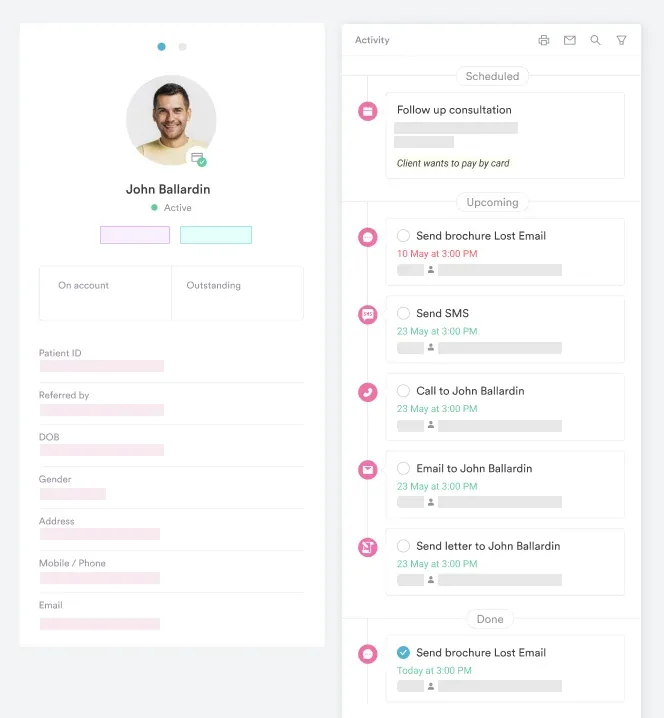
Teams working with IPV survivors need a record that clinicians can reach easily and nobody else can. The wheel fits into a clinical note system as a structured assessment form, with each tactic as a yes/no field plus a narrative box.
Build it into intake and the answers land in the patient’s record as you go. That gives you a longitudinal account of the abuse rather than a series of disconnected notes. Practice management software like Pabau, built for therapy practices, handles the capture and the storage in one place.
Keep sensitive disclosures in a confidential section of the record, flagged so staff know to handle them carefully. That guards against an abuser reaching the information in person or through a shared account. Confidentiality from the abuser, not only HIPAA compliance, is a safety requirement here.
The wheel remains the most widely used IPV assessment framework, and it still carries limitations worth naming. The original model came from interviews with heterosexual women, so it reflects that perspective. The male privilege tactic does not apply universally, because power differences in same-sex and non-binary relationships may not follow gendered lines.
Population-specific adaptations address some of that. Even so, a single wheel cannot describe every abuse dynamic. Hold that in mind when a patient’s account does not fit the diagram.
Timing is another limit. The wheel names the tactics in play, while Walker’s cycle of abuse sets out the four repeating phases an abusive relationship moves through.
Some research argues the model favors coercive control, meaning deliberate and strategic tactics, over reactive or impulsive violence. That can miss relationships where the violence is mutual, or where a mental health condition contributes to it. The Duluth Model acknowledges these critiques, and no longer presents the framework as universally applicable.
The wheel also emerged from work with male abusers and female survivors. Clinicians working across genders, orientations, and cultures should adapt the language to their own patient population. Training staff on the wheel’s limits as well as its uses keeps it a guide rather than a script.
Any healthcare professional who screens for IPV or works with survivors should know the wheel. That includes primary care physicians, psychologists and therapists, nurses in emergency and maternity care, social workers, victim advocates, shelter staff, and batterer intervention facilitators.
Training on the wheel is standard for healthcare professionals in many jurisdictions. The Cleveland Clinic and the National Domestic Violence Hotline both publish educational overviews of the wheel for survivors and the public.
Survivors benefit from seeing the wheel themselves. Naming the eight tactics validates an experience many have been told was not that bad, or were blamed for. It frames coercion, isolation, and emotional manipulation as abuse even where physical violence is rare or absent.
Three things change. Disclosure goes up first, because tactic-by-tactic questioning surfaces abuse that a single yes-or-no question never reaches.
Intervention then gets specific. Knowing which tactics a patient faces shapes the safety response, so the plan addresses the money or the isolation instead of offering general advice.
Documentation holds up better. A structured assessment against a recognized framework shows that the practice screened for IPV systematically. That matters when a court later reads the record.
Across a team, training on the wheel standardizes how staff screen for a disclosure and how they respond to one. Fewer cases get missed, and patients meet the same response wherever they enter the practice.
Most practices record a disclosure in the same free-text note as the rest of the visit. That makes it hard to find later, hard to audit, and easy to expose. A printed visit summary or a shared portal login can put it in front of the abuser.
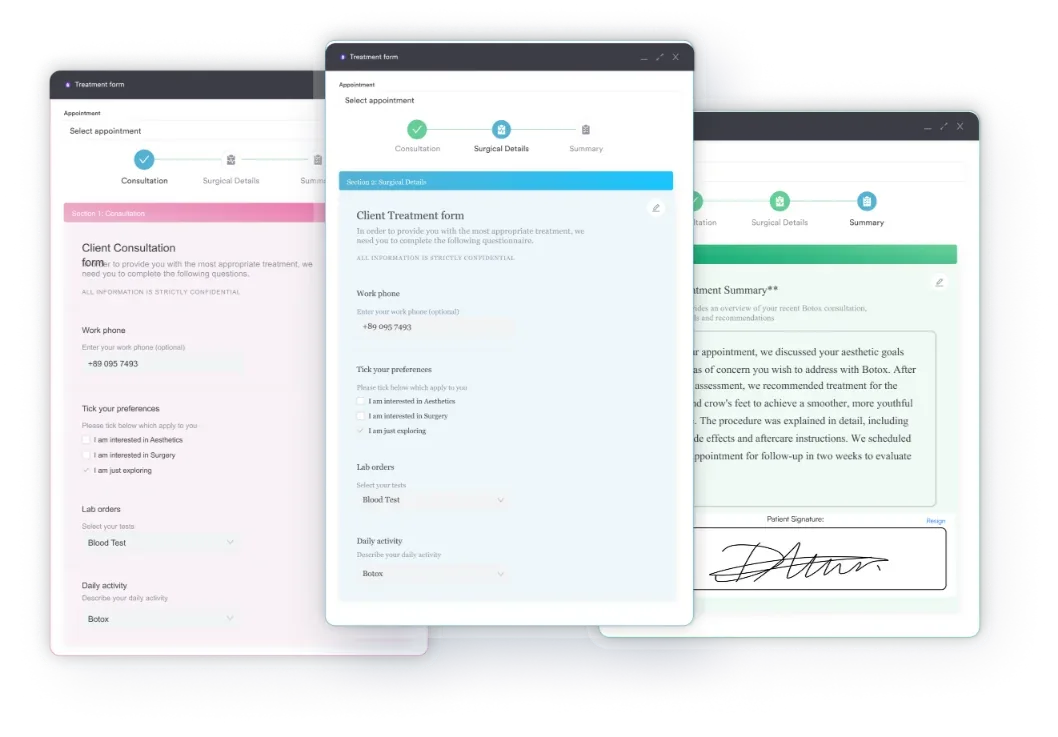
Pabau, our practice management platform, handles the same job differently. You build the eight tactics into a digital intake or clinical form, so the assessment is captured as structured fields rather than prose. The answers write into the patient’s record, and permissions control which staff can open them.
What you get is a dated record of a pattern of control, with the confidentiality the situation demands. It is ready for a safety plan or for a court. Every Pabau subscription includes the forms, the records, and the permission controls, so none of it sits behind a higher tier.

Pabau’s digital forms and patient records capture wheel-based assessments as structured data, with permissions controlling who can open a disclosure. Your team screens the same way every time, and the record stands up later.

The wheel earns its place because it changes the question. Ask about violence and you get a single answer. Walk the eight tactics and you get the shape of a relationship.
The trade-off is time. A tactic-by-tactic screen takes longer than one question, and it will surface disclosures your team then has to act on. That is the point of running it, and it is worth settling staffing and referral routes before you roll it out.
Download the wheel and pick the adapted version that matches your patient population. Then decide where a disclosure will live in your records, before the first one arrives. Book a demo to see how Pabau captures that documentation and keeps it out of the wrong hands.

Working through the tactics with a patient? The domestic violence worksheet gives you a structured form for recording what the patient describes.
Ready to turn a disclosure into a plan? The mental health safety plan sets out warning signs, contacts, and the steps a patient can take.
Screening an adolescent patient? The safety plan for teenagers adapts the same planning process for teen relationships.
Need the trauma history behind the disclosure? The trauma questionnaire template covers the background a wheel-based screen usually raises.
The power and control wheel is a diagnostic tool developed by the Duluth Model in 1984. It names the eight tactics abusers use to hold control. Those are coercion and threats, intimidation, emotional abuse, isolation, minimizing and blaming, using children, economic abuse, and male privilege. The spokes are surrounded by an outer ring of physical and sexual violence.
The Domestic Abuse Intervention Project (DAIP) in Duluth, Minnesota, developed it in 1984, based on interviews with domestic violence survivors. DAIP remains the custodian of the wheel and of the wider Duluth Model.
They screen by walking through each of the eight tactics rather than asking one question about violence. They record which tactics the patient reports, build a safety plan around those tactics, and use the wheel in staff training. The structure makes it easier for a patient to name something they had played down.
Yes. Use the download at the top of this page. You can also take the original from the Duluth Model, which publishes the wheel and its adapted versions as free PDFs. Healthcare organizations reference and adapt it widely.
The power and control wheel describes abusive tactics. The Equality Wheel describes healthy relationship behaviors: negotiation and fairness, respect, trust and support, shared responsibility, responsible parenting, and economic partnership. Clinicians often use both, so a patient can name what is happening now and what would tell them it had changed.
Yes. The Duluth Model publishes an LGBTQ+ version that covers homophobia-based control and threats of outing. A teen version adds digital abuse tactics, and an immigrant communities version covers immigration status as leverage. Use the one that matches the patient’s relationship and identity.