Crisis safety plan template
A crisis safety plan is a short, personalized written plan that a patient and cl...

2
Last Updated: Oct 19, 2026
A social determinants of health screening is a structured set of questions about the non-medical conditions shaping a patient’s health. It covers food access, housing, transportation, money worries, and social isolation.
Practices run it to find barriers that a clinical visit alone won’t reveal. Health systems and payers increasingly expect this information, and it changes what a care plan should look like.
This guide gives you a free, customizable template and compares the validated tools clinicians use most. It also walks through how to run, document, and act on a screening. A short form is the easiest place to start, and you can expand it once your referral pathways are working.
A ready-to-use screening form covering food security, housing stability, transportation, financial strain, social isolation, and referral consent. It also has space for clinician notes and a signature.
Download template
A social determinants of health screening identifies non-medical barriers that affect diagnosis, adherence, and recovery.
Five core domains are food, housing, transportation, financial strain, and social isolation.
PRAPARE and the AHC HRSN Screening Tool are the most widely referenced validated instruments.
ICD-10-CM Z codes Z55 to Z65 document social needs in the clinical record.
A screen only helps once you know whether the referral it triggered met the patient’s need.
A social determinants of health screening form is a patient-completed or clinician-administered questionnaire that records the social conditions affecting health. It captures information that medical history forms miss, including whether a patient can afford medication, get to appointments, or keep stable housing.
In the United States, screening is often linked to value-based programs. The Centers for Medicare and Medicaid Services (CMS) tested a standard screening approach through its Accountable Health Communities model.
The model’s performance period ran from May 2017 to April 2023, after a one-year no-cost extension of its original April 2022 end date. Requirements differ by program and payer, so confirm current rules before building a workflow around them.
The template follows the same domain structure as the validated tools, so staff can complete it in a single intake visit. Work through it in this order:
Keep the clinician notes field brief. A line such as “unable to afford transportation to dialysis, referred to local ride program” helps the next clinician more than a paragraph of narrative.
Screening suits any setting where the care plan depends on the patient’s ability to follow it. Primary care and community health centers use it most, but private practices and integrative practices find it useful for complex patients.
A standard form makes screening consistent across staff, which matters when several clinicians see the same patient. It also gives you a dated record if a payer or auditor asks how social needs were assessed.
Because the questions are fixed, you can compare results across patients and over time. That comparison supports population health reporting without relying on memory or free-text notes.
Pilot the form with one session before rolling it out. Note which questions patients skip or misunderstand, then reword those items for your population.
The template is a practical starting point, but many organizations also use a validated instrument. The table below summarizes the tools most often cited in primary care, using the publicly available descriptions from their developers.
Use PRAPARE when you want a broad assessment that includes patient strengths. Use the AHC HRSN tool when a payer or program specifies it. Either can be paired with the template above for internal documentation.
Screening works best when it is built into existing intake rather than added as a separate task. Decide in advance who asks the questions, when they are asked, and where the answers go.
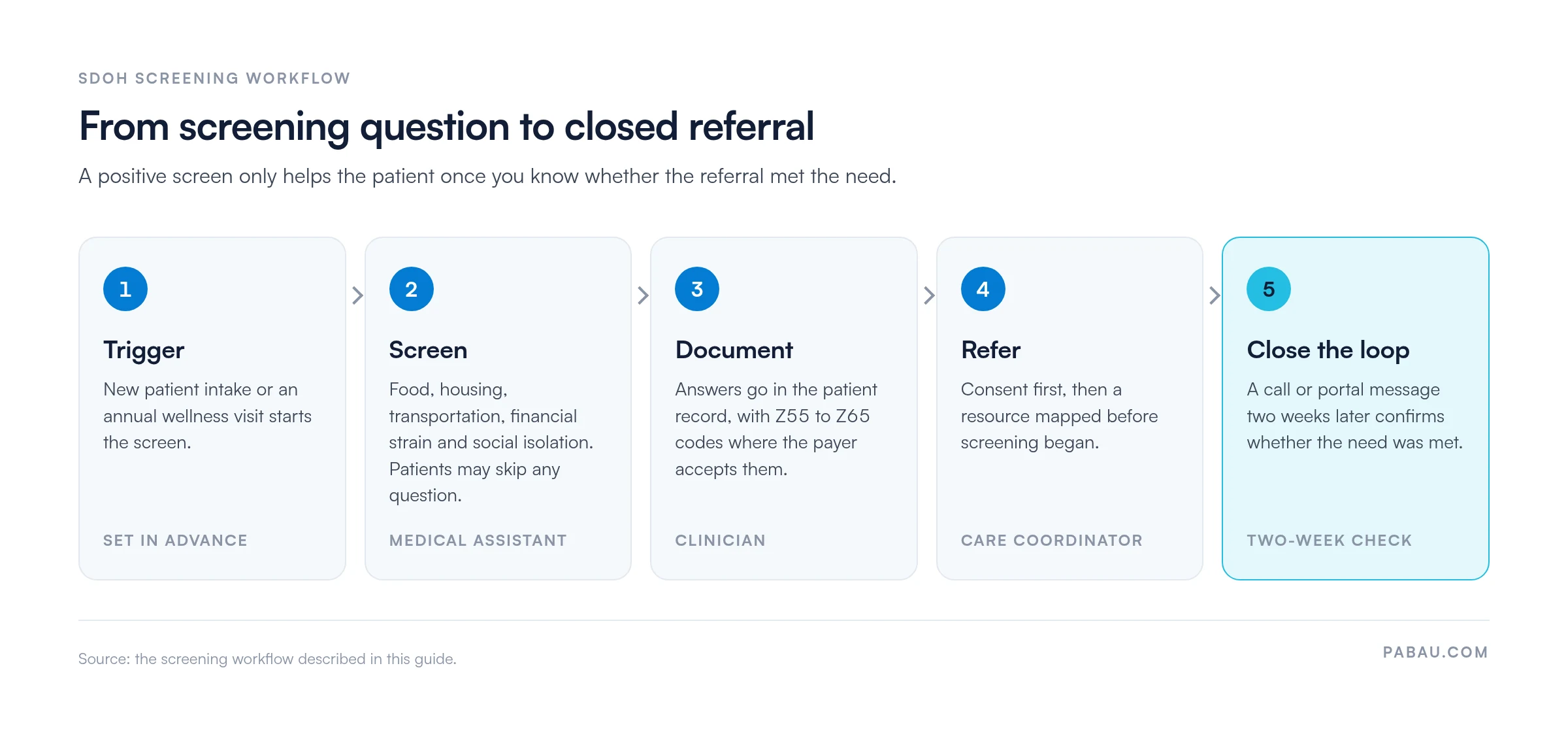
If you already hand out a new patient questionnaire, add the screening pages to that packet so patients complete one set of forms. The diagram below follows a single screen from that trigger to a confirmed referral outcome.
ICD-10-CM codes in the range Z55 to Z65 describe social circumstances such as employment, housing, economic status, and education. Coding rules change, and applicability depends on the payer. Confirm code selection with a certified coder before submitting a claim.
Documentation should record the patient’s stated need in plain language, the date, and the action taken. Clinicians can then reference the same finding in later visits without repeating the screening.
A positive screen only helps if the patient reaches a resource. Map referral options before you start screening, because availability varies by county and by eligibility rule.
For pregnant patients and families with young children, a WIC referral form sends a food-insecure household to the federal nutrition program. Track each referral until you know how it ended. A follow-up call or portal message two weeks later shows whether the need was met.
On paper, a screening form gets filled in at the front desk, scanned later, and read by whoever finds it. Pabau, the practice management platform we build, includes patient intake software that publishes the template as a digital form. Answers land directly in the patient record, and the referral consent can sit in the same form.
Pabau’s medical records management keeps each patient’s domain answers in a single view, so the next clinician sees the same barriers without reading old notes. Staff can also set automated follow-up tasks for positive domains, so the two-week check happens without anyone keeping a list.

Pabau keeps digital forms, patient records, and follow-up tasks in one place, so screening results reach the clinician who needs them.

Start with the short form, but build the referral list before you ask the first question. Screening without somewhere to send a positive answer tells patients you noticed the problem and then left it with them.
Once the list exists, the screen earns its place in a care plan. The trade-off is staff time: every positive domain adds a referral and a follow-up. Budget for that two-week check from day one, or the screen stops at documentation.
Book a demo to see how Pabau turns a screening form into tracked referrals and follow-up tasks inside each patient’s record.

Need a functioning score to sit beside the screen? WHODAS 2.0: Free template measures how health conditions affect daily activities and participation.
Tracking how social needs affect wellbeing? Quality of life questionnaire and assessment template gives you a repeatable measure to compare over time.
Collecting the basics first? Demographic information form: Free template and what to include covers the fields that sit alongside a social needs screen.
Sending a patient home with unmet needs? Discharge planning worksheet: A free downloadable template helps you line up support before the patient leaves.
Want one form for general health details? Universal health form template: Free PDF and how to complete it explains each section and how to fill it in.
A social determinants of health screening is a structured questionnaire that identifies non-medical needs affecting a patient’s health. It covers food, housing, transportation, financial strain, and social isolation.
PRAPARE is a validated screening tool developed by the National Association of Community Health Centers. It assesses social needs and patient strengths and is widely used in community health settings.
No single rule requires every practice to screen. CMS has tested screening through programs such as the Accountable Health Communities model, so check the requirements of your specific program and payer.
ICD-10-CM codes Z55 to Z65 describe social circumstances. Confirm code selection with a certified coder because applicability depends on the payer.