Treatment summary
A treatment summary is a written record of what care was delivered during an epi...

3
Last Updated: Oct 16, 2026
A WIC referral form is the document a licensed provider signs to certify that a patient meets the nutritional risk criteria for WIC. The program is the USDA’s supplemental nutrition benefit for pregnant and postpartum women, infants, and children under five.
Your signature turns a clinical finding into an enrollment file. The form therefore needs patient details, the risk you documented, and measurements the agency still accepts. Each state also runs its own WIC program, with its own version of the paperwork.
Below you can download a general template, see what belongs in every section, and check how recent your numbers need to be.
One page, seven sections: patient details, participant category, measurements and lab values, nutritional risk, diagnosed conditions, provider certification, and a block for the WIC agency. Print it, or complete it on screen.
Download template
A WIC referral form records clinical nutritional risk and carries a licensed provider’s signature, which starts a family’s WIC enrollment.
Every form needs patient details, provider credentials with an NPI, the risk you documented, recent measurements, and your dated signature.
Most state programs want height and weight taken within 60 days of the WIC appointment, so check the date before you sign.
Each state runs its own WIC program, so download your state’s official form and treat this template as a reference.
Digital intake forms let staff capture these details once, review them for completeness, and keep a signed copy in the patient record.
The referral certifies one judgment. You assessed this patient, you found a medical or nutritional risk that WIC recognizes, and the rest of the form supports that finding. Every other field exists to help the agency act on it.
WIC is funded by the USDA Food and Nutrition Service and delivered by state health agencies. It serves pregnant, postpartum and breastfeeding women, infants, and children up to their fifth birthday.
Two conditions have to be met. Family income must sit at or below 185% of the federal poverty level, and the applicant must carry a documented nutritional risk.
The agency verifies income itself, so your form only answers the clinical half. That split matters, because a signed referral is not an enrollment decision. The local WIC agency still holds a certification appointment, confirms income and residency, and issues benefits from there.
A licensed healthcare provider who can assess nutritional status signs the referral, and federal rules leave the detail to each state.
These credentials are accepted across state WIC programs:
Settle this once, before your first referral. Call the local WIC agency and ask which credentials it accepts, then record the answer somewhere your whole team can find it.
Scope of practice varies by state, and each agency applies its own program policy on top of the licensure rules.
State layouts differ, but the same seven blocks show up on almost every version. Use this as the field map when you adapt the template to your own workflow.
An out-of-date measurement is a common reason for a referral to come back. Most state programs want height and weight taken within 60 days of the WIC appointment. The blood work rule then changes with the participant category.
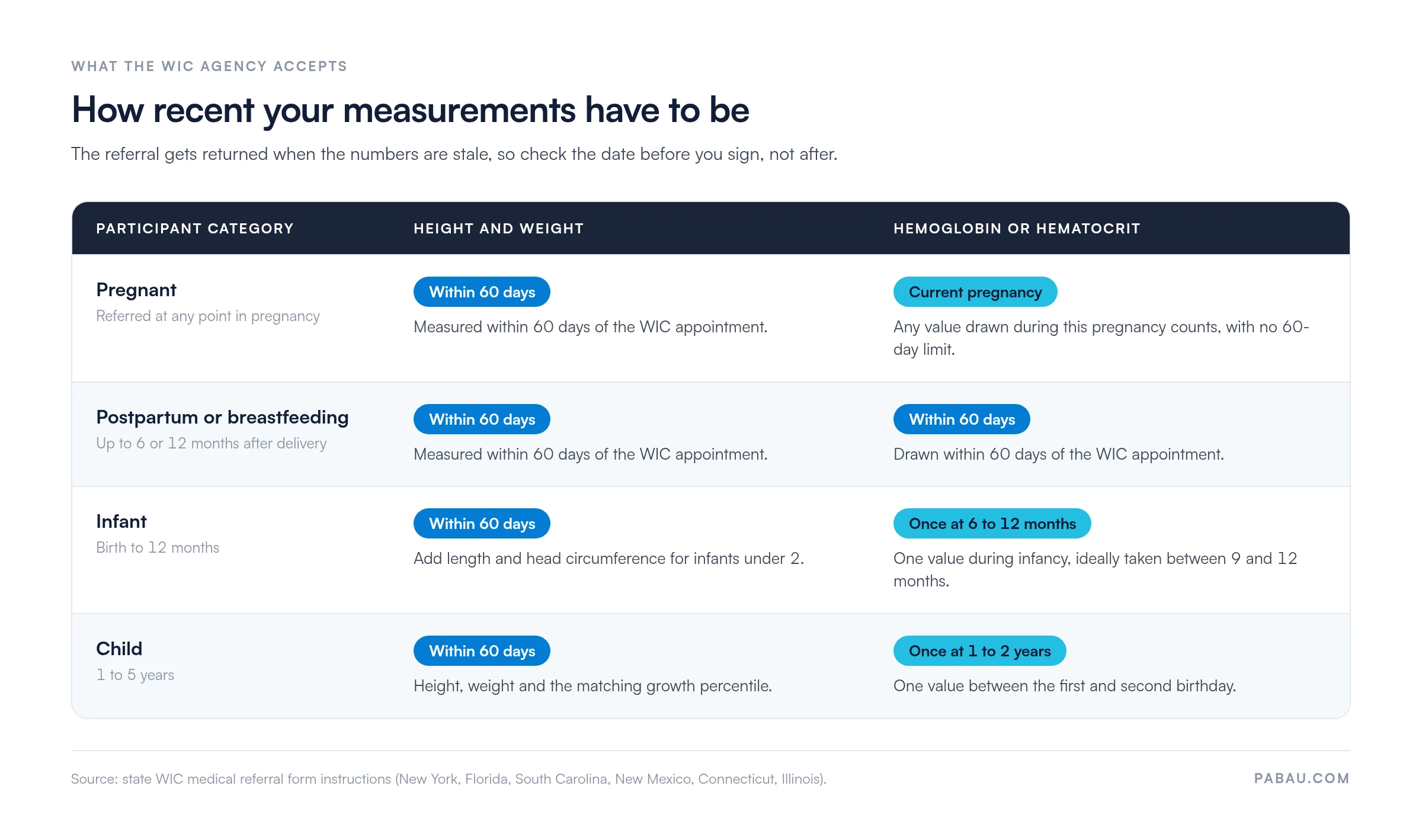
Pregnancy is the exception on hemoglobin. A value drawn at any point in the current pregnancy is accepted, so an early booking result still counts. For infants and children, the agency looks for one value inside an age window, not a recent draw. Send the date you have rather than repeating the test.
All of this gets easier when the numbers are already dated in the chart. Keeping a vital signs record for each visit means you can answer the recency question without reopening the file.
Risk criteria are set by federal regulation and applied by each state agency. In practice, most referrals cite one of the following:
Check only what you confirmed. A box you cannot support from the clinical note will be queried, and that query costs the family an appointment. State lists also shift as USDA guidance is updated, so pull your agency’s current criteria once a year.
Sending clinical detail to an outside agency is a disclosure, so handle it the way you handle any other. Where your state or your own policy calls for written consent, keep a signed HIPAA authorization form in the chart. That settles the question before the fax goes out.
Four problems come up again and again. Measurements taken at a visit three months ago no longer qualify. A risk box gets ticked from memory rather than from the note.
The form also goes out unsigned, because it was printed after the patient left. And the practice keeps no record of where it was sent, so nobody can confirm it arrived.
Those are process problems rather than clinical ones. All four are fixed by completing the form during the visit.
Layout, field order, risk codes and submission methods all vary between states. Use your state’s official document where one exists, and keep the template above as a reference for what a complete referral contains. If you cannot find the form, the local WIC agency will send it to you.
Referrals outside WIC need less detail and no nutrition fields. For those, a general medical referral form template is the faster starting point.
Most practices still print the referral, complete it by hand, and photocopy it for the chart. The demographics and the measurements already sit in the patient record, so the same details get written out a second time. That is where the transcription errors come from.
Practice management software like Pabau replaces that with digital forms. You build the referral once as a form template. Patient demographics pull straight from the record, and you complete the clinical fields on screen. The signature is captured on the same form, so it never goes out unsigned.
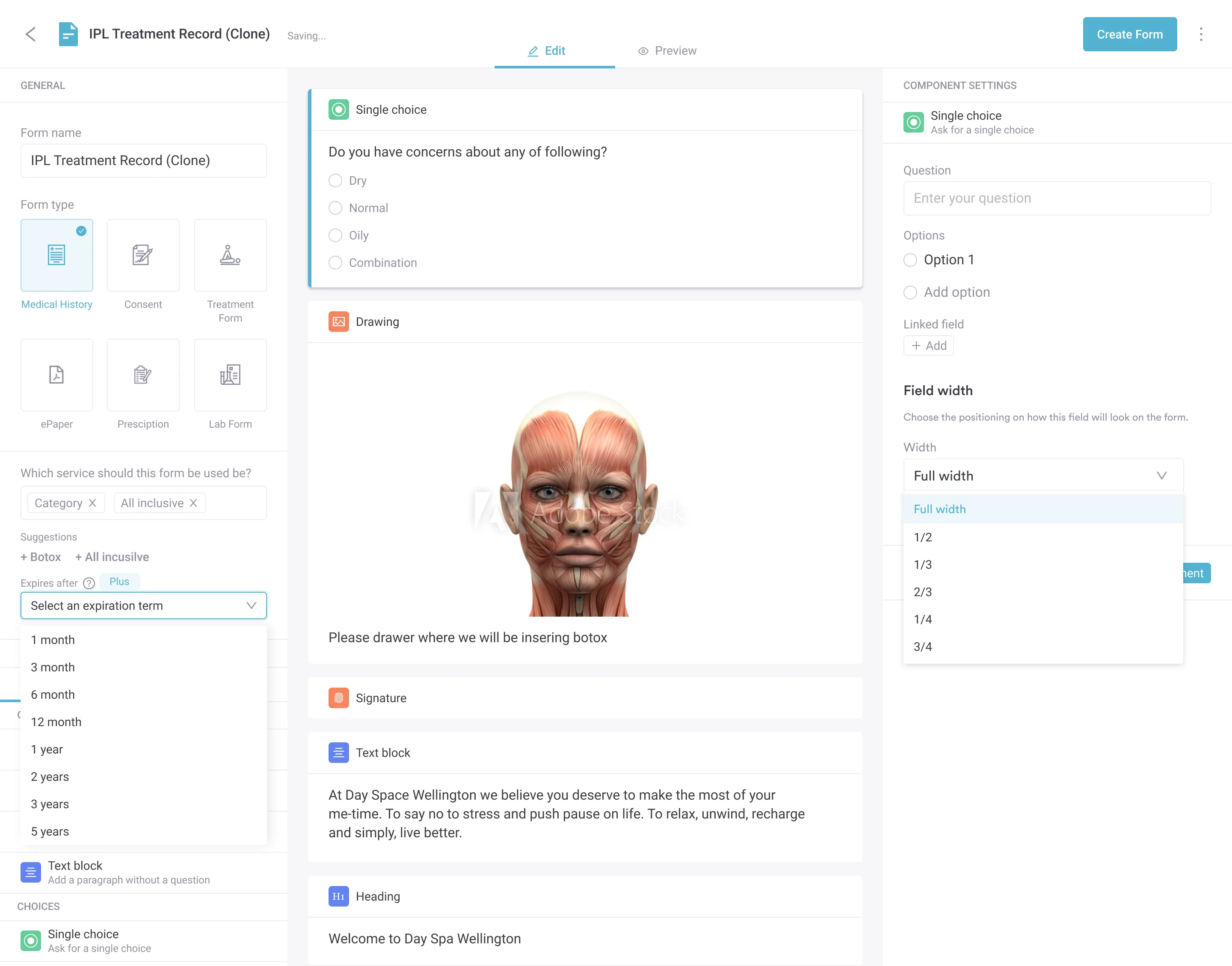
The finished form saves to the patient record and exports as a PDF. Staff can then send it by whatever method the local agency accepts. The copy you keep is the copy you sent, and the audit trail sits in the chart rather than in a filing cabinet.
If your intake still runs on paper, that is the part worth changing first. Good patient intake software gives every later form, referrals included, clean data to draw from.

Pabau’s digital forms pull patient demographics from the record and capture nutritional risk during the visit. Your team then keeps the signed referral in the patient record, not on paper.

WIC referrals are quick to complete and easy to get returned. Three things decide it: the credential that signs, how recent the measurements are, and whether each ticked risk is supported in the note. Get those right and the family reaches a certification appointment instead of a phone call.
Use your state’s official form where one exists, and keep the template here as the reference for what a complete referral looks like. Book a demo to see how Pabau’s digital forms capture referral details once and keep a signed copy in the patient record.

Need a referral form for something other than WIC? Medical referral form template covers the same handover without the nutrition fields.
Asked to justify a treatment or a product to a payer? Medical necessity letter sets out the structure and the wording reviewers look for.
Referring an infant or a child? Consent to treat a minor records who may authorize care when a parent is not in the room.
Building the assessment behind the referral? History and physical form gives you the full intake structure that feeds a nutritional risk finding.
No. The referral certifies nutritional risk. A request for special formula or medical food usually goes on a separate state document, such as California’s CDPH 247.
Yes. WIC clinics can measure height, weight and hemoglobin on site. A provider referral saves the family that step and gives the agency your clinical findings up front.
Validity varies by state, and six to twelve months is typical. Check your state agency’s guidance, or ask the local WIC clinic when you set your referral process up.
Send the referral with the fields you can complete, and note why the value is missing. WIC clinics can draw hemoglobin at the certification appointment.
The WIC agency keeps what you send. File your own dated copy in the patient record, together with the date and the method you used to send it.