Trauma response test: Free template for clinicians
A trauma response test is a structured screening questionnaire that helps clinic...

8
Last Updated: Oct 15, 2026

WHODAS 2.0 measures disability across six functioning domains and reports one standardized 0 to 100 score.
The 12-item form takes about 5 minutes. The 36-item form takes 20 to 30 minutes and adds domain-level scoring.
The 36-item form can be interviewer-, self-, or proxy-administered, so the longer version is not interview-only.
The severity bands are uneven, and severe alone runs from 50 to 95 on the scale.
Digital forms in practice management software like Pabau capture the responses and file the converted score in the client record.
A standardized WHO instrument that measures disability and functioning across six life domains: cognition, mobility, self-care, getting along, life activities, and participation. Use it as a self-report form, run it as an interview, or hand it to a proxy respondent.
Download templateWHODAS 2.0 is a free World Health Organization questionnaire that scores how much a health condition limits daily functioning. It covers six domains and converts the answers into a single 0 to 100 score, where higher means more disability.
Below you get the three versions, both scoring methods, and how to read the number you end up with. Watch the severity bands as you go. They are uneven, and the severe band alone swallows almost half the scale.
WHODAS 2.0 stands for the World Health Organization Disability Assessment Schedule 2.0. It is a standardized, cross-cultural instrument that measures functioning across six life domains. Unlike condition-specific scales, it applies to any health condition, including mental health disorders, physical injuries, neurological conditions, and chronic illness.
Developed by WHO and validated globally, it is used in clinical assessment, outcome monitoring, insurance eligibility screening, and research. It applies to people aged 18 and older, across cultures and healthcare settings.
There are three versions, built for different time budgets. Pick the one that fits your appointment length and your patient population.
The 12-item form suits rapid screening and a tight schedule. The 36-item form gives you domain-level detail for an in-depth functional assessment. The hybrid opens with the 12 items and adds 24 more, and Computer-Adaptive Testing keeps the run time down.
Scoring runs across six domains drawn from the World Health Organization’s International Classification of Functioning, Disability and Health (ICF). Each domain covers a distinct part of daily life.
The six together cover the span of adult functioning and apply whatever the diagnosis is. That makes the instrument portable across specialties. A practice running a mental health EMR can store the domain scores next to the treatment plan rather than in a separate file.
Scoring depends on the version you ran. Both methods produce the same output, a single figure on the 0 to 100 scale.
Sum the scores from all 12 questions. Each item is scored 1 to 5, where 1 is no difficulty and 5 is extreme difficulty. The raw total runs from 12 to 60. Convert it with this formula: (raw score − 12) ÷ 48 × 100.
Score each item, then sum within each domain. That gives you a score per domain plus an overall figure, both on the 0 to 100 scale. Domain-level scoring is the reason to run the longer form, because it tells you which part of daily life is taking the hit.
The arithmetic is identical every time, which makes it a good candidate for automation. A practice that collects the form digitally can hand the conversion to its patient intake software and get the score back without a calculator.
The score reports how much difficulty the person reported, not how severe their diagnosis is. The standardized 0 to 100 scale is read in five severity bands.
Those bands are not the same size, which matters the moment you report a result. Severe runs from 50 to 95, so one label holds almost half the scale.
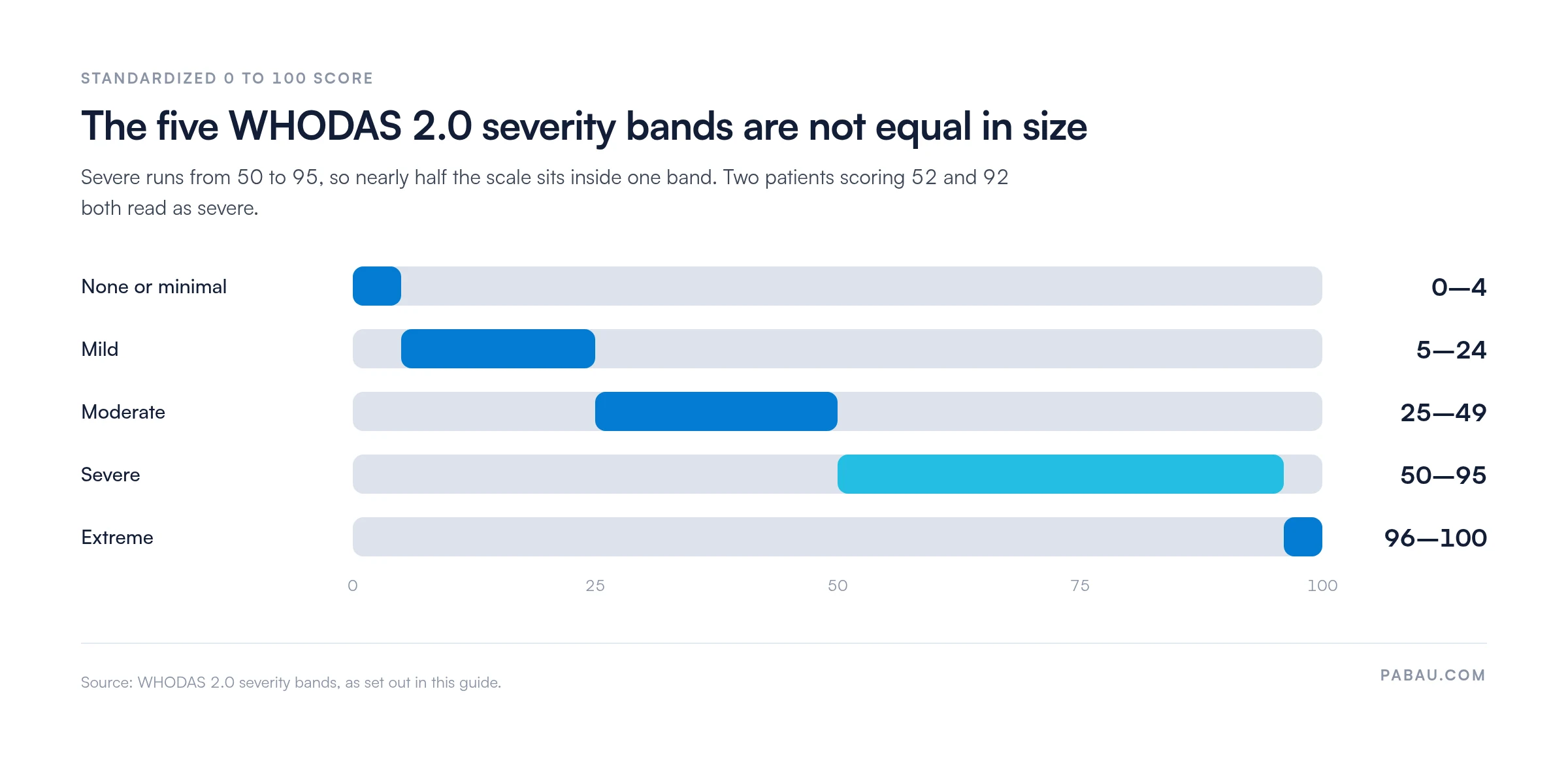
So report the number, not only the band. Repeat the same version at intervals and the trend tells you more than the label does. A drop from 88 to 62 is clear progress even though both scores sit in severe.
Administration depends on the version and on the patient in front of you. Self-report saves clinician time. An interviewer catches confusion and can probe an answer that does not fit. WHO also publishes a proxy form, for cases where a family member or carer answers on the patient’s behalf.
The 12-item form and the self-administered 36-item form can both be completed by the patient alone. They fill it in at home, in the waiting room, or through an online portal. That suits routine screening and follow-up in a busy schedule.
A trained clinician reads each question aloud, clarifies wording, and probes when an answer does not match the history. That keeps administration consistent and produces richer notes. A psychiatric evaluation template gives you a structure to run the rest of the interview against.
WHODAS 2.0 appears in the Diagnostic and Statistical Manual of Mental Disorders, Fifth Edition (DSM-5) as a cross-cutting functional assessment measure. Clinicians run it at psychiatric evaluation and again during treatment, to quantify disability and track response to therapy.
Other uses include outcome monitoring, insurance eligibility decisions such as 1915(i) State Plan Amendment programs, disability assessment, and research. In each of those, the score is only useful if it is stored where the rest of the case sits. Therapy practice management software keeps the number, the date, and the version together in the client record.
WHO-led studies and peer-reviewed research report strong internal consistency, with Cronbach’s alpha between 0.84 and 0.90 across domains. Test-retest reliability and cross-cultural validity hold up as well. The instrument performs consistently across languages, health systems, and adult populations.
Validity evidence shows the score tracks clinical judgment and other established disability measures. It separates severity levels, and it moves when the patient’s functioning moves. That sensitivity to change is what makes it usable as a repeated outcome measure rather than a one-off snapshot.
WHO publishes WHODAS 2.0, and it is free to use, copy, and distribute in clinical practice and research. No licensing fee or written permission is required for the 12-item or 36-item forms. Download the PDF at the top of this page to start using it.
Translations are available through WHO’s official WHODAS resource page. Psychology practices can keep the completed forms and the score history in one client record with psychology practice software.
Scoring on paper means a clinician adds the items up by hand, applies the conversion, and types the result into a note. That is three chances to make an arithmetic error before the number reaches the chart. Practice management software like Pabau removes all three steps.
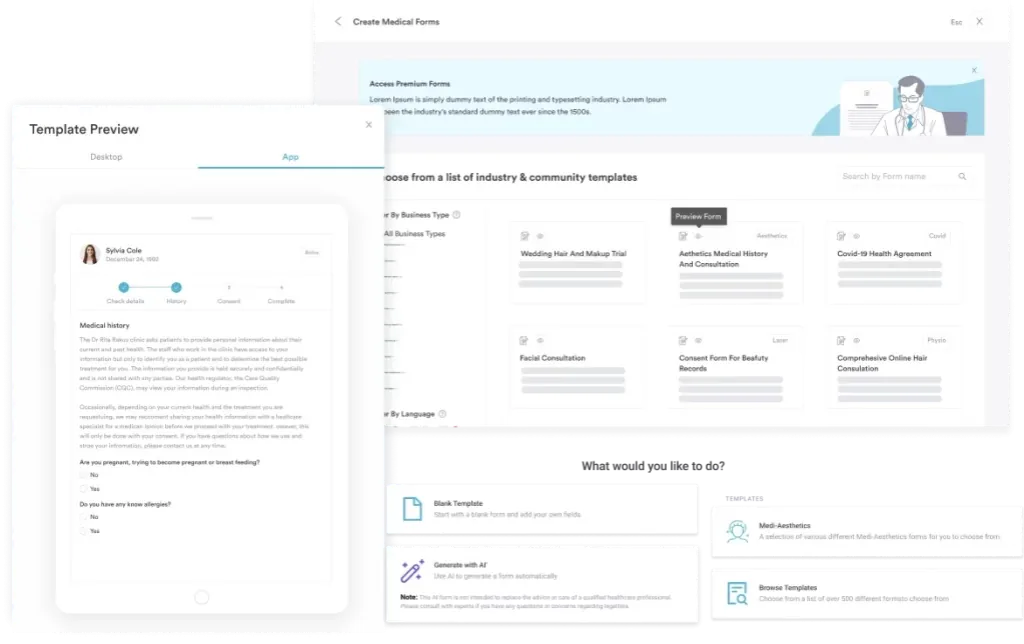
You build the questionnaire once as a digital form that mirrors the instrument. Patients complete it before the appointment or on a tablet at reception. Pabau applies the conversion and writes the 0 to 100 score straight into the client record.
Because each score lands with its date attached, the next administration lines up beside the last one. You get a trend across visits without a side spreadsheet, and no one has to re-key a figure that was already collected.
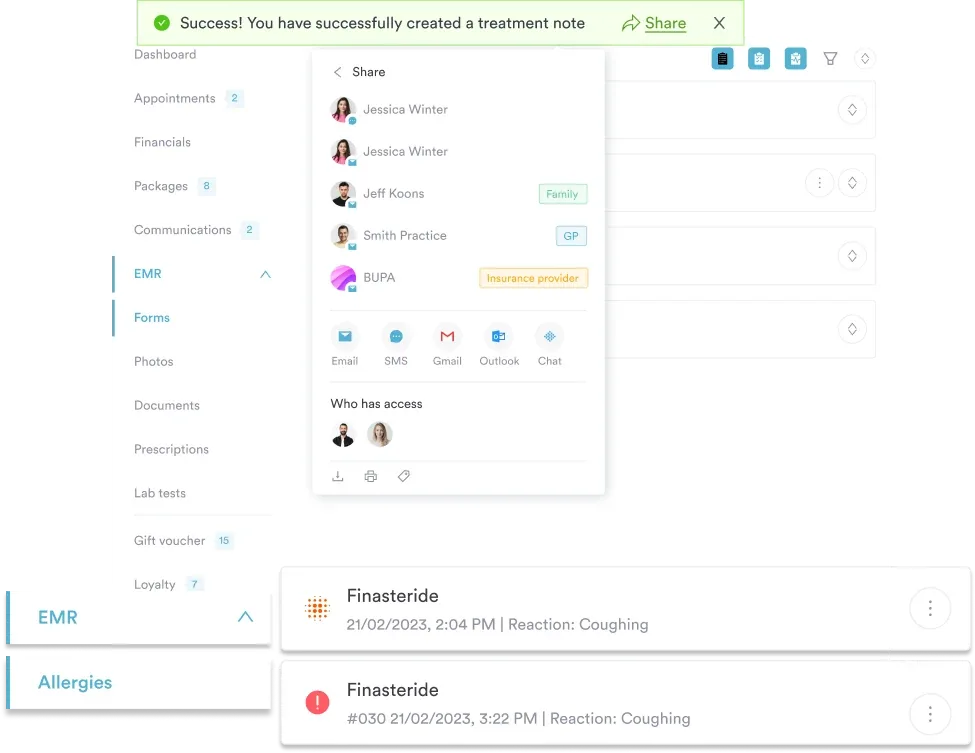

Pabau captures WHODAS 2.0 responses on a digital form and converts them to a 0 to 100 score. The result files itself in the client record, dated and ready to compare.

The version you pick decides what you get back. The 12-item form gives you a number in about five minutes. The 36-item form costs half an hour and tells you which domain is driving that number.
Whichever you run, hold the version and the administration mode constant between visits. A score collected by interview and then by self-report is not a clean comparison. The uneven severity bands will already hide small movements, so record the figure itself and not only the band.
Download the PDF above and it will do the job on paper. Book a demo to see how Pabau collects the responses, scores them automatically, and keeps the history in the client record.

Tracking change session by session? Outcome rating scale template is a brief measure that fits between longer WHODAS 2.0 administrations.
Need a broader outcome measure? Outcome questionnaire template runs to 24 items and comes with its own scoring guide.
Documenting the evaluation itself? Psychiatric evaluation template gives you the interview structure that a disability score slots into.
Comparing software for a psychiatry practice? Best EHR for psychiatry weighs six platforms for practices that run structured assessments.
The six domains are cognition, mobility, self-care, getting along, life activities, and participation. In order, they cover thinking and memory, movement, hygiene and dressing, social relationships, household and work tasks, and community involvement.
Sum the item scores, which run 1 to 5 per item, then convert the raw total to a standardized 0 to 100 scale. The 12-item version uses simple scoring. The 36-item version also calculates domain-specific scores. Higher scores indicate greater disability.
The 12-item version takes about 5 minutes and suits screening and self-report. The 36-item version takes 20 to 30 minutes and adds domain-level scoring. It can be interviewer-, self-, or proxy-administered.
Yes. WHODAS 2.0 is published by the World Health Organization and is free for clinical use, research, and copying. No licensing fee or copyright permission is required.
WHODAS 2.0 is included in DSM-5 as a cross-cutting functional assessment measure. Clinicians use it during psychiatric evaluation to quantify disability, track treatment response, and document the severity of functional impairment.
A score of 100 represents extreme disability. Scores from 96 upward indicate near-complete or total disability across the measured domains, meaning the person cannot perform most activities independently.