Vegan based diet plan: Free template and nutrition guide
A vegan based diet plan is a structured dietary plan that builds every meal arou...

3
Last Updated: Oct 14, 2026

A universal health form is the pediatric health certificate a child needs to enroll in child care or school.
The template has two parts, one for the parent or guardian and one for the examining health care provider.
Section II records growth measurements, immunization status, care plans, and screenings for lead, hearing, vision, development, and scoliosis.
The provider signs a clearance statement covering all child care or school activities, including competitive contact sports.
State rules differ, so check whether New Jersey, Washington DC, or Connecticut mandates its own version first.
A two-part pediatric health certificate for child care and school entry. Parents complete the child’s details, contacts, and consent. The provider records the physical examination, growth measurements, immunizations, preventive screenings, and the clearance signature.
Download templateA universal health form is the health certificate a child needs before starting child care or a new school year. The parent fills in the history and the contact numbers. A provider then examines the child and signs the line that clears that student for school activities.
That signature is what the school nurse is waiting for, and one blank field sends the family back for a second appointment.
For a pediatric practice in August, those repeat visits add up fast. Getting the two sections, the screenings, and your state’s mandate right keeps the form moving on the first pass.
A universal health form is a standardized pediatric health certificate that records a child’s health status for child care or school enrollment.
The parent or guardian completes the history half and signs consent for the school nurse to discuss it. A licensed provider completes the clinical half after a physical examination.
The document does two jobs at once. It sets a baseline for the child’s growth, immunizations, and screening results on a fixed date. It also records the provider’s opinion that the student is medically cleared for child care or school activities.
That clearance reaches physical education and competitive contact sports, unless the provider notes an exception. So a provider with any doubt about a sport writes the limitation in, rather than leaving the box empty.
Every prompt on the form assumes a child. Head circumference, lead screening, developmental screening, and a parent signature line have no adult equivalent. A practice that treats adults needs a general medical history form instead.
Two sections cover the whole document, one for the family and one for the examining provider. No other paperwork travels with it unless a child has a special care plan.
The consent line here only covers discussing the form with the school. Treatment consent is a separate document, so keep a minor treatment consent form on file as well.
The provider enters the examination date, states whether the physical examination was normal, and lists any abnormalities. Immunization records attach here, along with the date the next dose is due.
Every clinical item offers the same three options. Mark none, tick that a special care plan is attached, or write a comment. That structure matters once the form reaches school, where a teacher reads it without a clinician in the room.
Six steps carry the form from your front desk to the school nurse. Name the owner of each one and the form stops stalling between two people. The path below shows where each handoff sits.
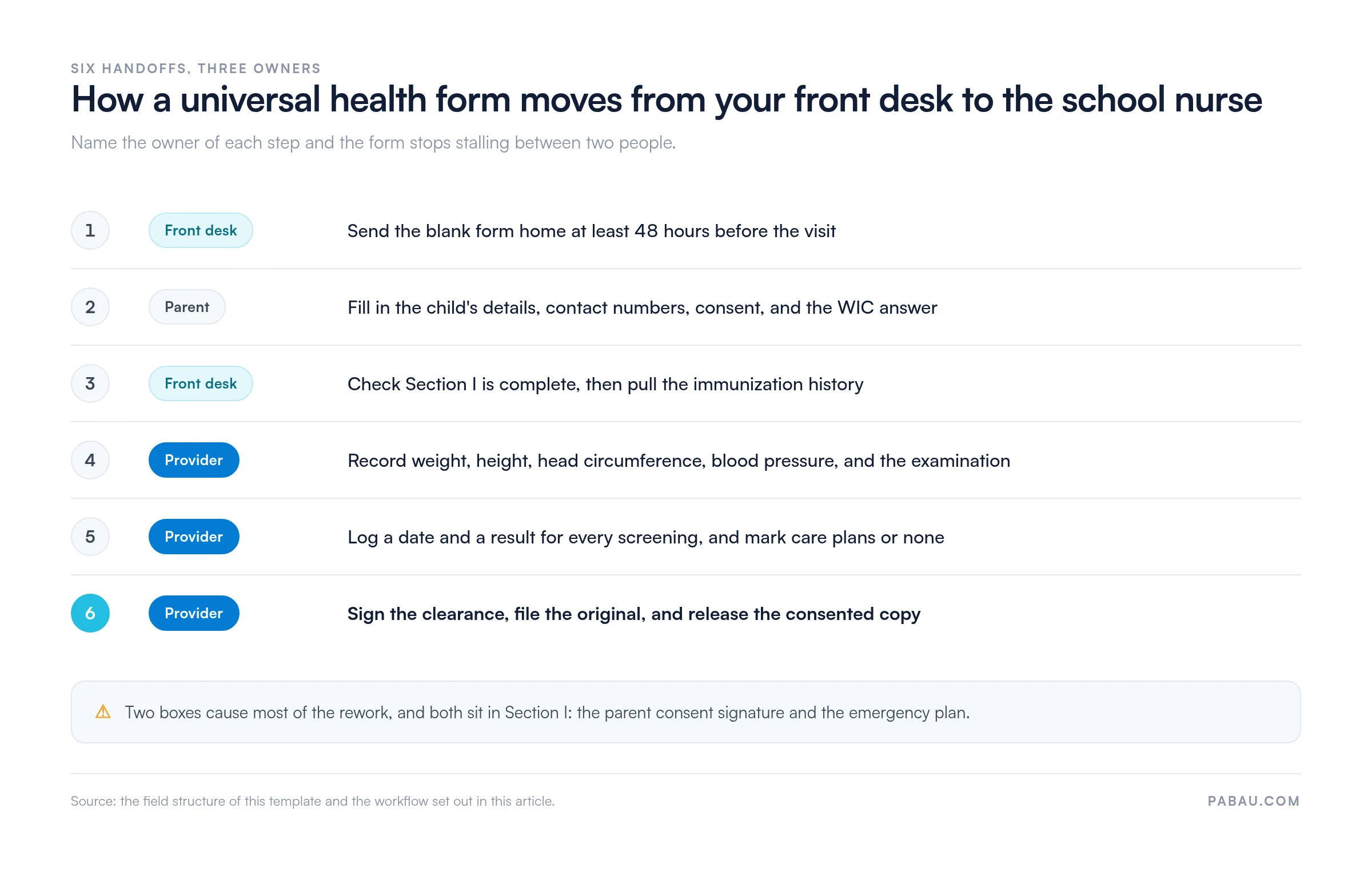
One staff member should own that check, before the child sees the provider. Two fields cause most of the rework, and both sit in the family’s half of the form. School staff act on the emergency information without a clinician nearby. A blank line there is a safety risk, not merely a paperwork problem.
Any practice that examines children for child care or school entry needs this form. Pediatric primary care providers reach for it most, followed by family physicians who keep children on their panel.
On the receiving end, school nurses and child care directors check these forms against a roster of hundreds of children.
A form that arrives complete and legible saves them a phone call. Consistent medical forms management on your side is what makes a complete form the norm.
Enrollment compliance: A signed certificate is what the school or child care center asks for, and most states set a deadline before the first day. One standard version stops a family from arriving with a form your provider cannot sign.
A faster back-to-school season: Pediatric practices see a summer spike in physicals. Sending Section I home in advance moves the history off the exam room clock, so the provider spends the visit examining the child. Paperless patient intake takes it further, with electronic signatures and automatic filing in the child’s record.
Safer days at school: Teachers and after-school staff are the people reading this form. Allergies, activity limits, equipment needs, and emergency signs each sit in a fixed box. Nobody has to guess what a child needs at lunch or at a track meet.
Continuity between provider and school: The consent line lets the provider and the school nurse discuss the child directly. When a family moves districts or changes practices, the last signed certificate gives the next provider a dated baseline.
Requirements vary by state, and several states publish their own mandatory form. Check your state and district before you adopt a generic version, particularly if you sign forms for families across state lines.
New Jersey publishes the CH-14 Universal Child Health Record, and Washington DC requires its own Universal Health Certificate.
A multi-location practice may need to keep more than one version on file. Immunization requirements also differ by state and age, so read your state’s school-entry schedule alongside the national one.
Paper certificates fail in predictable ways. The form goes home in a backpack, comes back with three fields blank, then sits in a folder the school nurse cannot reach. Practice management software like Pabau moves that whole exchange onto one patient record.
Parents complete Section I on a phone before the visit through digital intake forms, and sign it electronically. Your team sees the finished history in the child’s record, so the provider walks in already knowing about the asthma plan.
Examination findings, screening dates, and the clearance signature attach to that same record, timestamped and audit-logged.

That matters most in August, when a practice can sign dozens of these in a week. When a family loses their copy, staff send another from the child’s record in seconds. Every version stays searchable if a district asks for proof.

Pabau’s digital forms let parents complete and sign the history section at home. The signed certificate then files itself in the child’s record, so your team spends back-to-school season examining children instead of chasing paperwork.

The signature at the bottom is the part that carries risk. A provider is attesting that a child can safely run, swim, and play a contact sport for a full school year. Blank fields turn that attestation into a question.
Download the template, check it against your state’s mandate, and decide who validates Section I before the child is seen. Those two habits keep families from making a second trip in September.
Book a demo to see how Pabau collects Section I before the visit and files the signed certificate in the child’s record.

Need the provider-side exam form on its own? History and physical form sets out the fields a full examination write-up needs before anyone signs it.
Want a fuller picture of the child’s background? Family medical history form captures the inherited conditions Section I does not ask about.
Sending records to a school or another provider? Medical release form for a minor covers the authorization you need before a record leaves the chart.
Does a caregiver need standing permission to seek care? Medical consent form for a babysitter is what families hand to a sitter or a summer camp.
Tracking the dental screening line? Baby teeth eruption chart gives you the age ranges to check a child’s dentition against.
Record the doses already given and the date the next one is due, then note the catch-up plan. Many states allow provisional enrollment while a child catches up. Check your state rule before you tell a family the child cannot start.
Section I asks whether the form may be released to WIC, the federal nutrition program for women, infants, and children. Tick yes and you can share the growth and hemoglobin results, which saves the family a second visit.
A licensed provider signs it, usually an MD, DO, nurse practitioner, or physician assistant. Some states accept other provider types. Scope of practice decides who may clear a child for school, so check your state rules.
Most jurisdictions accept an examination performed within the past 12 months. Some districts also ask for a fresh form at set grade levels. Confirm the window with the school nurse before the visit.
The terms overlap. The form is the blank document, and the certificate is the completed version carrying the provider’s clearance signature. Some states use one term, some use both.