Sample treatment plan
A sample treatment plan is a structured clinical document that sets out a patien...

3
Last Updated: Oct 12, 2026
A therapeutic interventions list is a reference of evidence-based treatment techniques, organized by clinical modality. Mental health clinicians use it to name the exact intervention they delivered in each session.
Therapists, counselors, psychologists, and psychiatrists work across dozens of modalities. These include cognitive behavioral therapy (CBT), dialectical behavior therapy (DBT), acceptance and commitment therapy (ACT), and eye movement desensitization and reprocessing (EMDR).
Each modality has its own terminology. A progress note has to record which intervention you used, what it was for, and how the patient responded.
This guide gives you a downloadable list of intervention terms you can copy into SOAP, DAP, or BIRP notes. It also shows how to phrase each one by modality, so your notes stay precise without repeating the same wording every session.
A ready-to-use PDF of intervention terms across CBT, DBT, ACT, EMDR, somatic, and humanistic modalities. Each term is phrased for direct use in SOAP, DAP, and BIRP progress notes.
Download template
A therapeutic interventions list names the techniques you use in session, such as cognitive restructuring within CBT.
Vague terms like counseling or therapy don’t show the clinical work done, so progress notes need the intervention named precisely.
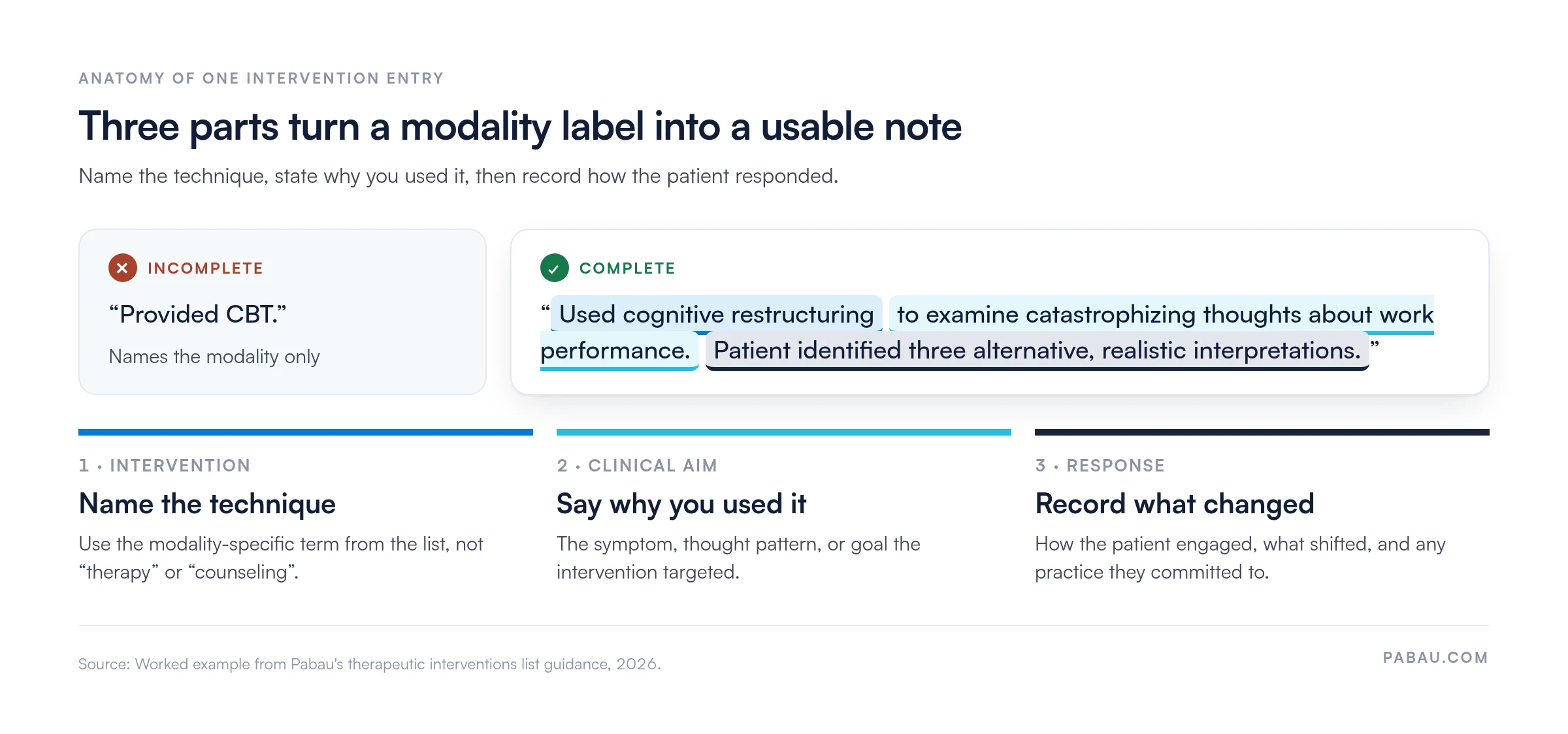
A complete intervention entry names the technique, states the clinical aim, and records how the patient responded.
Grouping terms by modality helps you find language that fits your approach and vary your phrasing from session to session.
Pabau, the practice management platform we build, lets you add your most-used intervention terms to customizable treatment note templates.
A therapeutic interventions list is a curated reference that names the specific, modality-aligned techniques clinicians use in session.
The distinction between modality and intervention matters. A therapy modality describes the overall approach, such as CBT, DBT, psychodynamic therapy, schema therapy, or exposure and response prevention (ERP). An intervention is the discrete technique applied within that modality.
In CBT, that might be cognitive restructuring, behavioral activation, or thought records. In DBT, it might be distress tolerance skills, emotion regulation coaching, or validation. For the evidence behind each type, see our guide to therapeutic interventions.
Progress notes, case notes, and clinical records must name the specific intervention, not just the modality label. “Provided CBT” is incomplete. “Used cognitive restructuring to identify and challenge catastrophic thinking” is clinically precise and shows the work done.
A well-curated list saves you inventing fresh wording every session, and it keeps your documentation aligned with the evidence base.
Interventions are organized below by the modality they come from, so you can find the terms that match your treatment approach quickly.
Cognitive behavioral therapy (CBT) is one of the most research-supported modalities and one of the most often documented in clinical notes. Key intervention terms include:
Dialectical behavior therapy (DBT), developed by Marsha Linehan, combines CBT with acceptance-based techniques. DBT interventions are documented as:
Acceptance and commitment therapy (ACT) and mindfulness-based stress reduction (MBSR) use acceptance and present-moment focus to reduce suffering. Commonly documented interventions include:
For post-traumatic stress disorder (PTSD), complex trauma, and acute trauma responses, trauma-specific interventions include:
Motivational interviewing (MI) and solution-focused brief therapy (SFBT) work with ambivalence and strengths. Commonly documented techniques include:
These modalities appear less often, but they are still frequently documented, and each has its own language for the patient’s experience:
Match each intervention you delivered to the exact term in the list, then write it into your note format (SOAP, DAP, BIRP, or narrative). Our SOAP note for counseling template shows where each entry sits in a SOAP note.
Step 1: During or right after the session, identify the main interventions you delivered. Was it cognitive restructuring, behavioral activation, or DBT distress tolerance skills? Name it precisely.
Step 2: Find the matching term in the list. Copy the exact wording if it fits your note format, or rephrase around the same core concept. For example, “distress tolerance” can become “taught TIPP skills for crisis management”.
Step 3: In the note’s Interventions or Assessment section, write a brief sentence on what you delivered and why. For example: “Used cognitive restructuring to examine catastrophizing thoughts about work performance. Patient identified three alternative, realistic interpretations.”
Step 4: Document the patient’s response. How did they engage with the intervention? Did their understanding shift, and did they commit to practicing it outside the session? This closes the loop and shows clinical impact.
Put together, every complete entry has the same three parts, as the example below shows.
Use this condensed table to find intervention terms by category, along with a phrase you can adapt for your note.
Name the intervention before you explain what happened. “Cognitive restructuring” at the start of the sentence signals the clinical technique, while “Helped the patient think differently” hides it. Lead with the intervention name, then add context.
Use active voice where it makes the technique clearer. “Taught the patient grounding techniques” reads more directly than “Grounding techniques were taught.”
Avoid one-word vagueness. Words like “counseling,” “talking,” and “discussed” tell the reader little about the clinical work. Name the modality and the intervention instead, as in “explored ambivalence using motivational interviewing.”
Always document the outcome or the patient’s engagement, not just what you did. “Used exposure therapy” alone is incomplete. “Used in-vivo exposure to a feared dog with support. Heart rate fell from 95 to 78 bpm, and reported anxiety dropped 40%” shows impact and guides future treatment.
Licensed therapists, counselors, and psychologists use it to document individual psychotherapy sessions with the precision licensing boards expect. Psychiatrists and psychiatric nurses who combine medication management with therapy keep it on hand for sessions that include both.
Trainees and newly licensed clinicians use the list to learn modality-specific language and build documentation confidence. Clinical supervisors use it to teach the difference between a modality label and a named intervention.
Group practice managers use it when they set up structured note templates in their therapy practice management software. That way, every clinician starts from the same set of terms.
Working from a shared list of intervention terms improves your notes in five ways:
Flag the two or three interventions you use most in your primary modality, such as cognitive restructuring and behavioral activation for CBT. Add them to your clinical record template so they’re ready in every note. Your most frequent clinical work then gets captured the same way each time.
One to three sentences per intervention is the standard. Name the intervention, briefly explain the clinical aim, and record how the patient responded.
For example: “Used cognitive restructuring to identify the thought ‘If I make one mistake, I’m a failure.’ Patient recognized this pattern and generated two alternative thoughts. Reported anxiety fell 20% during the exercise.” That is complete enough for clinical clarity, billing review, and supervision.
Yes. Many interventions need repeated practice to work. Behavioral activation might continue across four sessions as the patient builds confidence, and DBT distress tolerance skills are practiced weekly over months.
The list helps you document that progression. Session 3 might read “Reviewed behavioral activation. Patient completed activity log and reported improved mood.” Session 4 might read “Extended behavioral activation to include social engagement. Patient attended event independently.” The varied phrasing shows meaningful change between sessions.
Document each one. Many clinicians use integrative or transdiagnostic approaches, combining CBT, ACT, and DBT in a single session. Your note should list both, for example: “Implemented cognitive restructuring (CBT) and opposite action skill (DBT) to manage depressive avoidance. Patient engaged with both and committed to an evening activity.” That transparency supports supervision and licensing, and it shows evidence-informed practice.
A modality list (CBT, DBT, psychodynamic therapy, and so on) describes the overall treatment philosophy and structure. An interventions list names the techniques within those modalities. Think of the modality as the container (DBT) and the interventions as its contents (distress tolerance, emotion regulation, mindfulness). Both matter in documentation, but interventions show the specific clinical work.
Yes. If your practice uses SOAP notes and space in the Assessment section is tight, abbreviate while keeping the meaning clear. “CR for catastrophizing” is common shorthand for “cognitive restructuring for catastrophizing thoughts.” Keep abbreviations consistent across your notes, and make sure supervisors and staff understand them.
Document both the attempt and the response. For example: “Attempted exposure therapy for social anxiety. Patient declined after psychoeducation. Shifted to values clarification, and patient responded positively.” This shows clinical flexibility, which is part of competent, patient-centered care.
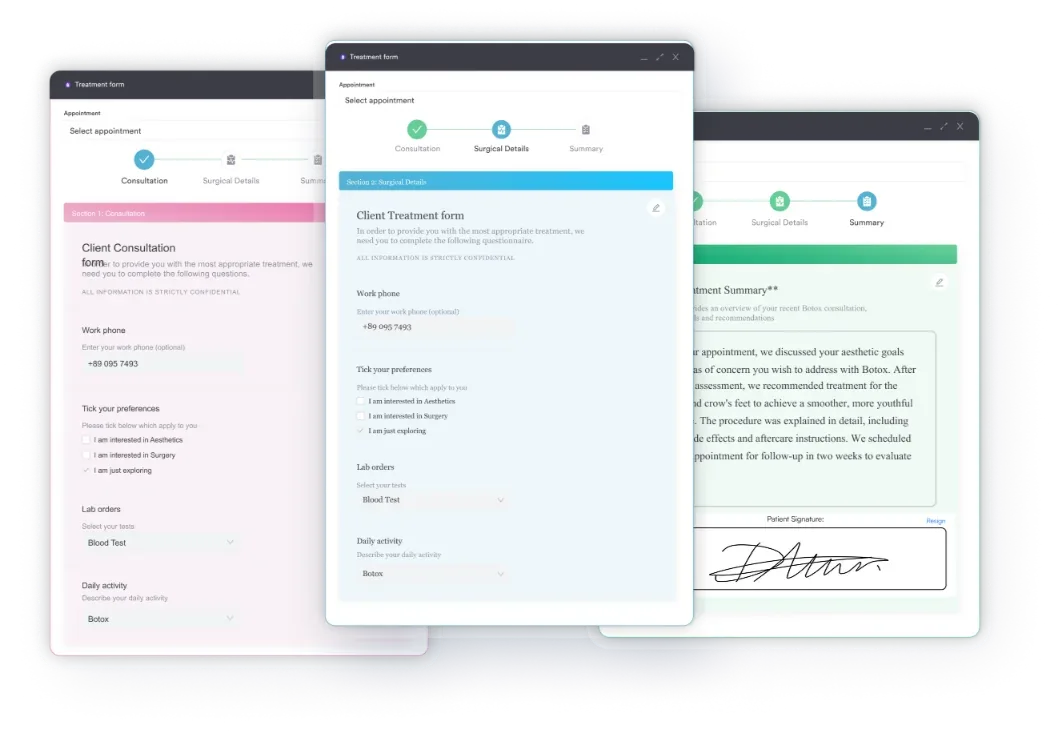
Typing intervention terms and patient responses from scratch after every session eats into time you would rather spend with patients. Pabau covers patient intake, consent, and treatment notes with digital forms you can customize.
Add the interventions you use most to your treatment note template. Every clinician then records the same modality-specific terms, so notes read consistently across your practice.
Pabau Scribe, our AI scribe, drafts your note from the session so you review and edit it rather than start from a blank page. In a mental health EMR shared by several clinicians, that helps reduce documentation time and keeps notes consistent across your practice.
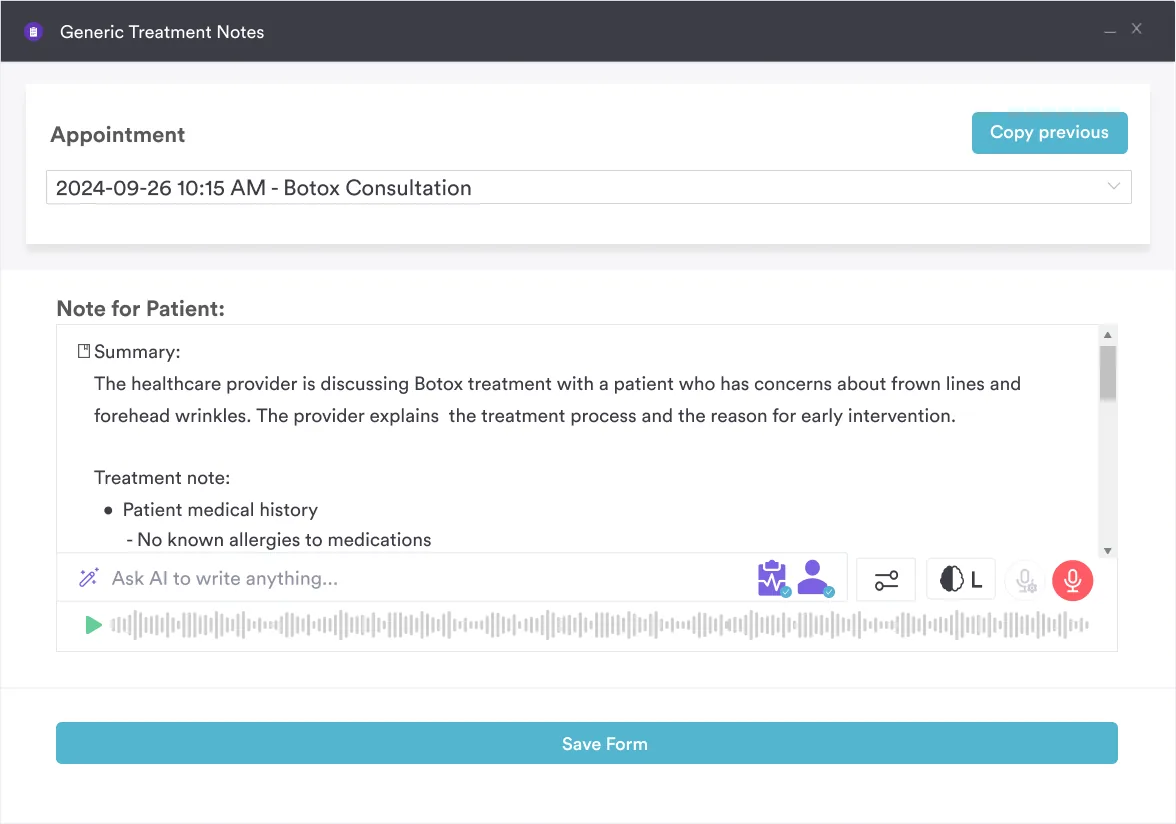

Pabau’s customizable note templates and Pabau Scribe help your clinicians record every intervention in consistent, precise language.

A note that names the intervention proves the clinical work, while a note that names only the modality leaves a reviewer guessing. Start with the two or three terms you reach for most, and write each entry with the technique, the aim, and the patient’s response.
Once those entries feel natural, extend the list to the rest of your modalities. If several clinicians share your records, Pabau’s psychology practice software keeps everyone working from the same note template.
Book a demo to see how Pabau keeps intervention notes precise and consistent across your team.

Need a structured intake assessment? Psychiatric evaluation template gives you a framework for documenting initial assessments alongside intervention planning.
Writing SOAP notes in a social work setting? SOAP notes for social work walks through applying intervention terms within a standard note structure.
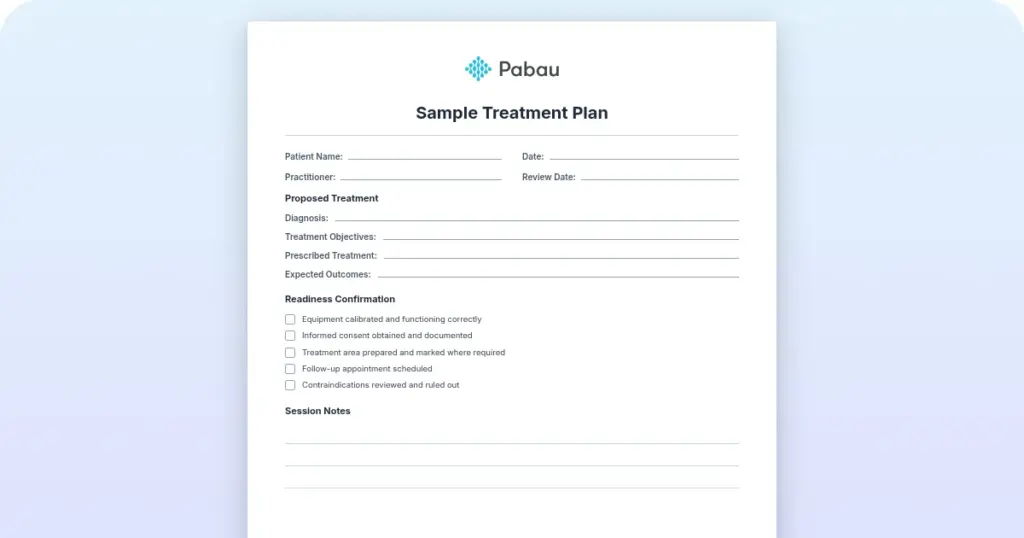
Turning interventions into a plan? Sample treatment plan shows how goals, modalities, and interventions fit together.
Teaching crisis skills in DBT? DBT STOP skill guide explains how to teach and document another distress tolerance skill.
Want a ready-made psychotherapy note? Progress notes for psychotherapy gives you a template to drop these terms into.
A therapeutic interventions list is a structured reference of evidence-based treatment techniques, organized by clinical modality (CBT, DBT, EMDR, and others). It helps mental health clinicians accurately document the interventions they deliver in session.
Common examples include cognitive restructuring, behavioral activation, exposure therapy, and psychoeducation from CBT. Others are DBT distress tolerance skills such as TIPP, and grounding techniques such as the 5-4-3-2-1 method. Each is documented with a brief note on how the patient engaged and responded.
There are dozens of named interventions across the major modalities, and this list covers 34 of the most often documented. They include CBT-based techniques (cognitive restructuring, behavioral activation, exposure) and DBT skills (distress tolerance, emotion regulation, interpersonal effectiveness). Trauma-focused methods (EMDR, somatic experiencing, grounding) and acceptance-based techniques (values clarification, defusion) complete the core set.
Name the intervention by its modality-specific term, such as cognitive restructuring rather than “thinking work.” Then explain the clinical aim and record the patient’s response, including whether they engaged, whether distress shifted, and whether they committed to practice. One to three sentences per intervention is standard.
No. A treatment plan names long-term goals and the modalities you’ll use. A therapeutic interventions list documents the specific techniques within those modalities that you deliver in each session. The treatment plan is the roadmap, and the interventions list is the toolkit.
Yes. The list is organized by modality so clinicians can find the right terms whichever approach they use in a session. Many clinicians use integrative approaches that combine CBT, ACT, and DBT, and they can document each intervention they use.