Packing list for infant travel
A good packing list for infant travel puts every essential in one place before y...

1
Last Updated: Oct 8, 2026
A self-esteem inventory is a standardized psychological assessment that measures a person’s overall self-evaluation, sense of worth and confidence across specific life domains. Mental health practitioners use it at intake, to track therapy progress and in research. It shows whether a patient holds a positive or negative view of themselves, which is a core factor in depression, anxiety and relationship difficulties.
This guide covers how to administer and score the two most widely used inventories, the Rosenberg Self-Esteem Scale and the Coopersmith Self-Esteem Inventory. It also explains how to interpret results and when each instrument fits your practice. A free downloadable template is below.
The template covers the 10-item Rosenberg Self-Esteem Scale and the Coopersmith Self-Esteem Inventory short form. It includes a scoring guide and an interpretation framework for mental health practitioners.
Download template
A self-esteem inventory measures how patients judge their own worth and abilities, which makes it a useful screening tool in therapy and wellness practices.
The Rosenberg Self-Esteem Scale (RSES) is the most widely used. It has 10 items on a 4-point scale, takes about two minutes, and reverse-scores items 2, 5, 6, 8 and 9.
The Coopersmith Self-Esteem Inventory (CSEI) adds depth with general, social, home and school subscales on its school forms. The adult form uses a work domain instead of school.
Neither scale has official cutoffs, so set your practice’s interpretation bands in advance. Treat a low score as a prompt for further assessment, since inventories screen but don’t diagnose.
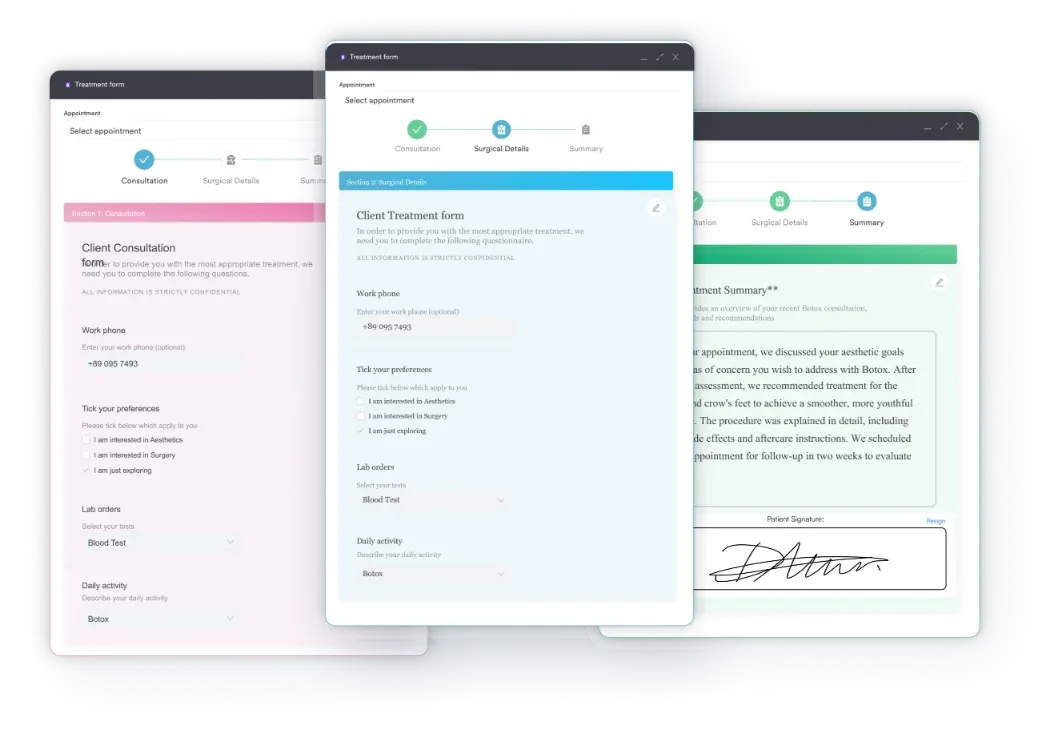
Pabau, the practice management platform we build, lets you send inventories as digital forms and keep each score in the patient record for outcome tracking.
A self-esteem inventory is a validated questionnaire that asks patients to rate statements about their worth, competence and self-regard on a structured scale. Most use a 4-point Likert scale, from strongly disagree to strongly agree. Inventories standardize measurement, so you can track change over time and compare results across patients and research populations.
In clinical practice, they serve three functions. Screening identifies low self-esteem as a presenting issue or comorbidity. Baseline measurement sets a starting point before therapy, and outcome measurement tracks whether self-perception improves after intervention.
The Coopersmith Self-Esteem Inventory (CSEI), developed by Stanley Coopersmith in 1967, measures self-esteem across four domains. They are general self, social self, home/parent relationships, and school/academic performance (school forms; the adult form uses a work domain instead of school). This multi-domain approach shows how self-esteem varies by context. A patient may feel confident with friends but insecure at home.
The CSEI comes in three versions. The school form (ages 8-15) has 58 items, and the school short form has 25. The adult form (ages 16 and up) is a separate 25-item instrument, so the short form doesn’t double as an all-ages version. Respondents mark each statement “like me” or “unlike me.” Raw scores range from 0-100, with higher totals reflecting more positive self-esteem.
The Rosenberg Self-Esteem Scale (RSES), published by Morris Rosenberg in 1965, is the most cited self-esteem instrument globally. Its 10 items and 4-point Likert scale make it quick and accessible. Scores range from 10-40, with higher totals indicating stronger self-esteem.
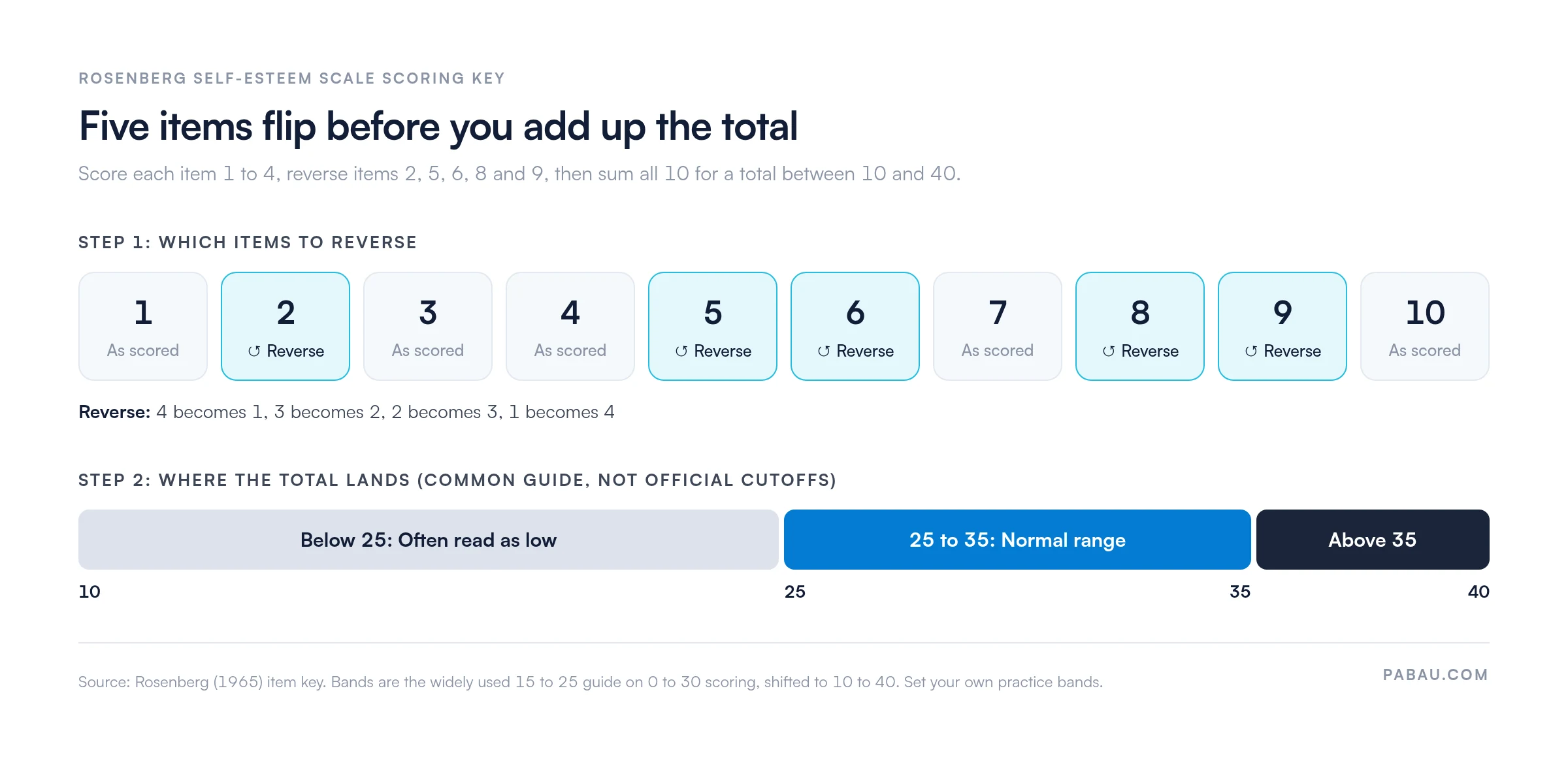
Five items are reverse-scored (items 2, 5, 6, 8 and 9), because disagreeing with them indicates higher self-esteem. Many practices prefer the RSES for its brevity and psychometric stability. It’s free to use for clinical and research purposes, but check the current terms of use before you reproduce it. When you only need this one scale, our Rosenberg scale template covers it on its own.
Follow these steps for accurate RSES scoring:
The key below shows which five items flip and where the commonly used bands fall on the 10-40 total.
For the 25-item CSEI short form, code each item as 1 if the response matches the scoring key and 0 if it doesn’t. Sum the items for a raw score of 0-25, then multiply by 4 to convert it to the 0-100 scale. On the full 58-item school form, subscale scores come from summing specific item clusters.
Score interpretation depends on context. Rosenberg set no official cutoffs, so the RSES bands below are a common guide your practice can adopt or adjust. A low score signals a symptom or maintenance factor that therapy can target, and it doesn’t amount to a diagnosis. Clinical notes for each band:
Clinicians often conflate self-esteem with related constructs. Selecting the right inventory depends on knowing which one you’re measuring:
A patient may have low self-esteem but high self-efficacy, such as a high-performing professional who doubts their worth despite clear competence. Use a self-esteem inventory when the issue is emotional self-regard. When capability beliefs are the concern, the coping self-efficacy scale fits better, and a self-worth worksheet suits therapy work on unconditional value.
Build self-esteem inventories into three key points of care:
Administer inventories in a neutral, non-judgmental way. Frame it as: “This helps us understand your view of yourself. There are no right or wrong answers.” Avoid administering one when a patient is acutely suicidal or in crisis, and stabilize safety first.
Compare the major instruments to select the best fit:
For most practices, the RSES is the starting point. It’s brief, free to use, well validated and easy to score. Use the CSEI when you need domain-specific insight, such as a child who struggles socially but feels confident academically. The State Self-Esteem Scale, a free 20-item measure, suits tracking short-term shifts, for example before and after a group therapy session.
Pro tip: Build your chosen inventory as one of your digital intake forms and record the total in the patient record. Each score then sits next to the notes it informs, ready to compare at the next administration.
Self-esteem inventories are standard in mental health practices, but they serve broader populations:
Consistent measurement: Inventories quantify self-esteem the same way every time, so you can compare patients’ scores across time and populations. Self-report alone (“I feel okay about myself”) is less reliable than a validated scale.
Early identification: Low scores flag patients at risk of depression, social withdrawal or poor treatment engagement, which prompts earlier intervention.
Treatment planning: Baseline and progress scores show whether self-esteem is a central treatment target or a secondary outcome of other work. Anxiety reduction, for example, may raise self-esteem indirectly.
Outcome documentation: Final scores show whether therapy worked, supporting both clinical records and program evaluation for funders or accreditation bodies.
Patient engagement: Discussing results together normalizes self-reflection and helps patients recognize progress they might otherwise overlook.
Store completed self-esteem inventories and scoring records in the patient’s Pabau record. Schedule a follow-up appointment or task to re-administer at your practice’s chosen interval, such as every 8 weeks. Trend review then takes minutes.
On paper, the RSES means printing the sheet, reversing five items by hand and filing a total that’s hard to find at the eight-week review. Progress then gets judged from memory instead of from two comparable scores.
Pabau’s software for running a therapy practice moves that work into one place. Patients complete the RSES or CSEI as a digital form at intake, and the completed inventory sits in their patient record alongside your clinical notes.
Pabau Scribe, our AI scribe, helps you write up session notes. Your reading of each score is documented the same day, next to the inventory itself.
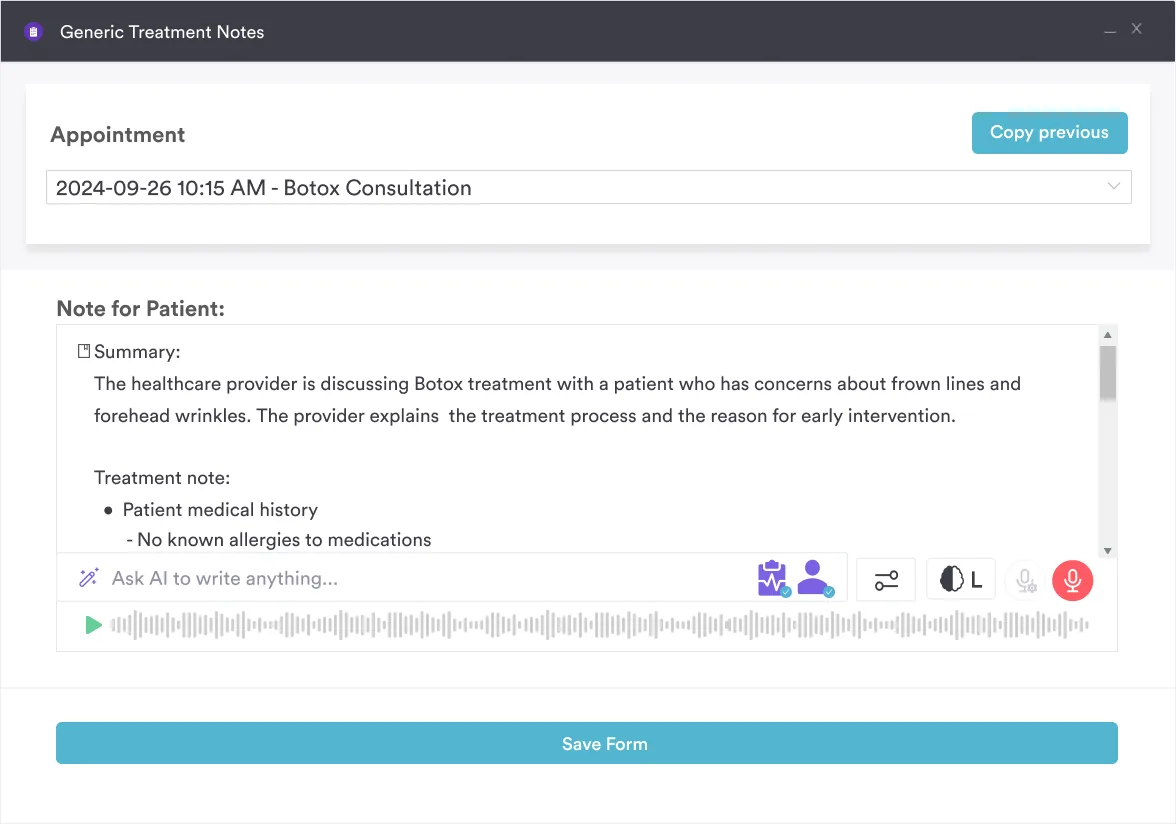
Here’s a typical workflow in Pabau:

Pabau sends the RSES or CSEI as a digital form and stores each completed inventory in the patient record. Book the re-administration as a follow-up, so progress reviews compare like with like.

Start with the RSES unless you need domain-level detail. It’s free to use, takes two minutes and gives you a baseline you can repeat every few weeks. Reach for the CSEI when a patient’s self-esteem looks uneven across home, school or social life, and budget for the Mind Garden license.
Whichever you pick, set your interpretation bands before the first administration and keep them fixed. Neither scale has official cutoffs, so shifting thresholds mid-treatment makes progress impossible to read. Book a demo to see how Pabau keeps each inventory score in the patient record, ready for your next review.

Working on self-esteem after screening? Self-esteem worksheet for adults is a natural next step once a low score is confirmed.
Screening a younger patient? Self-esteem worksheet for teens adapts the same work for adolescents.
Want patients to reflect between sessions? Self-esteem journal template gives them a regular record to bring to therapy.
Looking beneath the score? Core Beliefs Inventory helps you surface the beliefs that keep self-esteem low.
Need a session-by-session outcome measure? Outcome rating scale template pairs well with a periodic self-esteem inventory.
A self-esteem inventory is a standardized questionnaire that measures how a person judges their own worth and abilities. It turns self-esteem into a score, so clinicians can track change over time and compare results across patients and research populations.
The Coopersmith Self-Esteem Inventory (CSEI) uses 25-58 items and takes 5-10 minutes. Its school forms measure general, social, home and school self-esteem, and it’s sold under license by Mind Garden, Inc., its publisher. The Rosenberg Self-Esteem Scale (RSES) is a 10-item global measure that takes about two minutes and is free to use. Choose the CSEI for multi-domain depth and the RSES for quick screening.
Score each item from 1 (strongly disagree) to 4 (strongly agree), then reverse-score items 2, 5, 6, 8 and 9. Sum all 10 items for a total between 10 and 40. Rosenberg set no official cutoffs, but a common guide treats 25-35 as normal and below 25 as low on this scale.
Self-esteem is your emotional judgment of your overall worth. Self-efficacy is confidence in your ability to complete specific tasks or reach goals. A patient may have low self-esteem but high self-efficacy, or the reverse. Use a self-esteem inventory to measure self-regard and a self-efficacy scale to measure capability beliefs.
The Rosenberg Self-Esteem Scale is free to use for clinical and research purposes, but check the current terms of use. The Coopersmith Self-Esteem Inventory is published by Mind Garden, Inc., where you purchase it before administering it. Always confirm current licensing terms before reproducing either instrument.
Give a baseline at intake, then repeat every 4-12 weeks depending on your practice’s protocol and treatment intensity. A patient in weekly therapy might take the RSES monthly, while one in intermittent sessions might complete it every 8-12 weeks. A final administration at the end of treatment measures the outcome.