Pabau Engage inbox

Pabau Engage is here: every patient conversation in one inbox.

Learn more
Practice Management Tips

Packing list for infant travel

A good packing list for infant travel puts every essential in one place before you leave the house. Forgetting a pacifier at a departure gate is a different problem than forgetting your own sunglasses. When an infant’s bag comes up short, the missing onesie, formula or pain reliever is usually needed at the worst possible moment.

Build the list around six categories, covering diapering, feeding, clothing and sleep, major gear, flight carry-ons and a small health kit. Pack two outfits per day plus two spares, and add a 20 percent buffer to your diaper count. This guide walks through each category, with a free printable checklist you can tick off before any trip.

Download your free packing list for infant travel

A print-ready checklist of diapering supplies, feeding gear, clothing quantities and major travel equipment for trips with infants. It also splits carry-on from checked items and lists a health and safety kit.

Download template
Key takeaways

Key takeaways

A packing list for infant travel organizes supplies by category so nothing critical is forgotten before departure.

Pack two outfits per day plus two spares, and add a 20 percent diaper buffer on any trip longer than a day.

TSA lets you carry breast milk and formula over 3.4 oz in your carry-on, and officers screen them separately from other liquids.

Formula, a favorite pacifier and the diaper kit belong in your carry-on, because your infant can’t go four hours without them.

Pediatric and family practices can collect infant health histories before pre-travel visits with digital intake forms in Pabau, our practice management software.

Found our content helpful?

How to use this infant travel checklist

Run through the checklist twice. Do it once when you start packing, to pull each item out, and once at the door, to confirm it made it into the bag. The categories below match the checklist sections, so you can cross-reference as you go.

  1. Check your trip type first. A two-hour road trip needs far less than a five-day flight abroad. The checklist flags air-travel items separately, so you can skip that section for ground trips.
  2. Adjust quantities by trip length. Every quantity guideline below uses a per-day formula. Multiply by your trip length, then add a buffer of 20 percent extra diapers and two spare outfits.
  3. Mark items you will buy or rent at your destination. Cribs, strollers and car seats can often be rented, borrowed or bought locally. Strike through each item you’ve confirmed is available on arrival, so your luggage stays manageable.
  4. Separate carry-on from checked bags before you pack. Use the carry-on vs checked table below as your split guide. Whatever the infant needs in the first two hours of travel goes in the carry-on.
  5. Do a final door-check against the list. Read each item aloud and physically touch it in the bag. This catches the diaper cream left on the changing table.

The per-day formulas add up faster than most parents expect, and the chart below runs them for four common trip lengths.
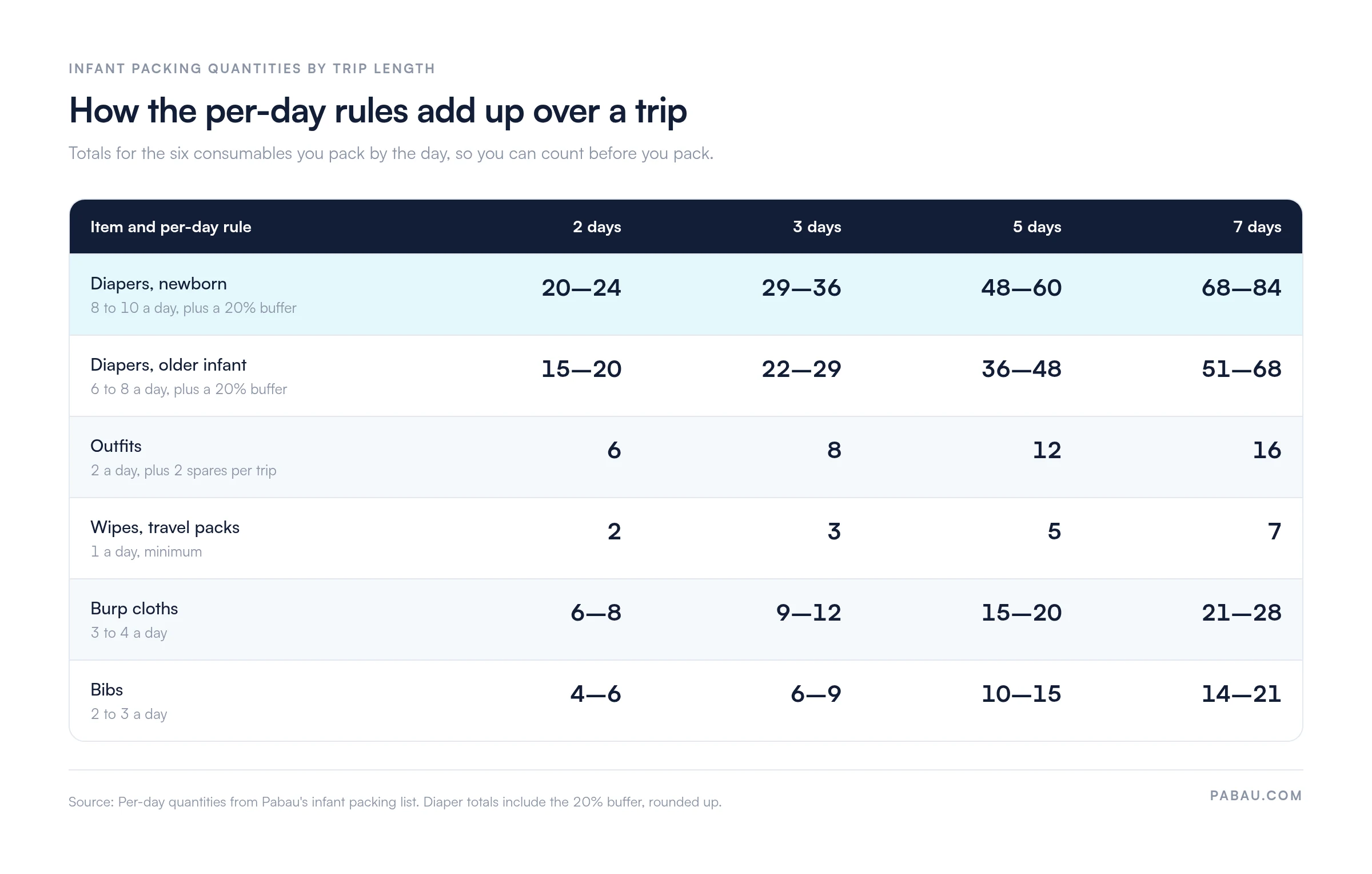
Table of infant packing totals by trip length for 2, 3, 5 and 7 days: newborn diapers 20-24, 29-36, 48-60, 68-84; older infant diapers 15-20, 22-29, 36-48, 51-68; outfits 6, 8, 12, 16; wipe packs 2, 3, 5, 7; burp cloths 6-8, 9-12, 15-20, 21-28; bibs 4-6, 6-9, 10-15, 14-21
A five-day trip with a newborn calls for 48 to 60 diapers once the buffer is added. Totals are calculated from this checklist’s per-day rules.

Diapering and hygiene essentials

Diapering is the highest-frequency task on any infant trip. Running out of diapers or wipes far from a store turns a routine change into an emergency. Overpacking this category is almost always the right call.

  • Diapers: 8-10 per day for newborns, 6-8 per day for older infants. Add a 20 percent buffer for delays.
  • Baby wipes: One travel-size pack per day, minimum. Useful beyond diaper changes: Hands, surfaces, spills.
  • Portable changing pad: Fold-flat versions slip into a diaper bag and protect against questionable restroom surfaces.
  • Diaper cream or barrier paste: Travel size. Long stretches in a car seat or carrier increase friction risk.
  • Disposal bags: Scented and resealable. They’re essential in hotel rooms, cars and aircraft.
  • Burp cloths or muslin squares: Three to four per day. They double as impromptu shade, light blankets and surface covers.
  • Hand sanitizer: For caregivers after changes when a sink isn’t available.

Keep at least two days’ worth of diapers in your carry-on if you’re flying internationally. Checked bags can be delayed, and the diaper supply shouldn’t depend on them.

Feeding supplies for traveling with an infant

Feeding needs vary sharply by age and method. Breastfeeding parents need different gear than formula-feeding families, and infants who have started solids need a third set of supplies. Travel days also disrupt feeding times, and an infant milk intake chart shows the typical amounts to aim for at your baby’s age.

  • Breastfeeding: Portable breast pump (battery-powered or manual for flights), storage bags, breast pads, a nursing cover if preferred and lanolin cream.
  • Formula feeding: Pre-measured formula in a dispenser or single-serve packets, plus enough bottles for the journey and one extra. Add a bottle brush and sterilizing tablets or a microwave sterilizer bag.
  • Solid foods (6+ months): Puree pouches (no refrigeration needed), a silicone bib and a spoon. Keep any homemade food in a small sealed container, inside an insulated bag with an ice pack.
  • Water for formula: Sealed bottled water if you use formula. Airport water is fine after security, but bring a backup bottle through the gate.
  • Feeding bib and cloth: Two to three per day. Clip-on silicone bibs pack flatter than fabric ones.

Per TSA guidance, breast milk, formula and juice for infants are exempt from the standard 3.4 oz liquid rule. You may carry any reasonable quantity. Tell the officer at screening, and remove these items for separate inspection.

Clothing and sleep gear

The standard rule: Two outfits per day plus two spares for the whole trip. Layering matters more than quantity. A onesie, a long-sleeve layer and a light jacket cover most temperature ranges and take less space than bulky items.

  • Onesies or bodysuits: Two per day, plus two spares for the whole trip.
  • Sleepers or pajamas: One per night, plus one backup.
  • Socks: Three to four pairs (they disappear constantly).
  • Hat: Sun hat for warm destinations, knit hat for cool ones. Infants lose heat rapidly through their heads.
  • Jacket or sleep sack: Aircraft cabins run cold. A wearable blanket or zip-up layer keeps the infant warm without loose bedding.
  • Portable crib or travel bassinet: Confirm it meets AAP safe sleep guidelines, with a firm flat surface, no inclined sleeping position and no soft bedding.
  • White noise machine or app: Familiar sleep sounds help infants settle in unfamiliar rooms.
  • Pacifier: Two, in a sealed case. Sucking during takeoff and landing helps equalize ear pressure.

Gear and equipment

Major gear decisions shape your entire packing approach. Each item below has a travel-friendly alternative worth knowing about before you commit to what goes in the car or checked luggage.

ItemBring it if…Travel-friendly alternative
Car seatYou need a rental car, rideshare, or plan to use it on the aircraftRent one at your destination. A CARES harness is FAA-approved for in-flight use by children over 22 lb.
StrollerLong walks, outdoor destinations, or infant under 4 monthsBaby carrier for shorter trips; lightweight umbrella stroller for city travel
Baby carrierAirport navigation, hands-free movement, or infant who needs contact sleepHard to replace at the airport, so pack it regardless
Portable cribDestination does not provide a crib or you are unsure of its safety standardCall ahead, since most hotels supply a crib on request

Per FAA guidelines, an infant car seat used on an aircraft must carry a specific label. It reads “This restraint is certified for use in motor vehicles and aircraft.” Check yours before you fly. Airlines vary on stroller and car seat check-in policies, so confirm with your carrier before assuming they’re free.

Infant air travel packing checklist

Flying with an infant adds a carry-on strategy that ground travel doesn’t require. Pack whatever your infant needs for the first four to six hours where you can reach it without opening checked luggage.

  • Carry-on diaper kit: Diapers for the flight plus two extras, wipes, a changing pad and one disposal bag per expected change.
  • Feeding supplies for the flight: Pre-measured formula or access to breastfeed, a nursing cover if preferred, and two bottles or pouches.
  • Change of clothes: Two spare onesies for the infant and one spare shirt for each caregiver (yes, you).
  • Pacifier and pacifier clip: Sucking during ascent and descent reduces ear discomfort from pressure changes.
  • Small sensory toy or teether: Keep it tethered, because a toy dropped under a plane seat is hard to retrieve.
  • Documents: Passport, required for any infant on an international flight. On domestic flights, bring a birth certificate as proof of age for a lap-infant fare.
  • Baby carrier: Invaluable for boarding, deplaning and any moment both your hands need to be free. Remove it for taxi, takeoff and landing, when the infant must be held or sit in an approved seat.

Tips for flying with an infant

Most in-flight problems trace back to connections, ear pressure and cabin temperature. You can plan for each of them before you board.

  • Book a direct flight when possible. Every connection adds another round of security, boarding and settling the infant.
  • Request early boarding. Most carriers offer it for families with infants. Use the extra time to stow gear and get organized before the cabin fills.
  • Feed during takeoff and landing. Swallowing helps equalize ear pressure. Breastfeeding, a bottle or a pacifier all work. Have whichever you use ready before the aircraft starts its roll.
  • Dress the infant in layers. Aircraft temperatures are unpredictable. A zip-up layer goes on or off in seconds.
  • Bring a noise-muffling wrap or carrier. Worn infants often sleep through engine noise that would otherwise disturb a stroller-riding baby. Remove the carrier for taxi, takeoff and landing, when the infant must be held or sit in an approved seat.
  • Walk the aisle when it’s safe. Movement is soothing. The galley at the rear of most aircraft is the most practical spot for a standing bounce when you can’t sit.

Health and safety items

A small health kit takes little space and saves a late-night search for a pharmacy in an unfamiliar town. Pack for the most likely minor scenarios: Fever, rash, congestion and sun exposure. If your infant does run a fever, log each reading on a fever temperature chart so the pediatrician can see the pattern.

  • Infant thermometer: Digital rectal thermometer for infants under six months. Ear or temporal thermometer for infants six months and older (check with your pediatrician for 3 to 6 months).
  • Infant pain and fever reliever: Consult your pediatrician before travel for age-appropriate dosing. Ask whether to pack acetaminophen, ibuprofen (for infants over six months) or both.
  • Nasal aspirator and saline drops: Congestion is common in pressurized aircraft, and saline helps loosen mucus safely.
  • Sunscreen: The American Academy of Pediatrics (AAP) advises keeping infants under six months out of direct sun. Use mineral-based sunscreen on them sparingly, and only when shade is unavailable. For infants over six months, apply SPF 30+ mineral sunscreen 15 minutes before exposure.
  • Hydrocortisone cream (low strength): For heat rash or contact irritation. Confirm suitability with your pediatrician.
  • Emergency contact card: Your pediatrician’s number, your insurance details and any allergy or medical notes for the infant.
  • Travel health insurance documentation: Confirm infant coverage before departure, especially for international trips.

Packing light without leaving anything behind

Packing light with an infant means cutting duplicates and bulk while keeping each category covered. Most parents overpack clothing and underpack consumables.

  • Use compression cubes for clothing. One cube per day’s outfits keeps the bag organized and compressible.
  • Confirm what the destination provides. A quick call to the hotel or vacation rental tells you whether a crib, high chair or bottle sterilizer is already there.
  • Buy consumables at your destination. Diapers, wipes and formula are available in most major cities worldwide. Packing three days’ supply instead of seven saves significant weight.
  • Choose a carrier over a stroller for short trips. A good baby carrier can replace the stroller entirely for urban trips under four days.
  • Pack a flat foldable tote. On the return journey it holds purchases from your trip without needing another bag.

What to pack in your carry-on vs checked luggage

This table gives you the carry-on vs checked split at a glance. When in doubt, move an item to carry-on rather than checked. A delayed bag is no help if it holds something the infant needs now.

Carry-on (always accessible)Safe to check (not urgently needed)
Diapers for the flight plus 2 extraBulk diapers for the trip
Wipes (travel pack)Extra wipe packs
Formula or breast milk for the flightSealed formula tins or bulk packets
2 spare infant outfitsFull clothing supply for the trip
Pacifier, teether, small toyNon-urgent toys and books
Health kit (thermometer, pain reliever, saline)Sunscreen, hydrocortisone, extras
Documents (passport, birth certificate, insurance card)Non-essential personal items
Baby carrierPortable crib (gate-check or checked)

Pro Tip

Flag every item your infant cannot go four hours without and move it to your carry-on regardless of size or weight. Formula, a favorite pacifier and the diaper kit are the three most common causes of in-flight distress when they end up in checked bags.

How Pabau helps pediatric practices prepare families for travel

Parents often book a pre-travel visit before an infant’s first flight or international trip. In many pediatric and family practices, the health history and consent for that visit are still collected on paper in the waiting room.

Pabau, our software for family practices, sends digital intake forms to parents before the appointment. Their answers land in the infant’s patient record, so the pediatrician walks in already knowing the travel plans and medical history.

Practices that run dedicated travel consultations can use travel clinic software to keep vaccination records and pre-travel advice on the same file. The visit gets shorter, and the time goes on the parents’ questions.

Run a pediatric or family practice?

Pabau’s digital forms let your team collect infant health histories and consent before each visit, so consultations start with the parents’ questions.

Pabau practice management software

Conclusion

Build the list a few days before you leave and scale the quantities to your trip length. Then split carry-on from checked before the first item goes in a bag. That order matters more than any single item. A diaper kit within reach solves more mid-journey problems than a perfectly packed suitcase.

The trade-off is weight. If you can buy diapers and formula at your destination, pack three days’ supply and save the space for gear you can’t replace on arrival.

For pediatric and family practices, the pre-travel visit is the moment to hand parents this checklist with the infant’s health history already on file. Book a demo to see how Pabau collects that history digitally before families walk in.

Continue your research

Continue your research

Keeping an infant’s vaccine history in one place? Immunization record form gives you a free template for logging each vaccine before a trip abroad.

Spotted a rash while you’re away? Pediatric rash chart helps you describe common childhood rashes clearly to a doctor.

Is your infant sleeping badly away from home? Pediatric sleep questionnaire screens for sleep problems worth raising with your pediatrician.

Wondering whether a reading is normal? Pediatric vital signs chart lists normal ranges for heart rate, breathing and blood pressure by age.

Frequently asked questions

What should I pack for traveling with an infant?

A packing list for infant travel covers five core categories: Diapering, feeding, clothing, major equipment and a health kit. Diapering means diapers, wipes, a changing pad and disposal bags. Feeding gear covers formula or breast pump supplies, bottles and bibs. Pack two outfits per day plus two spares, and bring a car seat, carrier and portable crib as needed. The health kit holds a thermometer, infant pain reliever, saline drops and emergency contacts. Add air travel items if you’re flying.

What do I need to bring for a baby on a plane?

For a flight, keep in your carry-on: Diapers for the flight plus two spares, wipes, and formula or breast milk for the duration. Add two spare infant outfits, a pacifier, a small tethered toy and a baby carrier. Bring your infant’s passport for international travel, or a birth certificate as proof of age for a lap-infant fare on domestic flights. TSA allows breast milk and formula over 3.4 oz, so declare them at screening.

How many outfits should I pack for a baby?

Pack two outfits per day plus two extra for the full trip. A three-day trip needs eight outfits total. Prioritize layers (a onesie plus a zip-up layer) over bulk items, and pack one spare outfit in your carry-on for the journey itself.

Do I need a car seat when flying with an infant?

You aren’t legally required to buy a separate seat for a lap infant, but the FAA recommends an approved child restraint system for safety. If you bring a car seat on the aircraft, it must display the label confirming FAA approval. For infants traveling as lap passengers, a carrier is for boarding and cruise only, never a safety restraint.

How do I pack light when traveling with a baby?

Confirm what your destination provides (crib, high chair, sterilizer) and strike those items from your list. Buy bulk consumables like diapers and wipes locally rather than packing the full supply. Replace a stroller with a baby carrier for trips under four days, and use compression cubes for clothing. Pack three days’ worth of supplies even for a seven-day trip if you are confident in local availability.
Found our content helpful?
Avatar photo
Maja Popovska
Content Writer

Maja is a Senior Content Writer at Pabau, where she covers everything from practice management and compliance to medical aesthetics and patient experience. Off the clock: binging true crime docuseries, baking and dreaming about travel.
×