Anja Dodevska
Anxiety tracker template: free printable PDF for clinicians
What is an anxiety tracker and how is it different from journaling? An anxiety t...

2
Last Updated: Oct 27, 2026
Free PDF 6 pages, print-ready Clinician-reviewed
A self-esteem journal is a guided worksheet that a client fills in each day, using the same set of prompts every time. This one runs six pages and holds five dated entries, with eight prompts repeated in each.
Therapists assign it as between-session homework so the cognitive work continues after the hour ends. Clients working on their own get the same structure without having to decide what to write about. The rest of this page covers how to assign it, what the eight prompts do, and how to reframe them for teenage clients.
Six pages holding five dated entries, with the same eight prompts repeated in each one. They run from daily affirmations and achievements through reframing a negative thought and naming the people who help.
Start from scratch, or upload this PDF or any form you already use, and Pabau's AI Form rebuilds it with tick boxes, text fields and a signature. Attach it to the treatment once, and every patient gets it on time.
AI Form rebuilds the consent, history and aftercare forms you already use. You review each one, then publish.
Patients complete forms on their phone before they arrive, so the front desk stops retyping paper.
Every signed form is versioned and attached to the treatment record, ready when you need it.
Set how long a consent stays valid. Returning patients skip forms they have already signed.
Supports HIPAA and GDPR compliance AES-256 encryption 4.8 on G2 4.7 on Capterra Trusted by 4,000+ practices worldwide

A self-esteem journal is a structured reflection tool that helps clients track confidence, challenge negative self-talk, and name their own strengths.
This template runs six pages and holds five dated entries, and every entry repeats the same eight prompts.
Four of those eight prompts ask about strengths, achievements, or supportive people, so the form suits clients who default to self-criticism.
Therapists assign it as homework to reinforce in-session learning. Clients can also work through it alone between appointments.
There is one version for every age group, so teenage and adult clients answer the same eight questions.
A self-esteem journal is a daily reflection worksheet built around fixed prompts about self-worth. Unlike a diary, the prompts do not change from entry to entry, so the client returns to the same questions each day. That repetition is what makes a shift in self-perception visible over a few weeks.
Those entries stay descriptive, so pair them with a validated self-esteem questionnaire at the start and again at review. Scoring the same measure twice puts a number beside what the patient wrote.
For therapists, it works as a CBT-aligned homework assignment. It exercises cognitive restructuring and behavioral activation in a form the client can complete alone.
The American Psychological Association describes expressive writing as a useful adjunct to talk therapy rather than a treatment on its own.
Structured journaling shifts how clients relate to themselves, and the shift compounds over weeks of practice.
None of this survives a homework assignment nobody tracks. A therapy practice management system lets you record what was assigned, when it is due, and whether it came back.
Five steps cover the workflow, from the first hand-off to the note in the client’s record.
Clients who fill it in on a phone or tablet and submit it before the appointment save you the transcription step. A paper copy works too, as long as somebody scans it into the record.
The template holds five dated entries. Each one repeats the same eight prompts in the same order, then leaves room for extra notes.
Adults answer these without any rewording, pulling in work, relationships, and boundaries. A client who habitually plays down their competence will find the achievements and reframing prompts do the heaviest lifting.
Group the eight by what they ask for and the balance of the form becomes clear. Four of the eight ask about strengths, achievements, or supportive people, and only one asks the client to argue back at a thought.
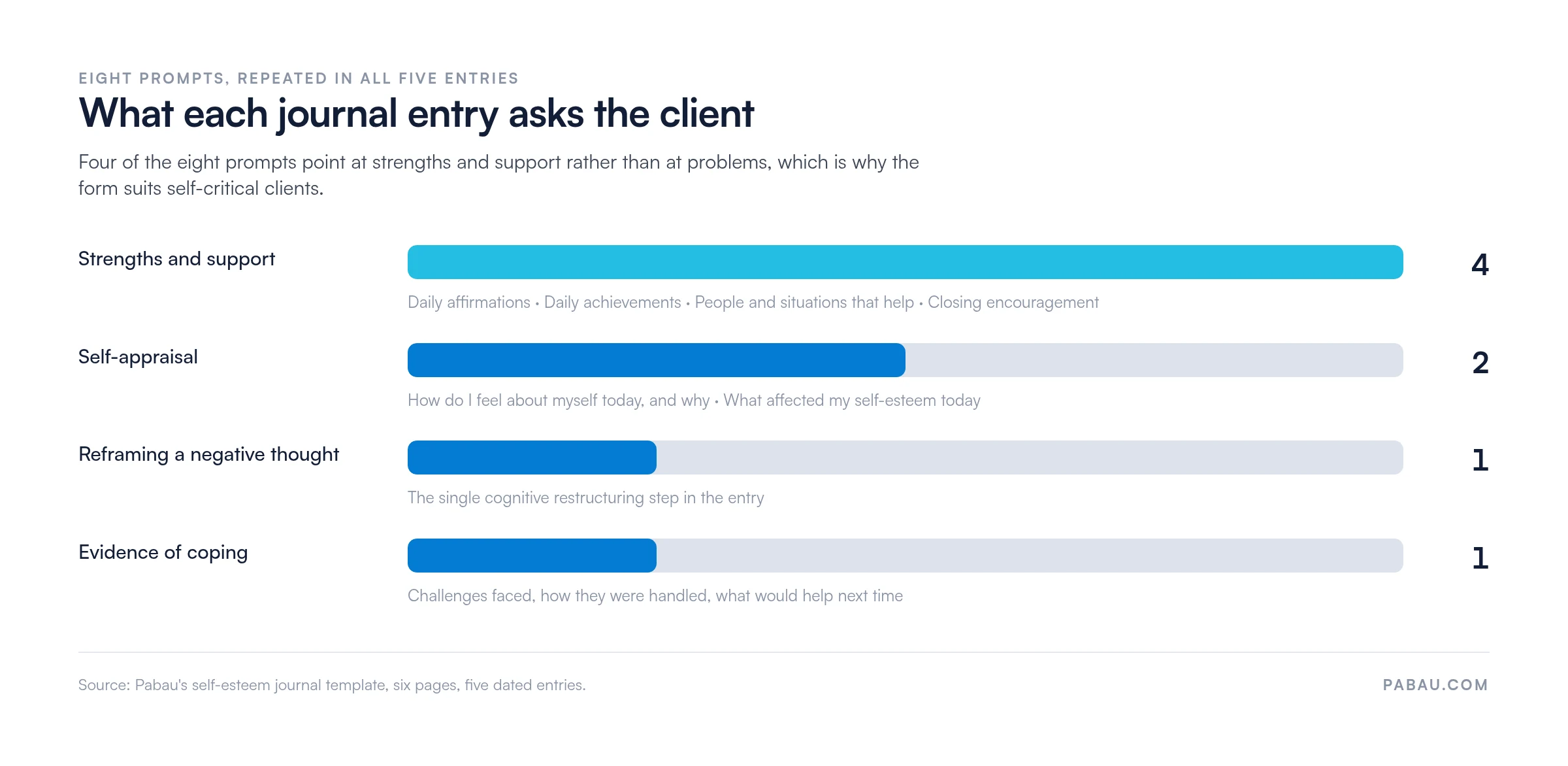
For a self-critical client, that weighting matters. A form made mostly of problem-solving prompts gives them one more place to record what went wrong.
There is no separate teen edition, and it does not need one. Adolescent clients bring peer comparison, academic stress, and identity questions, and the eight prompts are broad enough to hold all of that. What changes is how you introduce them.
Consistency is the hurdle with this age group. Automated client reminders in practice management software like Pabau can nudge a teen between appointments. The prompt then arrives from the software rather than from a parent.

The journal is a CBT tool at heart. It operationalizes cognitive restructuring, the technique where a client identifies an unhelpful thought pattern and replaces it with a balanced, evidence-based alternative.
The reframing prompt walks the client through a three-step sequence.
When you assign the journal explicitly as CBT homework and review the entries, the client internalizes the sequence faster. Over several weeks the automatic thoughts lose their grip, because the client has written evidence that they do not hold up.
Clinicians using mental health EMR software can annotate a submitted entry with a therapeutic reflection and keep it with the note.
Each entry is a single page, so a client can finish it in one sitting or spread the eight prompts across the day. Anchoring it to fixed times removes the decision about when to write.
Some clients sustain a full entry every day. Others hold the habit at three or four entries a week, which is fine. Each download covers five entries, so print another copy as the weeks add up.
A missed day can turn the journal into another source of shame. Treat a skipped entry as material instead. Ask what got in the way, and problem-solve that in session.
A free download removes every step between the client and the resource. They do not create an account, wait for an email, or hit a paywall. They open the PDF and start writing.
This template has been refined through use in CBT, counseling, and coaching settings. The wording, the structure, and the prompts follow standard cognitive-behavioral practice, so you can hand it over without editing it first.
Therapists also adapt it. Adding a practice logo, or narrowing the prompts for a population such as eating disorder recovery, both work. Keep a note of which version a client received, so the record matches what they filled in.
Most practices hand the journal over as a printout and hope it comes back. The therapist remembers the assignment, the client forgets it, and neither the due date nor the completed pages reach the file.
Pabau handles the journal as part of the treatment record instead. You attach the form to the client’s file, set the reminder cadence, and the client submits their entries through the client portal. Each submission lands against the appointment it belongs to.
The outcome is a shorter review at the start of the next session. You open the note, read what they wrote, and spend the hour on the material rather than reconstructing whether the homework happened.

Pabau attaches forms to the client file, sends the reminders, and files each submitted entry against the right appointment. Your notes and your homework stay in one place.

The journal earns its place by being boring in the right way. The same eight questions, five days running, is what turns a vague intention into a record the client can read back.
The trade-off is that it only works if somebody looks at it. An unreviewed journal becomes a chore, and the client stops filling it in. Reserve the session time before you assign the first entry.
Download the template, assign it in your next session, and set the review time in the same conversation. Book a demo to see how Pabau tracks assigned homework and files each entry against the client’s record.

Want a shorter version for adult clients? Self-esteem worksheet for adults gives you a single-sheet exercise you can complete inside one session.
Working with a teenager? Self-esteem worksheet for teens reframes the same questions around school, friendships, and body image.
Need a baseline score to track? Rosenberg self-esteem scale template gives you a short measure to repeat at review points.
Looking for a broader prompt set? Self-reflection journal template widens the questions beyond self-worth for clients in general counseling.
Building a strengths-based homework plan? Best possible self worksheet adds a future-focused exercise that pairs well with daily journaling.
Write honestly about your day using the prompts provided. Cover your accomplishments, the strengths you used, the negative thoughts you noticed, and the evidence that contradicts them. There is no right answer, and the practice is reflection rather than perfection.
Many clients report a better mood within two or three weeks of daily practice. Shifts in self-esteem usually emerge over four to eight weeks, and consistency matters more than how long each entry takes.
No. The journal is a homework tool that supports therapy rather than replacing professional care. It works best alongside regular sessions, where a therapist helps interpret the patterns and adjust the approach.
Self-esteem is your assessment of your own abilities and performance, as in “I am good at this task”. Self-worth is the unconditional belief that you have value as a person, independent of achievement. Journaling builds both.
Yes. There is no separate teen edition, and the same eight prompts work for adolescent clients. Therapists usually explain each prompt with examples drawn from friendships, school, and body image.
Self-confidence is belief in your ability to do a specific task, such as giving a presentation. Self-esteem is the broader acceptance of yourself as a person. Both develop through journaling, though they are distinct.