Nutrition tracker pregnancy
A pregnancy nutrition tracker is a daily log in which pregnant patients record f...

Last Updated: Oct 7, 2026
A vasodilators medication list is a clinical reference that groups vasodilator drugs by class, with generic and brand names, route, indication, and typical adult dose. Clinicians use it to find an agent quickly, prescribe it safely, and counsel patients on what to expect.
The core vasodilators are calcium channel blockers, ACE inhibitors, ARBs, nitrates, PDE-5 inhibitors, and alpha-blockers, plus direct vasodilators such as hydralazine and sodium nitroprusside. Amlodipine, lisinopril, and losartan cover most outpatient hypertension, while IV nitroprusside and nitroglycerin are kept for emergencies.
Every one of these drugs relaxes smooth muscle in blood vessel walls, which lowers vascular resistance and blood pressure. The downloadable list below is built for cardiology, primary care, internal medicine, and cardiac nursing practices.
A ready-to-use reference table of vasodilator medications by class, with generic and brand names, routes, indications, and typical adult dosing. It covers both outpatient and inpatient cardiovascular prescribing.
Download template
Vasodilators relax the smooth muscle in blood vessel walls, which lowers vascular resistance and blood pressure in cardiac, systemic, and pulmonary conditions.
Six major classes act as vasodilators: Calcium channel blockers, ACE inhibitors, ARBs, nitrates, PDE-5 inhibitors, and alpha-blockers, each with its own mechanism.
Oral agents such as amlodipine, losartan, and lisinopril handle outpatient care, while IV sodium nitroprusside and nitroglycerin are reserved for acute and emergency settings.
Watch for headache with nitrates, peripheral edema with calcium channel blockers, hyperkalemia with ACE inhibitors and ARBs, and hypotension across every class.
Never combine sildenafil or tadalafil with a nitrate, because the pairing can cause severe hypotension.
A vasodilators medication list is a structured reference document that catalogs vasodilator drugs in a standardized table. Each row gives the generic name, brand names, drug class, route, primary indications, and usual dose range.
Practices use it in three ways:
The list is organized by drug class and by route, so clinicians can filter by indication and setting. Stable outpatient hypertension calls for different agents than an acute hypertensive crisis. To keep antihypertensives, heart failure drugs, and anticoagulants in one reference, pair it with our cardiovascular medication list.
Vasodilators are medications that relax and widen blood vessels by acting on the smooth muscle cells in vessel walls. This lowers peripheral vascular resistance and blood pressure, and it improves blood flow to vital organs.
Each class reaches that effect through a different mechanism:
Vasodilators are used in three main clinical areas. In systemic hypertension, they lower blood pressure in essential and secondary hypertension and in hypertensive emergencies. In heart failure, they reduce cardiac afterload and improve cardiac output. In pulmonary arterial hypertension, they help prevent pulmonary vascular remodeling and right heart failure.
Vasodilators fall into six major pharmacological classes based on their mechanism of action. Each class has its own efficacy profile, side effect pattern, and clinical role. Two direct vasodilators, hydralazine and sodium nitroprusside, relax vascular smooth muscle without belonging to any of the six.
The table below lists the most-used vasodilators with their generic names, common brand names, class, route, indication, and typical adult dosing. It’s the core of the downloadable reference.
Note: Dosing is for reference only. Always consult current prescribing information and individual patient factors (renal function, age, drug interactions, contraindications) before prescribing. Doses vary by formulation, indication, and patient response.
Vasodilators are used in three major clinical contexts. Clinicians choose an agent based on the indication, the patient’s comorbidities, and the evidence base. The matrix below maps each class to the conditions it’s used for.
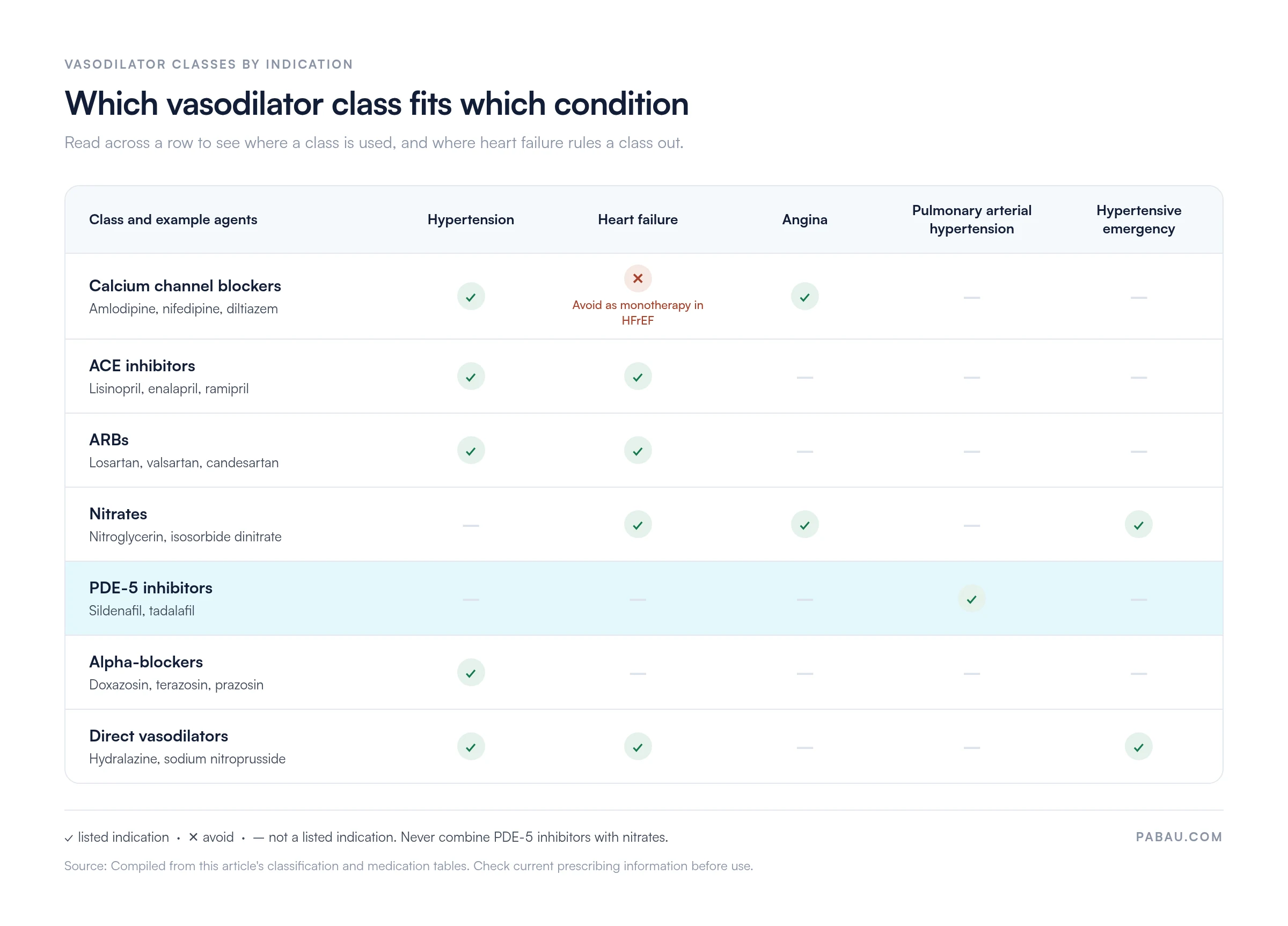
First-line vasodilators for systemic hypertension include calcium channel blockers (amlodipine, nifedipine), ACE inhibitors (lisinopril, ramipril), and ARBs (losartan, valsartan). These agents lower blood pressure by reducing peripheral vascular resistance. Major guidelines support them, including the 2025 AHA/ACC hypertension guideline.
Starting doses and titration ranges differ from one ACE inhibitor to the next. Our ACE inhibitor list sets them out agent by agent.
In heart failure with reduced ejection fraction (HFrEF), ACE inhibitors, ARBs, and hydralazine combined with nitrates reduce cardiac afterload and improve forward flow. Combination therapy is often necessary. Calcium channel blockers are generally avoided as monotherapy in HFrEF because of their negative inotropic effects.
PDE-5 inhibitors (sildenafil, tadalafil) are FDA-approved agents for PAH. These agents selectively dilate the pulmonary vasculature and help prevent right heart failure. Endothelin receptor antagonists and prostanoids are alternative PAH therapies.
Every vasodilator class carries its own adverse effect profile. Explaining these effects to patients supports adherence and helps the care team catch complications early.
Some dietary vasodilators have modest, evidence-based blood pressure-lowering effects. They complement guideline-directed antihypertensive therapy and should never replace it.
Caution: Evidence for natural vasodilators is limited and variable. They should not substitute for pharmacological therapy in moderate-to-severe hypertension or other cardiovascular conditions. Counsel patients to keep taking their prescribed agents.
The FDA updates vasodilator drug labeling, safety alerts, and recall information through DailyMed and its drug safety communications. Key regulatory considerations include:
Clinicians should regularly review the FDA drug database and professional society guidelines for updated safety communications. Our nitrates medication list puts the PDE-5 interaction next to nitroglycerin and isosorbide doses.
This reference is designed for practice staff and clinicians to build into daily prescribing and patient counseling.
Weight loss practices see many patients with high blood pressure, since excess weight raises it. Keeping this list inside your weight loss clinic software puts each patient’s antihypertensives next to their program notes.
Disclaimer: This template is for educational and reference purposes only. It doesn’t replace clinical judgment, current prescribing information, guideline review, or a pharmacist’s advice. Always check the latest FDA prescribing information, local formularies, and professional guidelines before prescribing any medication.
A medication reference often lives in one place and the patient’s prescribing history in another. Staff end up switching between a PDF, the chart, and a separate prescribing tool to confirm a single dose.
Pabau, the practice management platform we build, brings prescribing, medication records, and treatment notes into the patient file. A prescriber can see the current vasodilator, its dose, and the last consultation note on one screen.
That means less copying between systems when a dose changes, and a clear record when you audit prescribing. Book a demo to see how prescribing works in Pabau.

Pabau brings prescribing, medication records, and treatment notes into one patient file. Your team can check a vasodilator dose and the last consultation note without switching systems.

The dose column matters, but the pairings and settings carry the most risk. A PDE-5 inhibitor next to a nitrate, or a calcium channel blocker in HFrEF, needs catching before the prescription goes out.
Adapt the downloaded list to your formulary, then review it whenever a label or guideline changes, as hypertension guidance did in 2025. A reference that lags the label misleads the staff who rely on it.
Book a demo to see how Pabau keeps each patient’s vasodilator history next to their treatment notes.

Prescribing nitrates for angina? Nitrates medication list sets out nitroglycerin and isosorbide doses, onset times, and the PDE-5 interaction to screen for.
Need dosing detail for ACE inhibitors? Medication list of ACE inhibitors covers starting doses, titration ranges, and the key clinical differences between ACE inhibitors and ARBs.
Building one reference for every heart medication? Cardiovascular medication list organizes antihypertensives, heart failure drugs, and anticoagulants by class in one downloadable template.
Treating blood pressure and lipids together? Cholesterol medication list groups statins, ezetimibe, and PCSK9 inhibitors for quick lipid-lowering reference.
Managing patients on blood thinners? Anticoagulant medication list covers warfarin, heparin, and direct oral anticoagulants such as apixaban and rivaroxaban.
Vasodilators are any medications that cause blood vessel relaxation and widening. The six major classes are calcium channel blockers (amlodipine, nifedipine), ACE inhibitors (lisinopril, ramipril), and angiotensin receptor blockers (losartan, valsartan). The other three are nitrates (nitroglycerin, isosorbide dinitrate), PDE-5 inhibitors (sildenafil, tadalafil), and alpha-blockers (doxazosin, terazosin). Each class works through a different pharmacological mechanism.
Yes. Nitroglycerin is a nitrate vasodilator that donates nitric oxide, a key signaling molecule that relaxes vascular smooth muscle and causes vasodilation. It is used for acute angina relief (sublingual tablets or spray), chronic angina prevention (patches, long-acting oral forms), acute heart failure, and hypertensive emergencies.
ACE inhibitors (lisinopril, enalapril) and angiotensin receptor blockers (losartan, valsartan) are first-line vasodilators for heart failure with reduced ejection fraction. The combination of hydralazine and isosorbide dinitrate is an alternative for patients intolerant of ACE-I/ARBs. Calcium channel blockers are generally avoided in HFrEF because of their negative inotropic effect.
Oral vasodilators (amlodipine, lisinopril, losartan, nitroglycerin patches) are used in stable outpatient hypertension and chronic heart failure management. IV vasodilators (sodium nitroprusside, IV nitroglycerin, IV hydralazine) are reserved for acute settings such as hypertensive emergency, acute decompensated heart failure, and the ICU. There, rapid titration and beat-to-beat BP control are required.
PDE-5 inhibitors sildenafil (Revatio) and tadalafil (Adcirca) are FDA-approved vasodilators for pulmonary arterial hypertension. These agents selectively dilate pulmonary vessels and reduce right ventricular afterload. Endothelin receptor antagonists and prostanoid analogues are alternative PAH therapies, often used in combination with PDE-5 inhibitors.
Calcium channel blockers block L-type calcium channels on vascular smooth muscle cells, reducing calcium influx. This prevents smooth muscle contraction and causes vasodilation. Dihydropyridines (amlodipine, nifedipine) preferentially dilate peripheral vessels; non-dihydropyridines (diltiazem, verapamil) also slow AV nodal conduction and reduce heart rate.