Montgomery-Åsberg Depression Rating Scale (MADRS)
The Montgomery-Åsberg Depression Rating Scale (MADRS) is a clinician-administer...

Last Updated: Oct 6, 2026
The state self-esteem scale (SSES) is a 20-item questionnaire that measures how a person feels about themselves right now. Heatherton and Polivy published it in 1991. Respondents rate each item from 1 (not at all) to 5 (extremely) across three domains, covering performance, social, and appearance. Thirteen items are reverse-scored first, and the three subscale totals add up to a score between 20 and 100. Higher scores mean higher state self-esteem.
Unlike the Rosenberg scale and other trait measures, the SSES tracks change from one session to the next. That makes it useful for pre- and post-intervention tracking, experimental designs, and brief wellbeing screening in mental health practices. You can download the full questionnaire, with its reverse-scoring key, from the box below.

The state self-esteem scale (SSES) is a 20-item questionnaire measuring momentary self-esteem across performance, social, and appearance domains.
The SSES uses a 5-point scale, from 1 (not at all) to 5 (extremely). Thirteen of the 20 items are reverse-scored before you total the subscales.
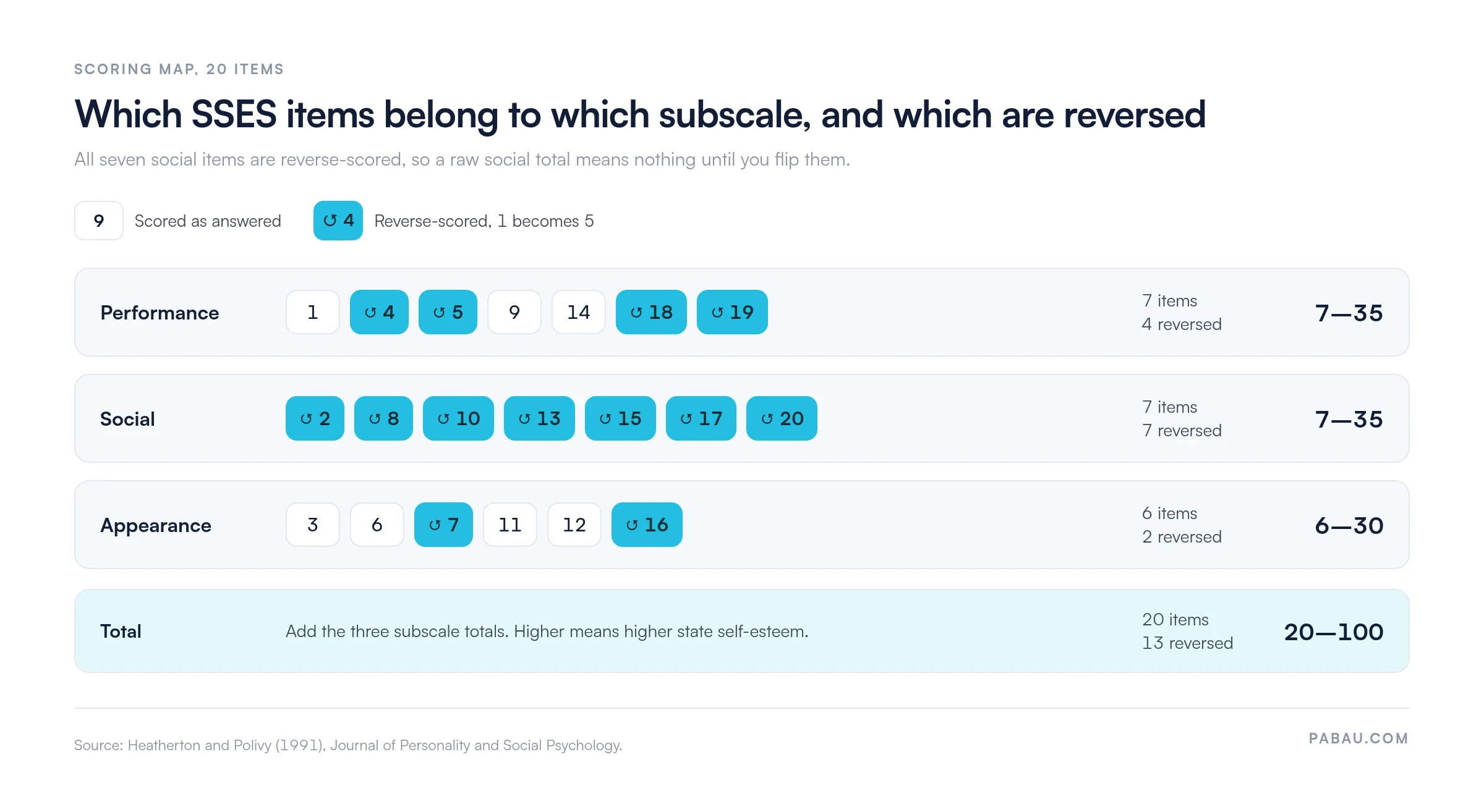
All seven social items are reverse-scored, so a hand-scored social total is wrong unless every one of them is flipped.
Total scores run from 20 to 100, and higher means higher state self-esteem. Heatherton and Polivy published no clinical cut-offs, so compare a score with the same patient’s earlier scores.
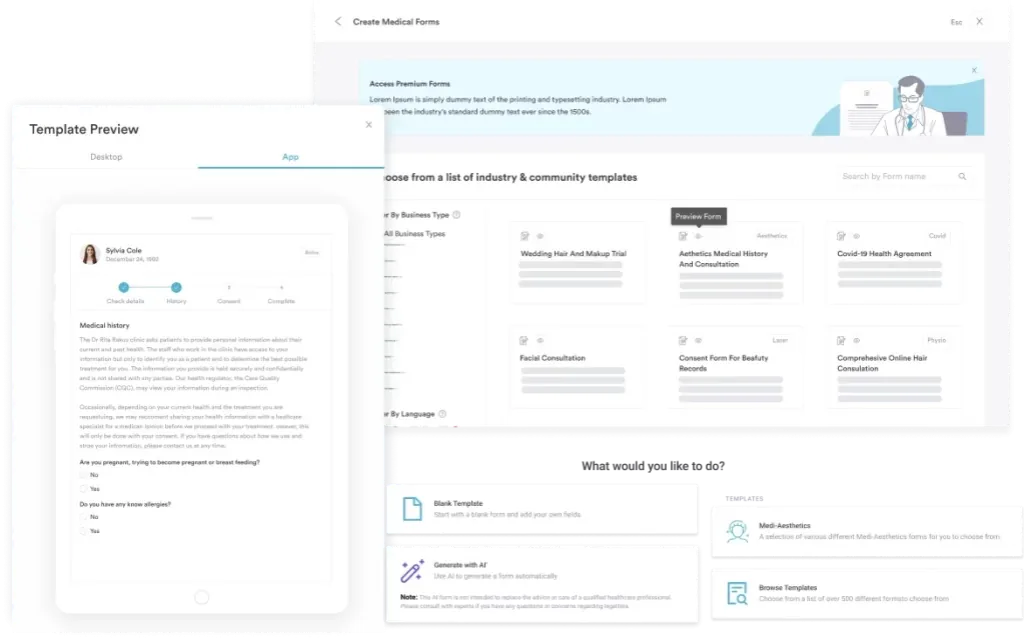
Pabau’s digital forms let practitioners send validated scales to patients and keep every score in the client record.
The full 20-item questionnaire with the 1 to 5 response options, the reverse-scoring key, and space to total each subscale. Ready to print for session use.
Download templateHeatherton and Polivy developed the SSES in 1991 and published it in the Journal of Personality and Social Psychology. It is a 20-item self-report measure of momentary self-esteem. The three domains it covers are performance (ability and competence), social (interaction and acceptance), and appearance (physical attractiveness and body image).
Trait self-esteem is stable over time. State self-esteem moves with situational feedback, performance outcomes, or appearance concerns. The SSES picks up those short-term shifts, which is what makes it sensitive to therapy, situational stressors, and experimental manipulations.
Respondents rate each item on a 5-point scale, where 1 is not at all and 5 is extremely. Thirteen items are reverse-scored: 2, 4, 5, 7, 8, 10, 13, 15, 16, 17, 18, 19, and 20. Flip those responses before you sum anything, so a 1 becomes a 5 and a 2 becomes a 4. Below is the complete 20-item list, in the published order.
The scale divides into three subscales, each measuring a different facet of momentary self-worth:
Two of those placements read oddly at first. Item 6 (“I feel that others respect and admire me”) sits under appearance rather than social. So does item 11 (“I feel good about myself”). Keep the published grouping so your totals stay comparable with the wider literature.
Scoring takes five steps. The map below shows which items belong to each subscale and which 13 of them get flipped before you add anything up.
Interpretation: Higher scores indicate higher state self-esteem, on the total and on each subscale. Heatherton and Polivy published no clinical cut-offs, so read a score against the same patient’s earlier scores rather than a threshold. Recording responses on a digital intake form keeps the raw answers on file, so you can re-check a total later instead of re-administering the scale.
The SSES has strong psychometric support in the peer-reviewed literature. Heatherton and Polivy’s 1991 validation study reported Cronbach’s alpha values of .86 to .92 across the subscales, which indicates high internal consistency. The scale has since been used with college student, clinical, and international samples, and it responds to both experimental manipulation and therapeutic change.
Construct validity rests on correlations with behavioral outcomes such as task performance and sensitivity to social feedback. Test-retest reliability depends on the interval you choose. Same-session retesting is highly stable, while one-week intervals show the state-level movement the scale was built to detect.
The Rosenberg self-esteem scale (RSES) is a 10-item trait measure of stable, global self-esteem. The two instruments answer different questions, so the choice follows your assessment goal. If you need a baseline rather than session-to-session movement, the Rosenberg self-esteem scale is the better starting point.
A validated 6-item short form exists for time-constrained settings. Webster, Howell, and Shepperd published the SSES-6 in 2022. It keeps the three-subscale structure with two items per subscale, and it takes under a minute to complete instead of roughly three. That suits session check-ins and brief wellbeing screening in busy therapy practices.
The SSES fits several clinical and research contexts:
Heatherton, T. F., & Polivy, J. (1991). Development and validation of a scale for measuring state self-esteem. Journal of Personality and Social Psychology, 60(6), 895-910. https://psycnet.apa.org/doi/10.1037/0022-3514.60.6.895
Webster, G. D., Howell, J. L., & Shepperd, J. A. (2022). Self-esteem in 60 seconds: The six-item State Self-Esteem Scale (SSES-6). Assessment, 29(2), 152-168. https://doi.org/10.1177/1073191120958059
Scoring the SSES on paper costs a clinician twice. Someone flips 13 responses by hand, totals three subscales, then types the numbers into the note. Each of those steps is a chance to transpose a digit.
Practice management software like Pabau shortens that path. Send the 20 items to the patient as a digital form before the session, and their answers flow into their digital clinical records. The result sits with the note instead of in a folder behind reception.
Because each administration is stored against the same patient, you can read the trend rather than hunt for last month’s paper copy. That turns the SSES into an outcome measure you can chart across a whole episode of care.
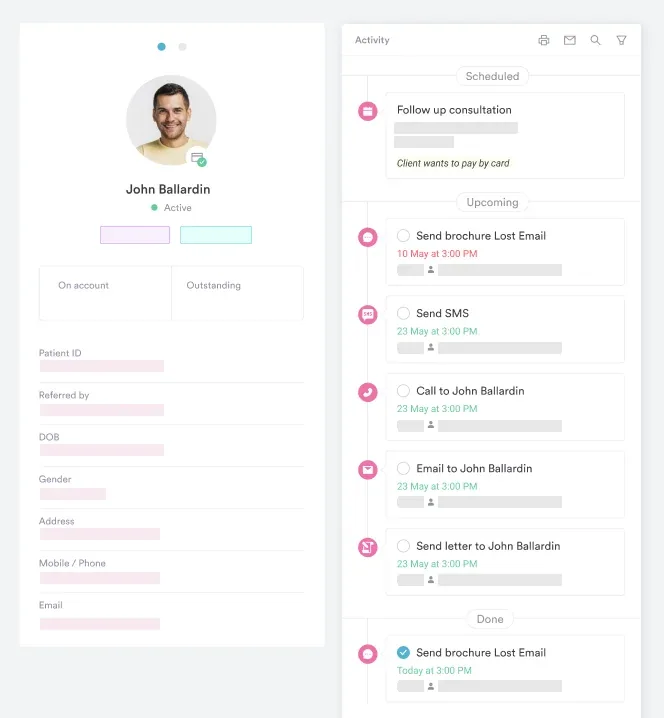

Send validated scales as digital forms, keep every score against the client record, and follow a patient’s progress across their whole episode of care.

The SSES rewards care in one place, and that is the reverse-scoring. Flip the 13 designated items, total the three subscales, and your number is comparable with the published literature. Miss the flip on the social items and that subscale reads backwards.
Because the scale carries no published cut-offs, one administration tells you far less than two. Run it at the start of an episode of care, then again after the intervention. The change between them is what you interpret.
Print the template above for paper administration. You can also build the same 20 items into your digital intake forms, so the flip is never skipped at the desk. Book a demo to see how scored assessments sit inside a patient record.

Need the trait counterpart? Rosenberg self-esteem scale template gives you the 10-item baseline to pair with session-by-session SSES scores.
Looking for between-session work? Self-esteem worksheet for adults turns a low subscale score into structured homework a client can take away.
Tracking the appearance domain? Body appreciation scale goes deeper on body image than the six appearance items in the SSES.
Need to document the result? Progress notes for psychotherapy shows where a scored assessment belongs in the session note.
The SSES measures momentary self-esteem across performance, social, and appearance domains. Clinicians use it to assess pre- and post-therapy shifts, track mood-related self-worth, guide social anxiety treatment, and monitor eating disorder recovery. It is sensitive to short-term change caused by therapy, feedback, or situational stressors.
The full SSES contains 20 items rated on a 5-point scale. A validated 6-item short form (SSES-6) is available for brief wellbeing screening or repeated session check-ins.
The SSES measures state, or momentary, self-esteem with domain-specific subscales. The Rosenberg scale measures stable, global trait self-esteem in 10 items. Use the SSES to track moment-to-moment change, and the Rosenberg scale for a baseline.
Reverse-score items 2, 4, 5, 7, 8, 10, 13, 15, 16, 17, 18, 19, and 20, then sum each subscale. Performance and social both run 7-35, and appearance runs 6-30. The total ranges from 20 to 100, with higher scores indicating higher state self-esteem. Building the items into a digital form keeps the raw responses on file for re-checking.
Yes. The SSES was published in the peer-reviewed literature (Heatherton & Polivy, 1991) and is freely available for clinical and research use with proper citation. The PDF template above gives you a ready-to-print version for patient administration.
The SSES was developed by Todd F. Heatherton and Janet Polivy and published in 1991 in the Journal of Personality and Social Psychology. The SSES-6 short form was developed by Webster, Howell, and Shepperd (2022).