Fear setting worksheet
A fear setting worksheet is a three-part exercise, laid out here as a three-page...

1
Last Updated: Oct 8, 2026
The talkaholic scale is a 16-item self-report questionnaire that measures compulsive communication, often called talkaholism. James C. McCroskey and Virginia P. Richmond published it in 1993 as a research measure. It helps clinicians, therapists, coaches, and individuals see whether heavy talking is situational or a persistent pattern.
Only 10 of the 16 items are scored, and the total runs from 10 to 50. Most people score below 30, scores from 30 to 39 are borderline, and McCroskey classes scores above 40 as talkaholic. This guide covers the official scoring formula, the interpretation bands, and how to use the scale in therapy, coaching, and self-assessment.
All 16 statements of McCroskey and Richmond’s talkaholic scale, each rated from 1 (strongly disagree) to 5 (strongly agree). The scoring section walks through the three-step formula, flags the six filler items, and gives the published bands for totals from 10 to 50.
Download template
The talkaholic scale is a 16-item self-report measure of compulsive communication, which is distinct from simply being talkative.
McCroskey and Richmond introduced the scale in 1993 in Communication Research Reports as a research measure of a single trait, with no subscales.
Only 10 items are scored, giving a total from 10 to 50, and McCroskey classes scores above 40 as talkaholic.
Compulsive talking may overlap with attentional, anxiety, or mood presentations, but the scale is not a diagnostic instrument for any DSM-5 condition.
Pabau, the practice platform we build, sends the scale before an appointment and files each completed questionnaire in the patient record.
Talkaholism, or compulsive communication, describes a persistent pattern of excessive talking that occurs across situations and is perceived as difficult to control. The talkaholic scale quantifies this trait using a 16-item questionnaire with a five-point Likert response format (strongly disagree to strongly agree).
The scale places a communication style on a continuum. DSM-5 has no talkaholism diagnosis for a score to confirm. Low scorers rarely talk excessively, while high scorers often find it hard to limit how much they talk in social and work settings.
Compulsive communicators often report that their talking feels automatic or driven. They may interrupt frequently, dominate conversations, or continue speaking despite social cues indicating listeners are disengaged or frustrated.
Being outgoing or talkative in social settings differs from compulsive talking in two ways. The first is how much control the person has. The second is whether they adjust to the situation.
Talkaholism comes from communication research, where it is studied as a personality trait. McCroskey also notes that a high talker is not the same as someone who “talks too much.” That phrase usually describes people who say unwelcome things or communicate poorly.
In his research, people who talk more are often rated more positively, as more competent and more likely to lead. So treat a high score as a prompt to look at context and consequences before judging how well the person communicates.
Each of the 16 items is rated on a five-point Likert scale. The options run from 1 (strongly disagree) through 2 (disagree), 3 (neutral) and 4 (agree) to 5 (strongly agree).
The items fall into three groups, and only two of those groups count toward the score.
The scale measures one trait, compulsive communication, so it has no subscales or dimension scores. The six filler items are answered like the others but never counted. Items 13 and 16 are not flipped on the 1-to-5 scale either. The formula subtracts them instead.
Step 1: Add the talkaholic items. Add the ratings for items 2, 3, 5, 7, 8, 10, 11, and 14. This subtotal falls between 8 and 40.
Step 2: Add the reverse-worded items. Add the ratings for items 13 and 16. This subtotal falls between 2 and 10.
Step 3: Apply the formula. Total score = 12 + (Step 1 subtotal) − (Step 2 subtotal). The total always lands between 10 and 50. Ignore items 1, 4, 6, 9, 12, and 15.
Here is a worked example. A respondent rates all eight talkaholic items at 4, for a Step 1 subtotal of 32. They rate items 13 and 16 at 2, for a Step 2 subtotal of 4. Their score is 12 + 32 − 4 = 40, which sits right on the talkaholic boundary. The diagram below maps every item to its role and shows where that 40 falls.
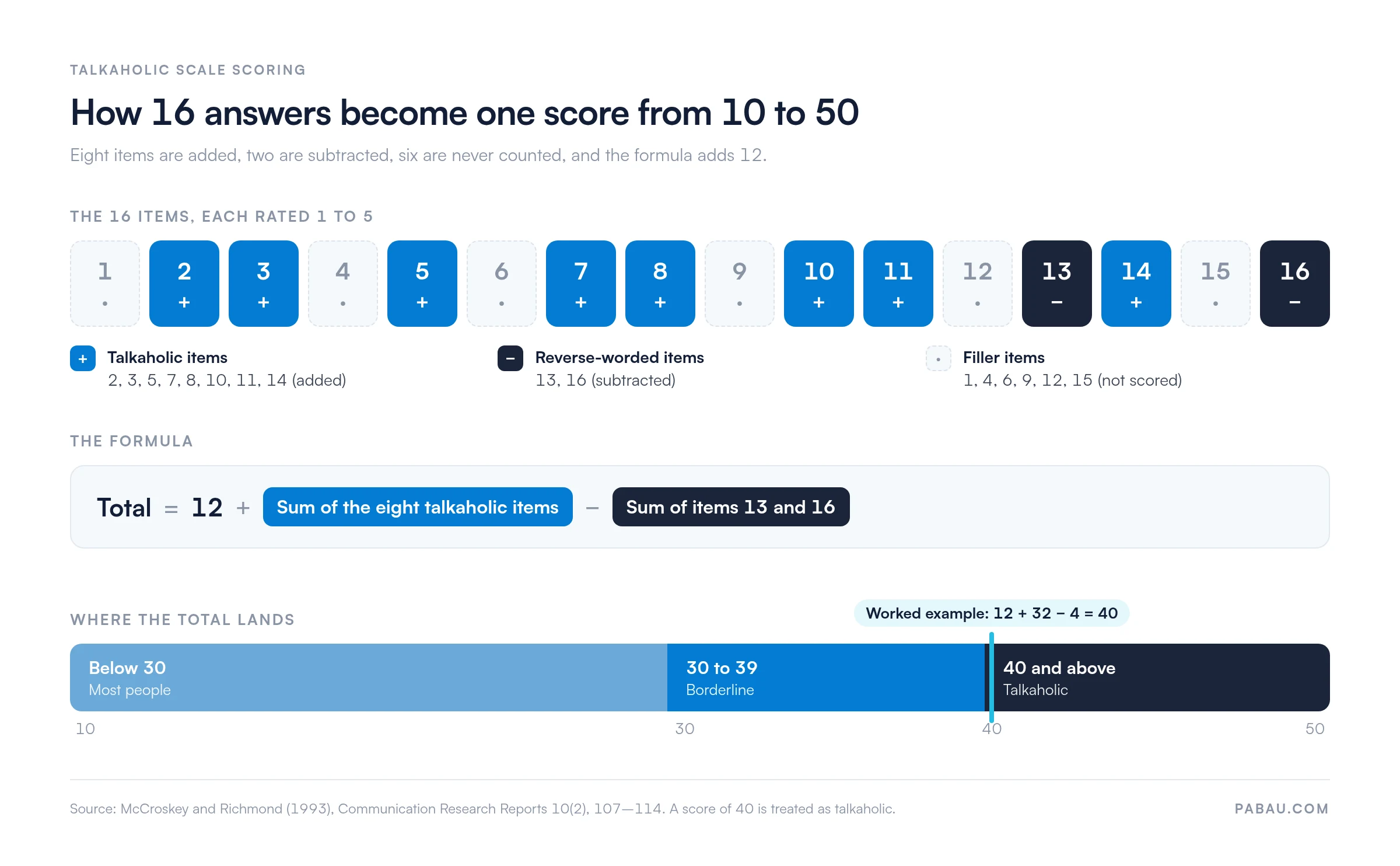
Step 4: Interpret the total score. McCroskey publishes three bands, shown in the table below.
McCroskey’s wording leaves a score of exactly 40 between the borderline band (30-39) and the talkaholic band (“above 40”). Treat 40 as the start of the talkaholic range and say so when you report it.
Important caveat: A high score describes how someone communicates and diagnoses no condition. It warrants a conversation with a qualified clinician, who can explore the underlying causes and the right intervention.
Compulsive talking may overlap with attentional, anxiety, or mood presentations. Those links come from clinical observation rather than from the talkaholic scale research, and the scale cannot diagnose any of these conditions.
Where you suspect one of these drivers, a targeted screen adds context. The adult ADHD self-report scale covers attentional symptoms, and the Altman self-rating mania scale checks for recent manic symptoms.
A patient may score high on the talkaholic scale and report significant distress or functional impairment. In that case, refer them to a mental health professional for a structured psychiatric interview against DSM-5 criteria.
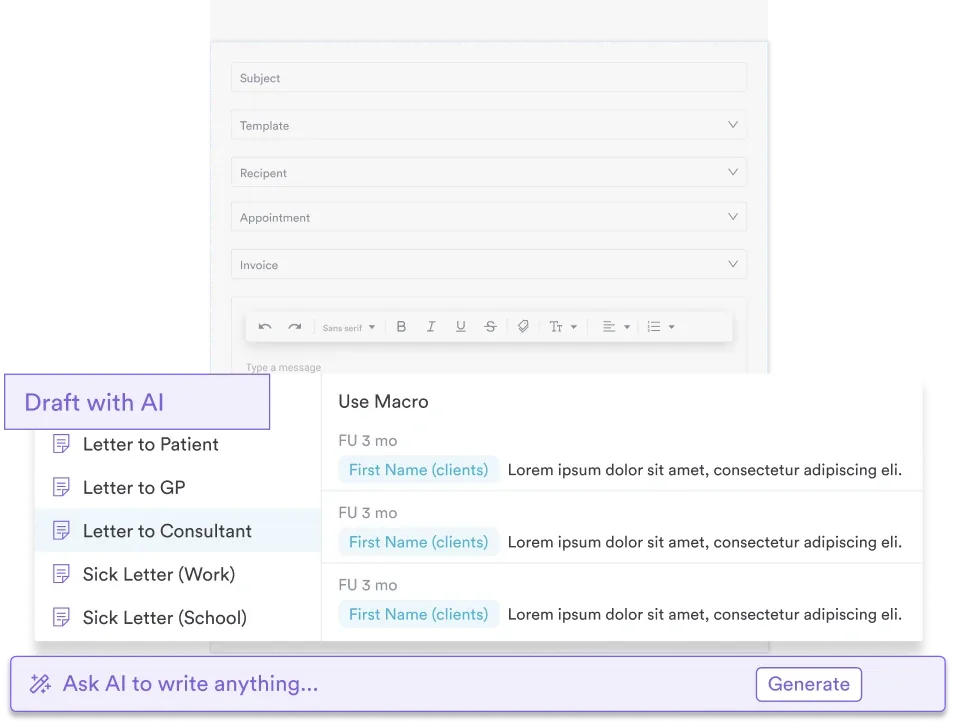
The six steps below take clinicians, therapists, coaches, and counselors from handing out the scale to tracking change over time.
Step 1: Administer the instrument. Have the patient complete all 16 items in a quiet, private setting. Allow five to 10 minutes. Sending the scale as one of your digital intake forms means the answers arrive legible and complete before the appointment.
Step 2: Score the questionnaire. Add the eight talkaholic items, subtract items 13 and 16, then add 12. Read the total against the interpretation table above.
Step 3: Discuss results in session. Present scores neutrally. Avoid diagnostic language (“You have talkaholism”). Instead: “Your score suggests you may experience difficulty moderating how much you talk in some situations. Let’s explore when this happens and what drives it.”
Step 4: Explore underlying drivers. Ask: “When you notice yourself talking a lot, what are you feeling? Anxious? Wanting to be heard? Uncomfortable with silence?” Answers guide intervention selection.
Step 5: Design targeted interventions. Anxiety-driven talkaholism may respond to relaxation, mindfulness, or cognitive restructuring. Talking driven by a need to be heard may benefit from empathy training or metacognitive awareness work. Impulse-driven talking may respond to executive-function coaching or communication skills training. A communication styles worksheet gives the patient a framework to start from.
Step 6: Track progress. Re-administer the scale at an interval you set for the patient’s plan, since there is no published retest schedule. Use the same interval each time so the scores stay comparable.
The free PDF download above contains the complete 16-item questionnaire. You can complete it as a self-assessment in five to 10 minutes, answering each item honestly. You can also use it with patients in a clinical or coaching setting.
If you score in the borderline or talkaholic range and feel distressed by excessive talking patterns, discuss your results with a mental health professional. High scores do not mean something is “wrong” with you, but they do suggest communication patterns worth exploring with professional support.
On paper, the talkaholic scale passes through three pairs of hands. The patient fills it in, a clinician adds up 10 items by hand, and the sheet gets scanned into a file. A slip in the formula, such as counting a filler item or adding items 13 and 16, changes the band a patient lands in.
Pabau’s therapy practice management software turns the scale into a digital form. Patients complete it before their visit through a care pathway, and the answers land in their patient record. The clinician walks into the session with the questionnaire already done.
Because every completed form stays in the same record, you can set the scale beside earlier results when you re-administer it. That makes progress conversations concrete instead of relying on memory.

Pabau’s digital forms send the talkaholic scale before the appointment and file each completed questionnaire in the patient record, ready to compare at follow-up.

The talkaholic scale earns its place when you score it the way McCroskey published it. Ten items, one formula, and three bands give you a number you can compare against the research and against the same patient later.
Treat that number as the start of a conversation. A borderline or talkaholic score tells you talking is hard to control, not why. The why, whether anxiety, mood, attention, or habit, is what shapes the plan, and it needs a clinical assessment the scale cannot give.
Book a demo to see how Pabau sends screening questionnaires before the visit and keeps every result in the patient record.

Want the wider personality picture? Big five personality test places a talkative patient’s extraversion alongside four other core traits.
Working on listening cues? Nonverbal communication worksheet helps patients notice the signals that a listener has stopped following.
Is the talking impulse-driven? Impulse control worksheet gives patients a structured way to pause before acting on an urge.
Does anxiety drive the talking? Anxiety triggers worksheet helps patients map the situations that set their anxiety off.
Need a formal impulsivity measure? UPPS impulsive behavior scale splits impulsivity into subscales you can score and track over time.
The talkaholic scale is a 16-item self-report questionnaire developed by McCroskey and Richmond (1993) to measure compulsive communication. Totals run from 10 to 50, and a higher score means a stronger drive to talk.
James C. McCroskey and Virginia P. Richmond created the scale. They introduced it in 1993 in Communication Research Reports (volume 10, issue 2, pages 107 to 114) as a research measure of compulsive communication. It is not a clinical diagnostic tool.
Respondents rate each of the 16 items from 1 (strongly disagree) to 5 (strongly agree). Items 1, 4, 6, 9, 12, and 15 are fillers and are not scored. Add items 2, 3, 5, 7, 8, 10, 11, and 14, then add 12. Subtract the sum of items 13 and 16 to get the score. Totals range from 10 to 50.
No. The talkaholic scale measures a communication trait, not a clinical condition. Compulsive talking may overlap with attentional, anxiety, or mood presentations, but the scale cannot diagnose any DSM-5 disorder. Diagnosis requires a full assessment by a qualified mental health professional.
Download the free PDF version from this page. You can print it or complete it digitally. Some psychology practices and academic institutions host online versions. Check with your therapist or university counseling center for access.
McCroskey classes scores above 40 as talkaholic, meaning the person is a compulsive communicator. Scores from 30 to 39 are borderline, and most people score below 30. A high score describes a communication trait, so it is a prompt to explore what drives the talking, not a diagnosis.
No. Talkaholism is not a DSM-5 diagnosis. It is a communication style dimension measured along a continuum. Compulsive talking may overlap with attentional, anxiety, or mood presentations, or it may be a learned pattern reinforced by social environments. The talkaholic scale identifies the trait, and a clinical diagnosis requires a full assessment by a qualified mental health professional.