Treatment summary
A treatment summary is a written record of what care was delivered during an epi...

Last Updated: Oct 16, 2026
A resilience test is a short questionnaire that measures how well a person copes with stress, setbacks, and change. Our free version has 10 statements, each rated from 1 (strongly disagree) to 5 (strongly agree). Totals run from 10 to 50 and fall into four bands, from low (10 to 20) to very high (41 to 50).
The total is a prompt for discussion, so read it alongside your own clinical assessment. Many practices send the form through digital intake forms before a first session, so the clinician can review answers in advance.
Ten first-person statements rated from 1 to 5, plus a score key that sorts totals of 10 to 50 into four bands. A notes box leaves room for the clinician. Print it, or rebuild it as a digital form for your practice.
Download template
A resilience test is a short self-report questionnaire that shows how a person rates their own ability to cope with stress and setbacks.
This template has 10 statements scored 1 to 5, so totals run from 10 (low resilience) to 50 (very high resilience).
A patient who ticks “Neutral” on every statement still scores 30, so check the answer pattern before you trust the band.
Validated scales such as the 25-item CD-RISC and the six-item Brief Resilience Scale suit research and formal outcome tracking.
Practice software such as Pabau can send the questionnaire before a session and file each completed form on the patient record.
A resilience test is a self-report questionnaire that estimates how well a person adapts after stress, adversity, or setbacks. Researchers including Ann Masten and George Bonanno describe resilience as keeping or regaining healthy functioning after adversity.
Most published measures cover similar ground, such as emotional regulation, social support, coping, and adaptability. The Harvard resilience measurement resource lists validated scales you can compare.
Resilience also shifts with circumstances. Someone who scores high in a calm month may score lower during a bereavement or a job loss. A single form describes how the person sees themselves right now.
The PDF runs to four pages and needs no scoring software. It includes:
Every statement is worded positively, so agreeing always means more resilience. That keeps scoring quick, because no items need to be reverse-scored.
Grouping the statements into four themes makes a completed form faster to read, as the map below shows.
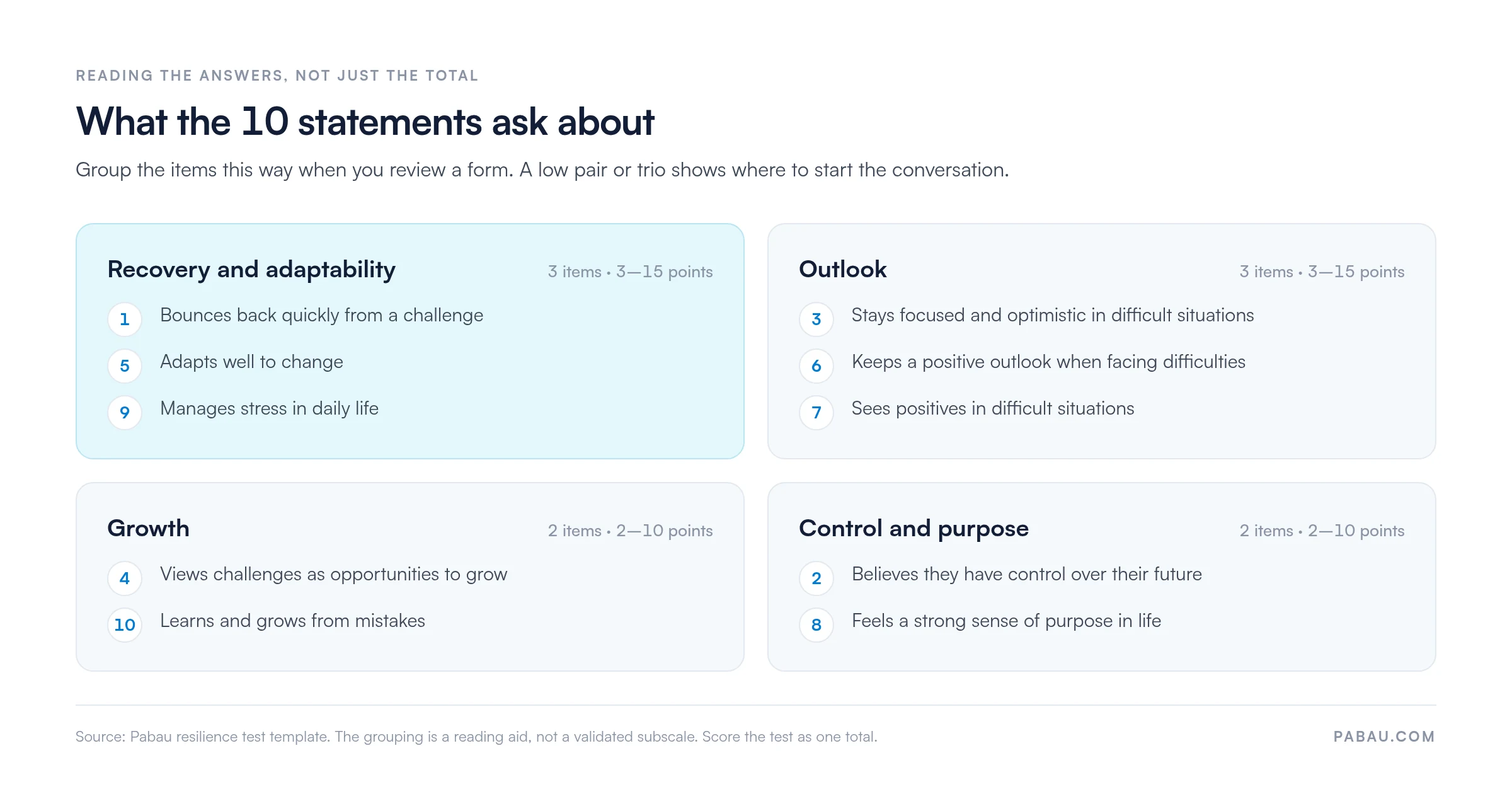
Scoring takes about a minute by hand. Follow the same five steps every time:
The band names come from the template’s score key. We wrote the two right-hand columns as reading guidance, and no study has tested them as clinical thresholds.
The chart below also marks what one repeated answer adds up to, which helps you spot a form filled in on autopilot.
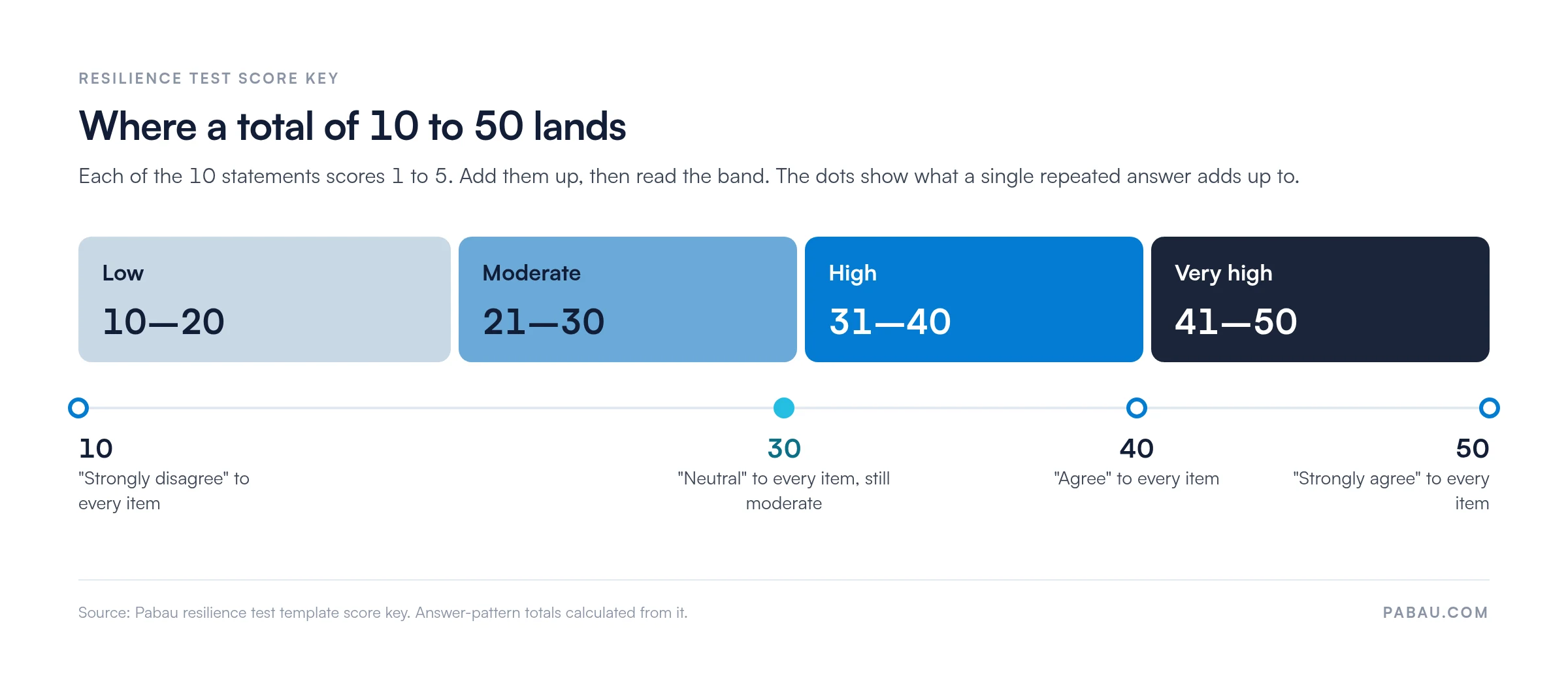
Read the total as an indication, then check how the patient reached it. Two people can both score 30 with very different answers.
One patient might answer 3 to every statement. Another might score high on growth and purpose but low on recovery and stress, with a similar total. The second form tells you far more about where to start.
No study has validated the template’s bands as clinical cut-offs, so use them as a practical guide. Pair the total with interview findings and the patient’s own account, and record how you reached your reading.
For patients in the low or moderate band, a resilience worksheet turns the conversation into practical exercises between sessions.
The questionnaire works best as the opening of a conversation about coping. A simple workflow keeps the process consistent across your team:
Pabau Scribe, the AI scribe built into Pabau’s practice software, can draft a session summary while you talk through the scores. Every summary still needs your review before it goes on file.
Repeat the questionnaire at points you agree with the patient, such as intake, a mid-point review, and discharge. Keep the version, format, and timing consistent, so a change in the total can be traced to the patient.
The questionnaire fits mental health, psychology, therapy, coaching, and wellness settings. Psychologists and therapists use it at intake or review. Coaches use it to set goals with their clients and track progress.
The statements are written for adults. For children and teenagers, choose a measure that was developed and tested for that age group.
Teams running mental health EMR software can keep results with the patient record, so the questionnaire sits alongside the notes it informed.
A short, free questionnaire is quick to use, and that speed comes with limits. Keep these in mind before you act on a score:
When you need a validated number for research, audits, or outcome reporting, use one of the scales below alongside the template or instead of it.
The Connor-Davidson Resilience Scale and the Brief Resilience Scale are the two most widely cited options. Here is how they compare with the free template.
Connor and Davidson published the 25-item scale in 2003 in Depression and Anxiety. Items are rated from 0 (not true at all) to 4 (true nearly all the time), giving totals from 0 to 100.
Shorter 10-item and 2-item versions also exist. The scale is proprietary, so request permission from the authors before you use any version.
Smith and colleagues published the six-item Brief Resilience Scale in 2008 in the International Journal of Behavioral Medicine. It measures how quickly a person bounces back after stress, which makes it a practical short check.
Items 2, 4, and 6 are reverse-scored, and the score is the average of all six. Averages of 1.00 to 2.99 suggest low resilience, 3.00 to 4.30 normal resilience, and 4.31 to 5.00 high resilience.
Psychological testing carries ethical duties, which the American Psychological Association sets out for practitioners. If you want to measure confidence in coping rather than bounce-back, the coping self-efficacy scale pairs well with this template.
A shared questionnaire gives your team consistent language for resilience conversations. Patients answer the same items each time, so changes are easier to see across sessions.
Staff can also refer to the same structure during handovers and supervision. For smaller practices, a free template saves the time it takes to build and test a questionnaire from scratch.
Store the scoring key with the printed or digital form so every team member totals the test the same way. Note the date, the version, and who administered it. Those three details make later comparisons fair and help you explain changes at review.
Digital versions are usually faster to send and file, while printed versions suit sessions without reliable connectivity. The content and scoring should stay the same either way.
If you move to digital, rebuild the form exactly as printed. Changing the wording or the order of the statements means old and new totals can no longer be compared fairly.
On paper, the resilience test lives in a folder. Comparing intake with discharge means finding two sheets, re-adding totals, and hoping someone wrote the dates down.
In Pabau, you build the questionnaire once as a digital form and send it ahead of the first appointment. Patients complete it on their phone before they arrive, and the answers file to their record.
Because each form sits beside your session notes, you can open last quarter’s answers next to today’s in seconds. Pabau’s client records keep the questionnaire, the note, and the plan together.
Therapy teams can see how forms, notes, and scheduling fit together in our therapy practice management software.

Pabau sends the resilience test as a digital form before the appointment and files every completed form on the patient record. You review answers in advance and compare repeats without digging through paper.

A 10-item questionnaire earns its place when it starts a better conversation. Score it the same way every time, read the pattern behind the total, and repeat it at points you agree with the patient.
Where you need a validated figure for research or outcome reporting, reach for the CD-RISC or the Brief Resilience Scale. The template is built for speed, so let it open the discussion and let your clinical judgment close it.
Keeping each form next to the notes it informed turns single scores into a record of change. Book a demo to see how Pabau sends questionnaires before appointments and keeps the results on the patient record.

Want to measure the support around a patient? Social support scale covers the ISEL-12 items and its scoring key.
Need to gauge stress before resilience? Stress assessment questionnaire gives you a template and a scoring guide for current stress levels.
Looking for a measure of hope and goal-setting? Adult hope scale scores agency and pathways thinking in 12 items.
Checking for burnout at work? Copenhagen Burnout Inventory scores personal, work-related, and client-related burnout.
Tracking overall wellbeing over time? Life Satisfaction Scale (SWLS) offers a five-item template with a scoring guide.
The resilience test template is a questionnaire for assessing psychological resilience and how a person copes with stress and adversity. Practitioners use it to open structured conversations about coping, and it does not diagnose any condition.
No. A resilience test is a screening and conversation tool, and it cannot diagnose a mental health condition. Results should be read alongside clinical judgment, history, and the patient’s own account.
Give each of the 10 answers 1 to 5 points, from strongly disagree to strongly agree, and add them up. Totals of 10 to 20 are low, 21 to 30 moderate, 31 to 40 high, and 41 to 50 very high.
On this template, a total of 31 or more falls in the high or very high band. Check that the answers fit the patient’s history and interview before you record a high score as a strength.
There is no single best scale for every setting. The Connor-Davidson scale has 25 items for a fuller picture, while the six-item Brief Resilience Scale suits quick checks when time is limited.
The CD-RISC is a validated, licensed scale with 25 items scored 0 to 4. This template is a free 10-item conversation tool scored 1 to 5, with no published norms. Use the CD-RISC when you need a validated result.
Repeat it at points you agree in advance, such as intake, a mid-point review, and discharge. Use the same version and format each time, so the setting doesn’t drive any change in score.
The statements are written for adults. For children and teenagers, use a measure developed and tested for that age group, and follow your local rules on consent.
The 7 Cs model comes from pediatrician Kenneth Ginsburg. Its seven parts are competence, confidence, connection, character, contribution, coping, and control. It was built for young people, though coping and control also appear in this template.
Yes, the download above is free to access and print. Adapt the wording for your practice where your local policies require it.