Despina Petrushevska

standard authorization form
What is a standard authorization form? A standard authorization form is a docume...

1
Last Updated: Nov 13, 2026
Free PDF 1 page, print-ready Clinician-reviewed
A TB risk assessment form is a short clinical questionnaire that decides whether a patient needs a tuberculosis test, before any test is ordered. It asks about exposure, symptoms, travel, and risk factors, so clinicians can sort patients into no test, a TST or IGRA, or prompt referral. The downloadable PDF is a general health risk assessment template, not a ready-made TB screening form. Your team adapts it with the TB questions from the table in this guide, using your state's wording.
A blank health risk assessment template with sections for visit details, medical history, preventive services, assessment and plan, and patient education. Add your TB screening questions before use.
Start from scratch, or upload this PDF or any form you already use, and Pabau's AI Form rebuilds it with tick boxes, text fields and a signature. Attach it to the treatment once, and every patient gets it on time.
AI Form rebuilds the consent, history and aftercare forms you already use. You review each one, then publish.
Patients complete forms on their phone before they arrive, so the front desk stops retyping paper.
Every signed form is versioned and attached to the treatment record, ready when you need it.
Set how long a consent stays valid. Returning patients skip forms they have already signed.
Supports HIPAA and GDPR compliance AES-256 encryption 4.8 on G2 4.7 on Capterra Trusted by 4,000+ practices worldwide

A TB risk assessment form decides whether a patient needs a TB test, not whether they have TB.
CDC guidance centers the form on exposure history, symptoms, and risk factors such as travel and immunosuppression.
Latent TB infection is identified only by a TST or IGRA result plus clinical evaluation, never by the form alone.
The downloadable PDF is a general health risk assessment template, so your team adds the TB questions before use.
Healthcare workers, new patients, and certain school and employment entrants are the groups most often screened.
A TB risk assessment form is a structured questionnaire that clinicians use to sort patients by their likelihood of tuberculosis infection. CDC’s clinical testing guidance targets testing at people with increased risk and discourages any testing approach that skips a risk assessment. A positive answer signals that a test is needed, and it says nothing yet about active TB.
Public health departments and occupational health teams use the same logic. The form captures what a clinician needs to choose between no further action, a tuberculin skin test (TST), or an interferon-gamma release assay (IGRA). A positive assessment leads to a TST or IGRA. Latent TB infection is identified only by that test result plus clinical evaluation.
Most TB risk assessment forms group their questions into a few clear categories. Each one maps to a specific clinical decision.
Clinicians use the answers to categorize risk, not to make a diagnosis. The CDC lists three core risk factors for latent TB infection. They are birth in or travel to a high-burden country, close contact with active TB, and immunocompromising conditions.
The PDF is a general health risk assessment template, not a ready-made TB screening form. It has six blank sections: visit details, health risk assessment, medical history, preventive services, assessment and plan, and patient education and counseling. Your team adds the TB questions from the table above before the first patient fills it in.
Each question category fits one of the existing sections:
Prefer a form with the TB questions already written? The TB skin test questionnaire includes exposure, risk factor, and symptom sections alongside the test record. For a wider annual wellness intake, the health risk assessment questionnaire covers the CMS-required domains.
The CDC’s TB guidance is risk-based. The 2019 NTCA/CDC recommendations for screening health care personnel moved away from universal annual testing for low-risk staff. The form now needs to establish individual risk rather than default to a test. At a minimum, it should record:
Read the current guidance directly from the CDC’s tuberculosis resources before finalizing any local version. Protocols and test preferences change, so check the publication date on every source.
Completion depends on the setting. Most practices use the form at new patient intake, while occupational health teams apply it to staff. These are the groups most often screened:
Whether a school or employer requires the form depends on state and local rules. Confirm the requirement with the relevant public health department before assuming it applies.
For healthcare workers, the form sits inside an infection control program. Baseline screening at hire combines a risk assessment, a symptom evaluation, and a TB test. After that, each staff member’s exposure risk and role decide whether more testing is needed.
Occupational health teams usually file the completed form with the staff member’s immunization record and test history. Employer obligations also sit within OSHA requirements, so confirm local compliance rules with your occupational health provider.
Pediatric screening follows age-appropriate criteria, and clinicians adapt the questions accordingly. Confirm the protocol your local TB program specifies for children before using an adult version.
State TB programs set their own forms, so a California form will not always match the one used in another state. California’s TB requirement for K-12 school employees starts with a risk assessment, and only staff whose answers show risk factors go on to testing. That variation makes the local version worth checking.
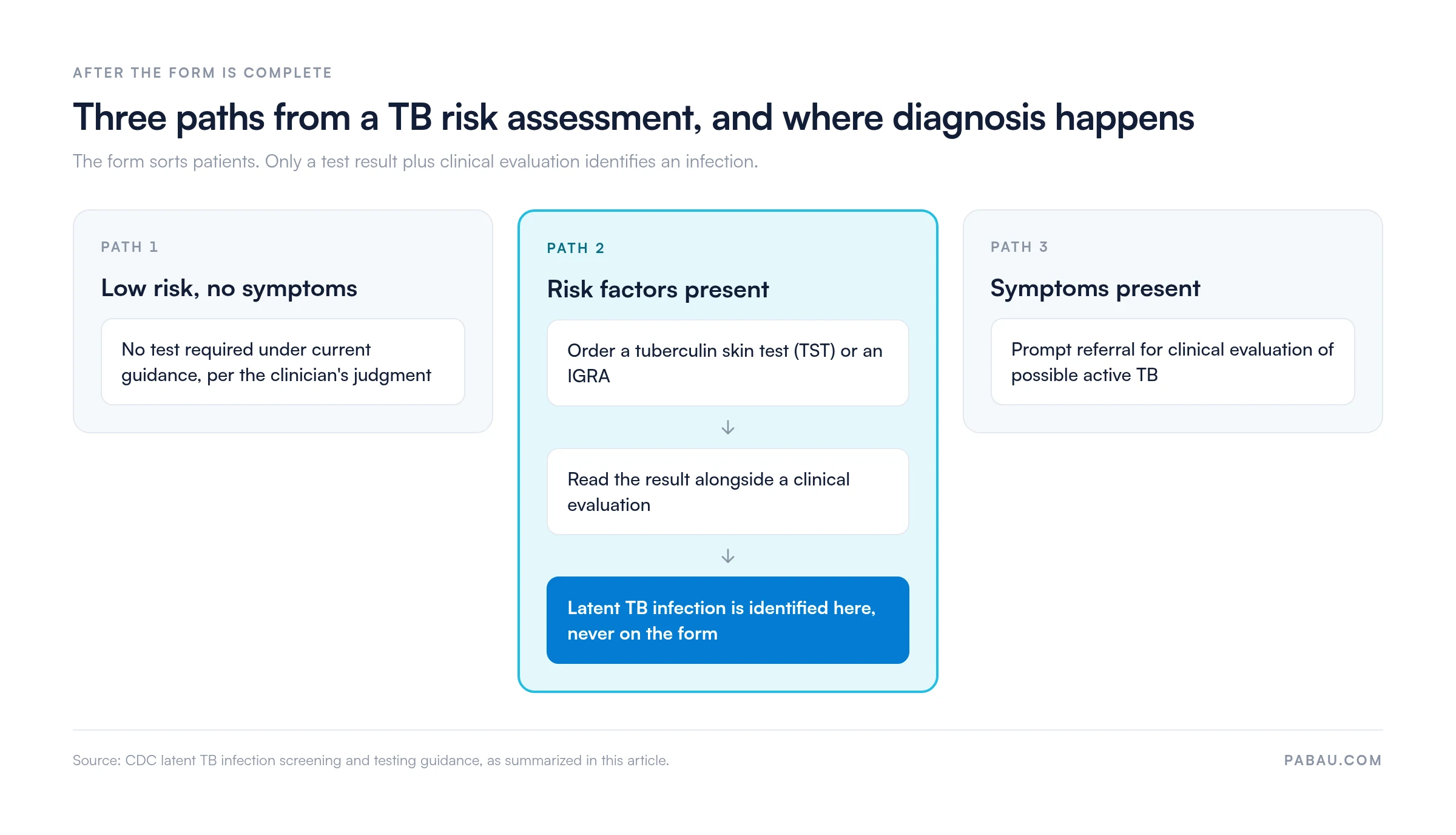
A completed form leads to one of three outcomes: no further action, a TB test, or referral. The clinician decides based on the answers, and the form does not replace clinical judgment.
A positive risk assessment confirms only that testing is needed. The diagram traces where each path ends, and diagnosis sits at the end of the testing path alone.
Paper TB forms get completed at the front desk, filed, and pulled again when a test result comes back. Each handoff is a chance for an unanswered exposure question to go unnoticed.
Pabau, the GP clinic software we build for primary care, sends the questionnaire ahead of the appointment through its digital forms. Patients answer on their phone, and the responses land on their patient record.
Your team builds the TB questions into the form once, in your state’s wording. Clinicians then review exposure history and risk factors next to the visit notes. The choice between no test, a TST or IGRA, or referral happens at the point of care.

Pabau’s digital forms send your TB risk assessment ahead of the appointment and file every answer on the patient record. Clinicians see the risk factors before they decide on a TST or IGRA.

Treat the TB risk assessment as a sorting step with three clear exits. Low-risk patients without symptoms need no test, patients with risk factors get a TST or IGRA, and symptoms mean prompt referral.
The downloadable template gives you the structure, but the TB questions are yours to add. Write them against your state’s form and the CDC’s risk factors before the first patient sees it. A form built that way holds up when a test result needs explaining.
Book a demo to see how Pabau sends your TB questionnaire before the visit and files every answer with the patient record.

Need the TB questions already written? TB skin test questionnaire covers exposure, risk factors, symptoms, and the test record in one form.
Running annual wellness visits? Health risk assessment questionnaire covers the CMS-required domains for a full risk review.
Tracking staff and patient vaccines? Immunization record form logs dates, doses, lot numbers, and titer results.
Deciding which screenings to offer by age? Health screening tests lists what to check and when.
Building a new patient intake? General practice intake form gathers history, medications, and allergies before the first visit.
A TB risk assessment form is a screening questionnaire that determines whether a patient needs a tuberculosis test. It captures exposure, symptoms, travel, and risk factors before any testing decision is made.
New patients, healthcare workers, and some school or employment entrants may be asked to complete one. Whether it is required depends on local and state rules.
No. The risk assessment is the screening step that decides whether a test is needed. A test result, together with clinical evaluation, is what supports a diagnosis.
Not always. The CDC’s 2019 guidance moved away from a universal annual requirement toward a risk-based approach, so frequency depends on exposure risk and local policy.
A positive result usually leads to a TB test, such as a TST or IGRA, and clinical review. It does not confirm infection by itself.