Journal prompts for mental health
Journal prompts for mental health are guided questions that help people process ...

3
Last Updated: Oct 13, 2026
The Copenhagen Burnout Inventory (CBI) is a free, 19-item questionnaire that measures personal, work-related, and client-related burnout as three separate scores from 0 to 100. Tage S. Kristensen and colleagues developed it at Denmark’s National Research Centre for the Working Environment (NFA).
That makes it a free, evidence-based alternative to paid burnout instruments, and a practical choice for staff wellbeing screening in a busy practice. Each subscale score is the average of its answers, from 0 (no exhaustion) to 100 (constant exhaustion).
Read the three scores separately, because each one points to a different fix. This guide covers how to give the questionnaire, score it, and act on the results, and the free PDF is below.
All 19 questions grouped into the personal, work-related, and client-related subscales, each with its answer options. A scoring panel records the three subscale scores and an overall score, with a short note on reading results from 0 to 100.
Download template
The Copenhagen Burnout Inventory measures personal, work-related, and client-related burnout as three separate scores, so you can see where exhaustion comes from.
Each answer converts to a score (0-100 per item), and each subscale score is the average of its items. Researchers often use 50 as a cut-point, but the CBI has no official threshold.
The CBI is free and open-access, needing only attribution to Kristensen et al. and the NFA, so practices can use it without licensing fees.
In Pabau’s practice management software, the calendar and team management tools let you act on CBI findings by rebalancing schedules across your team.
The Copenhagen Burnout Inventory is a 19-item self-report questionnaire that measures occupational burnout across personal, work-related, and client-related domains. Kristensen and colleagues first published it in 2005 in the journal Work & Stress. They built it in response to limits in existing measures, particularly the Maslach Burnout Inventory (MBI).
The MBI has three subscales covering exhaustion, depersonalization, and reduced accomplishment. The CBI centers on fatigue and exhaustion instead, and its framework suits any human-services profession, from nursing and therapy to occupational health and coaching.
The NFA maintains the CBI and makes it freely available for clinical, research, and occupational health use. It requires only proper attribution. That makes it a practical fit for small and mid-sized practices that want evidence-based staff wellbeing assessment without licensing costs.
Rolling the CBI out to your team takes five steps, each grounded in occupational health practice.
Run the CBI in the same month each year so you can compare trends over time. December after the holiday rush or June at fiscal year-end both work well. Year-on-year changes show whether your workload and support changes are working, or whether staffing and scheduling decisions need adjusting.
The CBI suits any practice, hospital, or human-services organization that wants to measure and prevent occupational burnout. Typical users include the following groups.
Running the CBI in your practice brings three practical benefits.
For practice managers, the CBI also documents a proactive occupational health program. On a UK team, it can support your documented approach to staff wellbeing under the Health and Safety at Work Act 1974. Staff health data also needs a GDPR lawful basis, so settle how you’ll store results before you collect them.
The CBI measures burnout in three domains, each with its own set of items. Knowing what each one captures helps you read results and target support accurately.
The bands are illustrative. The CBI has no official validated cut-offs, so use them to compare people and teams over time rather than to diagnose anyone.
Scoring takes four steps, using the scoring panel in the PDF download.
The chart below shows how each answer turns into points and which items feed each subscale.
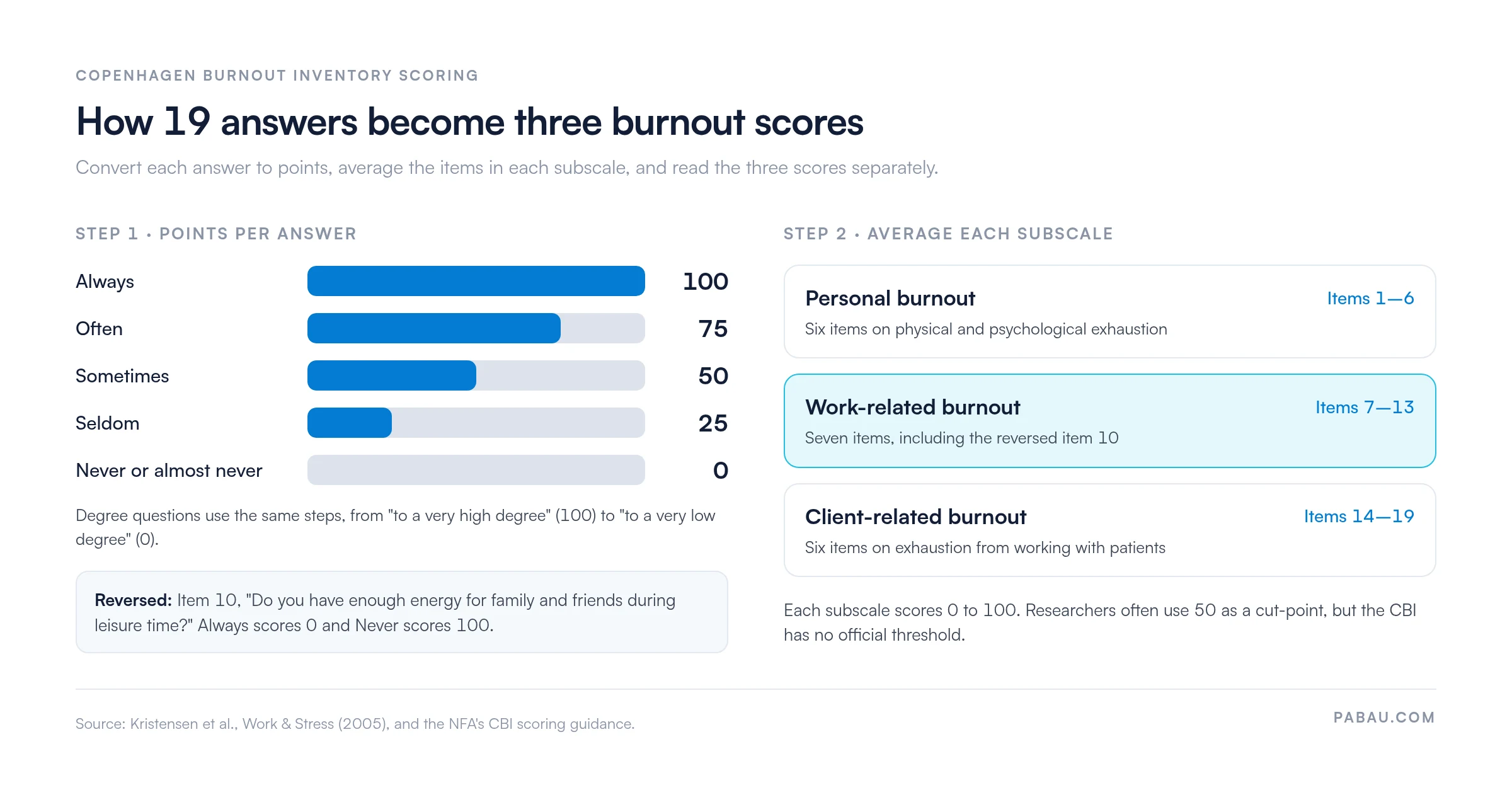
Read each subscale on its own. Kristensen designed them to be interpreted separately, and a clinician can score low on personal burnout but high on work-related burnout. That pattern points to workload rather than general exhaustion.
The PDF also has an optional overall score, the average of the three subscales, but it can hide which domain is driving the problem. If personal burnout is the high score, a broader stress assessment questionnaire can help pinpoint pressures outside work.
A CBI score tells you who is running on empty. The fix usually sits in the calendar, in who is booked back-to-back and who keeps covering the late appointments.
Pabau’s calendar shows appointments across your whole team in one view. You can see where a high-scoring practitioner’s week is overloaded and move bookings to colleagues with capacity. Its team management tools keep staff schedules in one place, so changes after a CBI round don’t live in a separate spreadsheet.
If your team runs a therapy or counseling service, the same platform gives you simpler therapy practice management. Intake forms, treatment notes, and invoicing sit in one system, which takes admin off the clinicians most at risk of burnout.

Use Pabau’s calendar and team management tools to rebalance appointments when CBI scores flag an overloaded practitioner.

Staff burnout is a practical problem with operational fixes. The CBI gives you the measurement, and the subscale that scores highest tells you where to look first.
Start with one anonymous round across the whole team, then repeat it in the same month next year. A high work-related score next to a normal personal score is the clearest case for changing schedules rather than adding generic wellbeing perks. The CBI has no official cut-offs, so the trend over time matters more than any single number.
Book a demo to see how Pabau’s calendar and team management tools help you turn burnout scores into fairer schedules.

Comparing burnout measures? Maslach Burnout Inventory gives you the MBI template with scoring for exhaustion, depersonalization, and accomplishment.
Running a mental health practice? Our mental health EMR keeps secure patient records, captures intake history before the first session, and supports virtual care.
Screening for stress outside work? The Holmes and Rahe Stress Scale scores recent life events that add to a person’s overall stress load.
Following up on mood symptoms? The PHQ-9 and GAD-7 template helps clinicians screen patients for depression and anxiety symptoms.
The Copenhagen Burnout Inventory is used to measure occupational burnout across personal, work-related, and client-related domains in healthcare, human services, and occupational health settings. Practices and organizations use it to screen for burnout, identify high-risk staff, and track wellbeing trends over time to guide workload adjustments.
Yes. The Copenhagen Burnout Inventory is open-access and free to use. You only need to attribute the tool to Kristensen et al. and the National Research Centre for the Working Environment (NFA) in Denmark. There are no licensing fees, which makes it a good fit for small and mid-sized practices.
The Copenhagen Burnout Inventory contains 19 items. Each answer converts to a score from 0 to 100 in 25-point steps. Six items measure personal burnout, seven measure work-related burnout, and six measure client-related burnout. Most people finish it in about five minutes.
No formal permission is required. The CBI is open-access, but you must attribute it correctly to Kristensen et al. (2005) and the National Research Centre for the Working Environment. For published research or reports, include the full citation and link to the NFA website.
The CBI differs from the MBI in scope and cost. The MBI is a 22-item tool that needs paid licensing through the publisher, while the CBI is free. The MBI covers emotional exhaustion, depersonalization, and reduced personal accomplishment. The CBI measures personal, work-related, and client-related burnout separately, which makes it more flexible across professions. Both are valid, and the CBI is often chosen for occupational health surveillance where budgets are tight.
Yes. The CBI-Student Survey has 25 items across four subscales. They are personal burnout (6 items), study-related burnout (7), colleague-related burnout (6), and teacher-related burnout (6). The client-related scale is split into colleague-related and teacher-related burnout. Researchers use it to study student wellbeing and mental health.