Maja Popovska

Emotional intelligence scale: Free PDF and how to score it
Download your free emotional intelligence scale A three-page questionnaire with ...

1
Last Updated: Nov 2, 2026
Free PDF 3 pages, print-ready Clinician-reviewed
The learned optimism test is a 48-item questionnaire that measures explanatory style, the habitual way a person explains good and bad events. Martin E.P. Seligman published it in his book Learned Optimism, first released in 1990. It scores each answer across three dimensions: Permanence, pervasiveness and personalization. Therapists and coaches use it to start conversations about thinking patterns. It is a self-report tool, not a diagnosis, so it supports clinical judgment rather than replacing it.
A printable copy of the 48 situations from Seligman's Learned Optimism, each with two explanations to choose from. Instructions for answering sit at the top of the form.
Start from scratch, or upload this PDF or any form you already use, and Pabau's AI Form rebuilds it with tick boxes, text fields and a signature. Attach it to the treatment once, and every patient gets it on time.
AI Form rebuilds the consent, history and aftercare forms you already use. You review each one, then publish.
Patients complete forms on their phone before they arrive, so the front desk stops retyping paper.
Every signed form is versioned and attached to the treatment record, ready when you need it.
Set how long a consent stays valid. Returning patients skip forms they have already signed.
Supports HIPAA and GDPR compliance AES-256 encryption 4.8 on G2 4.7 on Capterra Trusted by 4,000+ practices worldwide

The learned optimism test measures explanatory style, the way a person explains good and bad events to themselves.
Its 48 forced-choice items score permanence, pervasiveness and personalization separately for good and bad events.
Seligman treats the hope score, permanence plus pervasiveness for bad events, as the single most important result.
The test is a self-report discussion tool, not a diagnosis of depression or any other condition.
Practice software such as Pabau lets patients complete the test online before a session, with results filed in their record.
The learned optimism test is a 48-item self-report questionnaire that measures explanatory style, the habitual way a person explains good and bad events. Psychologist Martin E.P. Seligman published it in his book Learned Optimism, first released in 1990.
Each item describes an everyday situation and offers two possible causes. The respondent picks the one closest to how they would explain it, even if they have never been in that situation. The pattern of choices shows whether they lean toward an optimistic or a pessimistic explanatory style.
The test grew out of Seligman’s earlier research on learned helplessness. Its research counterpart is the Attributional Style Questionnaire (ASQ), published by Peterson, Seligman and colleagues in 1982. The book version is shorter to score and written for a general reader, which is why practitioners often use it as a discussion tool.
Explanatory style is judged along three dimensions. Each one describes how a person explains an event, and each has an optimistic and a pessimistic pole.
The poles flip for good events. A pessimist explains a setback as permanent, pervasive and personal, then writes off a success as temporary, specific and down to luck. An optimist does the reverse in both cases.
Permanence asks whether a person sees a cause as lasting or passing. A patient who says a missed promotion means they will never advance is using a permanent explanation. One who says it reflects this quarter’s workload is using a temporary one.
Pervasiveness asks whether a cause spreads across the whole of a person’s life. A pessimistic reading of one failed exam might conclude they are bad at every subject. An optimistic reading ties the result to one subject and one set of study habits.
Personalization asks who the person blames. Internal explanations place the cause in the self, while external ones place it in circumstances or other people. In Seligman’s scoring, personalization mostly reflects self-esteem, while permanence and pervasiveness shape how hopeful a person feels. Where self-blame stands out, a state self-esteem scale measures how a patient feels about themselves right now.
The free PDF reproduces the 48 situations as a printable form. It opens with one instruction: Pick the choice that best describes how you would explain each situation. Respondents who have never been in a situation imagine themselves in it.
The situations mix good and bad events. Good events include a successful project, winning an athletic contest and doing well in a job interview. Bad events include failing an important exam, missing an engagement and running out of gas late at night.
The form carries the questions and answer choices only. It does not print which choice scores a point or which subscale each item feeds. Keep the scoring key from Seligman’s book beside you when you mark it, or score it in your own system.
Administer the test in one sitting, before you discuss explanatory style with the patient. Talking about the three dimensions first tends to steer people toward the answers they think are optimistic.
Some items assume a romantic partner, a stock portfolio or a tax return. If a patient has none of these, ask them to answer as they imagine they would rather than skip the item. A skipped item leaves its subscale one point short.
Each answer scores 0 or 1, and each of the 48 items belongs to one of six subscales of eight items. That gives every subscale a range of 0 to 8. The subscales cover the three dimensions twice, once for bad events and once for good events. The map below shows how the six subscales combine.
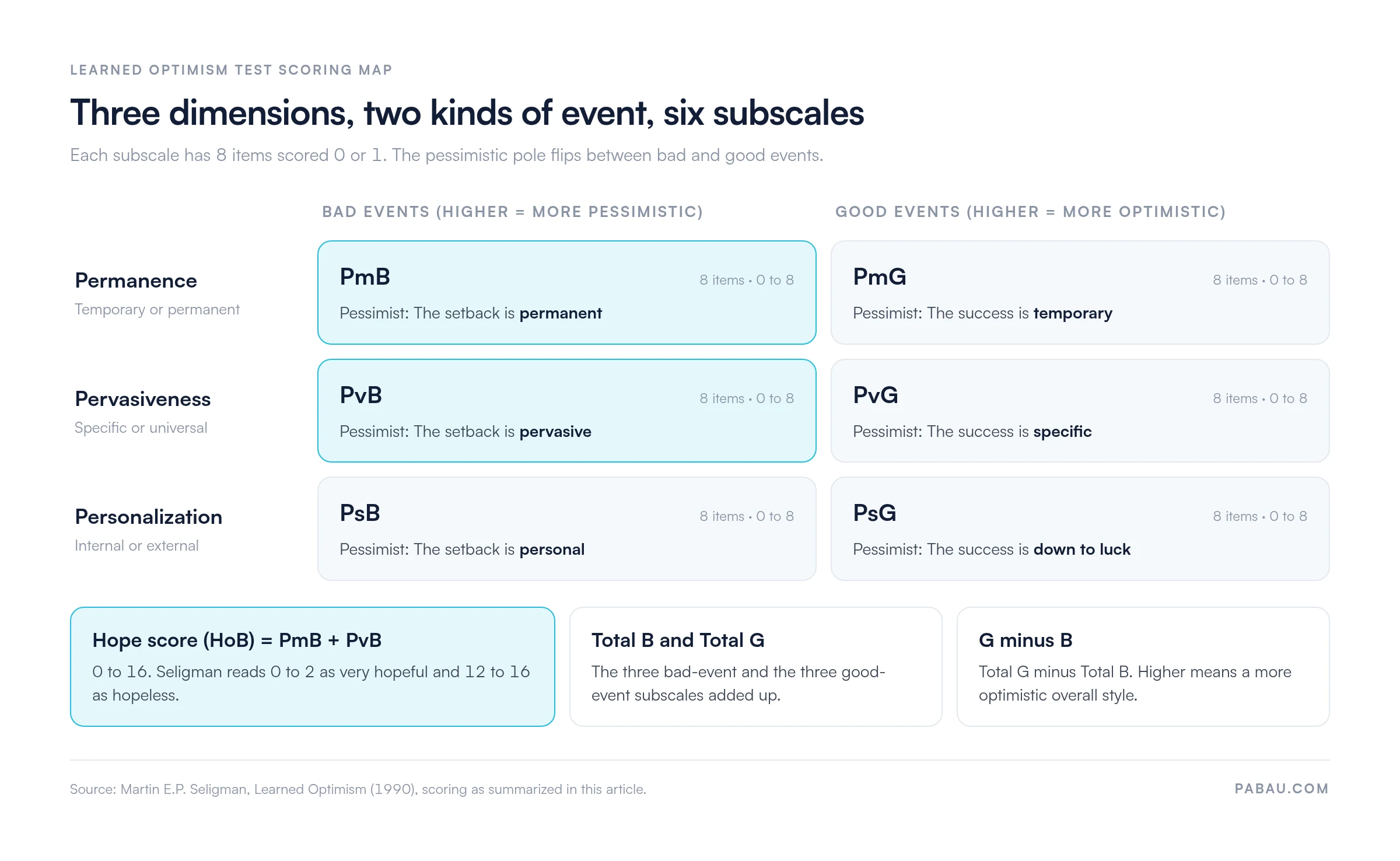
Seligman calls the hope score the single most important result on the test. A hope score of 0 to 2 reads as very hopeful, while 12 to 16 reads as hopeless. To follow up a high score, the Beck Hopelessness Scale measures hopelessness directly.
Interpret the results by reading the bad-event subscales first. They show where a patient’s explanations of setbacks turn permanent, pervasive or personal, and that is where most of the useful conversation sits.
Then look for the subscale that stands out. A patient with a high PmB and a low PvB expects setbacks to last but keeps them contained. A high PsB with low permanence and pervasiveness points to self-blame more than to hopelessness.
One item from the PDF shows how to open that discussion. For a failed exam, “I wasn’t as smart as the other people taking the exam” names a lasting trait. “I didn’t prepare for it well” names something the patient can change before the next one.
Treat the descriptive bands in the book as a reference for a general readership, not a clinical cut-off. Comparing a patient’s scores with their own earlier scores tells you more than comparing them with a population average.
Practitioners use the test as a conversation starter rather than a verdict. The results show which explanations a patient reaches for most often, and that gives both parties a concrete starting point.
When you repeat the test, use the same version and the same instructions each time. Otherwise a change in score may reflect the form rather than the patient.
The learned optimism test sits between two better-known research measures. The ASQ measures the same explanatory style in more depth, while the Life Orientation Test-Revised (LOT-R) measures general optimism in a few minutes.
Choose the learned optimism test when you want to understand the reasoning behind a patient’s outlook. Choose the LOT-R when you need a brief overall score, and the ASQ when the results feed a study.
Test results work best when they lead to a plan. Start with the dimension where the patient scored most pessimistically, and assign one short exercise that targets it.
Seligman’s main tool is the ABCDE model, which builds on Albert Ellis’s ABC model from rational emotive behavior therapy. The patient writes down the Adversity, their Belief about it and the Consequences. They then Dispute the belief and note the Energization that follows. An ABCDE CBT worksheet gives them a structure to fill in between sessions.
Four limits decide how much weight a single score can carry.
Seligman also argued for flexible optimism rather than optimism at any cost. Where a mistake carries serious consequences, a realistic reading of the risk matters more than a hopeful one.
Many practices still print the test, hand it over in the waiting room and file the paper copy after scoring. That eats into session time and leaves results scattered across folders. It also makes a repeat test hard to compare with the first one.
Pabau’s software for therapy practices turns the questionnaire into a digital form. Patients complete it on their own device before the appointment. Each completed test is stored in their record next to your treatment notes.
You start the session with the answers already in front of you. When you repeat the test later, both sets of results sit in the same file, so you can see how a patient’s explanations have moved.

Pabau’s digital forms let patients complete questionnaires like the learned optimism test before their session. Every result is stored in their record, ready to compare at the next review.

The learned optimism test is most useful as a map of how a patient explains events. The hope score tells you where to start, and the patient’s own answers give you the examples to work with.
Keep the trade-off in view. The forced-choice format is quick to complete and easy to discuss, but it flattens nuance and its scenarios have aged. Use it alongside clinical judgment, and repeat it to measure change rather than to label anyone.
Book a demo to see how Pabau sends assessments before each session and keeps every result in the patient’s record.

Want a second view of how patients cope with setbacks? Resilience test measures how quickly a patient recovers from stress and adversity.
Ready to turn pessimistic explanations into practice? Positive reframing worksheet walks patients through rewriting a negative interpretation of an event.
Need an exercise for disputing a belief? Putting thoughts on trial worksheet has patients weigh the evidence for and against an automatic thought.
Is a high hope score a warning sign? Beck Hopelessness Scale gives you a validated measure of hopelessness to follow up with.
Can optimism go too far? Pollyanna syndrome explains when excessive optimism stops serving a patient.
The learned optimism test is a questionnaire that measures explanatory style, the habitual way a person explains events. It comes from Martin Seligman’s book Learned Optimism, first published in 1990.
Yes. Practitioners use it to open conversations about thinking patterns, but it is not a diagnostic instrument and should be interpreted alongside clinical judgment.
Yes. The free PDF prints all 48 situations with their two answer choices, ready to use with patients or in training.
The learned optimism test has 48 questions. Each one describes a situation and offers two explanations, and the respondent picks the one closest to their own.
Each answer scores 0 or 1 and counts toward one of six subscales of eight items. The subscales combine into a hope score, bad-event and good-event totals, and an overall score.
A low hope score is the strongest sign of an optimistic style, and Seligman reads 0 to 2 as very hopeful. Treat his bands as a general reference, not a clinical threshold.
Both measure explanatory style. The ASQ is the research instrument, where respondents write their own causes and rate them, while the learned optimism test uses forced choices.
Yes. Seligman’s central argument is that optimism can be learned, using cognitive skills such as disputing pessimistic beliefs with the ABCDE model.