Rebuilding trust in a relationship worksheets
Rebuilding trust in a relationship worksheets are structured exercises that guid...

1
Last Updated: Oct 20, 2026
Questions about gender roles are structured prompts that help clinicians, counselors, researchers and educators explore how people understand and experience gender expectations. Typical examples ask who should have the final word on decisions at home, or whether men are expected to hide vulnerability.
This page gives you a free 25-statement questionnaire to download, plus discussion prompts and interpretation notes for clinical and group settings.
Gender role expectations can shape mental health, help-seeking and relationships, yet intake forms rarely ask about them directly. A consistent question set makes these patterns easier to document and compare over time.
A five-page form with 25 statements across five sections, from social norms and personal attitudes to masculinity and women’s advancement. Each statement is rated from strongly agree to strongly disagree, with space for respondent details and notes.
Download template
Gender roles are the expectations a society attaches to each gender, so this questionnaire measures beliefs and experiences.
Explain the difference between sex and gender before intake so each question reads clearly.
Use the discussion prompts for group work, education and reflective practice.
Review responses against the conflict and stereotype sections before drawing clinical conclusions.
Pabau, the practice management platform we build, saves completed forms to the patient’s record so answers are easy to find at the next session.
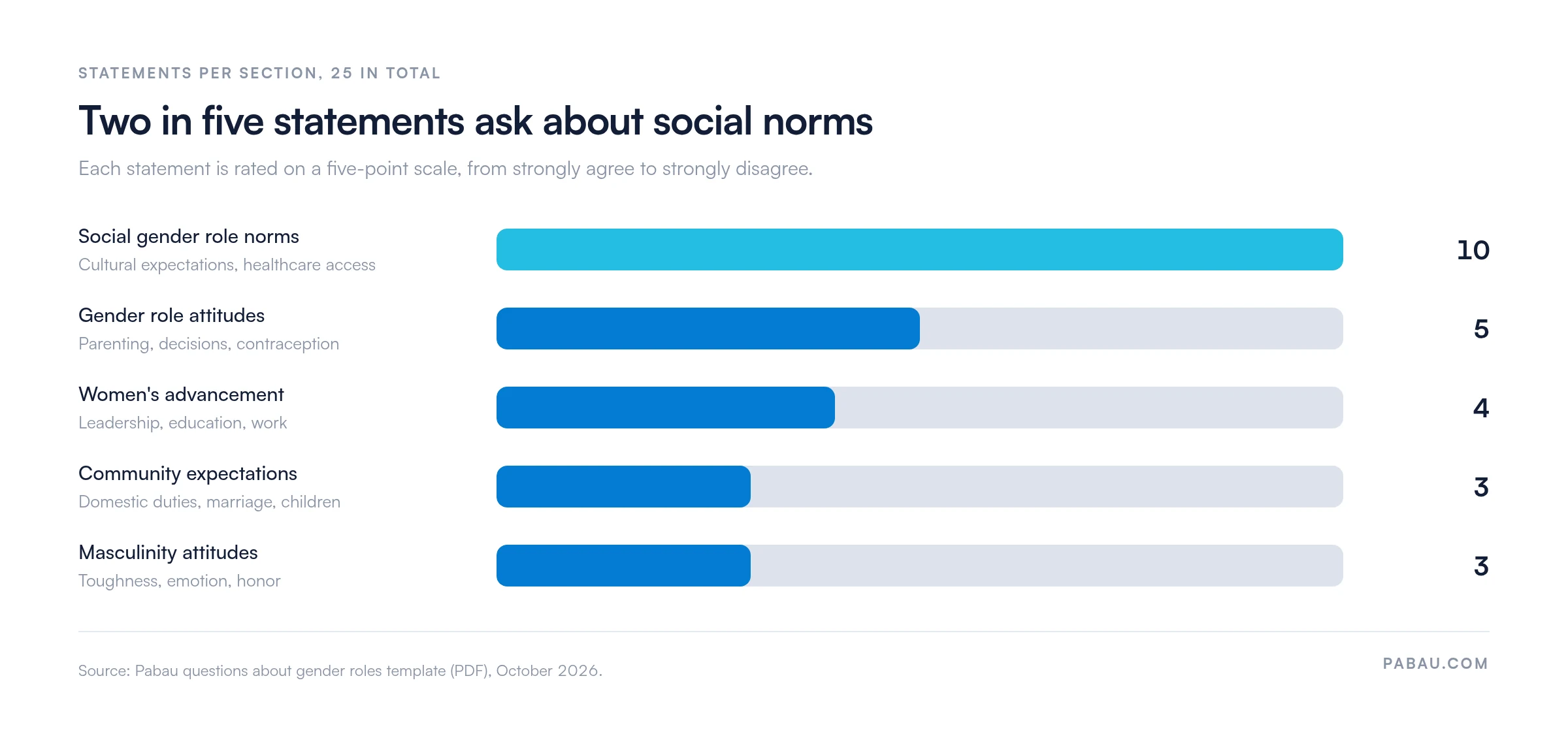
The downloadable form is a 25-statement attitude survey. Each statement is rated on a five-point scale from strongly agree to strongly disagree. A respondent section records age, education, occupation and, optionally, gender identity.
As the chart below shows, the first section holds 10 of the 25 statements. That weighting makes the form stronger on perceived community norms than on personal identity.
The open-ended discussion, conflict and equality prompts further down this page are not part of the PDF. Use them alongside the form in sessions and workshops.
Gender roles are the behaviors, responsibilities and expectations a society assigns to people on the basis of gender. The WHO and the American Psychological Association both describe gender as socially constructed rather than purely biological. That is why assessment tools focus on beliefs and experiences rather than fixed traits.
Clinically, gender role expectations can influence mental health, help-seeking and relationship satisfaction. Gender role conflict is one framework researchers use to describe that tension. James O’Neil’s Gender Role Conflict Scale is a widely cited psychometric instrument in peer-reviewed psychology literature.
The form works across intake, therapy, group and research settings. At intake, it sits alongside a standard psychotherapy intake form rather than replacing it. Follow these five steps to keep administration consistent.
The core prompts capture general beliefs in open-ended form. Ask each one in a neutral tone and let the patient answer in their own terms.
For couples work, follow the relationship prompt with a set of couples therapy questions that explore how each partner divides time, money and care.
Stereotype prompts work well in group settings because they invite comparison without requiring personal disclosure. Facilitators can rotate them across one session or spread them over a structured group counseling plan.
Frame stereotype questions as observations about society, not judgments about the individual. Patients answer more openly when they describe messages they received instead of defending their own views.
Conflict questions help clinicians identify where a patient’s goals or self-image clash with the roles they feel expected to play. These prompts are most useful once rapport is established.
Ask the patient to name a situation where a gender expectation and a personal value pulled in different directions. Then ask how they responded and how they felt afterward. Peer-reviewed research has linked role conflict to distress. Treat any distress the patient discloses as a priority, not a finding to score.
Equality prompts suit HR teams, educators and facilitators running workshops. They move the conversation from individual belief to shared structures such as pay, caring duties and leadership pipelines.
Gender identity is a person’s internal sense of their own gender, which can differ from the sex recorded at birth. Gender expression is how that identity is shown through dress, behavior and presentation. These prompts treat identity as the patient’s to define.
Ask how the patient’s sense of self fits or conflicts with the roles others expect of them. Let the patient set the language, and avoid assuming how identity relates to any role. When identity is the reason for the referral, a gender identity quiz built for inclusive intake asks those questions directly.
Responses are a starting point for clinical conversation, not a diagnosis. The form has no published scoring key, so read patterns across sections rather than totaling a score. Check each section against the patient’s wider history before recording any conclusion.
Gender schema theory, proposed by Sandra Bem in 1981 in Psychological Review, explains how people sort information into gendered categories.
Questionnaires built on this idea ask how strongly a person relies on those categories when judging themselves and others. Her Bem Sex Role Inventory rates how strongly someone identifies with traits labeled masculine or feminine.
Gender essentialism is the belief that gender categories reflect fixed natural differences. Assessments often include essentialist items so clinicians can see how firmly a patient holds that view.
Paper copies of this form tend to get scanned, filed and forgotten. When a theme from the first session matters again in the sixth, someone has to dig the sheet out of a folder.
With Pabau’s digital forms, the questionnaire goes to the patient before the appointment and saves to their record once submitted. You review the ratings next to your session notes instead of asking the same questions twice.
Forms, scheduling and treatment notes share one system, so the questionnaire, the booking and the follow-up note stay together. That makes Pabau practical software for therapy practices that run intake and follow-up from one place.

Pabau’s digital forms send the questionnaire before the session and save every answer to the patient record. You review responses beside your notes instead of chasing paper.

Gender role beliefs shape how patients seek help, share caring duties and talk about emotion. Asking about them directly gives you a documented starting point instead of an assumption.
Start with the 25-statement form at intake, then bring in the discussion or conflict prompts only where the clinical aim calls for them. A fixed form compares well over time, while open questions surface the story behind a rating. Used together, they give you a trend and the reasons behind it.
Book a demo to see how Pabau sends this questionnaire before the session and keeps every answer in the patient’s record.

Want prompts that deepen self-awareness? Reflection questions gives you 14 examples for sessions and journaling.
Exploring how a patient sees themselves? Identity worksheet template helps patients put their sense of self into words.
Working with couples? Relationship questionnaire (RQ) comes with a free template and scoring guide.
Supporting couples through role conflict? Marriage counseling questions covers prompts on roles, communication and shared expectations.
Need a quick reference on models of therapy? Counseling theories chart summarizes the major counseling theories side by side.
They cover the beliefs and expectations a person holds about gender roles at home, at work and in the community. This template pairs a 25-statement agreement survey with discussion prompts on stereotypes, role conflict, equality and identity.
Clinicians, counselors, researchers and educators can all use it, depending on their qualification and setting. Use it within your scope of practice and local professional guidance.
No. Gender role conflict describes tension between expectations and personal values, while gender dysphoria is a clinical condition classified in the DSM-5. The questionnaire is not a diagnostic tool.
Store responses in a secure, access-controlled record. In the US, HIPAA requires safeguards for health information. In the UK and EU, GDPR also requires a lawful basis and a retention policy.