Monika Lazarevska

Life goals worksheet: Turn what matters into SMART goals
Download your free life goals worksheet template A three-page PDF that moves fro...

1
Last Updated: Nov 4, 2026
Free PDF 3 pages, print-ready Clinician-reviewed
The Modern Racism Scale is a self-report questionnaire that measures subtle, contemporary racial prejudice. It uses a short set of agree/disagree statements (7 items in the original 1981 version). The statements target views that do not read as overt racism, such as the belief that discrimination is over.
John B. McConahay introduced the scale with colleagues in 1981 and set out the full account in a 1986 chapter. It is a research and training tool for comparing attitudes across groups, never for labeling one person. This free PDF prints 15 statements on a five-point agreement scale, with boxes for a total score and two subscale scores.
A three-page PDF with 15 statements, each rated from +2 (strongly agree) to -2 (strongly disagree) or left unanswered. It closes with boxes for a total score and two subscale scores.
Start from scratch, or upload this PDF or any form you already use, and Pabau's AI Form rebuilds it with tick boxes, text fields and a signature. Attach it to the treatment once, and every patient gets it on time.
AI Form rebuilds the consent, history and aftercare forms you already use. You review each one, then publish.
Patients complete forms on their phone before they arrive, so the front desk stops retyping paper.
Every signed form is versioned and attached to the treatment record, ready when you need it.
Set how long a consent stays valid. Returning patients skip forms they have already signed.
Supports HIPAA and GDPR compliance AES-256 encryption 4.8 on G2 4.7 on Capterra Trusted by 4,000+ practices worldwide

The Modern Racism Scale measures subtle racial prejudice with a short set of agree/disagree statements (7 items in the original 1981 version).
McConahay introduced the scale with colleagues in 1981 and set out the full account in a 1986 chapter.
The free PDF prints 15 statements on a +2 to -2 scale, and this guide supplies the scoring key it lacks.
Never score an opt-out tick as 0, because 0 is the neutral answer on the form.
Use it for research and training only, report group-level results, and debrief every participant.
The Modern Racism Scale is a self-report questionnaire that measures subtle, contemporary racial prejudice. It uses a short set of agree/disagree statements (7 items in the original 1981 version).
McConahay introduced the scale with colleagues in 1981 and set out the full account in a 1986 chapter. That chapter is “Modern Racism, Ambivalence, and the Modern Racism Scale”. It appears in Prejudice, Discrimination, and Racism, edited by Dovidio and Gaertner.
The statements target views that do not read as open hostility. McConahay’s account centers on themes such as the following.
It is a research and training tool. The scale describes patterns across groups, and it is not designed to label individuals, so read scores as group-level findings only.
The Pabau PDF runs to three pages. It opens with an optional name line and a date field, then goes straight into 15 statements with no instructions in between.
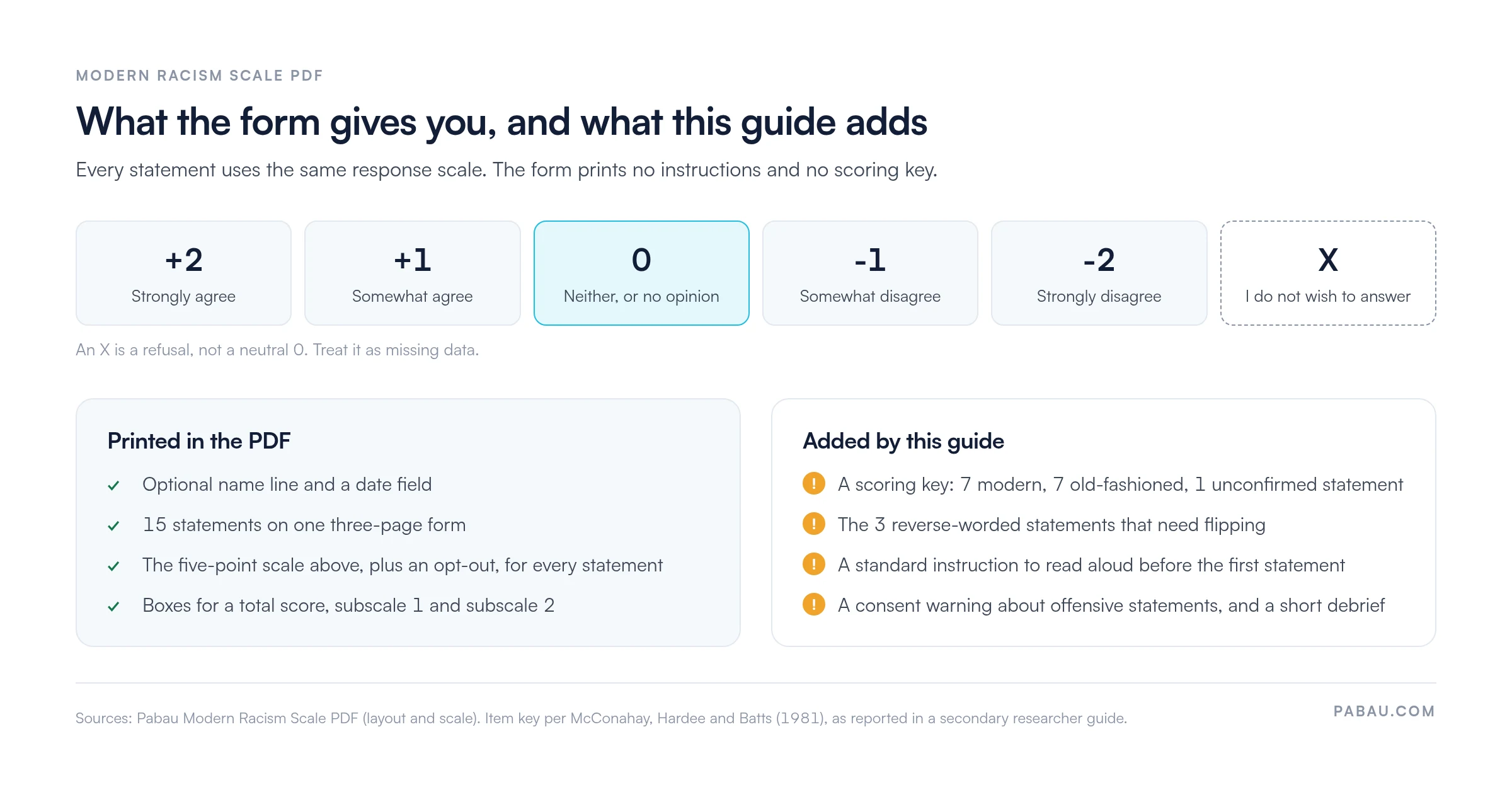
Each statement carries the same six boxes. Five run from +2 (strongly agree) to -2 (strongly disagree), and the sixth reads “I do not wish to answer”. The last page ends with boxes for a total score, subscale 1 and subscale 2.
The form prints no scoring key, so it never says which statements feed each subscale or which are reverse-worded. The scoring key further down this page fills that in.
The wording is dated. Using “blacks” as a noun reflects the language of the early 1980s, when the items were written. If you update any wording, report the change when you publish results.
The diagram splits what the form prints from what this guide adds to it.
The 15 statements combine two sets, as McConahay, Hardee and Batts did in 1981. Modern racism items sit alongside old-fashioned racism items, which voice open, blatant prejudice.
The table follows the PDF’s order. Statements are paraphrased, so offensive wording is not repeated here.
To score, give each answer its printed value, from +2 to -2. Flip the sign on statements 1, 9 and 13, because agreeing with them signals lower prejudice. Then sum each subscale.
With seven statements per subscale, each subscale runs from -14 to +14, and higher means more prejudice. An X stays out of the sum and is reported as missing.
What we could not verify: This key follows a secondary researcher guide that uses the same 15 statements and cites the 1981 paper. We could not check it against the 1981 paper or the 1986 chapter.
Statement 3 is the open question. That guide scores it as modern, which would make eight modern items, yet the 1981 scale had seven. It is also the only statement that never mentions race. Confirm its role in the 1981 paper before you score it.
The PDF also labels its boxes only “subscale 1” and “subscale 2”. We read them as modern and old-fashioned, in that order, so name them in your protocol.
Run through this list once, before the first participant sees the form. Each step takes minutes, and each one saves you a re-score later.
Check the wording before you print anything. Compare every item in the PDF against the original publication, and note any differences in your methods section. Small wording changes can alter what a score means, so record the exact version you administered and the date you used it.
Because the PDF has no instructions, read one standard instruction aloud so every participant hears the same thing. The script below is our suggestion, not part of the PDF.
“This form lists statements about race and public life. For each one, tick the box that best matches your view. There are no right or wrong answers. You can tick X for any statement you would rather not answer, and you can stop at any time.”
Then let the participant answer alone. Who hands the form over matters too. The scale was built to feel less loaded than older measures, yet Fazio and colleagues (1995) reported that some answers shifted with the administrator’s race.
Keep the administrator, the room and the wording the same across participants. Because answers can lean toward what sounds acceptable, some studies add the Marlowe-Crowne Social Desirability Scale alongside it.
Close every session with a short debrief. Explain what the scale measures and why some statements voice prejudiced views. Say how the answers will be stored, and give a contact for questions.
Scoring follows the key above. Once the scores are in, the next risk is how they get read.
The errors below come from how the form is laid out, so they are easy to make and easy to prevent.
Researchers in psychology and social science use the questionnaire most, along with graduate students and instructors who teach attitude measurement.
It belongs in studies and in teaching about how attitudes are measured. It does not belong in an individual assessment or a patient record.
Studies of culture and identity sometimes pair attitude measures with an acculturation measure, such as the Vancouver Index of Acculturation.
Yes, the Modern Racism Scale has published reliability and validity evidence. The figures vary by sample, though, so cite the study closest to your own population.
McConahay’s 1986 chapter is indexed in APA PsycNet. Later researchers have reassessed the scale for newer samples, including a paper titled Reassessing the Modern Racism Scale in Modern Times.
Critics have long argued that some items also tap political conservatism. Where your design allows, measure political orientation as well, so you can separate the two.
If those critiques matter for your study, look at the Symbolic Racism 2000 Scale (Henry and Sears, 2002, Political Psychology 23(2), 253-283). Its authors built it in response to critiques of earlier measures, the Modern Racism Scale included.
What to check: Confirm the internal consistency figures in the study you cite. Then confirm the response anchors against the 1986 source before you report results.
Sound psychometrics still leave the ethical side to settle. Racial attitude data is sensitive, so ethical review should come before fieldwork begins. Many institutions require Institutional Review Board (IRB) approval for research like this.
The APA Ethics Code sets professional standards for psychologists who use measures like this one.
In the US, the HHS Office for Human Research Protections explains federal rules for protecting research participants.
Practices that host studies or staff training often run consent on paper. Sheets get printed, signed, scanned and filed, and a missing signature only surfaces at audit time.
Pabau, the practice management platform we build, includes digital forms and consent in every plan. A participant can complete and sign the consent form digitally, before or at the session, so there is nothing to scan or file.
Keep the attitude responses themselves outside any patient record. Collect them under participant codes and report them as group data. If your practice offers therapy and counseling, the forms tools you use for intake can cover study paperwork too.

Book a demo to see how Pabau’s digital forms and consent tools handle signed paperwork for research and training sessions.

The Modern Racism Scale is useful in a study or a training session if you treat the PDF as a response sheet. The scoring key, the instruction, the consent warning and the debrief all sit outside the form.
Settle those before the first participant sits down, and confirm statement 3 in the 1981 paper. Your scores will then compare cleanly with earlier work, and a few mis-scored opt-outs will not tilt a small sample.
Psychology teams that run studies alongside clinical work can look at psychology practice software. Book a demo to see how Pabau handles digital consent forms for research and training sessions.

Studying culture and identity? Vancouver Index of Acculturation measures heritage and mainstream cultural orientation.
Worried about socially desirable answers? Marlowe-Crowne Social Desirability Scale helps you spot response bias in self-report data.
Need a broader personality measure? Personality Assessment Inventory template covers a widely used clinical self-report inventory.
Tracking outcomes across sessions? Outcome questionnaire template explains its 24 items and scoring.
Managing a mental health caseload? Mental health EMR software covers clinical records for therapy and psychiatry teams.
John B. McConahay introduced the scale with colleagues in 1981 and set out the full account in a 1986 chapter. That chapter is “Modern Racism, Ambivalence, and the Modern Racism Scale”, in Dovidio and Gaertner’s Prejudice, Discrimination, and Racism.
Not always. It was built to feel less loaded than older measures, yet Fazio and colleagues (1995) reported that some answers shifted with the administrator’s race. Keep the administrator and setting the same for every participant.
Parts of it are. Several statements refer to US debates of their era, and critics argue the items overlap with political conservatism. Henry and Sears (2002) built the Symbolic Racism 2000 Scale partly in answer to those critiques.
Only after adaptation. Researchers have built versions for other countries, including Germany, Colombia and New Zealand, where one version targets attitudes toward Māori. Validate any adaptation in your own sample, because reliability has varied between versions.
The Old-Fashioned Racism Scale targets open, blatant prejudice, such as opposing integration. The Modern Racism Scale targets subtler views, such as denying that discrimination continues. The Pabau PDF mixes both kinds, and the scoring key separates them.