Grains food list: whole vs refined grains (free PDF)
A grains food list sorts grain foods into whole and refined groups, so patients ...

3
Last Updated: Oct 20, 2026
A printable disability form for doctor to fill out records a patient’s diagnosis, functional limitations and work capacity for a disability claim. For Social Security Disability Insurance (SSDI) or Supplemental Security Income (SSI), the physician writes the residual functional capacity (RFC) assessment and a medical source statement. In California, the doctor certifies Part B of the EDD DE 2501 for State Disability Insurance (SDI).
Two forms often land on a doctor’s desk by mistake. The SSA-827 is a release the patient signs, and the SSA-3368 is the patient’s own disability report. Our free template below gives your practice a one-page sheet for logging each request before the clinical work starts.
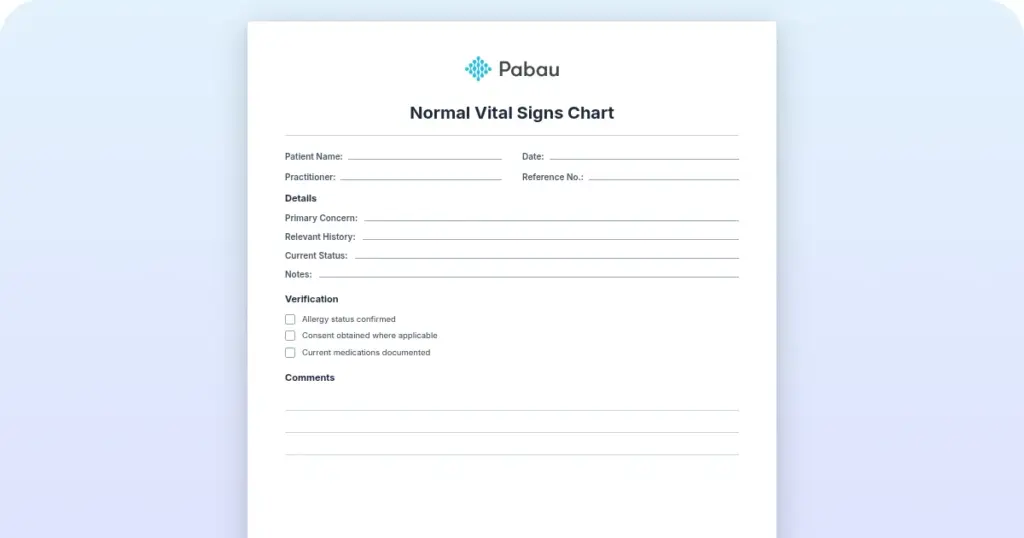
A one-page request form covering the patient’s details, record or MRN number, the reason for the request, relevant history, and current medications and allergies. It closes with a patient confirmation and an office-use section for logging who received the request and what action was taken.
Download template
A printable disability form for doctor to fill out documents diagnosis, functional limitations and work capacity to support a Social Security or state disability claim.
The RFC assessment and the medical source statement are the physician’s own documents for SSDI and SSI claims.
The SSA-827 and SSA-3368 are patient forms, so the practice supplies records rather than completing them.
California EDD Form DE 2501 is the claim for State Disability Insurance benefits, and the physician certifies its Part B.
Logging each request with the patient’s details and a received date keeps form turnaround visible to the whole team.
A disability form for doctors is any document a disability program asks the treating physician to complete or support. The physician’s job is to supply objective medical evidence, covering diagnosis, functional limitations, treatment response and work capacity.
Disability Determination Services (DDS) are the state agencies that make disability decisions for the Social Security Administration (SSA). They rely on these records to decide eligibility, and a vague or incomplete medical file can delay or sink a claim.
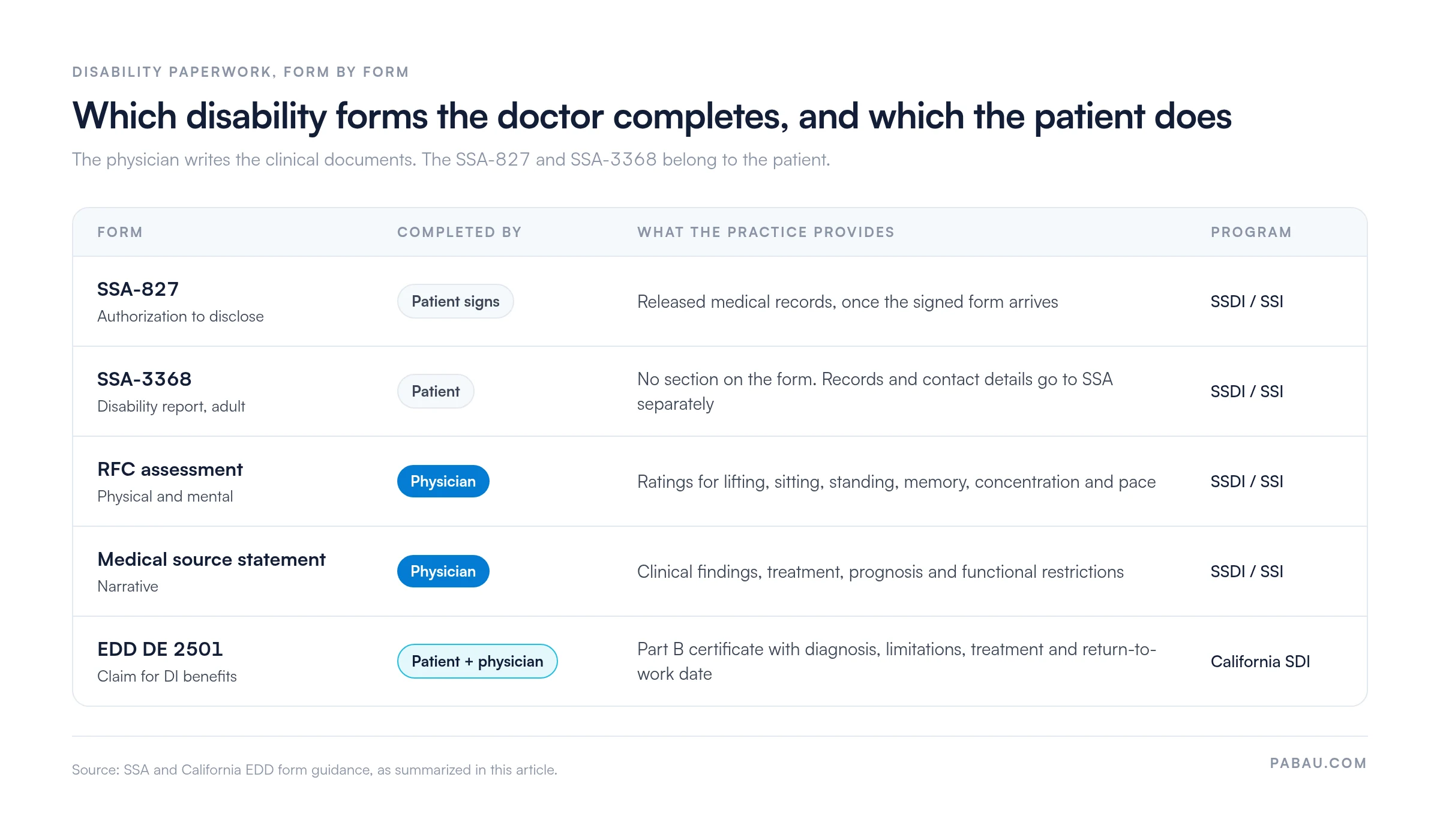
Five forms come up most often. Only some of them are clinical documents the physician writes, which is worth knowing before a patient hands one over.
The split matters because each form needs a different person to act on it. The table below sorts the five by who completes them.
The SSA publishes standardized forms for the federal disability process. Two of them reach doctors’ offices most often, although neither one is a clinical form.
SSA Form 827 is a patient authorization that lets your practice release medical records directly to DDS. The patient signs it, and the physician completes no clinical section. Your team may still be asked to confirm treatment dates or send records that were missing from the first request.
File the signed authorization in the patient’s record, as you would any release of confidential information. Patients can get the printable SSA-827 form at SSA.gov.
SSA Form 3368 (Disability Report – Adult) is completed by the patient or claimant. It covers their medical conditions, onset date, work history, medications and the name of every provider who treated them. The SSA’s own guidance says not to have the treating physician complete it.
The physician’s part comes later, when DDS contacts the providers listed on the report. Answer that request promptly, and log what was sent on a medical record request form. The printable report itself is on SSA.gov.
An RFC assessment often carries the most weight of any document a physician submits in a disability case. It spells out what a patient can and cannot do despite their conditions, which is how examiners judge work capacity.
A physical RFC covers standing, walking, lifting, carrying, reaching, bending, balance and coordination. A mental RFC covers understanding, memory, concentration, pace, persistence, social interaction and impulse control. Complete whichever matches the patient’s impairments, or both if they have physical and mental conditions.
The SSA’s Disability Professional Resources page explains what medical sources should report. If your practice already runs pre-employment checks, a work physical form captures some of the same functional findings.
California’s Employment Development Department (EDD) runs State Disability Insurance (SDI), a program separate from Social Security. It covers disabilities that aren’t work-related. Patients applying for SDI file the DE 2501, and the physician completes its Part B medical certification.
Part B asks for the diagnosis, functional limitations, treatment prescribed and expected return-to-work date. Physicians can certify it through SDI Online or on the paper form. The English claim form can’t be downloaded or reproduced, so patients file online through myEDD or order a paper copy via EDD Forms and Publications.
Include the diagnosis, onset date, treatment history, functional limitations, prognosis and work capacity, then sign and date the form. Missing or vague clinical information slows the claim down. Here’s what each item should cover.
When a program wants a narrative rather than boxes, a diagnosis letter from doctor can carry the same detail.
Work capacity also matters outside the disability claim itself. A patient who keeps working with restrictions needs a workplace accommodation form, which is a separate request under the ADA.
These six steps are written for patients, so your front desk can share them with anyone who asks.
Step 1: Get the right form. Download or order the form the agency asked for, such as an RFC questionnaire, a medical source statement or the EDD DE 2501. The SSA-827 and SSA-3368 are yours to complete.
Step 2: Complete the patient sections. Fill in your name, date of birth and claim or Social Security number before the appointment.
Step 3: Bring it to the appointment and explain. Hand the form to your doctor at the start of the visit. Briefly explain that you’re applying for disability and need the form completed.
Step 4: Allow time for completion. The physician may complete it during the visit or ask you to come back once your records are assembled.
Step 5: Collect the signed form and submit it. Send the original to the SSA or EDD as the instructions say, and keep a copy for your records.
Step 6: Expect follow-up questions. Disability examiners sometimes contact the physician’s office with questions. Let the office know a call may come so they can answer quickly.
Disability requests rarely arrive on schedule. A patient asks at checkout, the form sits in a tray, and nobody knows whether records went to DDS until an examiner calls.
Pabau, the practice management platform we build, gives those requests a home. Patients complete intake and history questionnaires through Pabau’s digital forms before the visit. The answers land in their patient records, next to past notes and diagnoses.
When the physician sits down to write an RFC or a medical source statement, the treatment history is already on screen. Pabau Scribe, our AI scribe, drafts the clinical note during the appointment, so functional findings are on record the same day.

Collect patient history before the visit, keep it in one record, and let Pabau Scribe draft notes, so disability forms take less physician time.

Disability paperwork usually stalls at the handoff between the front desk and the physician. Once your team knows which forms the physician writes and which only need records, each request reaches the right person on day one.
The trade-off is physician time. A careful RFC takes longer than a quick signature, yet examiners lean on it more than any other document. Budget for it, log every request with the free template above, and fewer claims come back for missing information. Book a demo to see how Pabau keeps patient history and notes ready for every disability form.

Need a sick note rather than a full disability form? Medical certificate template covers short absences that don’t call for an SDI or SSA claim.
Is the patient only missing a few days of work? Doctor’s note for work gives employers the confirmation they need without clinical detail.
Sending records to a third party? Medical release form records the patient’s consent before any file leaves your practice.
Building the history an RFC depends on? History and physical form captures the baseline findings a disability examiner will ask about.
Collecting patient details before the visit? Medical information form gathers conditions, medications and contacts in one place.
SSA forms (SSA-827, SSA-3368 and RFC assessments) support federal Social Security Disability Insurance (SSDI) and Supplemental Security Income (SSI) claims. EDD forms, such as California’s DE 2501, belong to State Disability Insurance, which covers disabilities that aren’t work-related. Eligibility rules, benefit amounts and form requirements differ between the programs.
There’s no federal deadline for a physician’s response. Many practices aim for about five to 10 business days, depending on record availability and the appointment schedule. Check the agency’s request letter for any date it sets.
Yes. SSA Form 827 is a free printable PDF at ssa.gov/forms/ssa-827.pdf. You sign it yourself to authorize the release of your medical records to the SSA, and your doctor’s office uses it to send them.
Physicians aren’t required to complete disability forms, although many will when a patient asks. If your doctor declines, ask why, since it may come down to time, unfamiliarity with the form or a clinical concern. Offer to book a dedicated appointment, or contact a disability advocate or legal aid organization for help.
Yes. An RFC assessment and a residual functional capacity evaluation are the same document. It quantifies what a patient can and cannot do despite their impairments. For example, it might state they can stand for two hours in an eight-hour day but can’t climb ladders.
File the DE 2501 through SDI Online in your myEDD account, which the EDD recommends. The English paper form can’t be downloaded, so order one from edd.ca.gov or ask your physician, employer or an SDI office for a copy.