Pabau Engage inbox

Pabau Engage is here: every patient conversation in one inbox.

Learn more
Book a demo Book a demo
☰
Compliance and security

Medical accommodation request form

Avatar photo Anja Dodevska
Last Updated: October 7, 2026

A medical accommodation request form is how an employee and their healthcare provider ask for workplace accommodations under the Americans with Disabilities Act (ADA). It records the employee’s medical condition, the functional limitations it causes at work, and the specific changes they need to do the job.

Submitting it starts the interactive process, the good-faith dialogue the ADA expects between employer and employee. The completed form also gives both sides a dated, confidential record. If a request is ever disputed, that record is the employer’s best evidence of compliance.

The rules apply to every practice with 15 or more employees, whether the request comes from a front desk coordinator or a clinician. A standard form keeps each request consistent and easier to defend.

Found our content helpful?

Download your free medical accommodation request form

The form covers employee and job details, functional limitations, healthcare provider certification, and the employer’s response. Print the PDF or adapt its sections to your practice’s own process.

Download template
Key takeaways

Key takeaways

A medical accommodation request form records the employee’s condition, functional limitations, and requested changes, which starts the ADA interactive process.

The employee describes how the condition affects their job, and the healthcare provider certifies the condition and its functional limitations.

Employers must keep medical information confidential and separate from personnel files, and respond with reasonable promptness, since the ADA sets no fixed deadline.

Pabau, the practice management platform we build, lets you send the form digitally, timestamp each submission, and store it securely.

ADA accommodation requests differ from FMLA certifications and from Rehabilitation Act forms for federal staff, and each follows its own rules.

What the form does under the ADA

The form is the first document in the ADA accommodation process, and it does three jobs:

  1. It formally tells the employer that a medical condition needs a workplace adjustment.
  2. It documents the functional limitations that affect job performance.
  3. It requests specific accommodations so the employee can perform the essential functions of the job.

An employee doesn’t need to say “disability” or cite the law to start the process. Any request for a work adjustment because of a medical condition counts. The employer must then take part in the interactive process to find an accommodation that works without causing undue hardship.

  • Legal basis: Title I of the ADA applies to employers with 15 or more employees. The Rehabilitation Act covers federal agencies and federal contractors. State laws, such as California’s Fair Employment and Housing Act (FEHA), often add broader protections.
  • Who completes it: The employee usually starts the request and completes their section. The treating healthcare provider completes the medical certification section.
  • Scope of information: The form asks what the employee can’t do, rather than for a diagnosis alone, and how those limitations affect work tasks.
  • Confidentiality: Under the ADA, all medical information collected must stay confidential and be stored separately from the employee’s regular personnel file.

What to include in the form

A complete form has five core sections, and each one feeds a different part of the interactive process.

Section Content required Completed by
Employee information Name, job title, department, supervisor, tenure, and work schedule. Employee
Job analysis Essential job functions, physical demands, work environment, and typical daily tasks. Employee and employer
Functional limitations What the employee can’t do, such as stand for long periods, lift over 10 lbs, or work in bright light. Also how each limitation affects specific job tasks. Employee and healthcare provider
Healthcare provider certification The medical condition (diagnosis optional, functional limitations mandatory), prognosis, relevant clinical notes, and the provider’s signature and credentials. Treating healthcare provider
Requested accommodations The specific changes needed, such as remote work two days a week, an ergonomic desk, or a flexible start time. Also which limitation each change addresses. Employee

The functional limitations section matters most. Rather than naming a diagnosis such as fibromyalgia, a strong form describes what the condition stops the employee doing. “Pain and fatigue prevent standing for more than 20 minutes” gives the employer something it can act on.

How employees should complete their section

Employees often worry about disclosing too much or hurting their career by asking. Clear guidance in this section eases that worry and gives the employer what it needs for the interactive process.

  1. Provide accurate job context. Describe your role, your key responsibilities, and how your condition affects those tasks. For example: “I’m a practice receptionist handling calls and front desk check-ins. My anxiety makes high call volumes at peak hours hard to manage.”
  2. Describe functional limitations, not the diagnosis. Focus on what you can’t do rather than the name of your condition. For example: “I can’t stand continuously without breaks,” or “I need a quiet space for concentration-heavy work.”
  3. Connect limitations to job impact. Make the link explicit: “Because I need frequent breaks, I can’t cover the front desk alone during busy periods.”
  4. Propose reasonable accommodations. Come with ideas, but stay open to alternatives. For example: “I’d like to work from home two days a week for focused tasks, or take calls only outside peak hours.”
  5. Secure supporting medical documentation. Ask your healthcare provider to complete their section of the form. Brief them on your job, and explain that the form asks for functional limitations rather than a full clinical summary.

What the healthcare provider needs to complete

Many providers fill in only a diagnosis. The documentation needs to show the disability and why an accommodation is needed, and a diagnosis on its own does neither. The functional limitations carry the weight.

  • Lead with functional limitations (diagnosis optional): “Patient experiences significant pain and fatigue limiting standing tolerance to 15 minutes at a time” is enough. A diagnosis such as fibromyalgia or lupus may be included, but it isn’t mandatory.
  • Specify the functional impact: “Due to [condition], the patient cannot perform [specific work task] because [functional limitation].”
  • Address prognosis: Note whether the condition is permanent, temporary, or long-term, because that sets how long the accommodation lasts.
  • Respect confidentiality: Use professional judgment about clinical detail. You might write “Patient has a condition affecting cognition and concentration” rather than naming a psychiatric diagnosis the accommodation doesn’t depend on.
  • Sign and date the form. Include your license number and credentials so the employer can verify your authority to certify.

How a request moves from submission to decision

An accommodation request moves through five predictable stages. The flow below shows who acts at each one and which record belongs in the confidential file.
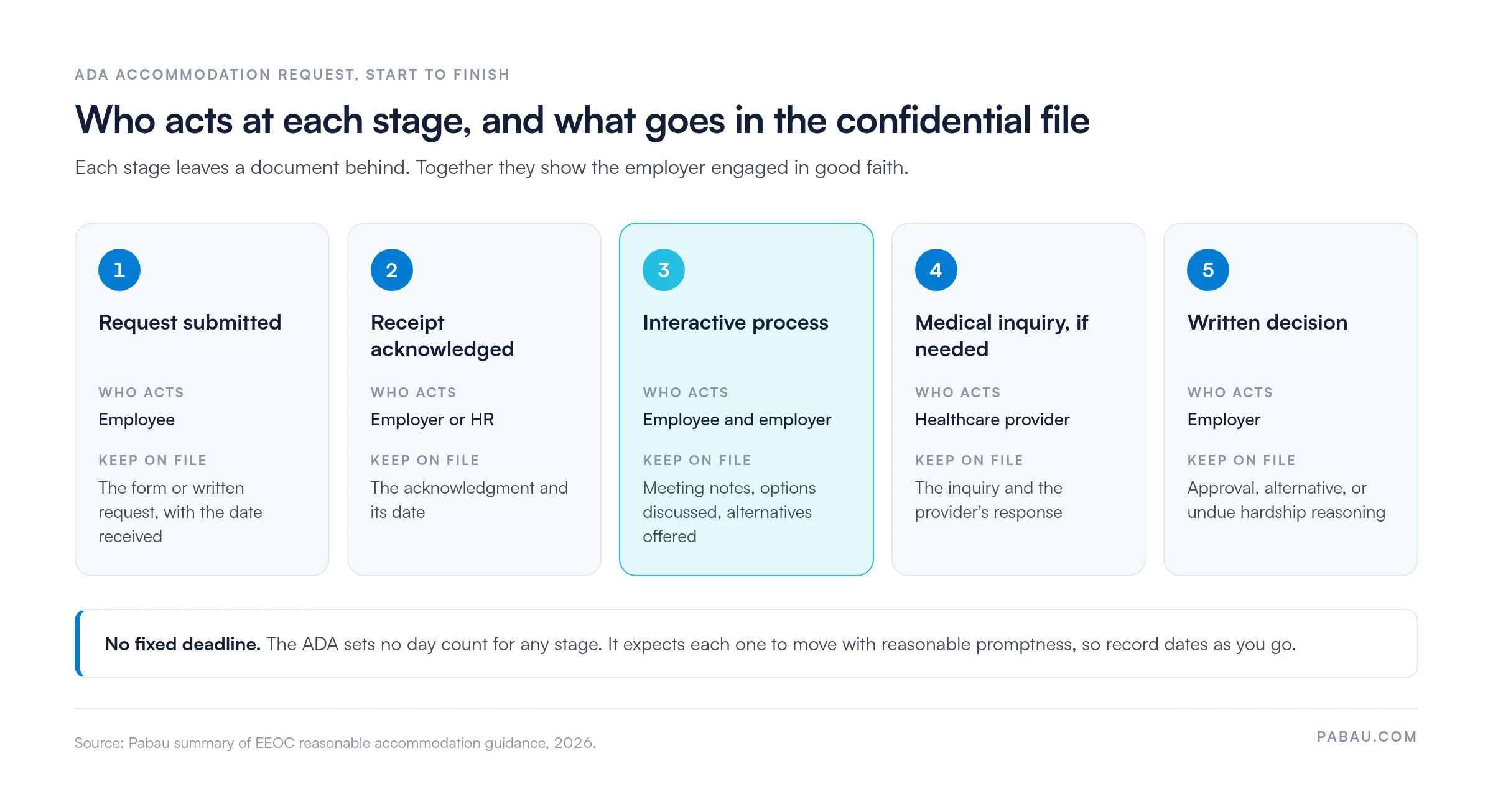
Five-stage flow of an ADA accommodation request.
Every stage leaves a dated document, and that trail is what shows good faith if a decision is challenged. Based on EEOC reasonable accommodation guidance.
  1. Submit the request. Send the completed form to your supervisor, HR, or the named contact. A verbal request counts too, but a written one leaves a record.
  2. The employer acknowledges receipt. Many employers confirm within three to five business days. That’s common practice, not a legal deadline.
  3. The interactive process begins. The employer meets with you to discuss your limitations, the accommodations you proposed, the job’s requirements, and any alternatives. Many employers aim to hold this meeting within 10 to 15 business days.
  4. The employer asks for more medical information, if needed. If the limitations are unclear, the employer may send a medical inquiry form, usually early in the process. The request must be job-related and consistent with business necessity.
  5. The employer responds with a decision. It approves the request, proposes an alternative, or denies it with a written explanation of undue hardship. Many employers aim to decide within about 30 days of a complete request.

None of those day counts comes from the ADA, which sets no fixed timeline. The law expects the employer to act with reasonable promptness, and an unnecessary delay can itself count as a failure to accommodate.

What the ADA requires is good-faith engagement throughout, rather than a perfect outcome. An employer that denies a request must document why that accommodation causes undue hardship, meaning significant expense or disruption. It must also show that no alternative accommodation would work.

Sample accommodation letter from a doctor

Many providers send a short letter with the form, or in place of it. A good letter states the functional limitations in clinical language that a non-medical HR reader can still follow.

[Date]

To whom it may concern,

This letter certifies that [Patient Name] is under my care for [condition]. Based on my clinical assessment, [Patient Name] has functional limitations that require workplace accommodation.

Functional limitations:

  • Cannot stand continuously for longer than [X] minutes without pain exacerbation
  • Requires [specific accommodation] to [functional outcome]
  • Condition is [temporary / permanent / expected duration]

Recommended accommodations:

Based on the functional limitations above, [Patient Name] would benefit from [specific accommodation]. This accommodation would let [Patient Name] perform essential job functions without undue pain, fatigue, or risk.

Please contact me if you need more detail on these functional limitations.

Sincerely,

[Provider Name, Credentials, License #, Contact]

The letter puts functional limitations ahead of the diagnosis and offers more detail if HR needs it. That makes it more persuasive, and easier to defend, than a brief note naming only the condition.

A doctor’s note for work covers an absence, while this letter explains how the employee can keep working. When an employer only needs the condition confirmed, a diagnosis letter template does that job.

When the employer sends a medical inquiry form

If a request lacks detail on functional limitations, the employer may send the provider a medical inquiry form. The EEOC strictly limits what employers can ask at this stage.

  • Permitted questions: More detail on functional limitations, how they affect specific job tasks, and the prognosis or expected duration of the accommodation.
  • Off-limits questions: General medical exams, questions about unrelated disabilities, genetic information, and treatment details beyond what supports the accommodation. A diagnosis isn’t requested unless it has already been disclosed.
  • Timing: The employer may ask for more information during the interactive process if the first request is unclear. It must allow the provider reasonable time to respond, typically 10 business days.
  • Medical record storage: All documentation stays confidential, separate from the personnel file. Only people with a need to know can access it, such as HR, the supervisor, and medical staff where relevant.

Confidentiality rules for employers and providers

The ADA sets its own confidentiality rules, separate from HIPAA. Medical information gathered for an accommodation is protected whether or not the employer is a HIPAA-covered entity.

  • Storage requirement: Medical information must be stored apart from the general personnel file. A locked cabinet, a separate filing system, or a secure digital record system does this.
  • Access limitation: Only HR, supervisors with an immediate need, and company medical staff, where relevant, may access accommodation documentation. Coworkers shouldn’t learn the details of a colleague’s accommodation.
  • Permissible uses: The information may be used to assess feasibility, weigh undue hardship, and meet legal obligations. It can’t be used for general HR decisions, discipline, performance management, or anything unrelated to the accommodation.
  • Disclosure prohibition: The employer can’t share the request or medical information with coworkers, patients, or other third parties without the employee’s written consent. A release of confidential information form documents that consent. Narrow exceptions apply, such as workers’ compensation and insurance carriers.
  • HIPAA distinction: HIPAA generally excludes employment records, even when the employer is a covered entity such as a medical practice. If the practice also treats the employee, that clinical chart is still protected health information, so keep the two files apart.

A compliance management system that tracks document security, access logs, and retention helps employers keep these files confidential. It also records their good-faith efforts.
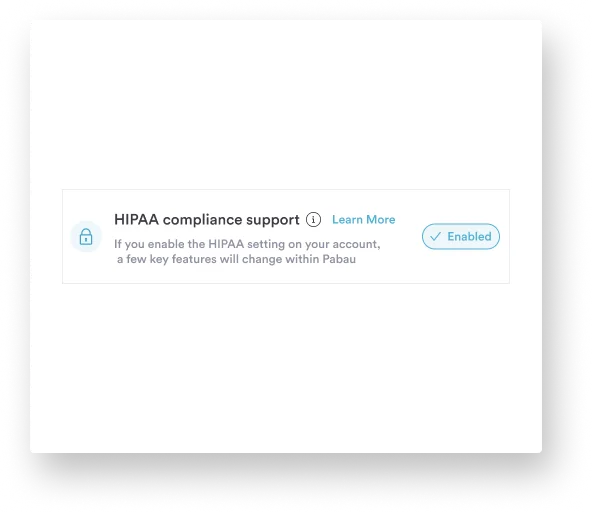
HIPAA compliance toggle
Pabau’s HIPAA compliance support setting adjusts key account features for patient health data. Accommodation files still need their own restricted folder, because HIPAA excludes employment records.

Accommodation requests vs. FMLA and other medical certifications

Employers often confuse the accommodation request with FMLA medical certification or state leave forms. Each one follows a different law and serves a different purpose.

Form type Legal basis Purpose
ADA accommodation request Americans with Disabilities Act, Title I Requests workplace changes so the employee can perform essential job functions. Triggers the interactive process and applies throughout employment.
FMLA medical certification Family and Medical Leave Act Certifies the need for unpaid, job-protected leave of up to 12 weeks a year. The employer must maintain health insurance during the leave.
State leave certification (California, New York, and others) State leave laws, such as CFRA, paid family leave, and paid medical leave Certifies the need for leave under a state program. Pay, funding, and job protection vary by state.
Rehabilitation Act (federal employees) Rehabilitation Act of 1973, Section 501 Requests workplace accommodations for federal employees. Works much like the ADA, under federal law.

An employee can file an ADA accommodation request and an FMLA certification at the same time, and the two run in parallel. The accommodation request adjusts the job, while the FMLA certification secures unpaid leave if the employee can’t work even with accommodations.

Federal employee accommodation forms

Federal employees fall under Section 501 of the Rehabilitation Act rather than the ADA, and federal contractors fall under Section 503. The reasonable accommodation standards are substantially the same as the ADA’s. The main differences are agency-specific procedures and timelines.

  • Who it applies to: Section 501 covers federal agency employees, and Section 503 covers federal contractors. Section 504 covers recipients of federal financial assistance, not contractors.
  • Form requirements: Agencies often use their own forms, so NIH and DOI each have one. The core information matches the ADA form: employee details, job analysis, functional limitations, and provider certification.
  • Timeline: No single OPM-mandated deadline exists. The federal best practice most often cited is a decision within about 20 business days, ranging from 15 to 25 by agency. Agencies must document the decision in writing.
  • Denial standard: Agencies may deny an accommodation that would cause undue hardship to agency operations. The standard mirrors the ADA’s, applied in the federal context.
  • Confidentiality: Federal agencies must keep accommodation records confidential under the Rehabilitation Act, which applies the ADA’s confidentiality rules.

Federal employees should ask for their agency’s own accommodation form, which most agencies publish on their HR or compliance pages. Contractor employees follow their employer’s process. Where no form exists, the sample forms from the Job Accommodation Network (JAN) are a sound starting point.

Adapting the form for your practice

The template above is a starting point. A practice owner handling staff requests and an occupational medicine specialist may each need to adapt its wording and focus.

  • For healthcare practices: Emphasize clinical job functions, such as patient care, standing, documentation, and exposure to chemicals or infection hazards.
  • For administrative settings: Focus on desk-based work, computer use, communication, and meeting attendance.
  • For hybrid roles: Split the job analysis into distinct functions, such as 40% patient-facing and 60% documentation. Then ask which functions the limitations affect.
  • Digital form version: Use digital forms software to collect responses electronically, timestamp each submission, and keep the records secure.

Check your state’s civil rights agency for extra requirements. California’s Civil Rights Department, New York, Illinois, and other states set their own accommodation standards and forms. Many go beyond the ADA, and where state law is stricter, you have to meet it.

Official sources for employers and employees

  • EEOC Enforcement Guidance on Reasonable Accommodation and Undue Hardship: the definitive reference for employer obligations and the interactive process.
  • The ADA: Your Responsibilities as an Employer: the EEOC’s plain-language overview of employer duties under Title I.
  • Job Accommodation Network (JAN): a federally funded technical assistance center offering sample forms, guidance, and accommodation examples by condition.
  • HHS HIPAA guidance: the federal source on which records HIPAA covers, including how it treats employment records.
  • Your state’s civil rights agency, for state-specific requirements and forms. Examples include the California Civil Rights Department and the New York State Division of Human Rights.

How Pabau keeps accommodation records dated and confidential

Many practices still handle accommodation requests on paper or by email. The form lands in an inbox, the provider’s letter arrives later as a scan, and the key dates sit in one manager’s head. That makes good faith hard to prove if a request is ever disputed.

With Pabau’s digital forms, the employee and their provider complete their sections online. Each submission is timestamped on arrival and stored securely, and staff permissions control who can open it.

The result is one dated record per request, from the first form to the written decision. Your HR lead spends less time chasing signatures, and the file is ready if anyone asks how a request was handled.

Keep every accommodation request dated and secure

Pabau’s digital forms collect the employee and provider sections online, timestamp each submission, and store it securely. You get a complete, dated record of every request.

Pabau clinic management dashboard

Conclusion

The form opens the request, but the dated trail behind it protects both sides. Acknowledgments, meeting notes, and a written decision are what show good faith when a request is questioned later.

If you’re adopting this template, start with the functional limitations section and brief providers on it. Then set an internal response target your team can meet, because the ADA gives you reasonable promptness rather than a deadline.

The trade-off is admin time. A careful file takes more work than a quick yes or no, but it costs far less than defending an undocumented decision. Book a demo to see how Pabau keeps each accommodation request dated, confidential, and easy to find.

Continue your research

Continue your research

Need to clear an employee for duty? Work physical form sets out the fitness-for-duty exam fields an occupational health provider completes.

Screening new hires after an offer? Pre-employment medical exam covers the post-offer exam and the records it produces.

Certifying time off for a staff member? Medical certificate template gives providers a ready format for confirming an absence.

Handling a request for medical records? Medical record request form walks through the authorization elements a valid request needs.

Collecting health details from staff or patients? Medical information form captures conditions, medications, and emergency contacts in one place.

Frequently asked questions

Who fills out the form, the employee or the employer?

The employee completes the employee section, covering personal details, the job, and functional limitations. The treating healthcare provider completes the medical certification section. The employer doesn’t complete the form, but it may ask for more detail through a medical inquiry form after the first request.

How quickly does an employer have to respond to an accommodation request?

The ADA sets no fixed deadline. The EEOC expects employers to respond with reasonable promptness, and an unnecessary delay can count as a failure to accommodate. Many employers aim to start the interactive process within 10 to 15 business days and decide within about 30 days. If more medical information is needed, the employer should say when to expect a decision.

Can an employer deny a reasonable accommodation request?

Yes. An employer may deny an accommodation that causes undue hardship, meaning significant cost or operational disruption, or offer an equally effective alternative instead. The denial must be documented in writing with specific reasons. A denial without a documented undue hardship analysis is unlawful.

What can an employer ask in a medical inquiry form?

Employers may ask for clarification of functional limitations, how they affect specific job tasks, the expected duration, and whether the condition is permanent or temporary. They can’t request general medical exams, diagnosis details beyond what supports the accommodation, genetic information, or details of other disabilities.

Do federal employees use a different accommodation request form?

Federal employees are covered by the Rehabilitation Act rather than the ADA, but the form structure and interactive process are substantially similar. Agencies may use their own forms, but the core sections are the same: employee details, job analysis, functional limitations, and provider certification. Check with your agency’s HR or compliance office for the required form.

How long should employers keep accommodation records?

The ADA requires employers to retain accommodation records for at least one year. Best practice is to keep the complete file for the length of employment plus one year, in case a discrimination claim arises. That file includes the request, interactive process notes, and decision letter. Secure digital storage with access controls protects confidentiality.
Found our content helpful?
×